
Track-Mounted Jaw Crusher
In the fields of mining, infrastructure development, and urban renewal, crushing operations frequently face challenges posed by extremely complex working conditions. While traditional stationary crushing lines offer stability, they suffer from lengthy installation cycles and difficulties in relocation; conversely, standard wheel-mounted mobile crushing stations, though flexible, often prove inadequate when confronted with rugged terrain characterized by mud, steep slopes, and scattered rubble. It is precisely in this context that the Crawler Jaw Crusher emerged—not merely as a piece of equipment, but as a "mobile crushing plant" capable of autonomous movement and all-terrain adaptability. This article will delve into the operational value, core advantages, and practical case studies of this equipment in harsh environments, offering a professional reference for your project's equipment selection process.

Crawler Crusher PDF,Download ↓↓↓
What is a Crawler Jaw Crusher?
A Crawler Jaw Crusher is a high-end mobile crushing unit that integrates a proven jaw crusher (typically used for primary/coarse crushing operations) onto a heavy-duty, hydraulically driven crawler chassis. It combines material feeding, crushing, and conveying functions into a single unit; requiring no external towing, it utilizes its own power system to move freely, steer, and even ascend slopes within the job site. Its fundamental design objective is to transcend terrain limitations, delivering crushing capacity directly to the source of the raw materials to realize highly efficient operational modes—epitomized by the philosophy of "I move to the material" or "crushing while in motion."
Core Application Scenarios: Conquering Complex Conditions
Leveraging its exceptional off-road maneuverability, this equipment is widely deployed in the following scenarios where terrain adaptability is a critical requirement:
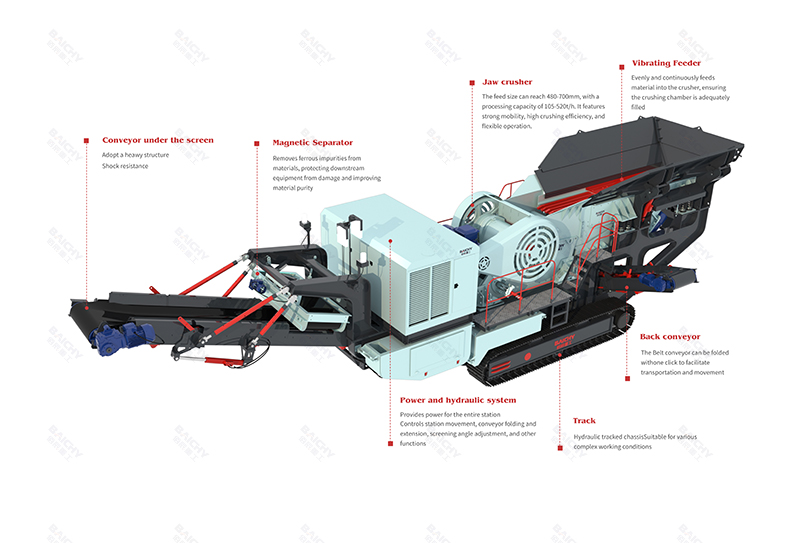
Track-Mounted Jaw Crusher Structural Diagram
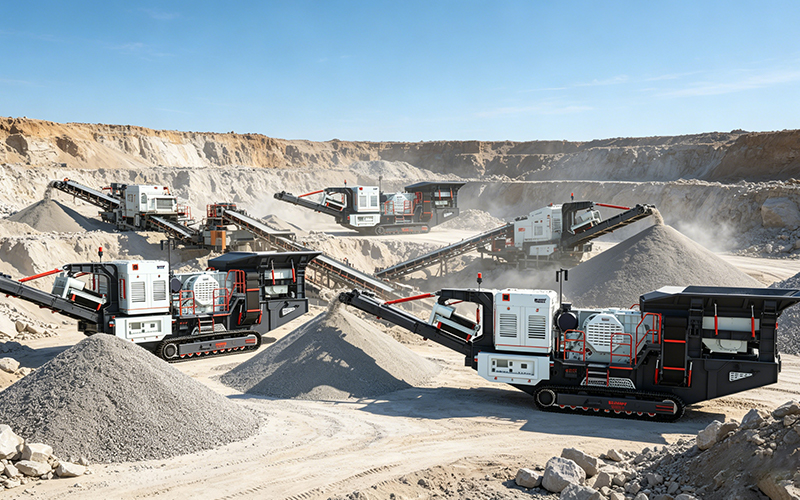
• Mountain and Open-Pit Mining: On mining faces characterized by significant topographical undulations, the equipment can drive directly to the piles of raw ore left after drilling and blasting. It performs primary crushing on high-hardness materials—such as granite, iron ore, and limestone—thereby drastically reducing the costs and risks associated with transporting ore down from the mountain.
• Road and Water Conservancy Construction in Remote Regions: Infrastructure projects—such as road construction and dam building—often require the on-site production of sand and gravel aggregates within deep mountain ranges or canyons. The Crawler Jaw Crusher can effortlessly traverse muddy access roads and rugged mountain paths, producing qualified coarse aggregates directly at the project site.
• Urban Construction Waste Resource Utilization: Although urban construction sites are often relatively flat, demolition sites are frequently strewn with rubble and characterized by confined spaces. This equipment features on-the-spot turning capabilities, allowing for the in-situ crushing and screening of concrete blocks and brick debris to produce recycled aggregates. This approach is not only environmentally friendly but also eliminates the dual costs associated with transporting waste off-site and purchasing new raw materials.
• Emergency Response and Site Clearance: Following disasters such as earthquakes or mudslides, this unit's powerful crushing capacity and high maneuverability make it a critical piece of equipment for rapidly clearing large concrete obstructions and reopening vital roadways.
Why Choose a Crawler-Mounted Jaw Crusher? — An Analysis of Core Advantages
Compared to stationary and wheel-mounted equipment, our crawler-mounted jaw crusher demonstrates unparalleled advantages when operating in rugged terrain:
1. Exceptional Terrain Adaptability and Off-Road Mobility: Utilizing a wide, heavy-duty crawler chassis, the unit features low ground pressure and high traction. Whether navigating steep slopes exceeding 25°, soft muddy ground, or work surfaces strewn with sharp rubble, it moves with ease—as if on level ground—and maintains stable positioning during operation.
2. Significantly Reduced Logistics and Operational Costs: Embracing the philosophy of "on-site crushing," the unit eliminates the substantial trucking costs typically associated with transporting materials to a stationary crushing plant. It also bypasses the cumbersome costs involved in pouring concrete foundations and installing steel structures required for fixed-line facilities. When relocating, the unit simply retracts its hydraulic outriggers and drives itself onto a flatbed transport truck—a process that is remarkably fast and efficient.
3. Robust Primary Crushing Capability and High Reliability: Equipped with a deep-chamber, high-inclination jaw crusher main unit, the machine accepts feed sizes ranging from 500mm to 950mm. Its high crushing ratio allows for the efficient processing of even the hardest, most abrasive rock materials. Critical components are constructed from highly wear-resistant materials to ensure a long service life under continuous, heavy-load operating conditions.
4. Intelligent Control and Dual Power (Diesel/Electric) Capability: The unit features an intelligent PLC control system and a wireless remote control device, allowing operators to manage driving, start/stop functions, and hydraulic discharge port adjustments from a safe distance. The power system supports independent operation via a high-performance diesel engine, but can also be connected to an external power source (dual-mode diesel/electric). This versatility makes it suitable for use in remote mining sites lacking grid power, as well as for urban night-time operations where strict noise regulations apply.
5. Environmental Protection and Integrated Design: Featuring an integrated unit design, the system can be optionally equipped with a pre-screening grizzly feeder (to remove soil and fines), a magnetic separator, and a dust suppression spray system. This effectively controls dust and noise, ensuring compliance with rigorous global environmental construction standards.
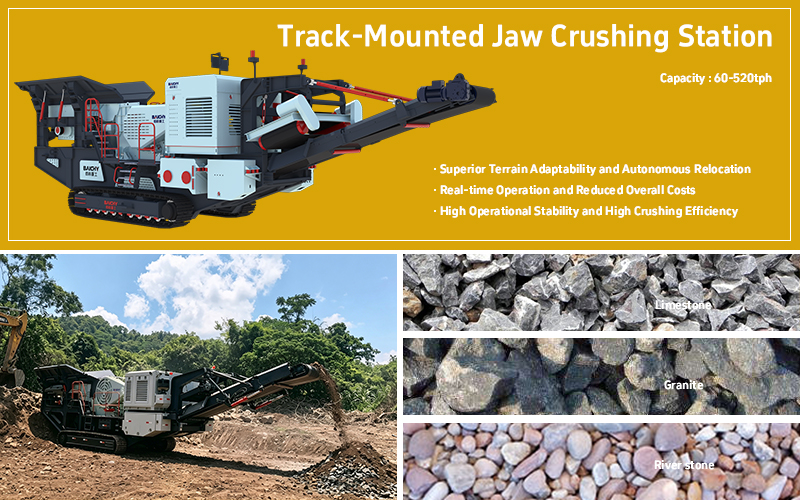
Track-Mounted Jaw Crushing Station
Technical Parameter Reference Table
To facilitate model selection, the following table outlines the typical technical parameter ranges for medium-sized crawler-mounted jaw crushers (specific values may vary depending on the model configuration):
| Parameter Item | Typical Value / Description | Remarks |
| Crushing Unit Model | C96 / C106 / C120, etc. | European-style or traditional deep-cavity jaw crusher |
| Feed Opening Size (mm) | 930×580 ~ 1200×800 | Determines the maximum stone size that can be accepted |
| Max. Feed Size (mm) | 480 ~ 750 | Recommended: ≤ 80% of the feed opening size |
| Processing Capacity (t/h) | 100 ~ 450 | Varies based on material hardness and feed size |
| Discharge Opening Range (mm) | 60 ~ 200 | Hydraulic adjustment; controls the output particle size |
| Travel Drive Type | Fully hydraulic crawler self-propelled | Features on-the-spot turning capability |
| Power Configuration | Diesel Engine (75–180 kW) / Electric Motor | Commonly uses brands such as Cummins or Volvo |
| Total Transport Weight (t) | 30 ~ 55 | Includes standard conveyor belt assembly |
| Gradeability | ≤ 20° ~ 25° | Depends on ground traction |
Related Success Stories
Case Study 1: Coarse Crushing Project at a Granite Quarry in Zigong, Sichuan
• Background: The client needed to mine high-hardness granite from a mountaintop location. Given the rugged mountain roads, utilizing a fixed crushing line would have required constructing a long-distance conveyor gallery or relying on frequent truck haulage—both of which would have incurred extremely high costs.
• Solution: The client deployed a crawler-mounted jaw crusher equipped with a C106 jaw crushing unit.
• Results: The equipment was able to self-propel up the mountain, performing the primary crushing directly at the mining face to produce an output size of 150–300 mm. Clients report that the equipment operates with exceptional stability and produces material of uniform particle size; furthermore, it can be relocated to new sites without the need for road construction, resulting in a significant improvement in return on investment.
Case Study 2: Construction Waste Resource Utilization Project in Yueqing, Zhejiang
* Background: Urban demolition activities generated vast quantities of concrete waste, which was scattered across multiple storage sites. Additionally, the project faced strict regulations regarding noise and dust control.
• Solution: We deployed a dual-power (diesel-electric) crawler-mounted jaw crusher, integrated with an iron separator and a water-spraying dust suppression system.
• Results: The equipment moved flexibly between various demolition sites, performing on-site crushing to transform waste into valuable resources. The site successfully met all environmental compliance standards, and the client provided the following feedback: "High production output, excellent service support, and—to date—zero operational faults."
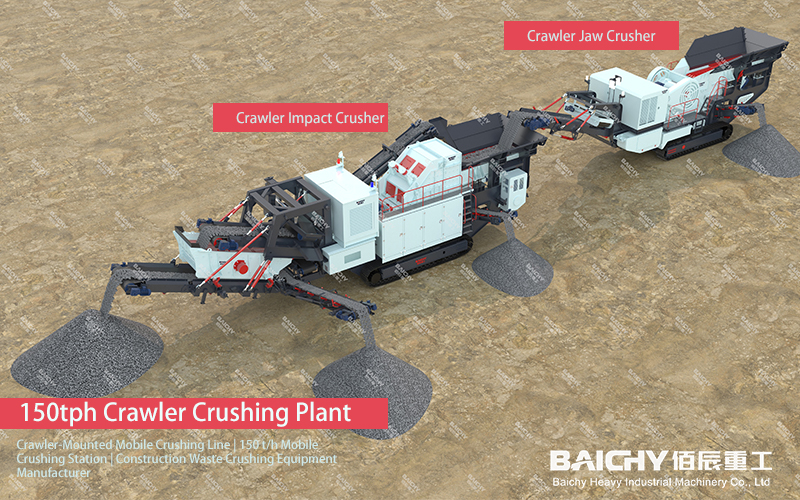
150tph Crawler Crushing Plant
Recommended Auxiliary Equipment
To construct a complete mobile crushing and screening production line—following the crawler-mounted jaw crusher (which serves as the primary coarse-crushing stage)—we typically recommend the following equipment:
1. Crawler-Mounted Cone Crusher: Serving as the secondary medium-crushing unit, this machine is particularly well-suited for high-hardness rocks (such as granite, basalt, and iron ore). Positioned immediately after the jaw crusher and connected via a transfer conveyor belt, it further reduces the material size to under 40mm.
2. Crawler-Mounted Impact Crusher: Ideal for processing materials of medium-to-low hardness (such as limestone and construction waste), or for use in road surfacing aggregate production where strict requirements exist regarding the shape of the finished product. As a secondary crusher, it produces cubic-shaped aggregates with a low content of needle-like or flaky particles.
3. Crawler-Mounted Mobile Screening Station: Used for tertiary or quaternary processing stages, this unit precisely classifies the crushed material according to particle size (e.g., 0–5mm, 5–10mm, 10–20mm). It is self-propelled and can operate independently or in conjunction with the upstream and downstream crushing units.
About of Baichy Heavy Industry
Baichy Heavy Industry is a high-tech mining equipment company integrating R&D, manufacturing, sales, and after-sales service. Focusing on crushing, grinding, and mineral processing equipment, we provide professional solutions to our customers. We are ISO9001:2015 、certified, and our products include mobile crushing palnts, crawler crushing plant, construction waste crushing plants, jaw crushers, sand making machines, cone crushers, fine crushers, grinding mills, ball mills, etc., all with reliable performance to meet diverse project needs.
Our advantages:
• Professional pre-sales support: Free project design and comprehensive solutions to help you accurately select the right equipment;
• Comprehensive on-site service: Providing installation guidance and worker training to ensure smooth equipment commissioning;
• Reliable after-sales guarantee: A complete after-sales system, timely response to technical inquiries and equipment maintenance, ensuring long-term stable operation.
To protect your rights, please contact us through the following official channels for professional service:
Official Website Customer Service
https://wa.me/+8615093222637
Email: [email protected]
We are committed to providing high-quality equipment and full-cycle services to deliver comprehensive intelligent solutions for the global mining industry!
Frequently Asked Questions (FAQ)
1. Is there a risk of the crawler-mounted jaw crusher tipping over or slipping while climbing slopes?
A: No. The chassis of our equipment features a professionally engineered counterweight design, ensuring an extremely low and centrally positioned center of gravity. The long ground contact length of the tracks provides powerful traction and climbing torque, typically enabling the machine to safely and stably ascend steep slopes of 20° to 25° (depending on ground soil conditions); furthermore, hydraulic outriggers assist in leveling and securing the unit once it reaches its operational position.
2. Compared to wheel-mounted mobile jaw crushers, is the maintenance cost for track-mounted units significantly higher?
A: Although track wear parts (such as track shoes and support rollers) require periodic inspection, track-mounted equipment eliminates the need for a separate towing vehicle and imposes virtually no requirements regarding the flatness of the work site (thereby saving on costs associated with road construction or laying steel plates). Consequently, its overall site-transfer efficiency and terrain-traversal capabilities far exceed those of wheel-mounted units. Modern tracks are constructed from highly wear-resistant alloy steel, ensuring a long service life; moreover, the entire machine features a centralized lubrication system, making routine maintenance remarkably convenient.
3. If operating in remote field locations without access to electricity, how do the diesel engine's fuel consumption and operational endurance perform?
A: The equipment is outfitted with a large-capacity fuel tank and a highly fuel-efficient, turbocharged, electronically controlled diesel engine (such as those from the Cummins brand). Taking a medium-sized model as an example, a full tank of fuel typically supports over 10 to 15 hours of continuous crushing operations. Furthermore, the diesel-driven mode delivers robust power output and remains unaffected by voltage fluctuations, making it ideally suited for remote mining sites. Additionally, an external power interface is provided, allowing operators to switch to electric motor drive—thereby reducing operating costs—whenever grid power is available.