 +86-15093222637
Contact us for a quote and free process design
Baichy know what you are expecting from mining project and we are making it happen with unrivalled products and services.
Leave Message


Spiral sand washing machine is a kind of efficient sand washing equipment, which is mainly used to clean and separate impurities such as stone powder and soil in sand and gravel.
☛ Contact Us Now To Get A Customized Production Line Configuration Plan.
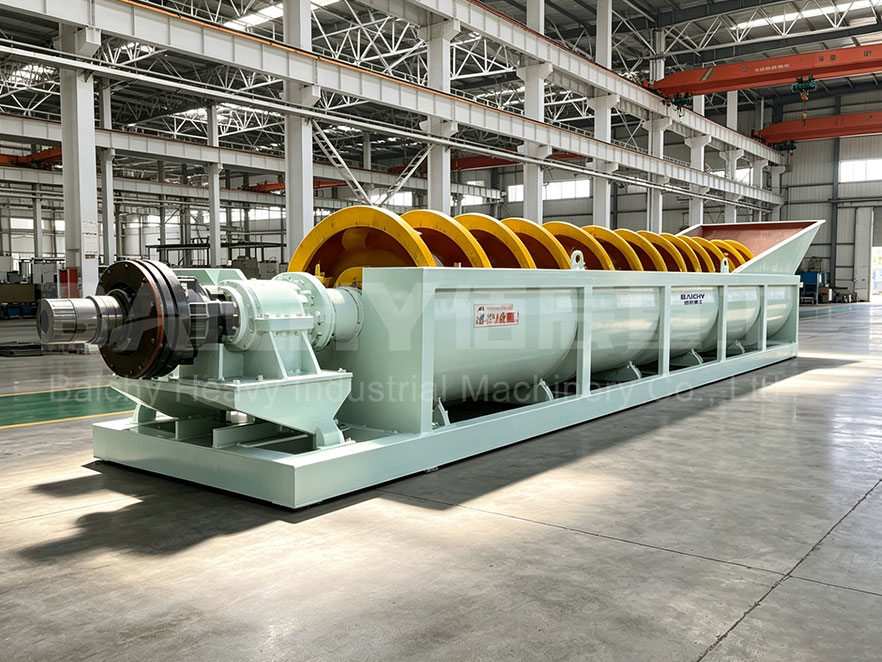
The spiral sand washing machine has significant advantages in efficient cleaning, reasonable structure, simple operation, wear resistance and durability, strong adaptability, energy saving, environmental protection and easy maintenance. It is an efficient, stable and reliable sand and gravel processing equipment.
The spiral sand washer is a high-efficiency sand and gravel cleaning machine that utilizes the rotating propulsion of inclined spiral blades combined with counter-current water rinsing. It simultaneously performs cleaning, dewatering, and classification within a single unit, making it indispensable downstream equipment for manufactured sand production lines and natural sand processing.
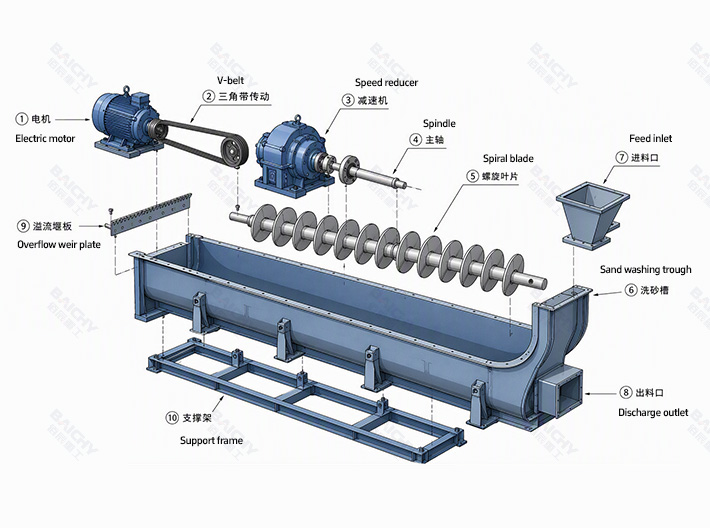
Baichy Heavy Industry’s XL series spiral sand washers offer processing capacities ranging from 6 to 400 tph and spiral diameters between ∅920 mm and ∅1500 mm, available in both single-spiral and double-spiral configurations. The equipment features a tank design with a 15° inclination and a classic drive train—motor to V-belt to gear reducer to spiral main shaft—resulting in a simple structure and minimal maintenance requirements.
Key Conclusion: The spiral sand washer is the most efficient equipment type for processing sand and gravel materials with high clay content and coarse particle sizes (≤30 mm). A single unit can reduce clay content from 15–20% to less than 0.8%, while consuming only 60–70% of the electricity per ton compared to wheel-bucket sand washers.
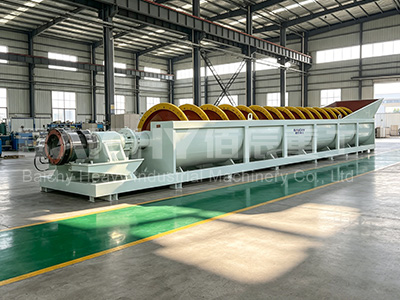
piral sand washer, screw sand washing machine
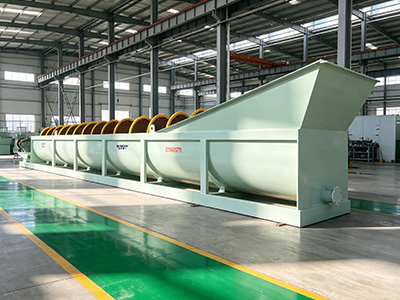
spiral sand washer for manufactured sand
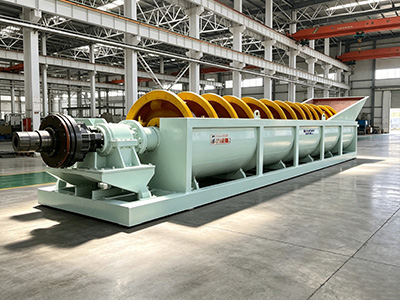
spiral sand washer for silica sand processing
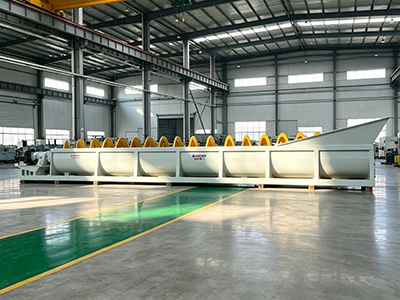
spiral sand washer for recycled aggregate
The spiral sand washer is suitable for the following key scenarios:
| Application Scenario | Typical Materials | Key Requirements |
| Manufactured sand production lines | Sand making from limestone, granite, basalt, river pebbles | Removal of stone dust (≤75μm); meeting fineness modulus standards |
| Concrete mixing plants | River sand, sea sand | Reducing silt/clay content to <1.0%; ensuring concrete strength |
| Mine processing plants | Quartz sand, silica sand, iron ore tailings | Desliming and classification; improving concentrate grade |
| Construction waste recycling | Recycled aggregates | Removing adhered mortar dust; improving aggregate cleanliness |
| Water conservancy & hydropower projects | Natural sand and pebbles | High-capacity continuous washing; meeting concrete aggregate standards |
• Raw materials with high silt/clay content (e.g., riverbed sand, manufactured sand from weathered rock) — Dual-spiral models (2XL1120/2XL1500) perform best
• Projects with strict requirements for fines content in the finished sand (e.g., sand for expressways and high-speed railways)
• Water-scarce regions — Low water consumption per ton; over 80% water recycling achieved when paired with a sedimentation tank
Spiral sand washing machine is suitable for processing sand and gravel of various particle sizes and hardness, including natural sand, machine-made sand, etc. At the same time, the equipment can also be customized according to the actual needs of users to meet the needs of different industries and application scenarios.
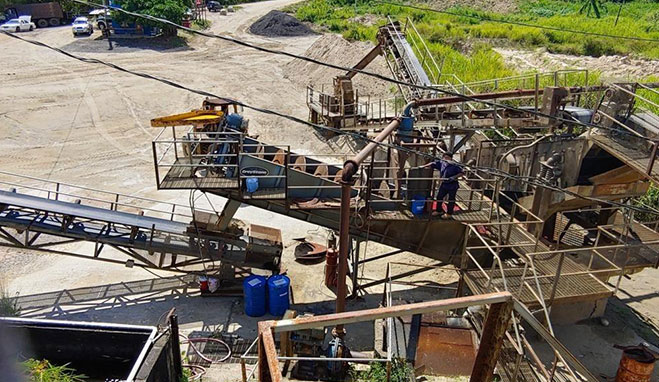
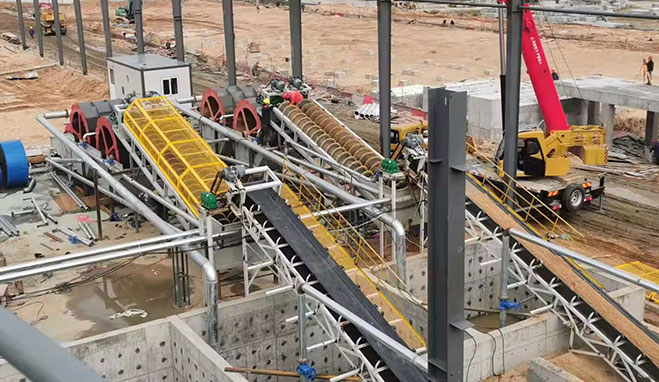
The working principle of the spiral sand washer is based on a combined mechanism of differential gravity sedimentation and mechanical agitation/washing.
Core components include: motor, V-belt drive mechanism, gear reducer, spiral main shaft (with wear-resistant blades), inclined trough (15° inclination), three overflow weir plates, a perforated water inlet pipe at the bottom, and a discharge outlet at the top.
1. Feeding and Soaking — Sand and gravel materials are fed evenly into the inlet at the lower end of the trough, which is pre-filled with clean water; the water level is controlled by the overflow weir plates. The head of the spiral is fully submerged in water, creating a sedimentation zone.
2. Agitation and Scrubbing — The motor drives the spiral main shaft to rotate at a low speed of 8–18 r/min via the V-belt and gear reducer. The spiral blades force the sand and gravel materials to tumble and rub against each other in the water, stripping away soil and stone dust adhering to the particle surfaces and bringing them into suspension.
3. Counter-current separation — Fresh water is continuously injected through a perforated plate at the bottom of the tank, creating an upward counter-current flow. Heavier, clean sand particles settle to the bottom and are pushed upward along the inclined surface by the spiral blades, while lighter silt, dust, and suspended impurities are carried by the rising water over the overflow weir and discharged.
4. Dewatering and discharge — The clean sand is conveyed by the spiral blades to the upper end of the tank; after natural drainage along the inclined section, it is discharged through the top outlet. The finished sand has a moisture content of 12–18% and can be deposited directly onto a belt conveyor for the next processing stage.
| Model | Spirals Number (pcs) |
Screw Diameter (mm) |
Sink Length (mm) |
Capacity (t/h) |
Motor Power (kw) |
| XL920-7.5 | 1 | ∅920 | 3600 | 40-60 | 4P-11 |
| 2XL920-7.5 | 2 | ∅920 | 7500 | 90-120 | 4P-11x2 |
| XL1120-7.5 | 1 | ∅1120 | 5000 | 40-120 | 4P-18.5 |
| 2XL1120-7.5 | 2 | ∅1120 | 10000 | 80-240 | 4P-18.5x2 |
| XL1500-9 | 1 | ∅1500 | 9800 | 100-170 | 4P-22 |
| 2XL1500-9 | 2 | ∅1500 | 18000 | 200-280 | 4P-22x2 |
Have Any Questions!
Don't Hesitate To Contact Us AnyTime.
If you need further information,please fill in your questions and comments in the form below.
Representatives from Baichy machinery will be back to you within the hour,thanking you for your support to Baichy machinery



