+86-15093222637
Contact us for a quote and free process design
Baichy know what you are expecting from mining project and we are making it happen with unrivalled products and services.
Leave Message


In the fields of mining crushing, construction waste treatment, etc., small jaw crushers are gradually becoming the preferred equipment for small and medium-sized crushing operations due to their compact structure, flexible configuration and excellent crushing efficiency. Compared with traditional large jaw crushers, small jaw crushers not only have lower investment costs, but also can adapt to more complex operating environments.
☛ Contact Us Now To Get A Customized Production Line Configuration Plan.
• Large jaw crusher: usually fixed installation, suitable for large-scale production lines, but the relocation cost is high.
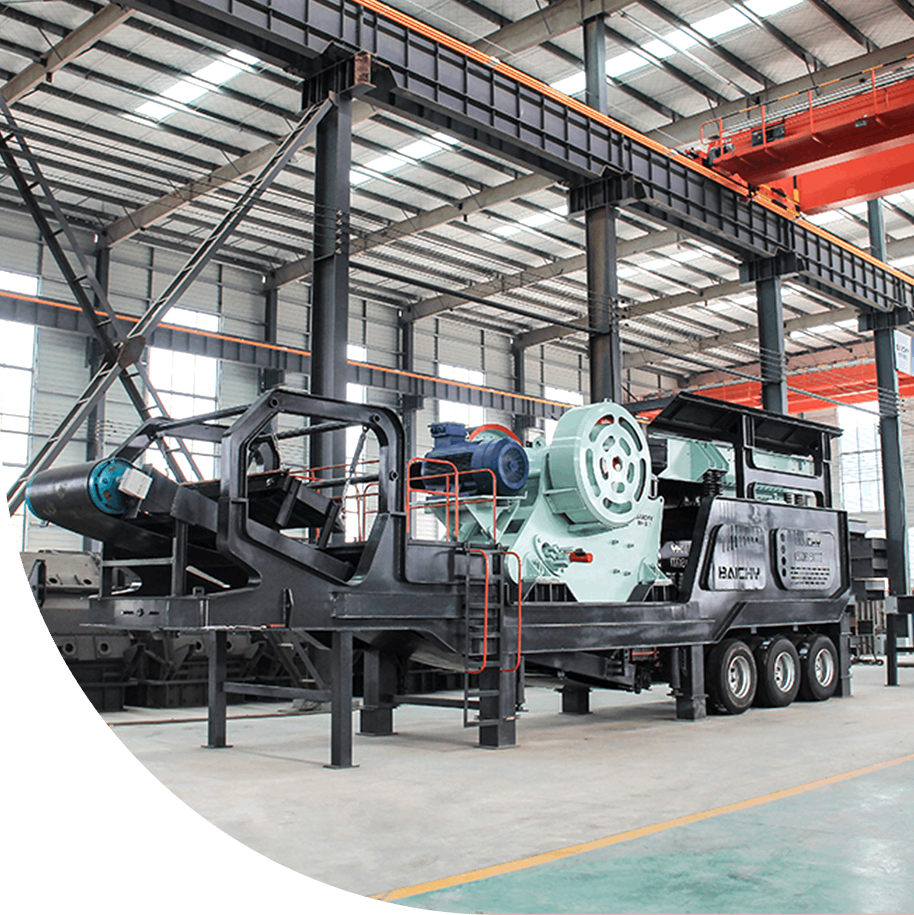
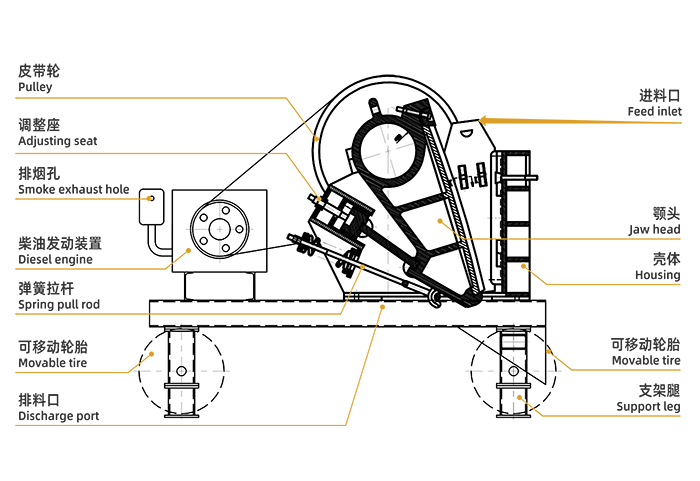
• Small jaw crusher: can be equipped with a mobile chassis (such as tire or crawler), easy to transfer, especially suitable for temporary construction sites, construction waste recycling, small quarries and other scenes.
• A standard large jaw crusher (such as PE600×900) usually costs hundreds of thousands or even millions, while a small jaw crusher (such as PE250×400) only costs tens of thousands of yuan, which is more suitable for small and medium-sized enterprises or individual investors with limited budgets.
• Lower maintenance costs and more convenient replacement of accessories.
• The motor power of small jaw crushers is usually between 5.5-30kW, which is more energy-saving than large equipment and conforms to the current policy trend of green mining and low-carbon production.
• Some new small jaw crushers adopt noise reduction design to reduce the impact on the surrounding environment.
Small jaw crusher price
jaw crusher model
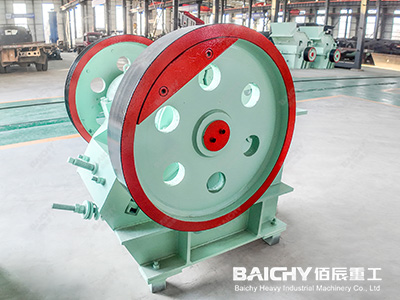
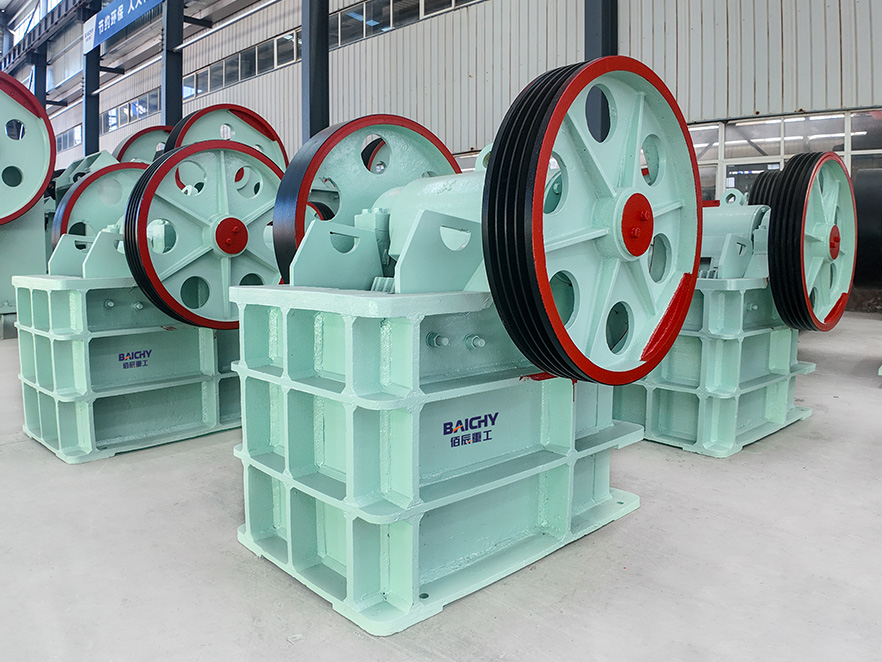
PE250x400 jaw crusher
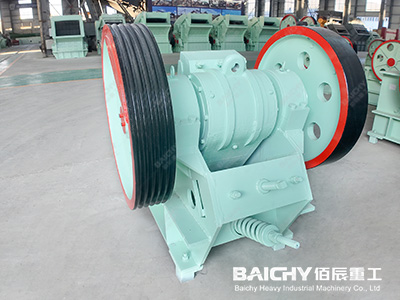
small stone crusher manufacturer
• PE150×250 (smallest model): feed opening 150×250mm, maximum feed 125mm, suitable for laboratory or small sand and gravel processing.
• PE250×400 (medium-sized): feed opening 250×400mm, maximum feed 210mm, suitable for small and medium-sized quarries.
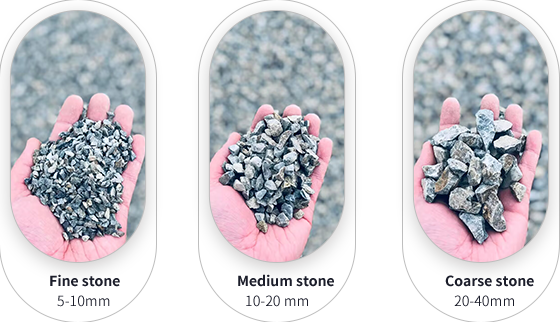
• Discharge is controlled by adjusting the jaw plate spacing, generally between 10-100mm, which can meet different crushing needs.
• If used for construction waste recycling or small quarrying, PE250×400 is recommended.
• If higher capacity is required, consider a mobile small jaw crusher, such as a tire-type jaw crusher.
The small jaw crusher is used extensively throughout the aggregate and mineral processing industry. Also, it is applied in mining, aggregate production, construction material recycling, etc. It is one of the most common limestone stone crushers.
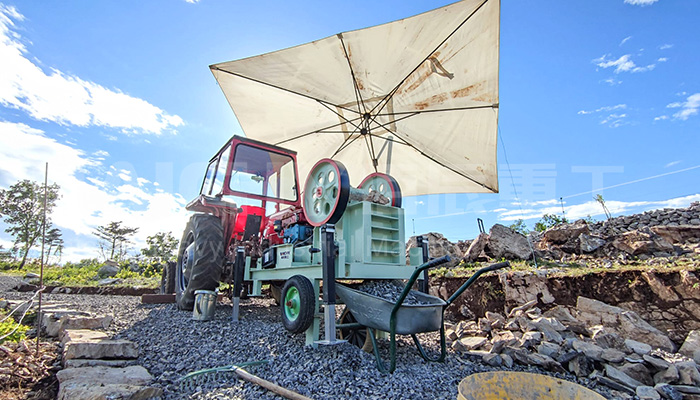
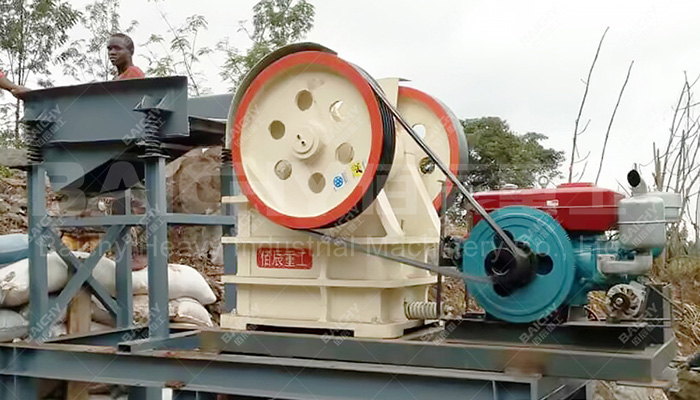
1. Recycling of construction waste
Small jaw crusher can easily crush concrete blocks, bricks and tiles, etc., and produce recycled aggregates with screening equipment to reduce the cost of construction waste treatment.
2. Primary crushing of small gold mines/tungsten mines
In Africa, Southeast Asia and other regions, small miners often use diesel-driven small jaw crushers for primary crushing of ore, which is low-cost and quick to see results.
3. Mobile crushing-ideal choice for temporary projects
With tire or crawler chassis, it can be quickly deployed in scenes such as highway construction, post-disaster reconstruction, and temporary quarries.
| Model | Feeding Open Size (mm) | Max. Feed Size (mm) |
Outlet adjusting size(mm) |
Capacity(t/h) |
Motor power(kw) |
Overall dimension(mm) |
| PE150X250 | 150X250 | 130 | 15-45 | 1-4 | 5.5 | 896*745*935 |
| PE200X300 | 200X300 | 180 | 15-50 | 2-6 | 5.5 | 910*750*990 |
| PE200X350 | 200X350 | 180 | 18-70 | 3-10 | 7.5 | 1000*870*990 |
| PE250X400 | 250X400 | 210 | 25-60 | 5-20 | 15 | 1215*1520*1030 |
Have Any Questions!
Don't Hesitate To Contact Us AnyTime.
Jaw crushers compress material between two steel plates and handle hard, abrasive rock (granite, basalt, ore) with low wear cost. Impact crushers strike the rock with blow bars and produce a more cubical, sand-like product, but wear parts wear faster on abrasive stone. Choose a jaw as the primary crusher for hard rock, and an impactor as a secondary crusher for shaping.
Mini lab models commonly start around US$1,100–$3,800, while portable PE150×250–PE250×400 diesel or electric units typically run US$5,000–$12,800. Final price depends on motor type, optional feeder, conveyor, remote chassis, and jaw-plate material.
Yes. Small jaw crushers are widely used on demolition and construction-waste sites to reduce concrete rubble, bricks, and asphalt into reusable hardcore. Remove rebar and tramp metal first, and consider a magnetic separator on the discharge conveyor if the debris contains steel.
The discharge opening is changed by adding or removing shims behind the toggle plate (or via a hydraulic wedge on newer models). Narrowing the gap produces finer product but lowers throughput; widening it raises capacity. Always retighten and check the jaw plate tension after adjustment.
Buy an electric unit if you have a stable 380 V / 220 V grid connection: it is quieter, cheaper to run, and needs no engine servicing. Buy a diesel unit for off-grid drilling, remote mining, trailer-mounted on-site crushing, or regions with unreliable power. Diesel models cost more to fuel and maintain but deliver full mobility.
If you need further information,please fill in your questions and comments in the form below.
Representatives from Baichy machinery will be back to you within the hour,thanking you for your support to Baichy machinery