+86-15093222637
Contact us for a quote and free process design
Baichy know what you are expecting from mining project and we are making it happen with unrivalled products and services.
Leave Message


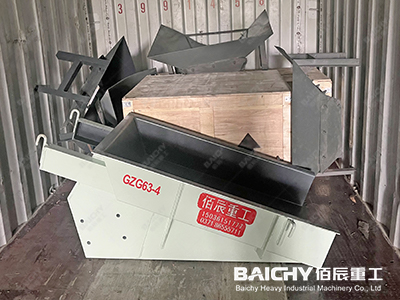
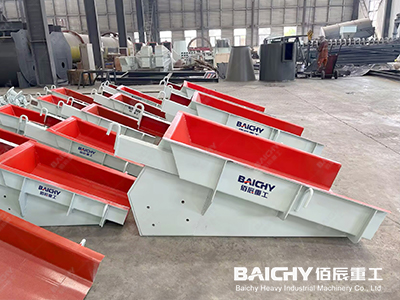
The Electromagnetic Vibrating Feeder is a conveying device that utilizes an electromagnetic exciter to drive a feeding trough in high-frequency vibration; it is widely applied in industries such as mining, metallurgy, coal, electric power, and chemicals.
☛ Contact Us Now To Get A Customized Production Line Configuration Plan.
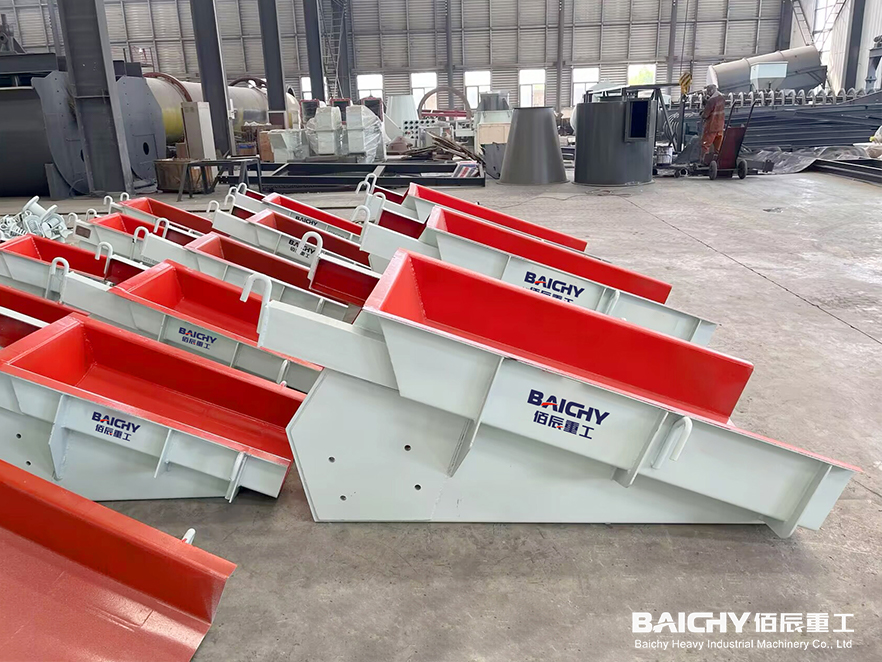
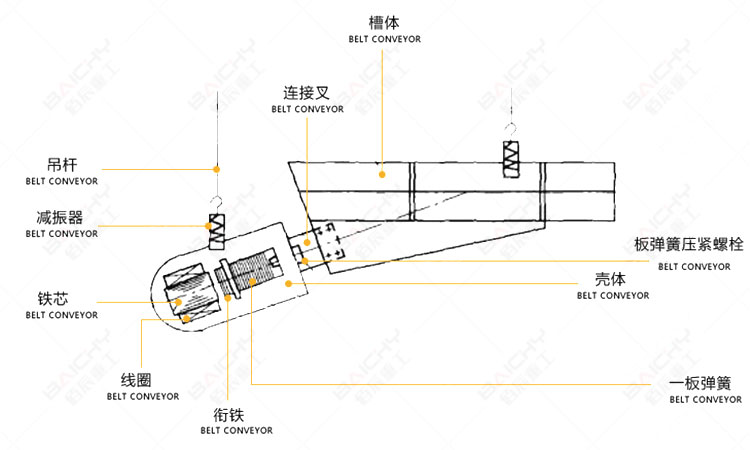
1. Feeding Trough: Used to hold and convey materials; typically constructed from welded steel plates, and can be fitted with liners as required.
2. Electromagnetic Exciter: The core component, comprising an electromagnetic core, a coil, and an armature.
3. Vibration Absorber (Spring System): Primarily composed of leaf springs, used to store energy and support the system.
4. Electrical Controller: Employs a half-wave rectification circuit to adjust the output voltage via a potentiometer, thereby enabling stepless (continuous) adjustment of the feeding rate.
5. Base and Suspension Device: Used to securely mount or suspend the equipment.
• Precise and Adjustable Feeding: By regulating the current/voltage of the electrical controller, the feeding rate can be adjusted very conveniently and precisely; furthermore, the system is easily integrated into automated control systems.
• Low Maintenance Costs: Lacking rotating parts (such as bearings or motors), the unit requires no lubrication; its simple structure results in minimal wear and a low failure rate.
• Efficient and Energy-Saving Operation: As the system operates in a state of resonance, its energy consumption is relatively low.
• Minimal Material Damage: Materials advance through the trough in a "hopping" motion, resulting in minimal wear on the trough itself while simultaneously preserving the integrity of the conveyed materials.
• High Safety: Capable of fully enclosed conveying, thereby preventing dust spillage and environmental pollution.
Factors to Consider for Selection:
• Material Characteristics: Particle size, moisture content, flowability, and corrosiveness (which influences the choice of trough material).
• Feeding Capacity: The required processing throughput in tons per hour (t/h).
• Installation Space: Whether a base-mounted or suspended installation configuration is required.
• Control Requirements: Whether remote control or interlinked control capabilities are needed.
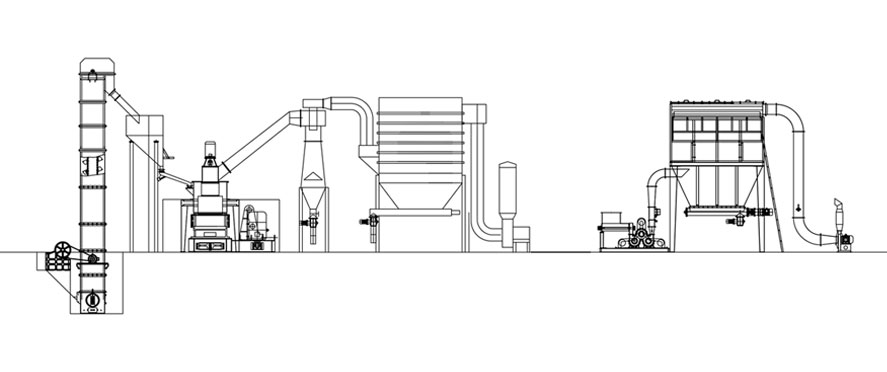
With the exception of the inner walls of the feed trough—which come into contact with the material—virtually no other components experience mechanical wear; this ensures a long service life and allows for a compact structural design.
Easily integrates with PLC or host computer systems to enable automated batching and quantitative feeding within the production process.
By harnessing the mutual conversion between electromagnetic energy and elastic potential energy, the system requires only minimal electrical power to maintain a substantial vibration amplitude.
Material moves continuously forward within the trough by "hopping" along tiny parabolic trajectories, rather than sliding across the surface of the trough.
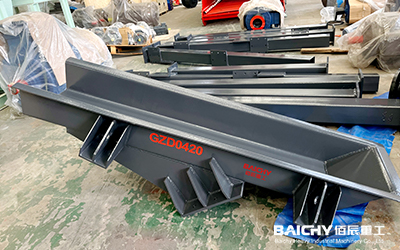
The electromagnetic vibrating feeder is an elastic system characterized by two-mass directional forced vibration.
1. Excitation Principle: It utilizes pulsed current within an electromagnetic coil to generate a periodic electromagnetic force. During the positive half-cycle of the alternating current, the electromagnetic force attracts the armature, thereby compressing the springs; during the negative half-cycle, the electromagnetic force dissipates, and the springs release their stored energy, driving the armature and the trough body to move in the opposite direction.
2. Resonance State: The system typically operates in a sub-critical resonance state—specifically, where its natural frequency is slightly higher than the excitation frequency—thereby enabling the generation of a large vibration amplitude using a relatively small excitation force.
3. Material Movement: The trough body undergoes reciprocating vibration at a specific inclination angle, causing the material to advance continuously in the feeding direction through a series of minute parabolic hops, thereby achieving uniform feeding.

| Model | Feeding Capacity(tph) | Object Max Allowed Input Size(mm) | Power(kw) | Valtage(v) | Clearance(a) | Double Swing(mm) | Total Weight(kg) |
| GZ1 | 5 | 50 | 0.06 | 220 | 1.9-2.2 | 1.75 | 75 |
| GZ2 | 10 | 60 | 0.15 | 220 | 1.9-2.2 | 17.5 | 155 |
| GZ3 | 25 | 70 | 0.2 | 220 | 1.9-2.2 | 1.75 | 225 |
| GZ4 | 50 | 100 | 0.45 | 220 | 1.9-2.2 | 1.75 | 460 |
| GZ5 | 100 | 150 | 0.65 | 220 | 1.9-2.2 | 1.75 | 656 |
If you need further information,please fill in your questions and comments in the form below.
Representatives from Baichy machinery will be back to you within the hour,thanking you for your support to Baichy machinery