+86-15093222637

Contact us for a quote and free process design
Baichy know what you are expecting from mining project and we are making it happen with unrivalled products and services.
Leave Message


The two-stage crusher is a high-efficiency crushing equipment. Its working principle is based on the design of dual rotors and dual-material chambers. This kind of machine crushes materials through two rotors at the same time, realizing the dual-stage crushing function of hammer powder and material powder, making the fineness of the crushed materials more uniform. Compared with traditional crushers, the output of a two-stage crusher can be increased by 50%.
☛ Contact Us Now To Get A Customized Production Line Configuration Plan.

Double-Stage Hammer Crusher has become an indispensable and important equipment in the industrial field due to its efficient, uniform, and reliable crushing performance and wide range of applications.
The double-stage hammer crusher is a high-efficiency fine crushing equipment developed by our company, featuring a unique double-rotor, screenless design. The equipment utilizes a two-stage series rotor system to achieve multi-stage crushing of materials, significantly increasing the crushing ratio and providing uniform and controllable (adjustable range 3-8mm) finished product particle size. The machine has a compact structure and uses wear-resistant alloy hammerheads and high-strength liners, making it suitable for fine crushing of various medium-hardness materials.
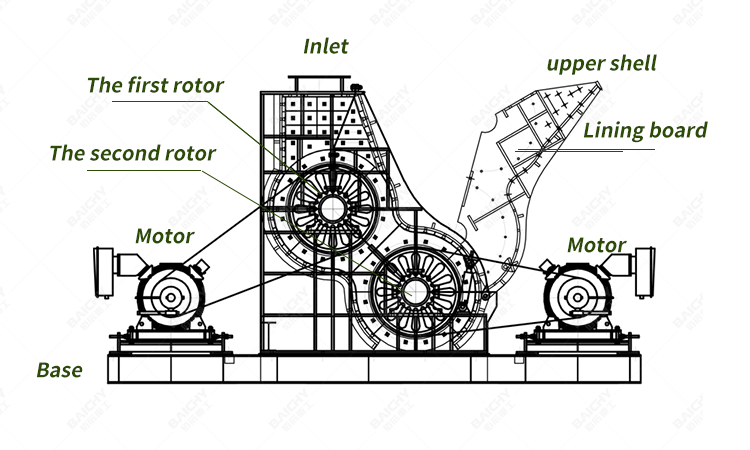
1. Double-Rotor System: Main drive device, two rotors rotate in the same direction but at different speeds.
2. High-Chromium Alloy Hammerheads: Main crushing components, wear-resistant and impact-resistant.
3. Adjustable Impact Plate: Works with the hammerheads to achieve impact crushing; the gap is adjustable to control the output particle size.
4. Heavy-Duty Frame: Overall welded structure with reinforced design in high-stress areas.
5. Hydraulic Opening Device: Facilitates inspection and maintenance, reducing downtime.
6. Transmission System: Motor drives the rotor via V-belts; overload protection device ensures safety.
7. Base and Vibration Damping Device: Reduces vibration and noise during equipment operation.
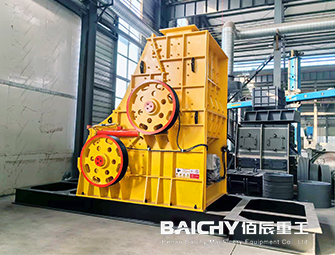
two stage hammer crusher
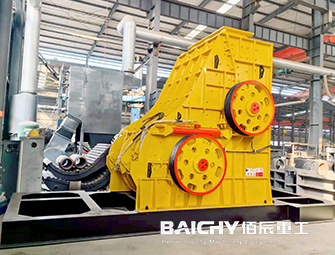
Hammer double stage crusher
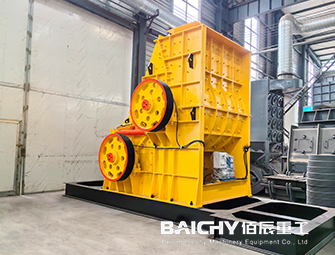
Two Stage Stone Crushing Plant
Two-stage crusher for sale
1. High-Efficiency Double Crushing: The double-rotor series design allows materials to be coarsely crushed by the first-stage rotor and then immediately finely crushed by the second-stage rotor, increasing crushing efficiency by more than 30%.
2. Uniform and Adjustable Particle Size: By adjusting the gap between the movable liner and the hammerheads, the output particle size can be easily controlled (adjustable within the range of 3-8mm), meeting different production needs.
3. Wear-Resistant and Durable: Uses high-chromium alloy composite hammerheads and high-manganese steel liners; the service life of key components is extended by 40%, reducing maintenance costs.
4. Non-Clogging Design: The unique screenless, multi-row hammerhead arrangement prevents clogging, even when processing materials with slightly higher moisture content, ensuring strong adaptability.
Double-Stage Hammer Crusher is suitable for crushing medium-hard materials with a compressive strength not exceeding 150 MPa and a moisture content of less than 12%, such as limestone, bluestone, coal gangue, shale, gypsum, and construction waste.
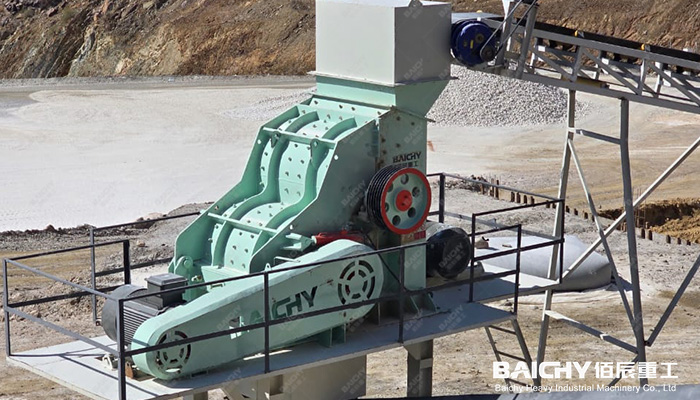
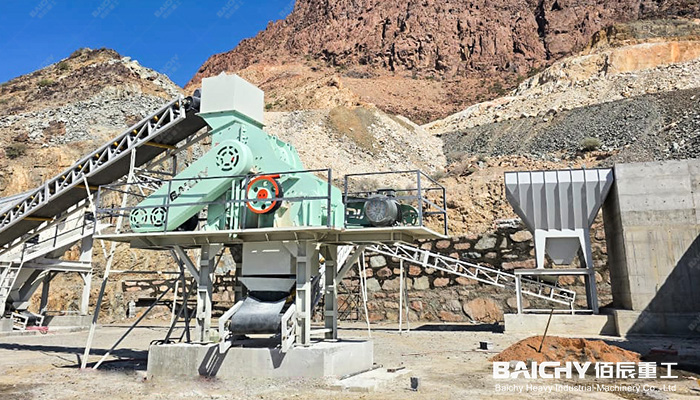
The double-stage hammer crusher achieves efficient fine crushing of materials through a two-stage series crushing process. Its working principle can be broken down into the following four consecutive steps:
First-stage impact crushing
The material enters the first crushing chamber through the feed opening.
It is immediately subjected to a violent impact from the hammers on the high-speed rotating rotor of the first stage, resulting in initial crushing.
First-stage impact crushing (rebound)
After gaining kinetic energy, the crushed material strikes the impact plate inside the machine chamber at high speed.
Under the combined action of impact force and rebound force, the material undergoes secondary crushing and changes direction.
Second-stage fine crushing
The material, after the first stage of crushing, enters the second crushing chamber.
Here, the rotor has a higher linear speed and the hammers are more densely arranged, causing the material to undergo a more intense impact-rebound cycle, resulting in further fine crushing.
| Model | Feeding Size(mm) | Discharge Size(mm) | Capacity(t/h) | Power(kw) | Overall Dimension (mm) |
| 2PC600×400 | ≤100 | ≤3 ( 0.5~0.075mm 50% 0.6~2mm 35% 2~3mm 15%) |
15−25 | 2×22 | 2350×926×1630 |
| 2PC800×600 | ≤100 | 45-60 | 2×55 | 3300x1250x1730 | |
| 2PC1000×800 | ≤120 | 50-70 | 2×90 | 5650×2067×2766 | |
| 2PC1000×1200 | ≤130 | 80-100 | 2×110 | 5650×2419×2765 | |
| 2PC1200×1400 | ≤150 | 100-120 | 2×160 | 5900×2660×2790 | |
| 2PC1400×1600 | ≤180 | 120-180 | 2×200 | ×4600 | |
| 2PC1600×2000 | ≤200 | 200-250 | 2×400 | 7400×3500×4266 |
Have Any Questions!
Don't Hesitate To Contact Us AnyTime.
Also called a screenless dual-rotor or coal-gangue crusher. Two rotors stack in one housing: the upper rotor breaks material first, the high-speed lower rotor re-crushes it, and particles also collide with each other. One pass does both secondary and fine crushing, giving a finer discharge with more fines — no re-crushing or wasted hammer wear from trapped fines.
Yes — no screen bars or bottom grate, so moisture isn't a hard limit. Coal gangue, shale, slurry, and slag pass through even in rain. Keep feed uniform and within top size; anti-clogging doesn't mean careless feeding.
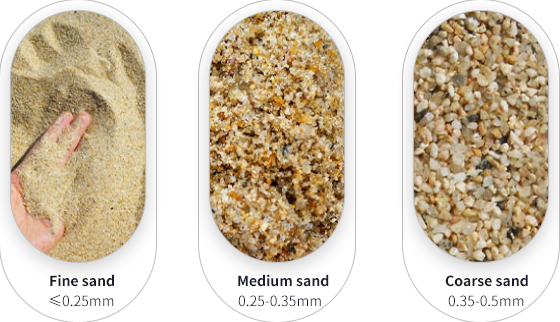
Mainstream models hit ≤3 mm, ideal for brick additives, internal fuel, and mine backfill. Adjust by changing hammer-to-liner gap. Worn hammers shift instead of being replaced — one set lasts roughly triple the usual life.
Four specs: max feed size, throughput, discharge size, combined motor power. Typical range: 100–200 mm feed, 10–180 t/h, two motors (e.g., 2PC800×600 = 45 + 55 kW). Match to actual feed moisture and top size — wet/hard material cuts real throughput, so don't trust rated numbers alone.
Hammers are the main wear part. Normal duty: replace every 500–800 hours (~3–4 weeks). Material matters: manganese steel 3–6 months; high-chrome / double-liquid composite alloy 6–12 months. Replace when: tip wear > half, coarse particles rise, or vibration increases. Bearing overheating = grease problem (fill cavity ~50%); chamber knocking = tramp metal or loose liner — add a magnetic separator on the feed side.
If you need further information,please fill in your questions and comments in the form below.
Representatives from Baichy machinery will be back to you within the hour,thanking you for your support to Baichy machinery