 +86-15093222637
Contact us for a quote and free process design
Baichy know what you are expecting from mining project and we are making it happen with unrivalled products and services.
Leave Message


PY series spring cone crusher is a medium and fine crushing mining crushing equipment with mechanical spring overload protection. The series is divided into three cavity types: PYB (standard type), PYZ (medium type), and PYD (short head type), which are respectively suitable for coarse crushing, medium crushing, and fine crushing (sand making). It is a classic crushing equipment in traditional mining and sand and gravel aggregate production.
☛ Contact Us Now To Get A Customized Production Line Configuration Plan.
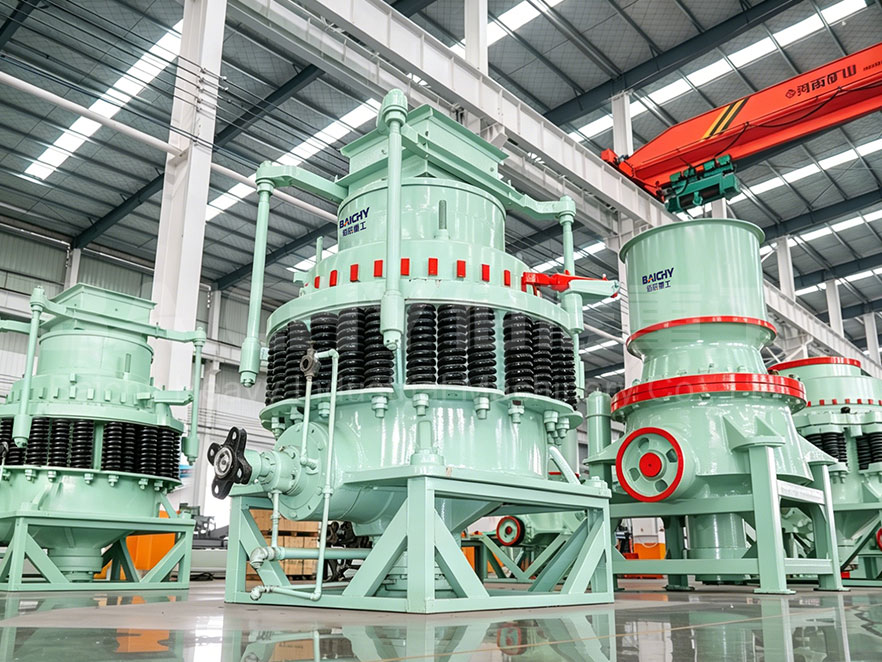
The PY Series Spring Cone Crusher is a proven secondary and tertiary crushing machine, typically installed after a jaw crusher in aggregates, quarry and mineral-processing lines.
- Spring release (over-iron protection) — when uncrushable tramp metal enters the chamber, the spring compresses and lets it pass, protecting the main frame;
- Three cavity types for different duties: PYB standard (secondary crushing), PYZ medium (fine/tertiary), PYD short-head (fine/ultra-fine);
- Grease or water seal keeps dust out of the lubrication system for reliable operation;
- Simple structure, easy disassembly and maintenance, universal spare parts — low running cost;
- A cost-effective choice for stable operations, upgrades of existing lines, and users with mature maintenance teams.
Industries: metallurgy and mining, aggregates & sand production, road building, chemicals and phosphate processing.
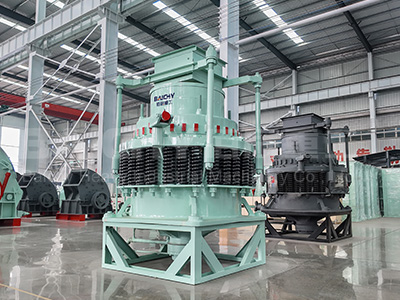
granite cone crusher
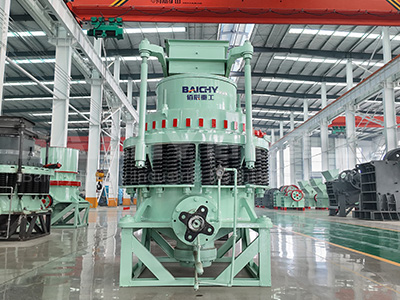
hard rock cone crusher
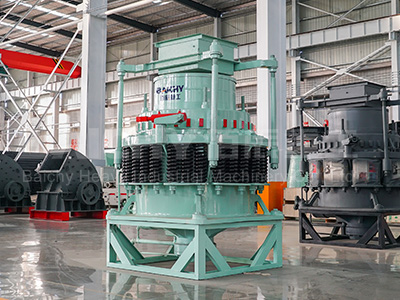
PY spring cone crusher
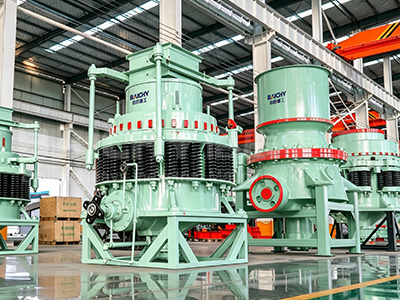
Cone Crusher Manufacturer
Applicable materials: iron ore, copper ore, gold/silver ore; granite, basalt, diabase, river pebble, quartzite, limestone, andesite and other medium-hard to hard rocks; also used in cement, refractories and glass-raw-material crushing.
Main sizes: mantle diameters of 600 / 900 / 1200 / 1750 / 2200 mm; motor power 30–160 kW; capacity roughly 15–300 t/h (per the model table).
Common specifications: PYB600, PYB900, PYB1200, PYB1750, PYB2200 (number represents the bottom diameter of the moving cone, unit: mm).
1. Hardness first — cone crushers suit medium-hard-to-hard rock (granite, basalt, iron ore). For soft rock (limestone, coal), an impact or jaw crusher is more economical.
2. Feed & product size — large feed / coarse product → PYB; fine 12–13 mm chips → PYD; in-between → PYZ.
3. Capacity & layout — match tph to mantle size (600/900 for small plants, 1200/1750 for medium, 2200 for large), and align with the upstream jaw opening and downstream screen apertures.
Note: never let welding pieces, drill steels or oversized metal enter the chamber; feed evenly across the distribution plate, otherwise the crusher will chatter and the liners wear unevenly.
Widely used in metallurgy to crush ores such as iron and copper, and in construction to produce aggregates from limestone, granite and other rocks, the PYB spring cone crusher delivers powerful, efficient crushing for both raw-material and aggregate production.
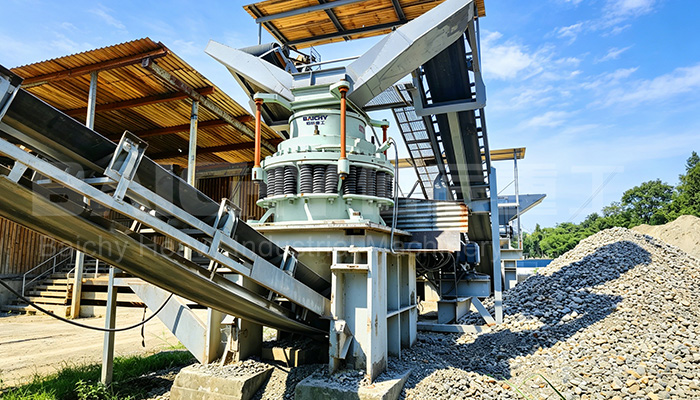
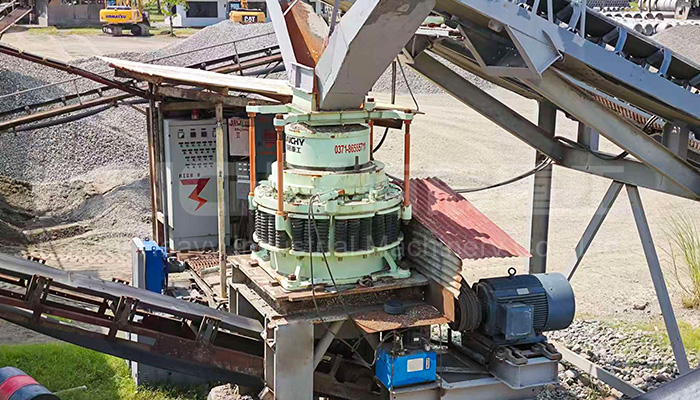
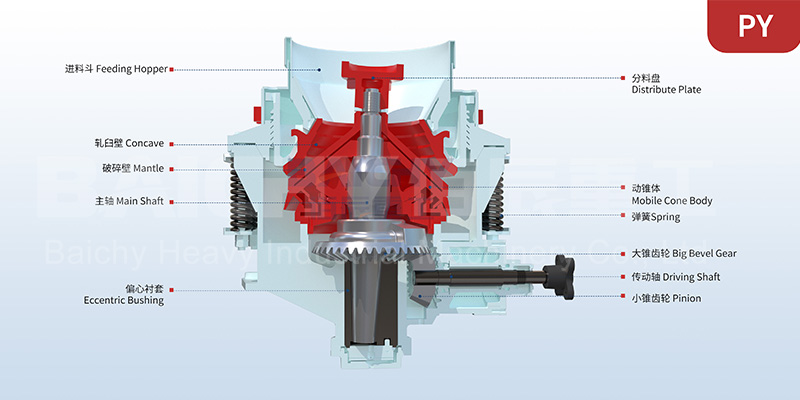
The PYB spring cone crusher is mainly composed of a frame, a transmission device, an empty eccentric shaft, a bowl-shaped bearing, a crushing cone (moving cone), an adjustment device, an adjustment sleeve, a spring, and a hydraulic station for adjusting the discharge port. Among them, the moving cone is supported on a spherical bearing and fixed on a suspended vertical shaft, which is placed in an eccentric sleeve, and the eccentric sleeve is placed on a thrust bearing.
• The swinging motion of the moving cone causes the gap between it and the fixed cone to move closer and farther from time to time.
• When the moving cone approaches the fixed cone, the gap between the two is reduced, which produces extrusion, shearing, and impact effects on the material, thereby achieving material crushing.
• The crushed material is discharged through the discharge port under the action of gravity and crushing force, completing the entire crushing process.
| Model |
Cone Diameter (mm) |
Max. Feed Size (mm) |
Outlet Setting Size (mm) |
Capacity (t/h) |
Power (kw) |
Overall Dimension (mm) |
| PYB-600 | 600 | 66 | 12-25 | 15-25 | 30 | 1740X1225X1940 |
| PYD-600 | 600 | 36 | 3-13 | 5-23 | 30 | 1740X1225X1940 |
| PYB-900 | 900 | 115 | 15-50 | 50-90 | 55 | 1990X1640X2380 |
| PYZ-900 | 900 | 60 | 5-20 | 20-65 | 55 | 1990X1640X2380 |
| PYD-900 | 900 | 40 | 3-13 | 15-50 | 55 | 1990X1640X2380 |
| PYB-1200 | 1200 | 145 | 20-50 | 110-200 | 110 | 2805X2300X2980 |
| PYZ-1200 | 1200 | 100 | 8-26 | 50-150 | 110 | 2805X2300X2980 |
| PYD-1200 | 1200 | 50 | 3-15 | 18-105 | 110 | 2805X2300X2980 |
| PYB-1750 | 1750 | 215 | 25-60 | 280-480 | 155-160 | 3610X2950X4185 |
| PYZ-1750 | 1750 | 185 | 10-30 | 115-230 | 155-160 | 3610X2950X4185 |
| PYD-1750 | 1750 | 85 | 5-15 | 75-230 | 155-160 | 3610X2950X4185 |
| PYB-2200 | 2200 | 300 | 30-60 | 590-1000 | 260-280 | 4790X3430X5080 |
| PYZ-2200 | 2200 | 230 | 10-30 | 200-580 | 260-280 | 4790X3430X5080 |
| PYD-2200 | 2200 | 110 | 5-16 | 120-370 | 260-280 | 4790X3430X5080 |
Have Any Questions!
Don't Hesitate To Contact Us AnyTime.
A: They differ only in crushing cavity. PYB standard has a deeper chamber and larger feed opening for secondary crushing at high throughput. PYZ medium suits secondary-to-fine duties. PYD short-head has a longer parallel zone and smaller closed-side setting, producing finer end products. Choose by the required crushing stage and final product size.
A: The spring type is mechanically simple, cheap to maintain, uses widely available spares and has a low capital cost — ideal for stable duties, older-line upgrades and workshops with existing repair experience. A hydraulic cone crusher offers easier CSS adjustment, hydraulic clearing and tramp release, and higher automation, suiting high-tonnage or frequently adjusted new plants. Choose spring when budget and maintenance simplicity matter most.
A: The PYD short-head model can close down to a 3–13 mm CSS and produces fine material and 12–13 mm chips. However, for a well-graded 0–5 mm manufactured-sand product, a vertical-shaft impact crusher (VSI / sand maker) gives a far higher sand yield and better fineness modulus. For sand production, pair the cone crusher with a VSI shaping crusher.
A: The main wear parts are the concave (fixed bowl liner) and mantle (moving cone liner), normally cast in Mn13/Mn18 high manganese steel. Life depends on rock hardness and feeding — months in hard rock (basalt, iron ore), longer on limestone. Even feeding and tramp-metal protection are the best ways to extend liner life.
A: Maximum feed size must not exceed the model's opening (e.g. about 115 mm for PYB900), and fines and mud should be pre-screened out. Material must be fed evenly across the distribution plate: biased feed causes one-sided mantle wear, uneven product gradation, lower output, and can even trigger vibration and abnormal spring loading. A feeder plus pre-screening is recommended.
If you need further information,please fill in your questions and comments in the form below.
Representatives from Baichy machinery will be back to you within the hour,thanking you for your support to Baichy machinery



