 +86-15093222637
Contact us for a quote and free process design
Baichy know what you are expecting from mining project and we are making it happen with unrivalled products and services.
Leave Message


The RS Series Rotors Powder Separator (epitomized by the T-Sepax High-Efficiency Triple-Separation Classifier) represents the third generation of high-efficiency classification equipment, developed specifically to meet the demands of industrial powder classification. It breaks through the limitations of traditional "coarse-fine dual separation," achieving a more precise "coarse-medium-fine triple separation."
☛ Contact Us Now To Get A Customized Production Line Configuration Plan.
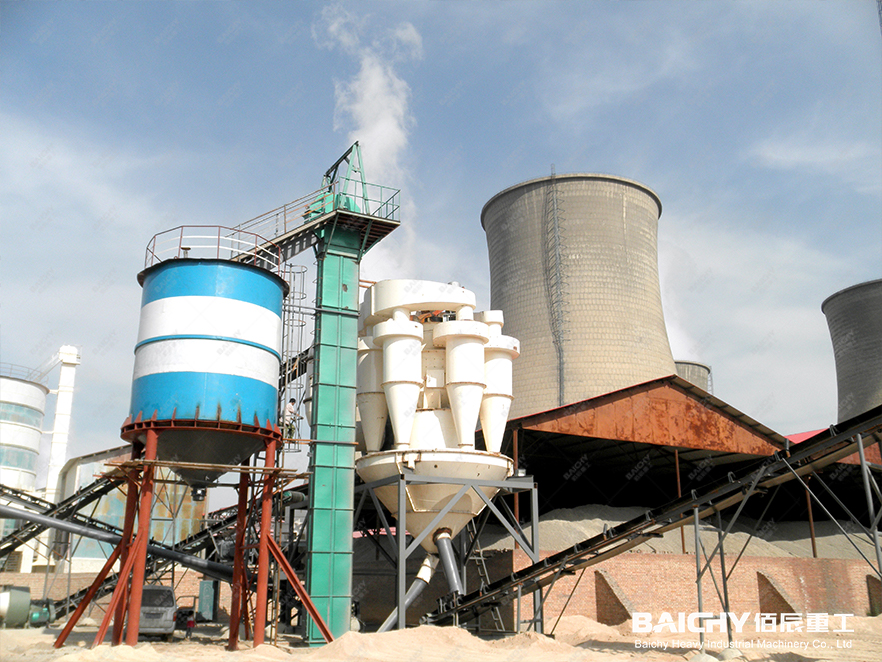
1. Extremely High Classification Efficiency (80%–90%): Due to shorter material residence times within the machine and increased frequency of cleaning actions, it effectively resolves the issue of fine particles adhering to the surface of coarse particles, thereby significantly reducing the phenomenon of "over-grinding."
2. Adjustable Product Particle Size Distribution: By adjusting the rotor speed (via stepless speed control), users can precisely control the specific surface area (e.g., 320–450 m²/kg for cement) and particle size distribution of the finished product.
3. Low System Investment & Flexible Configuration:
• Can operate as either a positive-pressure or a negative-pressure system.
• Features four integrated cyclone collectors, simplifying external piping layouts and saving space.
4. Low Power Consumption & Long Service Life:
• Employs an aerodynamically optimized blade design to minimize operational resistance.
• Wear-prone components (such as liners and rotor blades) are constructed from high-chromium wear-resistant steel plates or industrial ceramics, ensuring extended maintenance cycles.
5. Significant Increase in Output: Under identical grinding mill configurations, the implementation of the T-Sepax system typically boosts the mill's output by 20%–40%.
RS Rotor Separator
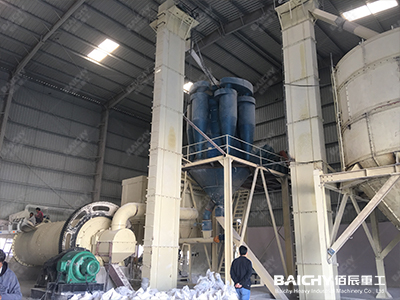
RS Dynamic Classifier
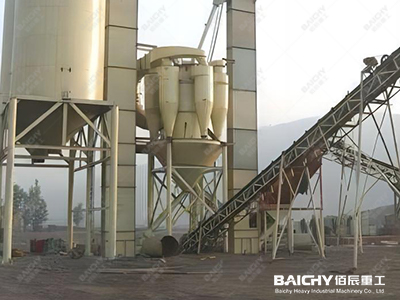
RS Series Centrifugal Classifier
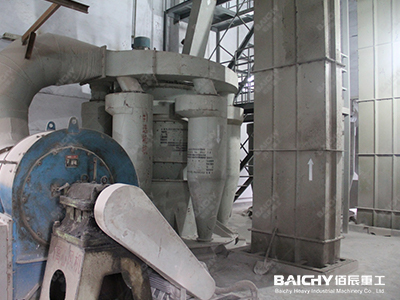
Ultrafine Powder Classifier
1. Cement Production Lines:
• Raw Meal Classification: Improves the qualification rate of raw meal and reduces its fineness prior to kiln entry.
• Finished Product Grinding: Operates within a closed-circuit circulation system to produce cement of various strength grades.
2. Roller Press Semi-Finish/Finish Grinding Systems: Serves as the core classification component, integrating seamlessly with roller presses.
3. Non-Metallic Mineral Processing: Enables the fine classification of materials such as limestone, quartz powder, heavy calcium carbonate, and gypsum powder.
4. Power Plant Environmental Management: Classification of fly ash (for the extraction of Grade I and Grade II ash).
5. Chemicals and Metallurgy: Dry classification of materials such as iron concentrates, titanium dioxide, petroleum coke, etc.
Particle size distribution is more reasonable, final product quality has been improved significantly.
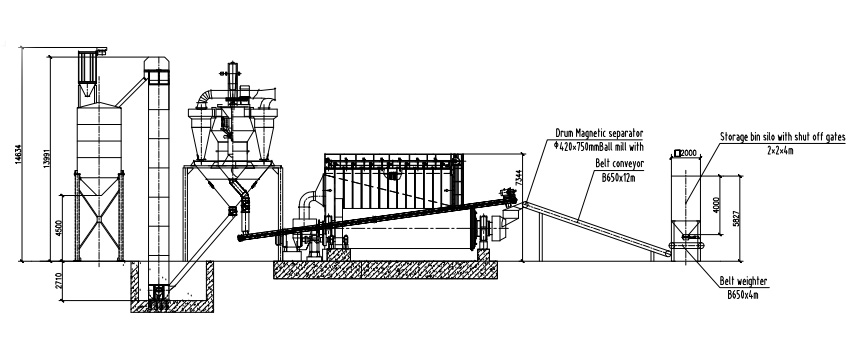
Breaking through the limitations of traditional air classifiers—which typically perform only a "coarse-fine binary separation"—this system separates materials in a single pass into three distinct fractions: coarse powder, medium-coarse powder, and finished fine powder.
Classification efficiency typically reaches 80% to 90%. Under identical operating conditions, a grinding system integrated with this equipment can typically increase output by 20% to 40%, while simultaneously significantly reducing the specific power consumption (kWh per ton) required to produce the finished product.
Utilizing a stepless rotor speed control system, operators can precisely adjust the fineness (specific surface area) of the finished product over a wide range simply by modifying the rotor speed via the central control system.
The equipment integrates both classification and collection functions into a single unit; it typically features four built-in, high-efficiency cyclone collectors, resulting in a simplified piping layout and a minimal physical footprint.
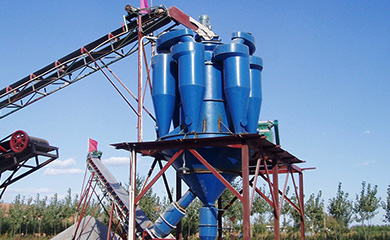
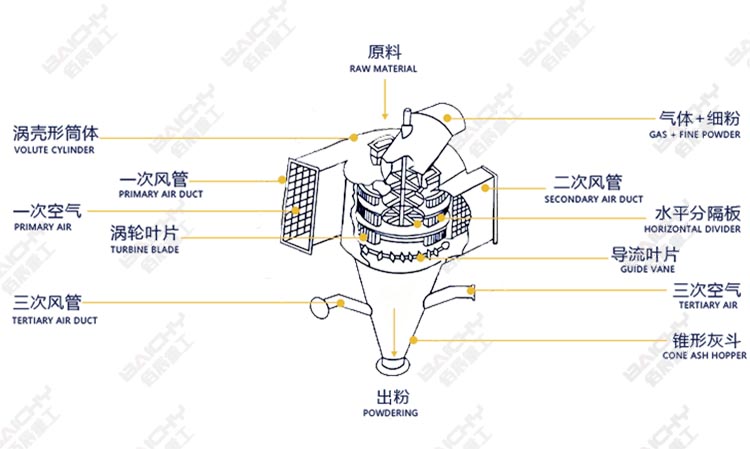
The T-Series Rotor Classifier combines the advantages of the O-Sepa classifier (utilizing laminar-flow classification technology) with the superior product collection capabilities of traditional cyclone classifiers.
• Classification Principle: Upon entering the machine, materials pass through multi-stage classification zones under the combined influence of a rotating dispersion plate and an upward airflow. Coarse particles settle and fall due to gravity; medium-coarse particles settle and are collected via internal cyclones; and fine particles are carried by the airflow through the rotor into an external dust collection system.
• Core Structure: Features a high-efficiency rotor paired with a vortex rectifier, optimizing the flow field distribution to ensure a more uniform airflow.

| Model | RS300 | RS400 | RS500 | RS600 | RS700 | RS900 | RS1000 | RS1100 | RS1200 | |
|---|---|---|---|---|---|---|---|---|---|---|
| Matched Ball mill(m) | Φ1.2 | Φ1.5 | Φ1.83 | Φ2.2 | Φ2.4 | Φ3.0 | Φ3.0 | Φ3.0 | Φ3.0 | |
| Main Motor | Model | YCTL200-4A | YCTL200-4B | YCTL255-4A | YCTL255-4B | YCTL250-4B | YCTL315-4A | YCTL335-4A | YCTL355-4B | YCTL355-4B |
| Rotating Speed(r/min) | 125-1250 | 125-1250 | 125-1250 | 132-1320 | 132-1320 | 132-1320 | 440-1340 | 440-1340 | 440-1340 | |
| Power | 5.5 | 7.5 | 11 | 15 | 18.5 | 37 | 55 | 75 | 75 | |
| Blower | Model | SCF5A | SCF-12 No.8C | SCF-12 No.8C | SCF-12 No.10C | SCF-12 No.12C | SCF-12 No.12C | SCF-12 No.16B | SCF-12 No.16D | SCF-12 No.16D |
| Volume(m³/h) | 18000 | 24216 | 30900 | 37960 | 58200 | 119332 | 168000 | 192000 | 192000 | |
| Air Pressure | 2.5 | 2.18 | 2.43 | 2.34 | 2.07 | 2.26 | 2.70 | 2.70 | 2.70 | |
| Rotating Speed(r/min) | 1000 | 1500 | 1600 | 1200 | 1000 | 800 | 960 | 960 | 960 | |
| Model | Y160M-2 | Y180M-2 | Y200L1-2 | Y225S-4 | Y250M-4 | Y355M1-8 | Y355M1-6 | Y355M3-6 | Y355M3-6 | |
| Power(kw) | 15 | 22 | 30 | 37 | 55 | 132 | 160 | 200 | 200 | |
| Rotating Speed of Shaft(r/min) | 190-380 | 190-380 | 190-380 | 150-350 | 150-350 | 140-350 | 100-300 | 100-300 | 100-300 | |
| Capacity(t/h) | 5-12 | 15-20 | 20-30 | 30-35 | 35-46 | 70-86 | 90-115 | 100-120 | 100-120 | |
https://www.baichychina.com/Powder/classifier.html
If you need further information,please fill in your questions and comments in the form below.
Representatives from Baichy machinery will be back to you within the hour,thanking you for your support to Baichy machinery



