
If you are looking for mobile crushing equipment in Venezuela to process highly abrasive river pebbles, a dual-module diesel-powered mobile line featuring a PE400×600 jaw crusher and a cone crusher is the most reliable choice for a capacity range of 15–35 tph.
Three compelling reasons:
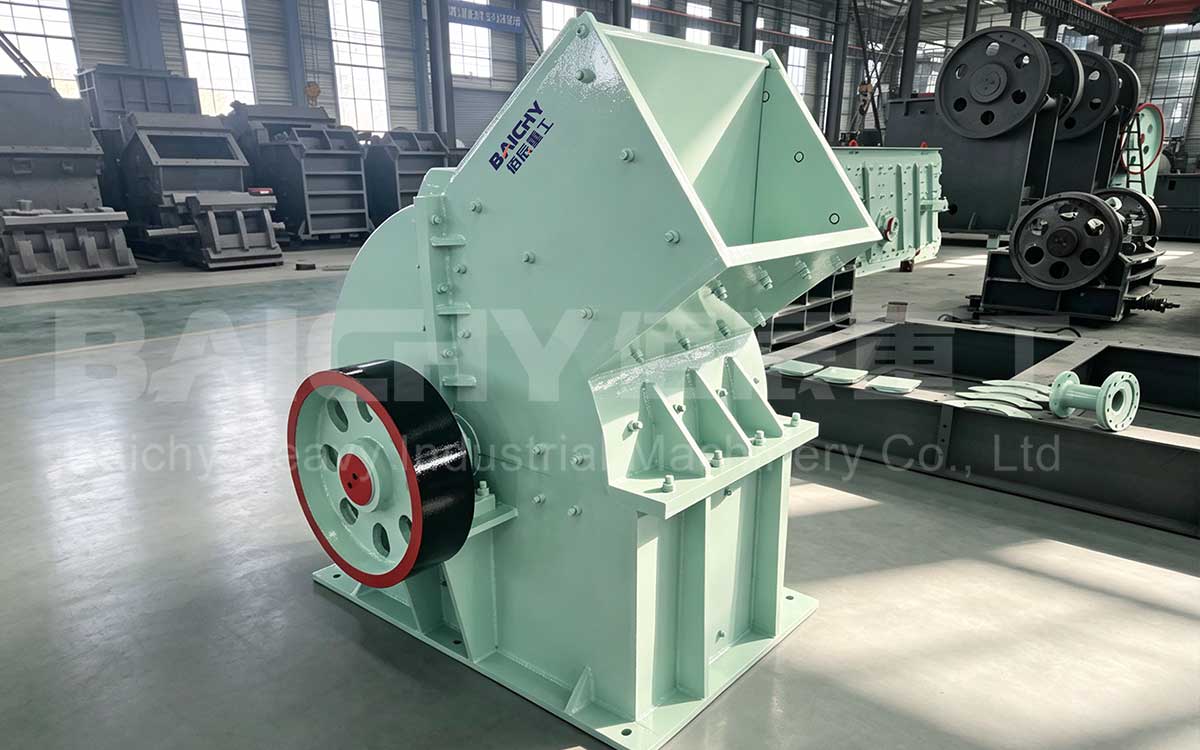
1. River stones require a cone crusher for the secondary stage—impact crushers and hammer crushers will have their liners worn through by the pebbles within 300 hours. The client correctly ruled out impact crusher options during the inquiry stage—a sound technical decision.
2. Diesel power is a critical necessity in Venezuela—not merely an "option," but a requirement for operational survival. Diesel engines ensure continuous production output during grid power outages.
3. A dual-module trailer setup offers greater flexibility than a single, heavy module—relocation can be handled by a single towing vehicle without the need for a crane.
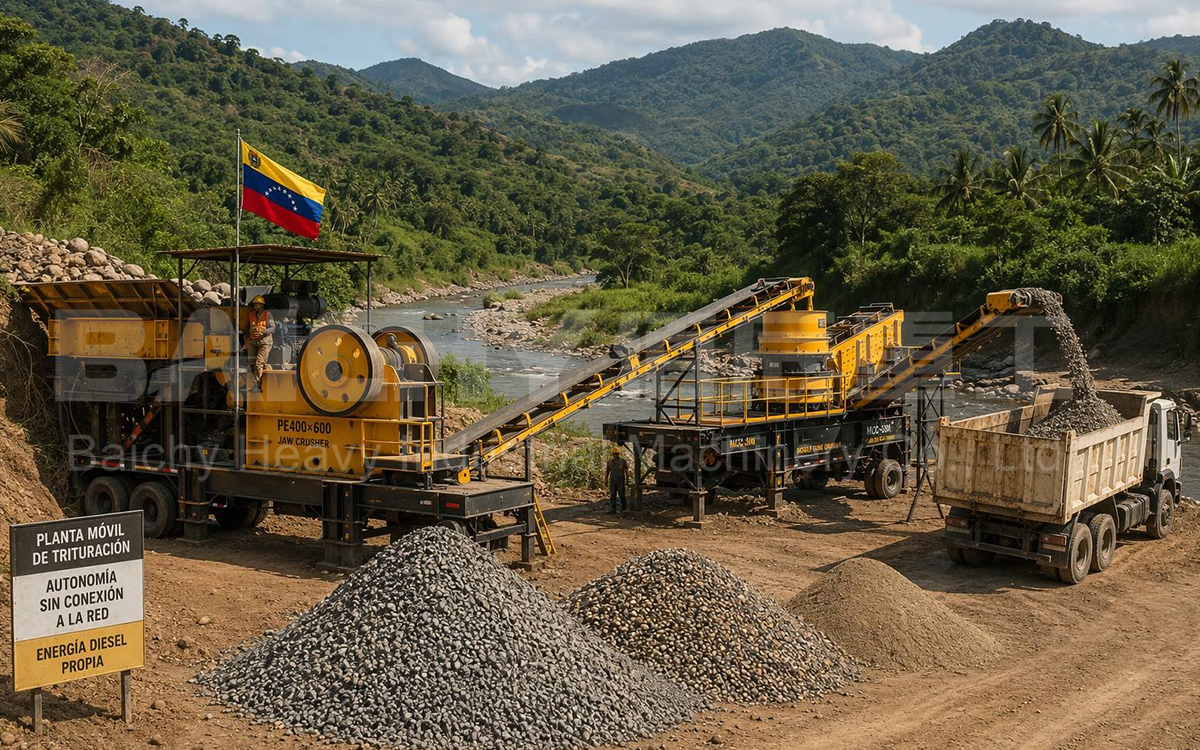
mobile aggregate crushing Venezuela
I. Pain Point Analysis: Why do river stone crushing operations often face problems?
1.1 Choosing the wrong secondary crusher = The start of downtime
River pebbles contain 65%–75% SiO₂ and have a Mohs hardness of 7–8. In the secondary crushing stage:
| Crusher Type | Suitability for River Stone | Wear Rate | Verdict |
| Impact Crusher | Blow bars fail within 200–400 hours | Extremely fast | ❌ Unsuitable |
| Hammer Crusher | Hammers need flipping/replacement every 300–500 hours | Very fast | ❌ Unsuitable |
| Cone Crusher | Manganese steel liners last 800–1500 hours | Normal | ✅ The only correct choice |
Data Source: Field measurements from a river stone project in the Philippines—when a PF1007 impact crusher processed river stones, blow bar lifespan was only 280 hours; after switching to a PYB900 cone crusher, liner lifespan extended to over 1200 hours.
1.2 Unstable power grid = A death sentence for electric-powered production lines
Venezuela's national grid suffers from frequent power rationing and voltage fluctuations exceeding ±15%. An all-electric configuration implies:
• Power outage = Total line shutdown, zero daily output
• Voltage fluctuations = Frequent motor overload or burnout
• Cost of voltage stabilizers + UPS may exceed the cost of the diesel generator set itself
1.3 Inadequate closed-loop circulation = Substandard finished product
Many small mobile plants feature only two-stage screening (finished product + oversize material), lacking natural sand recovery and a closed-loop return for oversize material. The consequences are:
• Natural sand mixes into the finished aggregate → Inconsistent gradation
• Oversize material is discharged directly → Low yield, raw material waste
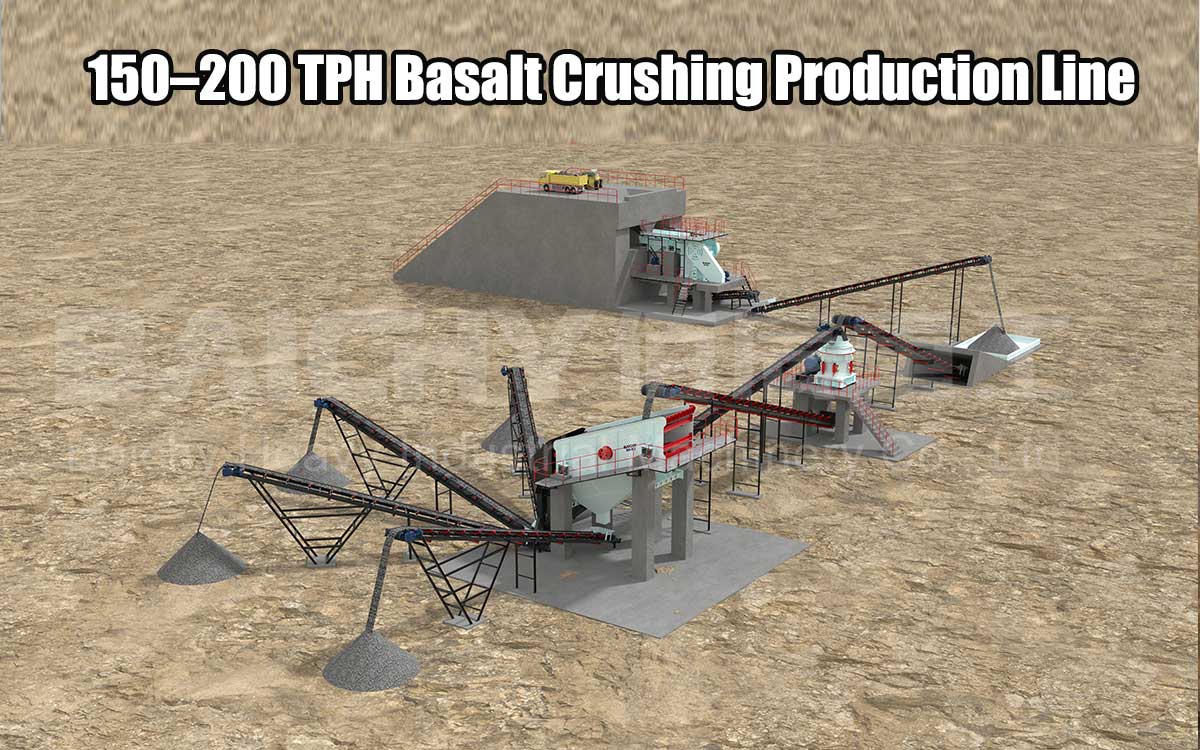
The three-way screening configuration requested by the client (natural sand / ≤19mm finished product / >19mm oversize return) is the correct setup to resolve this issue.
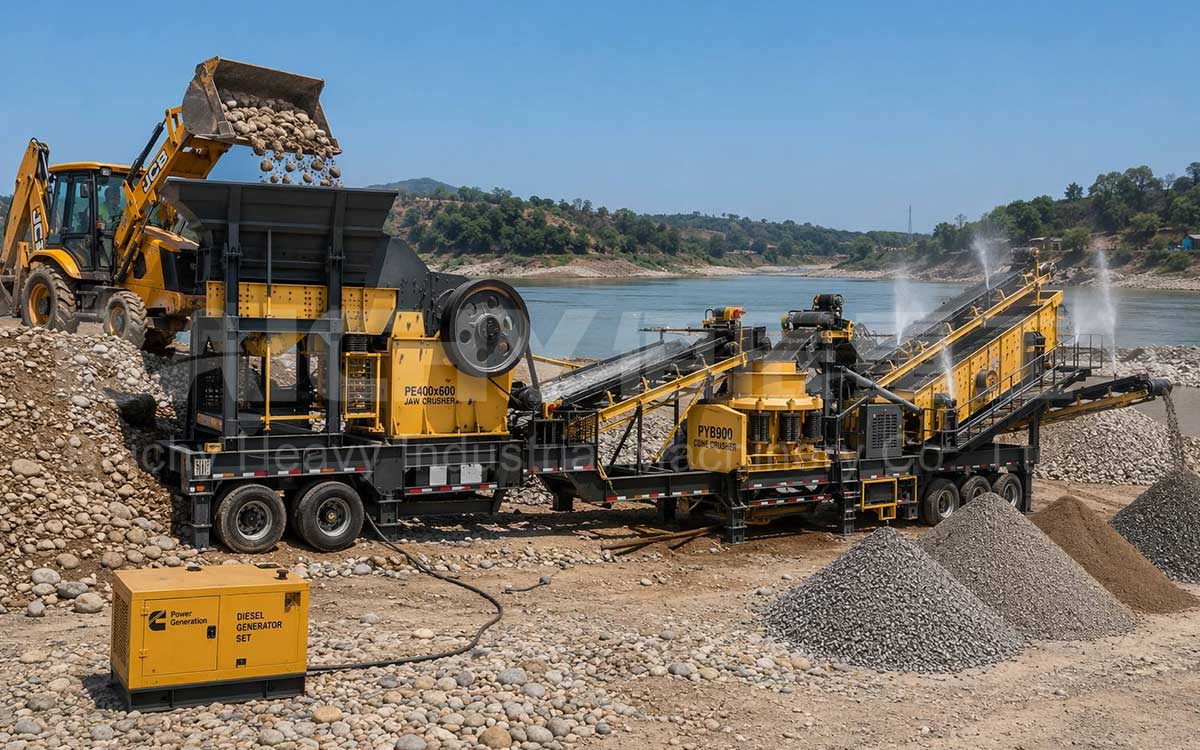
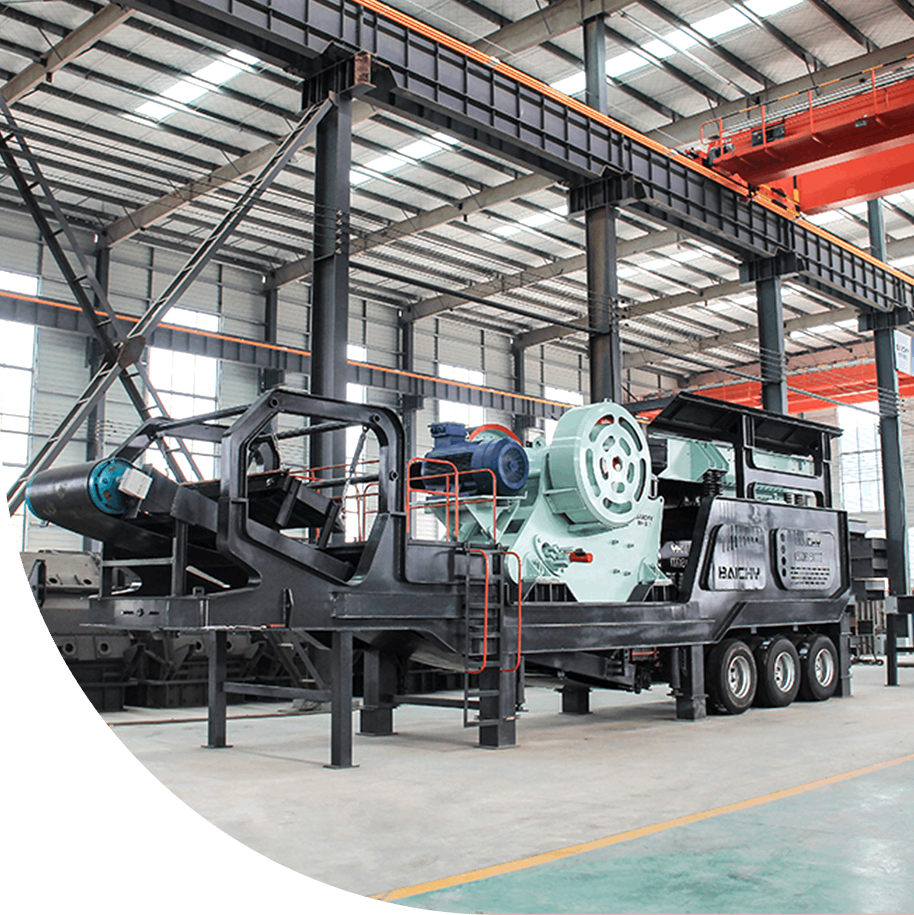
portable-river-stone-crusher-plant
II. Recommended Solution: Dual-Module Diesel-Powered Mobile River Stone Crushing Line
2.2 Core Equipment Specifications
| Equipment | Model | Key Parameters | Quantity |
| Jaw Crusher | PE400×600 | Feed opening 400×600mm, Max feed 340mm, Discharge opening 40-100mm, Capacity 16-65 t/h, Motor 30kW | 1 |
| Spring Cone Crusher | PYB900 | Crushing cone diameter 900mm, Max feed 115mm, Discharge opening 15-50mm, Capacity 20-50 t/h, Motor 55kW | 1 |
| Vibrating Feeder | GZD850×3000 or ZSW380×96 | Grizzly bar spacing 50-80mm (pre-screening natural sand), Motor 2×2.2kW | 1 |
| Triple-Deck Vibrating Screen | 3YK1545 | Screen surface 1500×4500mm, Three screen decks: 20mm / 6mm / 3mm, Motor 15kW | 1 |
| Belt Conveyors | B500/B650 | 1 feed belt, 1 inter-module transfer belt, 2 finished product discharge belts, 1 material return belt | 5 units |
| Diesel Generator Set | 150–200 kW | Recommended: Cummins or Weichai engine; includes control cabinet + fuel tank | 2 units |
2.3 Production Capacity Commitment
Processing river stone (SiO₂ ~70%, bulk density 1.6 t/m³), with finished product size ≤19mm:
| Parameter | Value | Remarks |
| Feed Capacity | 15–20 m³/h | Depends on river stone particle size distribution |
| Finished Aggregate (5-19mm) | 10–16 t/h | Approx. 60-70% of total output |
| Natural Sand (0–5 mm) | 4–8 t/h | From feeder pre-screening + screen underflow |
| Total Output | 16–24 t/h | Combined capacity; actual output depends on raw material gradation |
Why a "range" instead of a "fixed value"? Capacity is influenced by three variables: ① Proportion of <50 mm fines in the river stone (higher proportion shifts capacity toward the upper limit); ② Cone crusher discharge setting (tighter setting yields lower capacity but better particle shape); ③ Surface smoothness of the river stones (smoother stones are harder to crush). Any quote promising a single, fixed figure is irresponsible.
2.4 Expected Particle Size Distribution (Product Analysis)
| Size Fraction (mm) | Proportion (%) | Application |
| 13–19 | 25–30% | Coarse concrete aggregate |
| 6–13 | 30–35% | Medium concrete aggregate / Road base course |
| 3–6 | 10–15% | Precast components / Asphalt mixture |
| 0–3 (Manufactured sand) | 5–10% | Fine concrete aggregate (to supplement natural sand shortages) |
Natural sand (from feeder pre-screening + screen underflow) is recovered separately and not mixed with crushed aggregate.
III. Translating Benefits: Commercial Value Behind the Parameters
3.1 "15–35 t/h" = Daily output value of 600–1,200
The market price for construction aggregate in Venezuela is approximately 15–25/t (depending on region and transport distance). Conservative estimates:
• Daily output: 120–180 t (8-hour shift) → Daily output value: 2,400–4,500
• Deducting operating costs (fuel + labor + wear parts) of approx. 8–12/t → Daily net profit: 1,000–2,200
• Payback period: 8–14 months (based on an estimated CIF price of 120,000–160,000 for the complete set)
3.2 Diesel-powered = Zero grid dependency
• "Standard configuration" from many Chinese suppliers is electric; for Venezuela, customers must source their own generators, with no guarantee of compatibility
• Baichy diesel solution: Generator set and primary crusher are factory-integrated and tested; ready for immediate use upon refueling at the port
• Fuel consumption: Approx. 18–25 L/h (combined for both modules), equivalent to a fuel cost of 0.8–1.2/t
3.3 Closed-loop circuit = 100% product yield
In production lines without a closed-loop circuit, oversized material (>19mm) typically accounts for 15–25% of the feed, requiring it to be sold at a low price or stockpiled. A closed-loop circuit converts this entire 15–25% into qualified finished product, resulting in an additional annual output of approx. 1,500–3,000 tons of finished aggregate.
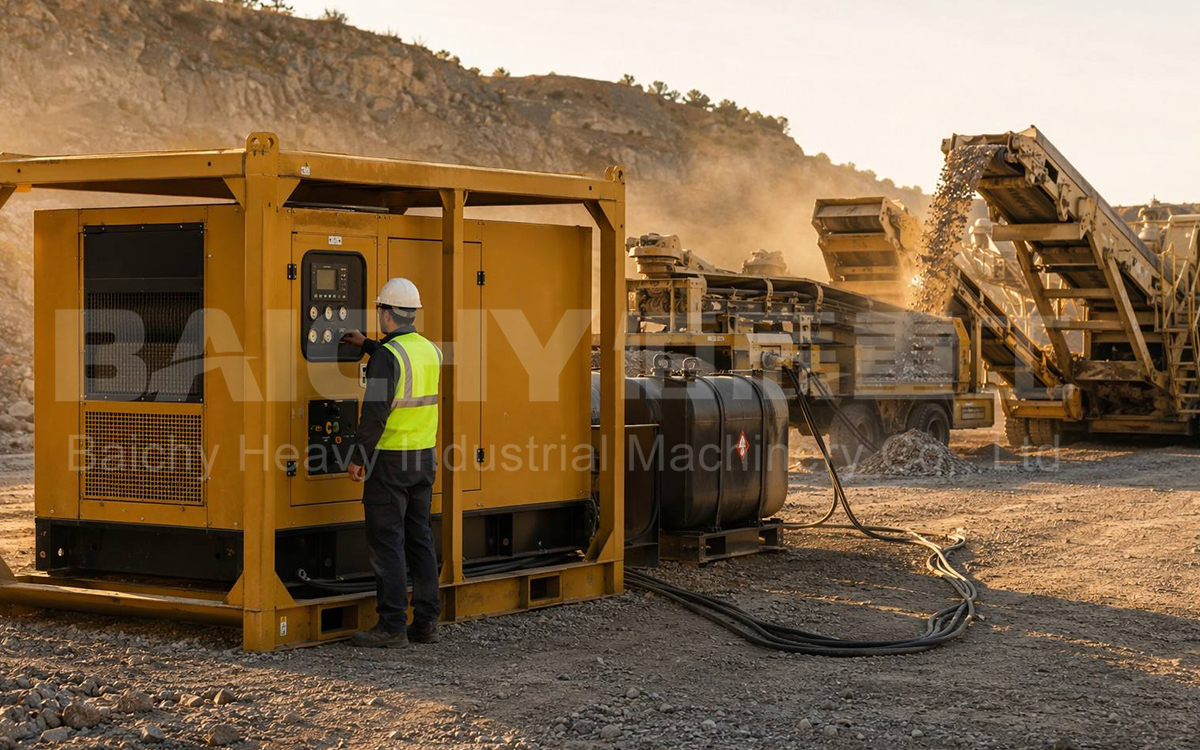
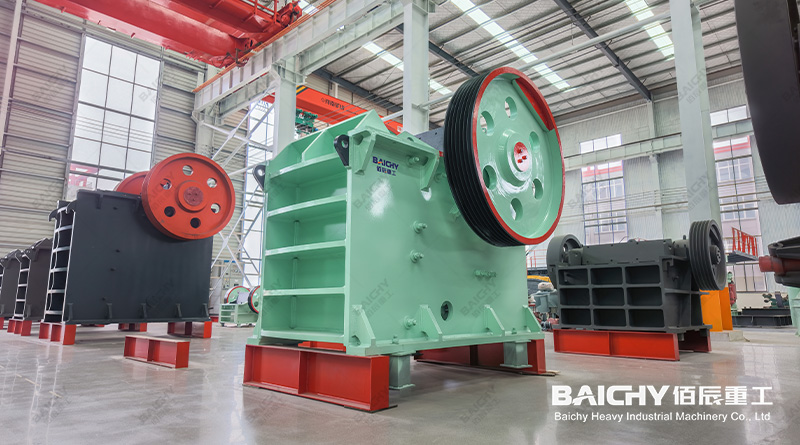
PE400×600 jaw crusher
IV. Comparison with Electric Alternative
| Dimension | Diesel Dual-Module (Recommended) | Electric Dual-Module (Alternative) |
| Initial Investment | 15–20% higher (includes generator set) | Baseline |
| Operating Cost | 0.8–1.2/t (fuel) | 0.2–0.4/t (electricity) |
| Grid Dependency | None | Fully dependent |
| Applicable Scenarios | Areas with unstable grids / remote mining sites | Near cities, areas with stable grid coverage |
| Relocation Convenience | High (no grid connection required) | Low (requires laying cables + transformers each time) |
| Maintenance Complexity | Periodic engine servicing | Simple |
| Recommendation for Venezuela | ⭐⭐⭐⭐⭐ | ⭐⭐⭐ |
Advice to Client: Primarily promote the diesel solution while offering the electric solution as an alternative (to satisfy the client's request for quotes on both). Emphasize the practical necessity of the diesel solution in the Venezuelan context while respecting the client's right to choose.
V. Transportation and Logistics Plan
| Logistics Element | Details |
| Port of Loading | Port of Shanghai / Port of Tianjin |
| Port of Discharge | Puerto Cabello (Recommended; Venezuela's largest container port) or Maracaibo |
| Transport Mode | Breakbulk or Ro-Ro (Roll-on/Roll-off) — Mobile station transported as a complete unit; no disassembly required |
| Module 1 Dimensions | ~9.5 × 2.5 × 4.2 m (L × W × H); Gross weight approx. 16–20 t |
| Module 2 Dimensions | ~11.5 × 2.8 × 4.5 m; Gross weight approx. 22–28 t |
| Cargo Volume | Breakbulk: approx. 180–250 CBM; Accessories/Spare parts: approx. 1 × 20GP container |
| Ocean Transit Time | Approx. 35–50 days (China → Puerto Cabello) |
| Reference Ocean Freight | FCL: approx. 4,500/20GP, 5,000/40GP; Breakbulk: charged by CBM/Ton (subject to real-time quotes) |
Flat-rack containers are generally not required — the mobile station features an integrated wheeled chassis, allowing for direct Ro-Ro or lift-on/lift-off loading. Spare parts and accessories are shipped in standard containers.
VI. Spare Parts and After-Sales Service
6.1 Recommended Spare Parts Package (2-Year Operation)
| Spare Part | Specification | Quantity | Estimated Replacement Cycle | Unit Price (FOB) |
| Jaw Plates (Fixed + Movable) | Mn13Cr2 / PE400×600 | 2 Sets | 800–1200 h/set | TBD |
| Cone Crusher Bowl Liner + Mantle | Mn18Cr2 / PYB900 | 2 Sets | 1000–1500 h/set | TBD |
| Vibrating Screen Mesh | 65Mn Woven Mesh, 20/6/3mm | 2 Sheets Each | 600–1000 h/sheet | TBD |
| V-Belts | Type B/C, Various Specs | 2 Sets | - | TBD |
| Bearings | Main Shaft Bearings (Jaw/Cone/Screen) | 1 Set Each | - | TBD |
| Conveyor Belt | B500/B650, EP200 | 50 Meters | - | TBD |
| Idlers + Pulleys | Various Specs | 10 + 2 | - | TBD |
| Diesel Engine Filters | Oil/Fuel/Air Filter Elements | 20 Sets | 250 h/set | TBD |
| Grease + Hydraulic Oil | - | Sufficient Quantity | - | TBD |
Estimated Package Price: FOB 8,000–12,000 (Subject to final configuration and manganese steel grade selection)
6.2 After-Sales Support Commitment
• Remote Support: Response via WhatsApp/Video within 24 hours; provision of troubleshooting and repair guidance
• Air Freight for Spares: Urgent spare parts shipped via air to major Venezuelan airports (Caracas / Maracaibo) within 3–7 days
• On-site Service: Optional — 1 Commissioning & Training Engineer; 7–10 days on-site in Venezuela; costs quoted separately
• Manual Language: English standard; Spanish versions of core manuals (Operation + Maintenance + Safety) available
• Warranty: 12 months or 2,000 operating hours (whichever comes first), covering manufacturing defects.