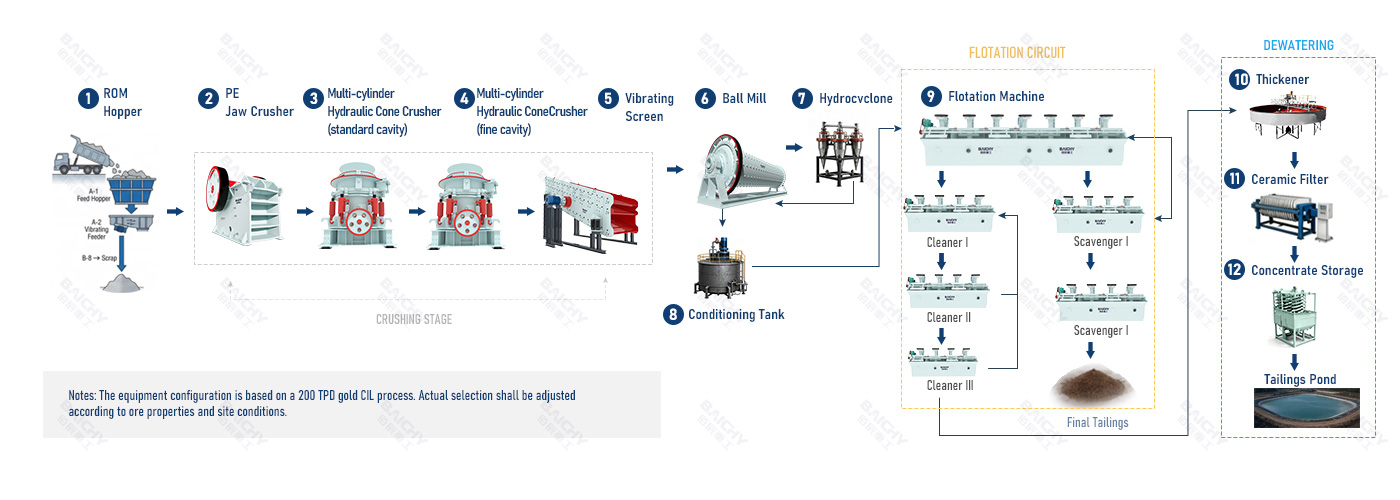
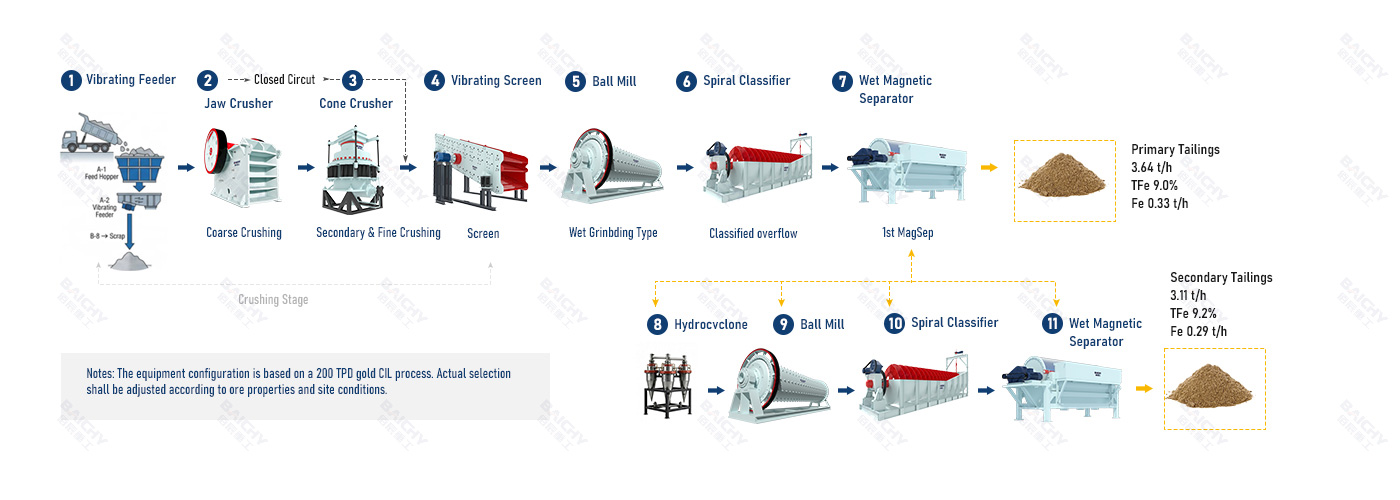
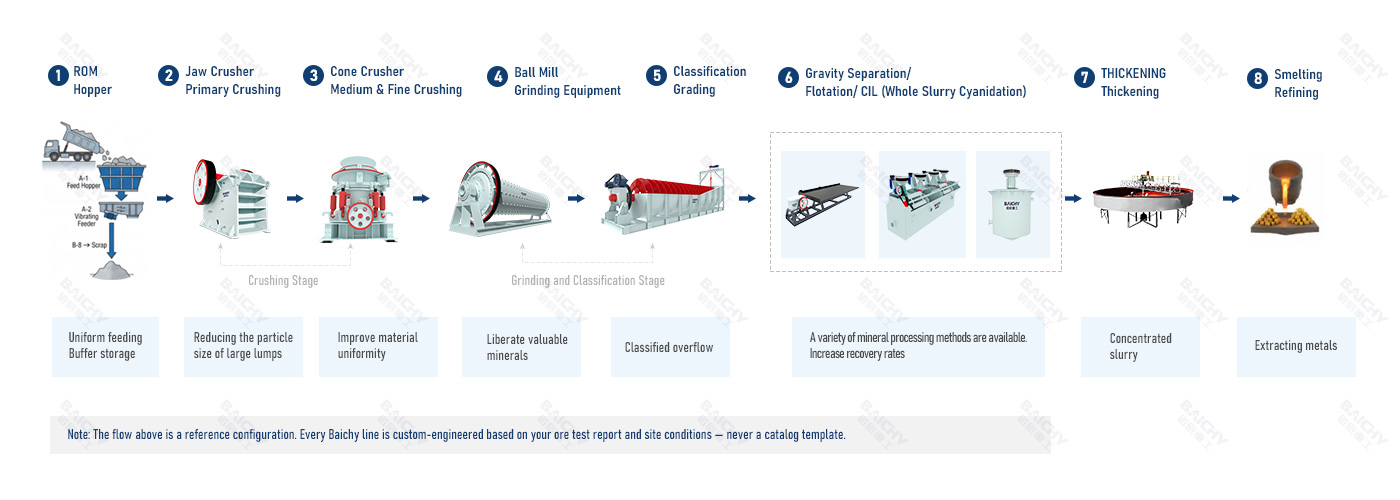
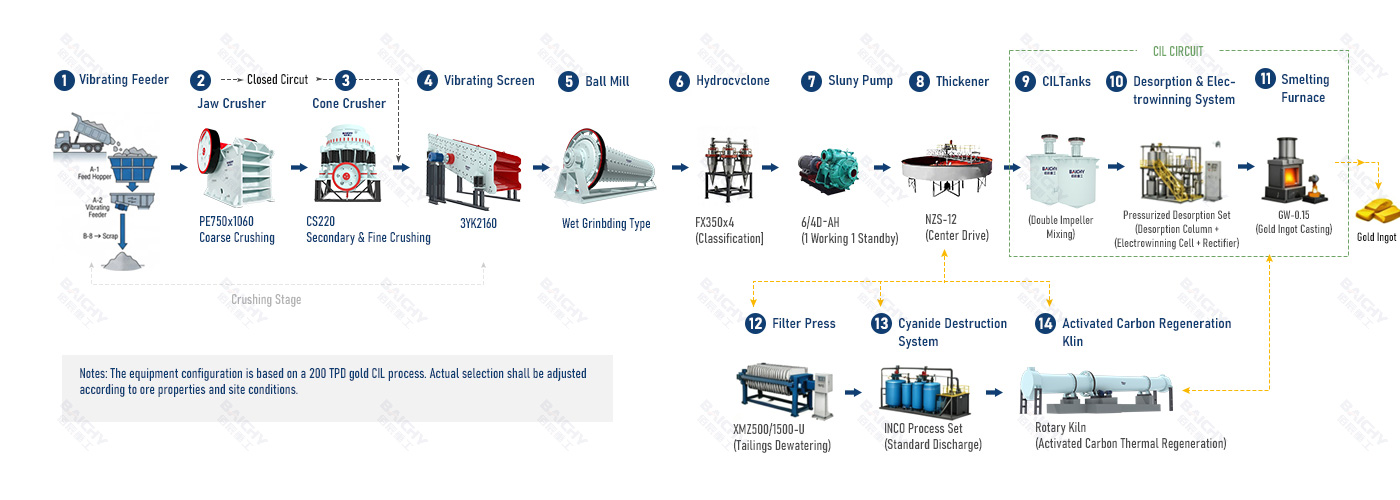
The gold ore processing production line has become the core competitiveness of modern gold mining development with its five major advantages: high recovery rate, automation, environmental protection, flexible adaptation, and economic benefits. Whether it is a large mine or a small and medium-sized concentrator, a scientifically designed production line can significantly increase gold production and reduce operational risks.
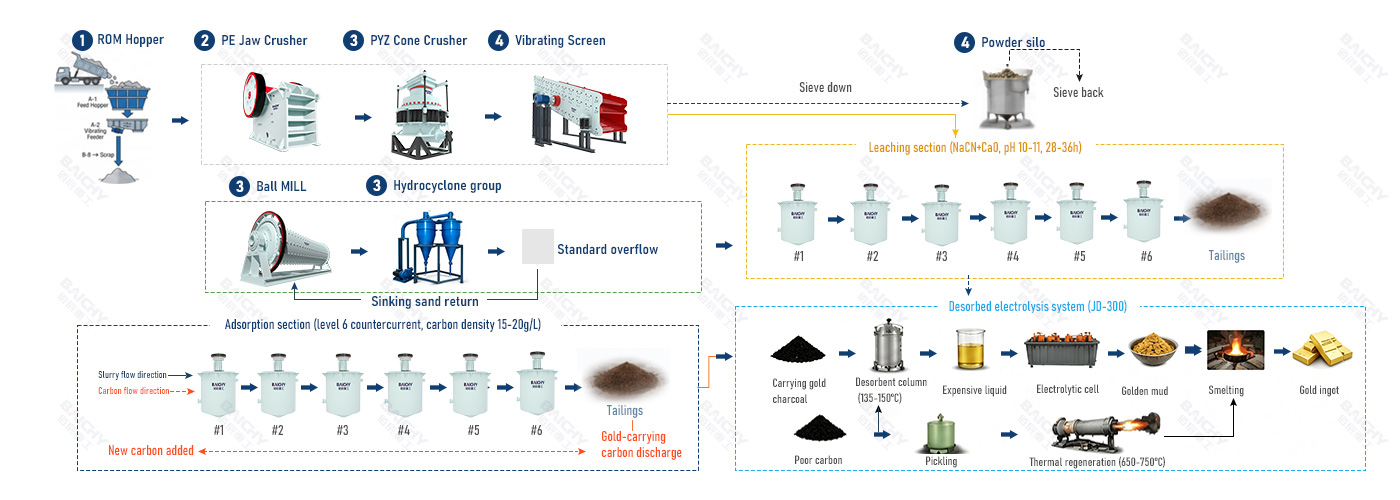
Gold ore CIP process (carbon leaching gold method) is a gold extraction process widely used in mineral processing plants. It involves dissolving gold from an ore or concentrate into a cyanide solution and then adsorbing the dissolved gold onto activated carbon.
Subsequently, the activated carbon is separated from the slurry and the gold is desorbed from the activated carbon for further processing.
Gold CIL process (carbon in leach) is an efficient method of extracting and recovering gold from its ore. By cyaniding and carbon leaching crushed gold ore slurry simultaneously, the CIL process lowers the gold mining operation cost and increases the gold recovery rate to 99%, which is the first choice of modern gold mining and gold beneficiation plants.
CIL mainly applies to the process of above 1g/t grade gold ore and gold ore with large bearing ore volume: silver, platinum, copper, etc. And CIL has a better performance in extracting these minerals at the same time.
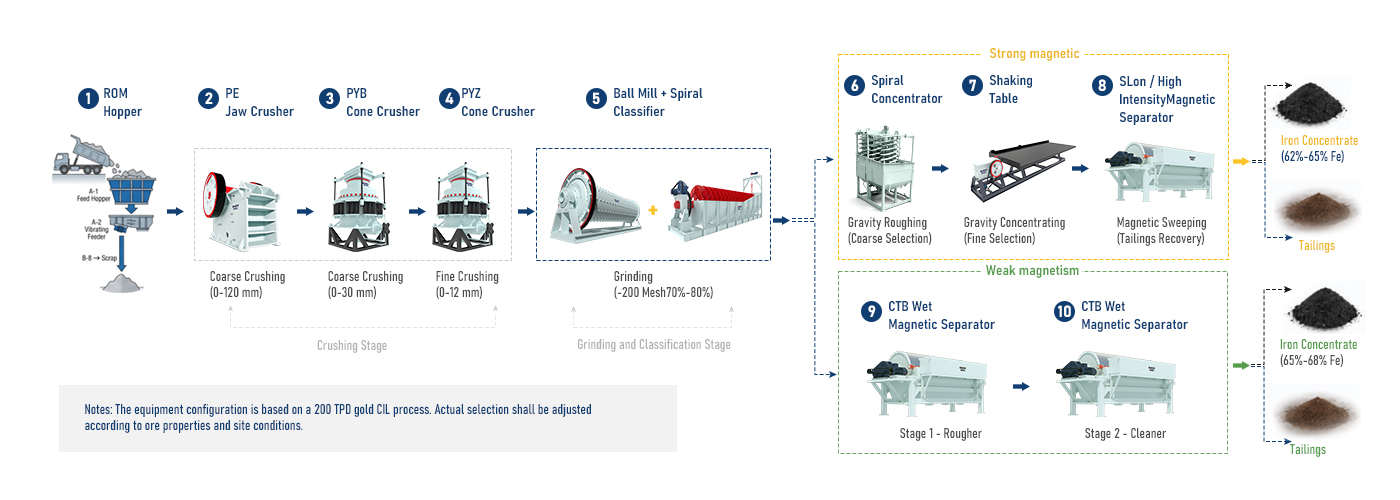
Magnetite is mostly granular aggregates with strong magnetism and wide distribution. According to the different types of iron-bearing minerals, magnetite can be divided into single magnetite ore and mixed magnetite ore, the magnetite iron ore beneficiation process is also different.
In general, single magnetite ore adopts a low-intensity magnetic separation method, and mixed magnetite ore adopts the combined process of multiple beneficiation methods, including magnetic separation, flotation separation, gravity separation, and so on.
The Hematite/Magnetite processing line adopts stage grinding and stage separation for high separation efficiency. The combination of strong magnetic separation and reverse flotation process ensures the concentrate grade and environmental protection.
Hematite/Magnetite separation process is suitable for complex structure hematite ore, such as hematite ore and impurities with uneven distribution of particle size, hematite ore with large content of fine particles, hematite ore with a small amount of magnetite, and the gangue minerals containing quartz or kaolin.
• Sulfide flotation can be added for oxidized ores
• Desliming process can be added for high-mud content ores
• Associated ores (copper-sulfur, copper-molybdenum, copper-iron) can be subjected to staged flotation or preferential/mixed flotation