
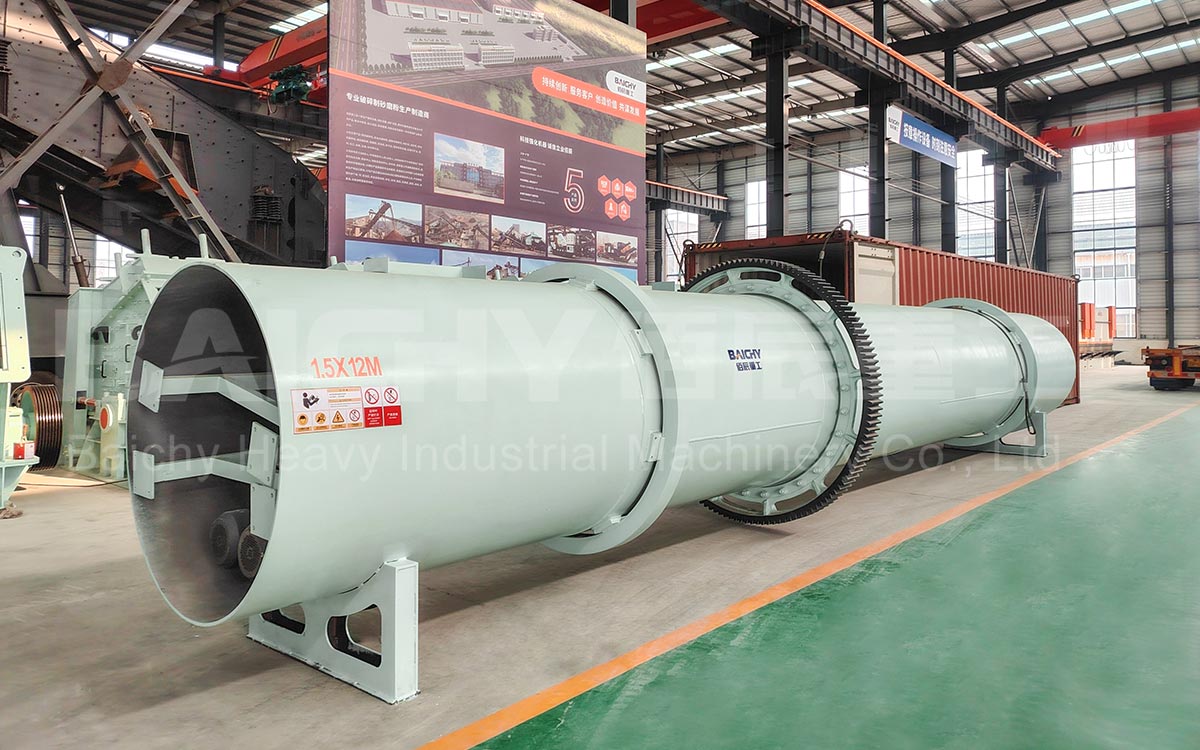
Iron Ore Rotary Dryer
1. Why South American Iron Ore Needs Drying — Three Unavoidable Realities
1.1 The Moisture Problem Is Built into the Beneficiation Circuit
Every tonne of iron ore concentrate that passes through wet magnetic separation (LIMS/WHIMS) or froth flotation exits the process at 8–18% moisture. Hematite from Brazil's Iron Quadrangle (Quadrilátero Ferrífero, Minas Gerais) typically lands at 10–14%. Magnetite from Chile's Atacama region and Peru's Marcona operations runs 8–12%. Limonite — common across the Amazon basin and Brazilian Pantanal fringes — carries 15–25% moisture, sometimes more, because its amorphous, porous structure traps water at the molecular level.
| Iron Ore Type | Typical Post-Beneficiation Moisture | Primary South American Region | Drying Challenge |
| Hematite (Fe₂O₃) | 10–14% | Minas Gerais (Brazil), Carajás (Pará) | Moderate — crystalline structure releases water predictably |
| Magnetite (Fe₃O₄) | 8–12% | Atacama (Chile), Marcona (Peru) | Low — dense, non-porous; drying is fast but requires fine-dust control |
| Limonite (Fe₂O₃·nH₂O) | 15–25% | Amazon basin fringes, central Brazil, Colombia | High — chemically bound water + physical moisture; sticky, lumps in drum |
1.2 Three Costs That Drying Eliminates
| Cost Category | Without Drying | With Drying (to <1% moisture) |
| Ocean freight penalty | ~500 tonnes water per 50,000-tonne shipment at 10% moisture → ~$15–25/tonne freight × 500 = $7,500–12,500 per shipment in wasted freight | Negligible |
| Pelletizing quality loss | Green-ball moisture variance >1.5% → drop strength <5 drops → fines generation + induration cracking | Green-ball moisture controlled to ±0.3% |
| Steel mill discount | Moisture >4% triggers price penalty (typically $2–5/tonne Fe); limonite with >6% moisture may be rejected outright | Full contract price; no quality deduction |
Bottom line: A φ2.4 × 18m rotary dryer processing 50 t/h of hematite concentrate pays back its capital cost in 12–18 months from freight savings alone — before counting the pelletizing yield improvement and steel mill premium recovery. For a 500,000 tpa operation, that's an annual freight cost reduction of $75,000–125,000.
1.3 South American Market Scale — Why Throughput Matters
Brazil produced approximately 410 million tonnes of iron ore in 2024, maintaining its position as the world's second-largest producer. Chile exported $1.31 billion in iron ore in 2025 Peru's Marcona mine alone ships over 10 million tonnes annually.
These are not 10,000-tonne-per-year artisanal operations. They are 500,000–50,000,000 tpa industrial complexes where a single dryer must handle 50, 100, or 200 tonnes per hour without breaking rhythm. Rotary drum dryers are the only single-machine drying technology that scales past 50 t/h without requiring parallel units — a point expanded in Section 3.
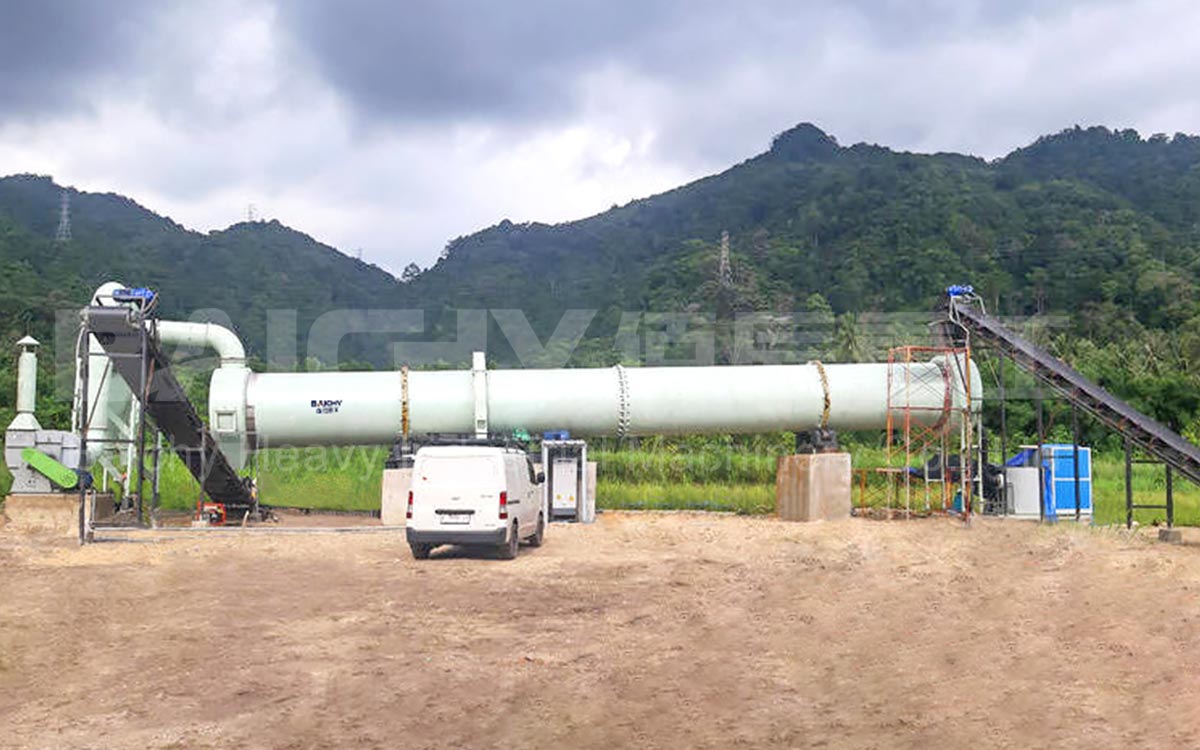
Iron Ore Rotary Dryer for Hematite
2. The Dryer That Handles All Four Ore Types — One Configuration, Field-Adjustable
2.1 Counter-Current: The Only Correct Choice for Iron Ore
Iron ore concentrates are not heat-sensitive. Hematite, magnetite, and limonite all tolerate continuous exposure to 600–800°C gas without chemical degradation (the lowest decomposition temperature among them is limonite, which begins losing chemically bound water at ~300°C — precisely what drying is designed to achieve).
Counter-current flow delivers 15–25% higher thermal efficiency than co-current because the driest, hottest material at the discharge end contacts the incoming high-temperature gas stream, extracting maximum residual moisture.
| Parameter | Co-Current | Counter-Current (Recommended) |
| Thermal efficiency | 55–65% | 65–80% |
| Exit material temperature | 60–80°C | 90–120°C |
| Fuel consumption (per tonne water evaporated) | 15–20% higher | Baseline |
| Iron ore suitability | ❌ Not recommended | ✅ Standard for all Fe ores |
2.2 By Ore Type: Flight Geometry & Drum Internals
| Ore Type | Feed Zone Design | Mid-Zone Flights | Discharge Zone | Special Consideration |
| Hematite | Standard L-type lifting flights | Curved parabolic — uniform curtain | Straight flights, low lift height | Predictable flow; no special internals needed |
| Magnetite | Standard L-type + reduced gas velocity (2–3 m/s) | Curved parabolic | Straight flights | Fine particle loss control: <0.5 mm magnetite fines entrained at >4 m/s gas velocity; cyclone + baghouse recovery essential |
| Limonite | Chain curtain zone + self-cleaning L-flights + back-mix with dried product (1:3 ratio) | Segmented, anti-stick coated flights | Straight flights | Sticky at 15%+ moisture; chain curtain breaks lumps; back-mixing coats wet feed surface with dry fines to prevent wall buildup |
| Mixed Ore / Variable Feed | Adjustable-speed screw feeder + VFD drum drive | Modular flight cassettes (swap in 4 hours) | Standard straight flights | Flexibility to handle campaign processing of different ore types |
Critical detail for limonite: Without a chain curtain in the first 2–3 meters of the feed zone, limonite at >18% moisture forms a rolling ball mass inside the drum that does not break into inpidual particles. The drum becomes a balling drum, not a dryer. Baichy's limonite package includes the chain zone as standard — not an option.
3. Core Technical Specifications — Iron Ore Rotary Dryer Models
3.1 Production Sizing Table (Wet Feed Basis)
| Model | Drum Dia. × Length | Wet Capacity (15%→<1% moisture) | Wet Capacity (22%→<1% moisture) | Motor Power | Floor Area (with furnace + dust collection) |
| φ1.5 × 12 m | 1.5 m × 12 m | 6–10 t/h | 4–7 t/h | 15 kW | ~120 m² |
| φ2.0 × 16 m | 2.0 m × 16 m | 18–30 t/h | 12–20 t/h | 22 kW | ~180 m² |
| φ2.4 × 18 m | 2.4 m × 18 m | 30–50 t/h | 22–35 t/h | 37 kW | ~240 m² |
| φ2.8 × 20 m | 2.8 m × 20 m | 50–80 t/h | 35–55 t/h | 55 kW | ~300 m² |
| φ3.0 × 22 m | 3.0 m × 22 m | 65–105 t/h | 45–70 t/h | 75 kW | ~360 m² |
| φ3.6 × 25 m | 3.6 m × 25 m | 110–200+ t/h | 75–130 t/h | 132 kW | ~460 m² |
Notes:
- Capacities based on iron ore concentrate (bulk density ~2.0–2.5 t/m³), counter-current operation, inlet gas temperature 600–700°C, ambient temperature 25°C
- Higher moisture feed requires longer residence time → lower throughput at same drum size
- Fine concentrates (<0.5 mm, typical for magnetite) reduce throughput by 10–15% due to gas velocity ceiling
- 60 Hz power supply: All motors available in 460 V / 60 Hz or 575 V / 60 Hz configurations for South American grid compatibility. No transformer required.
3.2 Key Operating Parameters
| Parameter | Range | Impact on Drying Quality |
| Drum rotation speed | 2–8 rpm (VFD adjustable) | Higher speed = denser material curtain = faster heat exchange; lower speed = longer residence time for high-moisture limonite |
| Drum inclination | 2–5° | Adjustable via trunnion base screws during commissioning |
| Inlet gas temperature | 500–800°C | 600–700°C is the sweet spot for iron ore; >800°C unnecessary and wastes fuel |
| Outlet gas temperature | 80–130°C | <80°C = condensation risk in baghouse; >130°C = excessive heat loss |
| Gas velocity inside drum | 2–4 m/s | ≤3 m/s for magnetite (<0.5 mm fines); ≤4 m/s for hematite (0.5–5 mm) |
| Residence time | 15–40 min | Limonite: 30–40 min (slow release); Magnetite: 15–25 min (fast, dense particle) |
| Final moisture | <1% (target 0.3–0.8%) | Pellet feed spec: ≤1%; direct reduction (DRI) feed spec: ≤0.5% |
4. Heat Source Selection — South America Reality Check
The single biggest operating-cost variable in iron ore drying is fuel. In South America, the decision tree is shaped less by preference and more by what is physically available within trucking distance.
4.1 Fuel Options Ranked by South American Applicability
| Heat Source | Fuel Cost per Tonne Water Evaporated (indicative) | Availability in South America | Best For |
| Natural gas burner | $4–8 | Chile (gas pipeline infrastructure), Argentina (Vaca Muerta), Peru (Camisea) | Operations with pipeline access; cleanest exhaust, no FGD required |
| Coal hot blast furnace | $3–6 | Brazil (domestic thermal coal + Colombian imports), Colombia | Remote mines where coal is cheaper than trucked gas; requires baghouse + optional FGD |
| Heavy oil / diesel | $8–15 | Universal — delivered by tanker truck to any mine site | Remote operations without coal or gas access; high operating cost limits large-scale use |
| Biomass (eucalyptus chips / bagasse) | $2–5 | Brazil (eucalyptus plantations near Minas Gerais operations; sugarcane bagasse) | Carbon-neutral positioning; eucalyptus is abundant and low-cost in Brazil's mining regions |
| Electrical | $12–20 | Grid-connected sites | Not recommended for primary drying — electricity cost in South America ($0.08–0.18/kWh industrial rate) makes it uneconomical for evaporation loads above 1 t/h |
4.2 Real-World Decision Flow for Brazilian Operations
1. On the Carajás railway corridor? → Natural gas priority (pipeline proximity); check gas supply contract before sizing dryer
2. In Minas Gerais, 200 km from the nearest gas trunk line? → Coal or eucalyptus biomass — cost-per-GJ comparison using delivered price to mine gate
3. In the Atacama (Chile) with solar irradiance of 2,500+ kWh/m²/year? → Hybrid gas + solar thermal preheating can reduce gas consumption by 15–20% (Baichy integrates with solar thermal collectors on request)
4. Remote Peru/Colombia site with no infrastructure? → Diesel for commissioning, then switch to coal or biomass for steady-state operation
Baichy does not lock you into a heat source. The furnace/burner is selected during quotation based on your mine gate energy prices and the local environmental permit requirements. The dryer drum, drive system, and dust collection are standardized — the heat source is custom.
5. Total Cost of Ownership — What 15 Years of Operation Really Costs
A dryer purchase is a 1-time capex decision. The decision that compounds over 15 years is fuel, electricity, labor, and maintenance.
5.1 TCO Comparison: φ2.8 × 20m Rotary Dryer vs. Fluidized Bed (50 t/h Hematite Concentrate, Natural Gas)
| Cost Category | Rotary Drum (φ2.8 × 20m, single unit) | Fluidized Bed (2 × 25 t/h parallel) | Delta (Rotary Advantage) |
| Equipment purchase | $180,000–260,000 | $200,000–280,000 | ±$20,000 |
| Installation & commissioning | $50,000–80,000 | $70,000–100,000 | -$20,000 |
| Annual fuel (gas, 7,200 hrs/yr) | $220,000–350,000 | $270,000–400,000 | -$50,000/yr |
| Annual electricity | $28,000–45,000 | $42,000–65,000 | -$14,000/yr |
| Operators per shift | 1 | 2–3 | -$20,000–40,000/yr |
| Annual wear parts | $8,000–18,000 | $15,000–30,000 | -$7,000/yr |
| Annual planned downtime | 3–5 days | 8–12 days | +4–7 operating days/yr |
| Design service life | 25+ years (Q245R shell) | 10–15 years (grid/fan replacement cycle) | 2× lifespan |
| 15-Year TCO (undiscounted) | $3.9M–5.8M | $5.3M–7.5M | 25–30% lower |
5.2 Where the Savings Come From
- Fuel efficiency: Counter-current rotary drum (65–80% thermal efficiency) vs. fluidized bed (50–70%). At 50 t/h and 7,200 operating hours/year, 10 percentage points of efficiency is real money.
- Labor: One operator per shift monitors drum speed, gas temperature, and moisture at discharge. A fluidized bed requires constant air-flow balancing across multiple chambers.
- Maintenance simplicity: No fluidizing grids to descale. No multi-chamber pressure balancing. The maintenance checklist fits on one page (see FAQ 5).
6. Emissions Compliance — Built for South American Standards
| Component | Function | Efficiency | Output Concentration |
| Cyclone dust collector | Coarse particle capture (>10 µm) | ≥90% | 1–5 g/Nm³ |
| Pulse-jet baghouse filter | Fine particulate capture (<10 µm) | ≥99% | <50 mg/Nm³ |
| Wet scrubber (optional) | Ultra-fine particulate + SO₂ removal | ≥95% | <30 mg/Nm³ |
| FGD system (optional, coal-fired only) | SO₂ removal | ≥90% | Compliant with CONAMA (Brazil) and DS 138 (Chile) limits |
- Brazil CONAMA 436/2011: Stack emission limit for particulate matter is 50–100 mg/Nm³ depending on source category. Baghouse-only configuration meets this.
- Chile DS 138: Industrial particulate limit for new sources is 30 mg/Nm³. Baghouse + wet scrubber recommended.
- Peru Supreme Decree 003-2017-MINAM: Particulate limit 50 mg/Nm³ for mining operations. Standard baghouse configuration sufficient.
Baichy quotes the emissions-control package based on the mine's specific permit conditions — no over-selling unnecessary equipment.
7. Frequently Asked Questions
Q1: Which dryer size do I need for 50 tonnes per hour of hematite concentrate at 12% initial moisture?
For hematite concentrate at 12% initial moisture → <1% final moisture, with a wet feed of 50 t/h, the required evaporation rate is approximately 5.5 t/h of water. A φ2.4 × 18m or φ2.8 × 20m model handles this comfortably. φ2.4 × 18m is the standard recommendation; φ2.8 × 20m provides headroom if moisture occasionally spikes to 15%. Final sizing depends on particle size distribution — send a 5–10 kg sample for a definitive drying curve.
Q2: Can the same dryer handle hematite one month and limonite the next?
Yes — with the modular flight cassette design. Standard hematite flights (curved parabolic, 18 flights around circumference) can be swapped to the limonite package (L-type + segmented anti-stick + chain curtain) within one 8-hour maintenance shift. The VFD drive allows drum speed to be adjusted for the different residence-time requirements (15–25 min for hematite, 30–40 min for limonite) without mechanical changes.
Q3: What is the fuel consumption per tonne of dried iron ore?
For hematite concentrate (12% → <1% moisture) in a φ2.8 × 20m drum, natural gas consumption is approximately 8–12 Nm³ per tonne of dried product, equivalent to $1.6–3.0/tonne at typical South American industrial gas prices. Coal consumption is approximately 16–22 kg per tonne of dried product. Limonite at 20% initial moisture roughly doubles the per-tonne fuel figure — this is the single biggest reason to dewater limonite mechanically (filter press or vacuum disc filter) before the dryer.
Q4: Our mine is at 3,800 meters in the Peruvian Andes. Does altitude affect dryer performance?
Yes — in two ways. First, reduced air density at high altitude reduces the combustion air mass flow for a given fan size; the burner and forced-draft fan must be sized for site elevation, not sea-level standard conditions. Second, the lower atmospheric pressure reduces the gas density inside the drum, which reduces convective heat transfer by 5–12% at 3,800 m compared to sea level. Baichy compensates by upsizing the drum by one diameter increment or increasing inlet gas temperature by 50–100°C. Specify site elevation at the quotation stage — this is not an afterthought.
Q5: What maintenance does the dryer require?
Weekly: inspect riding ring contact surfaces and grease trunnion roller bearings. Monthly: check trunnion wheel alignment (laser alignment tool) and labyrinth seal integrity at feed and discharge ends. Annually: replace wear liners in the feed zone (high-abrasion area); inspect and clean baghouse filter bags; check VFD and motor insulation resistance. The drum shell (Q245R boiler-grade steel, 12–22 mm thick) has a design life exceeding 25 years and does not require replacement under normal operation. Full annual shutdown: 3–5 days.
Q6: Can you deliver and commission in South America?
Yes. Baichy has delivered rotary drying systems to mining operations in Brazil, Chile, and Peru. Equipment ships from Shanghai or Tianjin in standard 40-foot open-top or flat-rack containers (drum sections bolt together on site). Typical ocean freight transit to Santos (Brazil), San Antonio (Chile), or Callao (Peru) is 35–45 days. Baichy provides on-site supervision for mechanical installation, alignment, electrical commissioning, and operator training — typically 2 engineers for 3–4 weeks.
8. Next Step: Get a Site-Specific Proposal
Every iron ore dryer Baichy builds starts with your data — not a catalog page.
Send these five data points to receive a customized technical proposal within 3 working days:
1. Ore type and source (hematite / magnetite / limonite / mixed; mine location)
2. Current moisture content (lab-measured, not estimated)
3. Target moisture content (pellet feed: ≤1%; DRI feed: ≤0.5%; other: specify)
4. Required throughput (tonnes per hour, wet basis)
5. Available heat source and delivered price (natural gas $/MMBtu, coal $/tonne mine gate, diesel $/liter, biomass type and $/tonne)
Optional but recommended: Ship a 5–10 kg representative sample to Baichy's pilot test facility. We run a full drying curve under your target conditions and return the results — moisture vs. residence time, optimal gas temperature, and finalized drum specification — within 5 working days of receipt. The test is free.