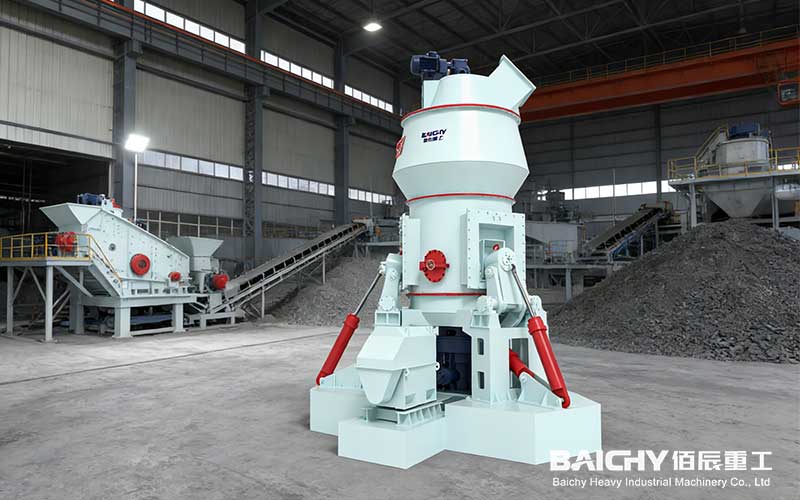
Vertical roller mill
The Ultra-fine Vertical Roller Mill is the preferred core equipment for achieving a production output of 5 tons per hour and a fineness of 1250 mesh, while simultaneously ensuring high energy efficiency. For non-metallic minerals with relatively low Mohs hardness (Grades 1–4)—specifically calcium carbonate, dolomite, and kaolin—pulverizing them to 1250 mesh (i.e., D97 ≤ 10 μm, corresponding to a particle size of approximately 1.4–5 microns) falls squarely within the realm of ultra-fine powder processing. To achieve a stable production capacity of 5 tons per hour, it is imperative to employ a large-scale vertical milling system that integrates grinding, drying, and classification functions, and is equipped with a high-precision turbine classifier—rather than relying on traditional Raymond mills or small-scale ring-roller mills.
The physicochemical properties of the target materials dictate the selection of the pre-treatment process and the materials used for the grinding rollers. Calcium carbonate (calcite) and kaolin often contain a certain amount of moisture; therefore, their moisture content must be controlled prior to entering the mill, or they must be processed using the drying airflow (supplied by a hot air furnace) inherent to the vertical mill system. Dolomite, being slightly harder, imposes more stringent requirements on the wear-resistant layers of the grinding rollers and grinding table. To ensure a stable throughput for the main mill, the feed material must undergo pre-treatment to achieve a uniform particle size of <10 mm (ideally <5 mm).
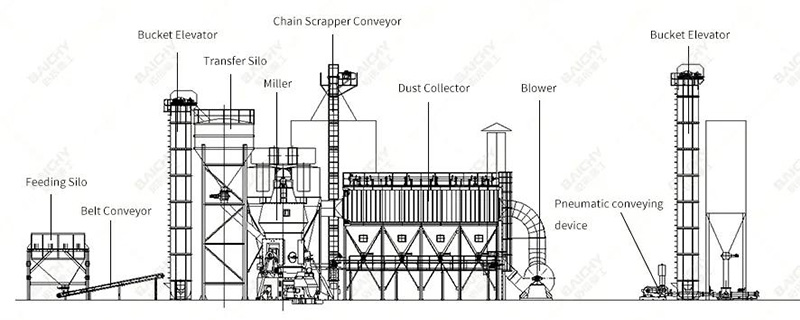
Schematic Diagram of the Process Flow for a Vertical Grinding
System power consumption and the consumption of wear parts (a characteristic feature of such high-intensity operations) constitute the core elements of operational cost control. In the ultra-fine processing range of 1250 mesh, the specific energy consumption per unit of product is significantly higher than that for coarse powder processing. Taking a 5-ton/hour vertical milling system as an example: the main mill motor typically requires 250–315 kW; when combined with the power requirements for the fan, classifier, and auxiliary equipment, the total installed capacity of the system ranges from approximately 350 to 450 kW, resulting in a specific energy consumption of roughly 70–90 kWh per ton. Although the wear parts—specifically the grinding roller sleeves and grinding table liners—are fabricated from high-chromium alloys or ceramic composite materials, the high-load operating environment necessitates their regular maintenance and replacement.
Key process parameters must strictly adhere to established particle size analysis standards to ensure product consistency and uniformity. The specific particle size corresponding to a fineness of 1250 mesh must be explicitly defined as D97 ≤ 10 μm or D50 ≈ 1.4–2 μm. It is recommended to conduct online or laboratory testing—in accordance with ISO 9276 (Representation of Results of Particle Size Analysis) or GB/T 19077 (Particle Size Analysis by Laser Diffraction)—to prevent "mislabeling of mesh counts." The classifier speed typically requires adjustment to 10,000–14,000 rpm to achieve precise particle size separation at this level of fineness.
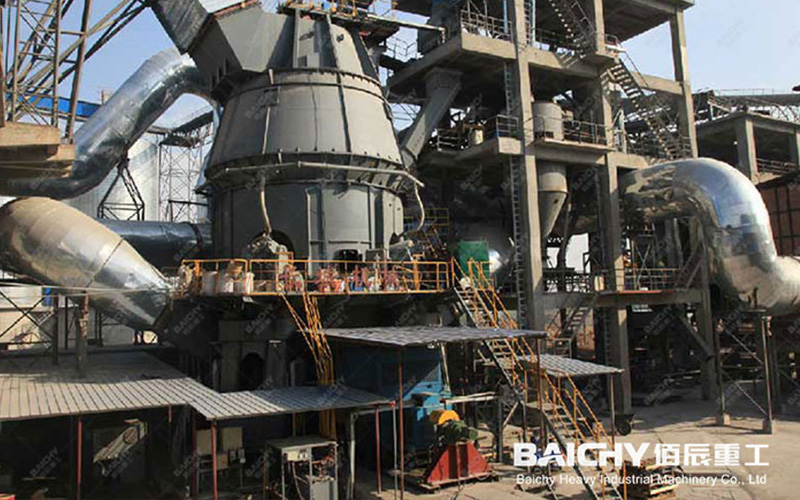
Vertical Roller Mill Grinding Site
The recommended configuration for a typical 5-ton/hour vertical grinding mill system is outlined in the table below:
| System Unit | Key Configuration & Parameters | Remarks |
| Main Equipment | Ultrafine Vertical Mill (e.g., Model LUM1125/DSM1100); Grinding Table Diameter: 1100–1250 mm; 3–4 Grinding Rollers | Hydraulic Pressurization System; Adjustable Pressure |
| Classification System | Multi-head (5-head) or Combined Dynamic-Static Turbine Classifier; Power: 5 × 15 kW or >75 kW; Variable Frequency Speed Control | Ensures D97 ≤ 5–10 μm |
| Feed Pre-treatment | Jaw Crusher + Hammer/Cone Crusher (Output Size: <10 mm) | Vibrating Feeder; Ensures Uniform Feeding |
| Drying Heat Source | Fluidized Bed Furnace or Waste Heat Utilization (for Kaolin/Wet Ores); Air Inlet Temperature to Mill: ≤200°C | Controls Finished Product Moisture Content to <0.5% |
| Collection System | Pulse Bag Filter (Filtration Precision: ≤0.1 μm; Dust Collection Efficiency: ≥99.5%) | Meets Environmental Standards and Ensures Effective Capture of Ultrafine Powders |
| Expected Performance Metrics | Throughput: 4–6 t/h @ 1250 Mesh; System Power Consumption: 70–90 kWh/t | Varies depending on Material Hardness and Moisture Content |
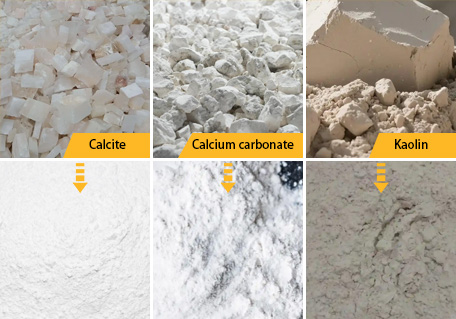
Calcite, calcium carbonate, kaolin Grinding
For kaolin processing, particular attention must be paid to the delamination effect and product purity to avoid contamination caused by over-grinding. When kaolin is processed for use as a paper-coating grade material, in addition to fineness, particular attention must be paid to its aspect ratio (the ratio of particle diameter to thickness). The shearing action provided by a vertical roller mill is superior to that of a purely compressive mill; if necessary, a delaminator can be installed in series to further enhance this effect.
The primary difference in processing dolomite versus calcium carbonate lies in their respective Mohs hardness values and the required grinding pressure settings. Dolomite (Mohs hardness 3.5–4) requires significantly higher grinding pressure than calcium carbonate (Mohs hardness 3); however, care must be taken to prevent excessive machine vibration. Vertical roller mills address this by utilizing a hydraulic system that allows for stepless pressure adjustment (e.g., 8–15 MPa), enabling the mill to be seamlessly adapted for the production of either material.
About of Baichy Heavy Industry
Baichy Heavy Industry is a high-tech mining equipment company integrating R&D, manufacturing, sales, and after-sales service. Focusing on crushing, grinding, and mineral processing equipment, we provide professional solutions to our customers. We are ISO9001:2015 、certified, and our products include mobile crushing palnts, crawler crushing plant, construction waste crushing plants, jaw crushers, sand making machines, cone crushers, fine crushers, grinding mills, ball mills, etc., all with reliable performance to meet diverse project needs.
Our advantages:
• Professional pre-sales support: Free project design and comprehensive solutions to help you accurately select the right equipment;
• Comprehensive on-site service: Providing installation guidance and worker training to ensure smooth equipment commissioning;
• Reliable after-sales guarantee: A complete after-sales system, timely response to technical inquiries and equipment maintenance, ensuring long-term stable operation.
To protect your rights, please contact us through the following official channels for professional service:
Official Website Customer Service
https://wa.me/+8615093222637
Email: [email protected]
We are committed to providing high-quality equipment and full-cycle services to deliver comprehensive intelligent solutions for the global mining industry!
Frequently Asked Questions (FAQ)
1. Q: I need to grind 5 tons of calcium carbonate per hour to a fineness of 1250 mesh (5 microns). Can I use a Raymond mill?
A: No, you cannot. Traditional Raymond mills (pendulum mills) are typically only capable of stable production up to 400 mesh. Even if a classifier is added, the output volume drops drastically—often to just a few hundred kilograms per hour—making it impossible to meet a high-output requirement of 5 tons per hour. Furthermore, their power consumption is extremely high. You must instead select an ultrafine vertical roller mill or a large-scale ring-roller/ball mill system equipped with a classifier.
2. Q: Does "1250 mesh" actually correspond to 5 microns or 10 microns? And where does the range of 1.4–5 microns you mentioned come from?
A: Mesh count and microns (μm) have an inverse relationship. "1250 mesh" typically refers to material capable of passing through a 1250-mesh sieve; the corresponding D97 value (meaning 97% of the particles are smaller than this size) is generally around 10 microns. Conversely, the range of 1.4–5 microns typically refers to the D50 value (the median diameter, meaning half of the particles are smaller than this size) or a stricter, narrower range for the D97 value. In the high-end powder processing industry, a specification of "1250 mesh" often implies a requirement of D97 ≤ 5 μm—or even D50 ≈ 1.4 μm. The exact particle size distribution must be determined using a laser particle size analyzer in accordance with the ISO 9276 standard.
3. Q: If I use the same vertical roller mill to process both kaolin and calcium carbonate, will the production output change?
A: Yes, it will change. Kaolin has a relatively low bulk density and a layered structure; therefore, at the same power output, its production yield may be slightly higher than that of calcium carbonate. However, if the kaolin contains crystalline water and requires drying, a portion of the hot air energy will be consumed for this purpose. Dolomite, due to its slightly higher hardness, may yield 10%–15% less than calcium carbonate at the same fineness. The advantage of the vertical roller mill lies in its ability to quickly adapt to these various materials by adjusting the airflow and grinding pressure.
4. Q: For a production line processing 5 tons per hour at 1250 mesh, approximately how many kilowatt-hours (kWh) of electricity are consumed per ton? Is this considered "high efficiency"?
A: When utilizing a modern ultrafine vertical roller mill system, the specific energy consumption is approximately 70–90 kWh per ton. Compared to older systems involving ball mills combined with classifiers (which consume about 120–160 kWh/ton) or vibrating mills, the vertical roller mill is currently recognized by the industry as a "high-efficiency," low-energy-consumption solution, offering electricity savings of 20%–30% compared to traditional processes.
5. Q: How long do the wear parts (grinding rollers and grinding table) typically last? Is the replacement cost high?
A: Under continuous, heavy-load operation at 5 tons per hour, high-chromium alloy wear parts generally have a service life of 8,000 to 12,000 hours (approximately 1 to 1.5 years). Although the initial "consumption" cost may appear high, when amortized over the total volume of processed powder, the cost of wear parts amounts to approximately 0.8–1.5 RMB per ton—a figure well within a controllable and reasonable range. Opting for composite ceramic roller sleeves can further extend the service life, though this entails a higher initial investment.
6. Q: If I wish to increase the production output to 10 tons per hour at a later stage, can the existing equipment directly accommodate this expansion?
A: We do not recommend operating a single piece of equipment under a sustained overload for extended periods. For a target output of 5 tons per hour, we recommend selecting a model such as the LUM1125 or DSM1100. However, to achieve a stable output of 10 tons per hour, you should directly select a larger mill model (such as the LUM1436 or DSM1250/1700); these models offer a production capacity of 9–14 tons per hour at 1250 mesh, thereby providing a more reasonable operational margin.
7. Q: What are the requirements regarding factory building height and foundation specifications for this system?
Answer: The height of the main ultrafine vertical mill unit typically ranges from 5 to 7 meters. When accounting for the classifier and associated piping, we recommend a minimum plant ceiling height of 9 to 11 meters. The foundation requires vibration-damping treatment, as the combined weight of the mill and its substantial grinding pressure (totaling tens of tons) necessitates the use of embedded concrete anchors for secure fixation.
8. Question: Does the system meet environmental protection standards? How is dust controlled?
Answer: The system operates under negative pressure and utilizes fully enclosed piping. The exhaust end is equipped with a pulse-jet bag filter (featuring a filtration precision of 0.1 microns), allowing the emission concentration to be controlled to <10 mg/m³. This complies with the environmental protection standards of most countries (e.g., the Chinese National Standard GB 4915).