+86-15093222637
Contact us for a quote and free process design
Baichy know what you are expecting from mining project and we are making it happen with unrivalled products and services.
Leave Message


The CTB series wet permanent-magnetic drum separator is the most widely used wet, low-intensity magnetic separation equipment in iron ore processing plants, representing the most cost-effective industrial solution for magnetite roughing and cleaning stages.
☛ Contact Us Now To Get A Customized Production Line Configuration Plan.
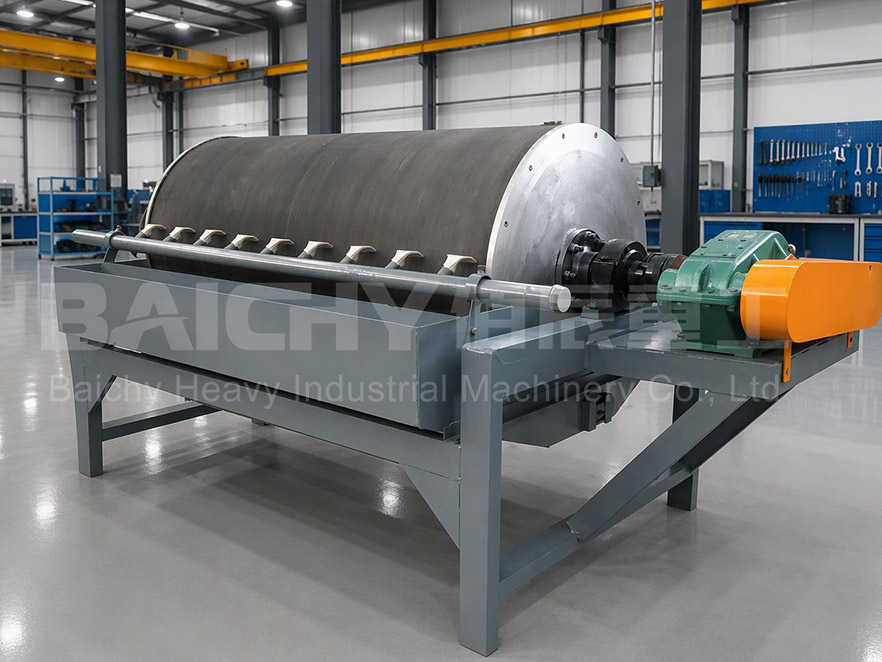
The wet magnetic separator is a core separation unit in iron ore beneficiation processes. It utilizes a constant magnetic field generated by permanent magnets to capture and separate strongly magnetic minerals (such as magnetite, titanomagnetite, and pyrrhotite) from the slurry within an aqueous medium, while simultaneously discharging non-magnetic gangue.
Baichy’s CTB series employs NdFeB (Neodymium-Iron-Boron) rare-earth permanent magnet materials as the magnetic source; this design features a short magnetic circuit and minimal magnetic flux leakage, resulting in high magnetic field strength at the drum surface. The equipment requires neither electromagnetic coils nor rectifier power supplies; once operational, it needs only a low-power gear motor to drive the drum rotation, resulting in significantly lower energy consumption compared to electromagnetic separators of the same processing capacity.
Unlike dry magnetic separators, wet separators utilize water as the medium. As the slurry passes through the tank, particles become fully dispersed, leading to a recovery rate for fine-grained magnetic minerals (≤0.15 mm) that is significantly superior to that of dry separation. For processing plants requiring subsequent ball milling or flotation stages, wet magnetic separators can be seamlessly integrated into the wet processing workflow without the need for additional drying steps.
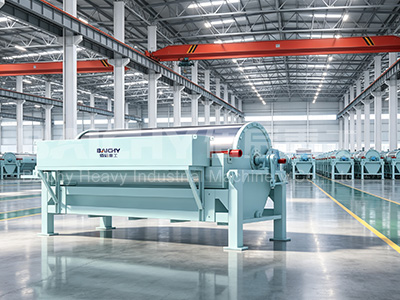
Wet Magnetic Separator
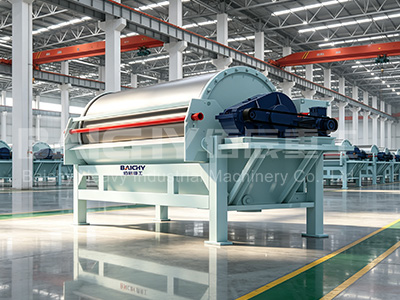
CTB Permanent Magnet Drum Separator
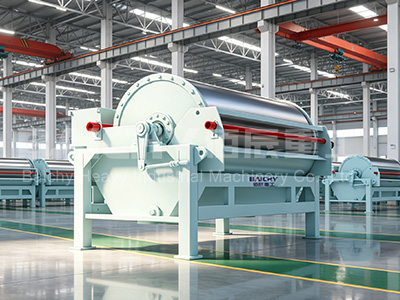
Iron Ore Magnetic Separator
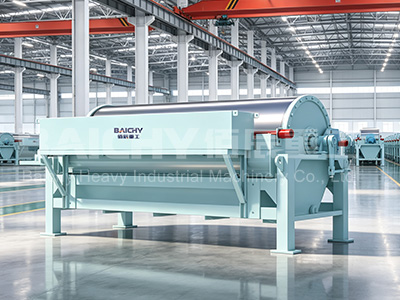
Magnetic Separator - Complete Conveyor Solutions
| Ore Type | Magnetic Characteristics | CTB Applicable Stage |
| Magnetite (Fe₃O₄) | Strongly magnetic; specific magnetic susceptibility ≥ 38×10⁻⁶ m³/kg | Full process: roughing / cleaning / scavenging |
| Titanomagnetite | Strongly magnetic; contains TiO₂ + V₂O₅ | Stage 1: roughing/tailings rejection; Stage 2: cleaning/grade upgrading |
| Pyrrhotite | Moderately strong magnetism | Combined with flotation to recover iron sulfides |
| Martite | Moderately weak magnetism; requires high-intensity magnetic separation | Beyond CTB capability; requires high-intensity magnetic separator |
• Quartz sand purification: Removes mechanical iron and weakly magnetic iron minerals introduced during crushing, providing qualified raw material for photovoltaic glass sand and high-purity quartz.
• Feldspar Iron Removal: Reduces Fe₂O₃ content and enhances the whiteness of ceramic-grade feldspar.
• Fluorite/Barite Iron Removal: Preserves the efficiency of downstream flotation reagents and improves concentrate grade.
• Coal Preparation Plant Heavy Medium Recovery: The CTB concurrent-flow tank magnetic separator is suitable for recovering magnetite powder heavy medium (-325 mesh); recovery rate ≥ 99.5%, with medium consumption controlled within 0.5–1.0 kg per tonne of coal.
• Mineral Processing Heavy Medium Recovery: Used in the closed-loop separation and recovery circuit for ferrosilicon/magnetite suspensions.
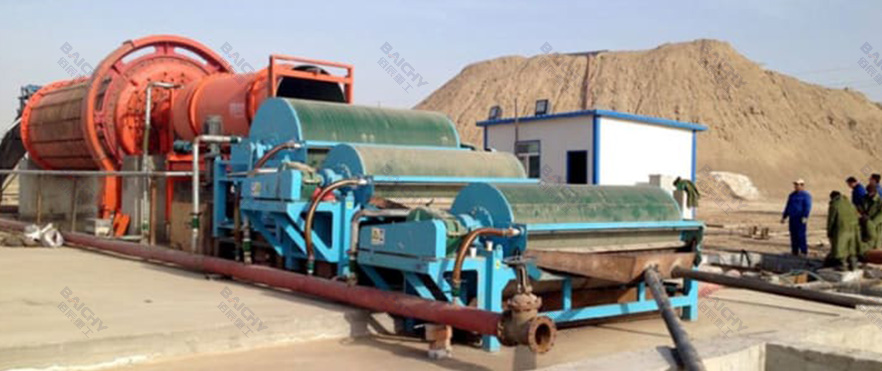
Radial magnetic system configuration; 4–6 poles; magnetic wrap angle of 106°–135°.
Alternating N-S permanent magnet arrangement; magnetic field strength remains ≥ 800 Oe at a distance of 50 mm from the drum surface.
All-permanent-magnet system; eliminates the need for rectifiers, excitation cabinets, or backup power supplies.
Slurry concentration of 25%–35%; turbulent flushing within the tank body.
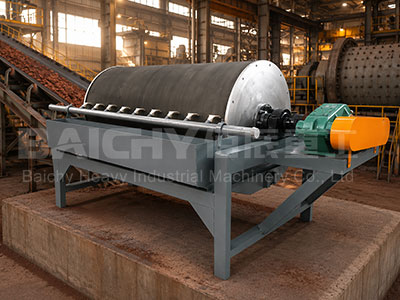
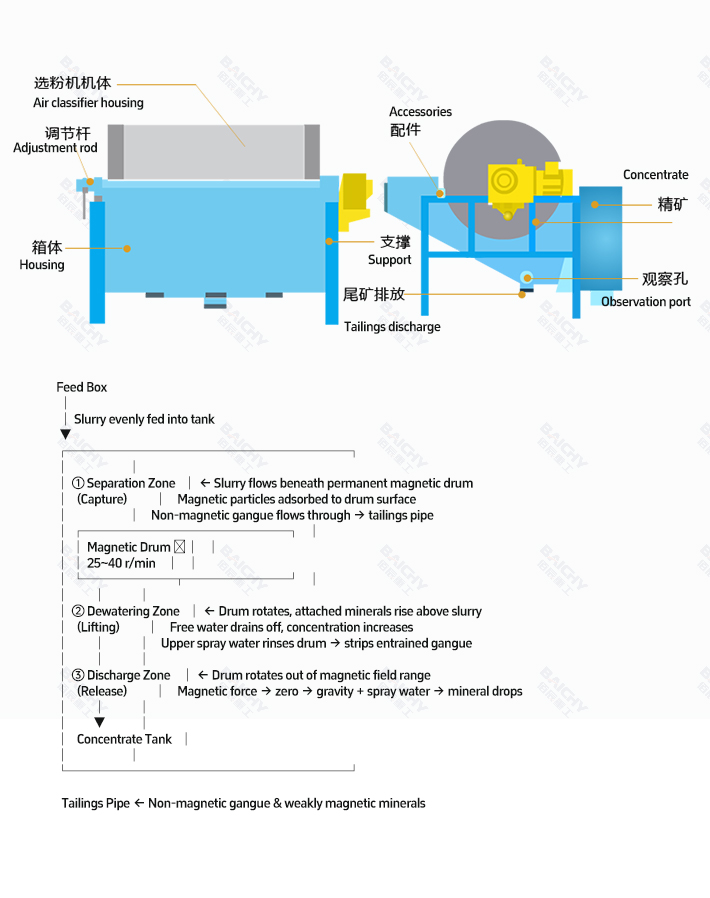
The magnetic separation process is continuous but can be physically pided into four stages:
• Slurry flows through the magnetic field zone beneath the drum at a concentration of 25%–35% and in a laminar or weakly turbulent flow state.
• Permanent magnets generate a field strength of 1450–1650 Oe on the drum surface, with magnetic flux lines penetrating the slurry.
• Strongly magnetic particles (specific magnetic susceptibility ≥ 38×10⁻⁶ m³/kg) become instantly magnetized in the field; the magnetic force gradient pulls them toward the drum surface, where they are captured.
• Non-magnetic gangue is unaffected by magnetic forces; it continues to flow with the water, passes through the magnetic field zone, and discharges via the tailings overflow outlet.
• The captured magnetic minerals rotate with the drum (counter-clockwise or clockwise), gradually emerging from the slurry pool.
• Under the influence of gravity, most of the free water entrained on the mineral surface drains back into the tank.
• Low-pressure water sprayed from a pipe above the drum washes the surface of the mineral layer, dislodging mechanically entrapped non-magnetic fine slimes—a critical step for upgrading the concentrate.
• As the drum continues to rotate, the magnetic mineral layer enters the edge or "dead zone" of the magnetic system, where the magnetic force rapidly drops to zero.
• No longer held by magnetic force, the minerals detach from the drum surface under the combined action of gravity and wash water, falling into the concentrate collection trough.
• A scraper or discharge roller at the bottom of the drum assists in removing any small amount of residual minerals.
• Once the drum surface is clean, it continues to rotate back to the separation zone to begin the next cycle.
• The entire process operates continuously: ore feeding, separation, and discharge occur simultaneously without interruption.

| Model | Drum Dia.(mm) | Drum Length(mm) | Rotating Speed(r/min) | Feeding Size(mm) | Capacity(t/h) | Motor(kw) |
| CTB6012 | 600 | 1200 | <35 | 2-0 | 10-20 | 1.5 |
| CTB6018 | 600 | 1800 | <35 | 2-0 | 15-30 | 2.2 |
| CTB7518 | 750 | 1800 | <35 | 2-0 | 20-45 | 2.2 |
| CTB9018 | 900 | 1800 | <35 | 3-0 | 40-60 | 3 |
| CTB9021 | 900 | 2100 | <35 | 3-0 | 45-60 | 3 |
| CTB9024 | 900 | 2400 | <28 | 3-0 | 45-70 | 4 |
| CTB1018 | 1050 | 1800 | <20 | 3-0 | 50-75 | 5.5 |
| CTB1021 | 1050 | 2100 | <20 | 3-0 | 50-100 | 5.5 |
| CTB1024 | 1050 | 2400 | <20 | 3-0 | 60-120 | 5.5 |
| CTB1218 | 1200 | 1800 | <18 | 3-0 | 80-140 | 5.5 |
| CTB1224 | 1200 | 2400 | <18 | 3-0 | 85-180 | 7.5 |
| CTB1230 | 1200 | 3000 | <18 | 3-0 | 100-180 | 7.5 |
| CTB1530 | 1500 | 3000 | <14 | 3-0 | 170-280 | 11 |
If you need further information,please fill in your questions and comments in the form below.
Representatives from Baichy machinery will be back to you within the hour,thanking you for your support to Baichy machinery