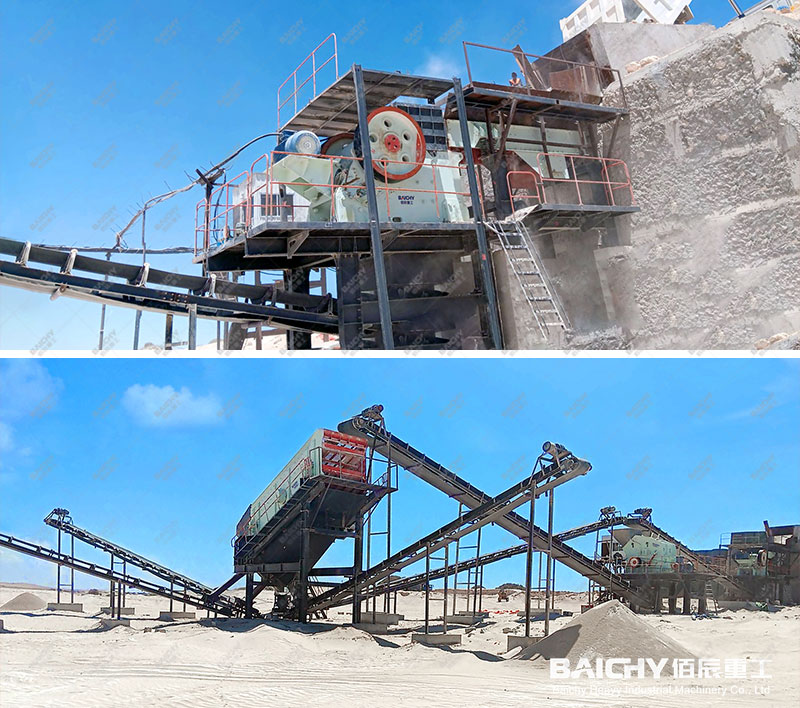
Stationary Crushing Production Line with Jaw Crusher
The jaw crusher is the primary choice for the first stage of rock crushing operations: it features a simple structure, high impact resistance, and versatility regarding material hardness, while offering significantly lower initial investment and operating/maintenance costs compared to cone crushers or impact crushers of similar capacity. For quarries, manufactured sand plants, and mines, selecting the right jaw crusher model directly determines the production line's maximum capacity and the cost per ton of crushed material—which is the core issue addressed in this article.
I. Pain Point Analysis: Why is Rock Crushing Challenging?
The primary hurdles in crushing rock materials are "hardness" and "abrasiveness":
| Material Type | Mohs Hardness | Abrasiveness | Typical Uses |
| Granite | 7–8 | High | Manufactured sand, railway ballast |
| Basalt | 7–8 | High | Highway aggregate, airport runways |
| Limestone | 3–4 | Low | Cement raw material, construction aggregate |
| Diabase | 7 | Medium-High | High-grade concrete aggregate |
Granite and basalt are hard and highly abrasive; under these conditions, the service life of blow bars in standard hammer crushers or impact crushers is drastically reduced. Furthermore, run-of-mine ore from open-pit operations often comes in chunks measuring 600–900 mm—sizes that standard equipment feed openings simply cannot accommodate. Additionally, quarries typically operate on continuous two- or three-shift schedules; every hour of equipment downtime results in a direct loss of thousands of yuan in production capacity. Jaw crushers were designed specifically to address these pain points.
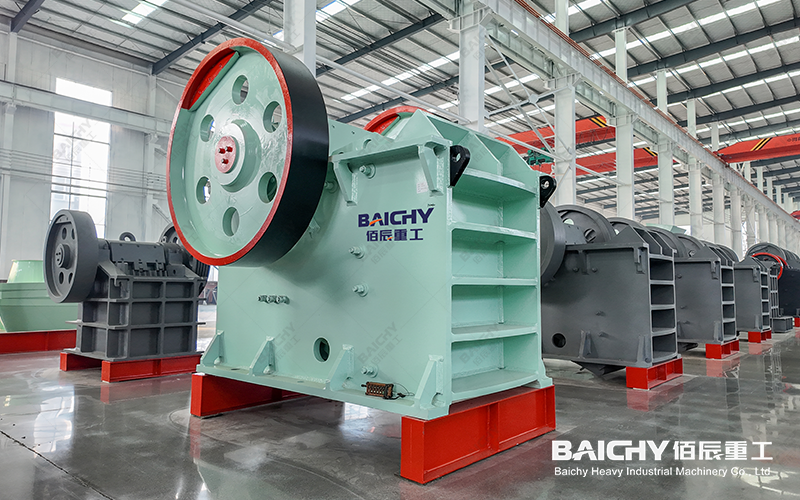
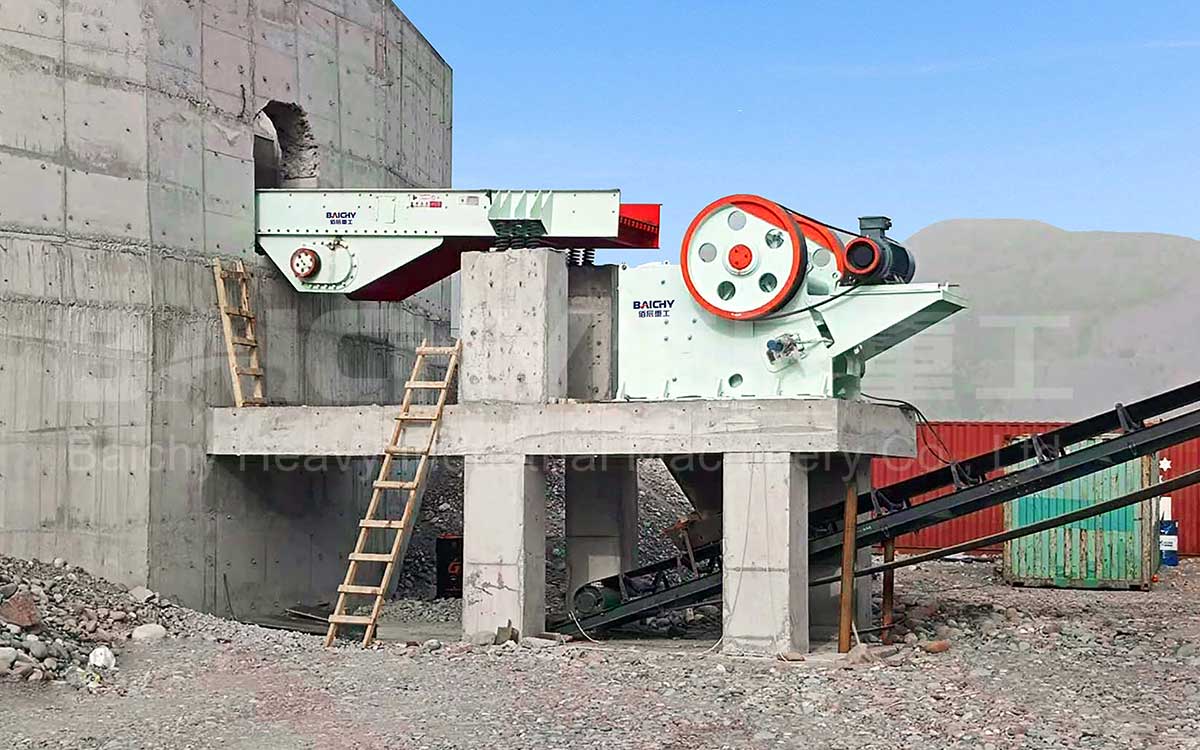
PE Jaw Crusher
II. Working Principle and Benefits
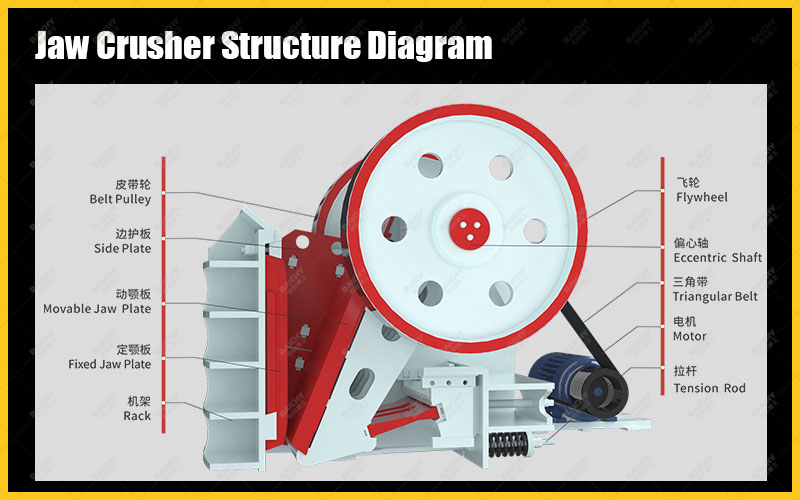
PE jaw crusher structure diagram
The jaw crusher operates on the principle of "compression crushing": driven by an eccentric shaft, the movable jaw plate swings periodically, forming a V-shaped crushing chamber (wide at the top and narrow at the bottom) against the fixed jaw plate. Material is repeatedly compressed and split until it is crushed to a size smaller than the discharge opening and then released. A flywheel stores energy to ensure smooth operation under heavy impact loads, while a toggle plate provides overload protection. Direct benefits of this mechanism:
• Large feed opening (e.g., 600×900 mm) → Accepts run-of-mine ore up to 500 mm directly, eliminating the need for secondary blasting and pre-screening, and reducing upfront investment costs by approximately 15%;
• Hydraulic discharge opening adjustment → Output particle size can be adjusted without stopping the machine or changing parts; the process takes just 10 minutes, resulting in an additional output of tens of tons per hour (based on a two-shift schedule);
• High-manganese steel/high-chromium alloy jaw plates → Service life of 8,000–12,000 hours when crushing granite; the plates are reversible, effectively doubling their lifespan, with a wear cost of less than 0.05 RMB per ton;
• Precisely matched motor power → Taking the PE600×900 model as an example, a 75 kW motor supports a capacity of 80–150 t/h with an electricity consumption of approximately 0.6–0.9 kWh per ton—significantly lower energy consumption than secondary crushing solutions of equivalent capacity.
III. Core Specifications (PE Series)
Processing capacity is rated based on medium-hard limestone (density approx. 1.6 t/m³); for granite or basalt, please apply a conversion factor of 0.7–0.8.
| Model |
Feeder Opening Size(mm) |
Max. Feeding Size (mm) |
Outlet adjusting Size(mm) |
Capacity (t/h) |
Motor Power (kw) |
Overall Dimension (mm) |
| PE250x400 | 250x400 | 210 | 25-60 | 5-20 | 15 | 1215x1240x1210 |
| PE400x600 | 400x600 | 350 | 40-90 | 15-60 | 30 | 1700x1750x1680 |
| PE500x750 | 500x750 | 425 | 50-100 | 40-130 | 45 | 2150x1900x1950 |
| PE600x900 | 600x900 | 500 | 60-125 | 90-180 | 55 | 2500x2010x2350 |
| PE750x1060 | 750x1060 | 630 | 60-150 | 110-380 | 110 | 2630x2310x3110 |
| PE900x1200 | 900x1200 | 750 | 95-165 | 220-450 | 132 | 3720x2850x3250 |
| PE1000x1200 | 1000x1200 | 850 | 200-300 | 280-560 | 160 | 3820x2850x3250 |
| PE1200x1500 | 1200x1500 | 1020 | 150-300 | 400-800 | 220 | 4590×3342×3553 |
| PE1500x1800 | 1500x1800 | 1200 | 210-360 | 520-1100 | 280 | 5100x4700x4300 |
IV. Selection Recommendations and Pitfalls to Avoid
1. Calculate based on required capacity: First, determine the target hourly output (e.g., 100 t/h). Calculate the jaw crusher's rated capacity as: Target Capacity &pide; 0.75. This reserves a 20–25% margin to handle large material chunks and fluctuations in feed rate;
2. Verify maximum feed size: The feed particle size must be ≤ 85% of the equipment's maximum allowable limit. If this limit is exceeded, a grizzly screen or primary crusher must be installed upstream; otherwise, frequent chamber jamming and damage to the jaw plates will occur;
3. Matching with secondary crushing: When the jaw crusher's discharge feeds directly into a cone or impact crusher, the discharge particle size must align with the secondary equipment's feed requirements to avoid the need for process reconfiguration.
4. Power supply and foundation: For export projects, verify voltage and frequency specifications (e.g., South Africa: 400V/50Hz; Mexico: 440V/60Hz; Ethiopia: 380V/50Hz). As the jaw crusher is heavy-duty impact equipment, a concrete foundation must be poured, and the flywheel and anchor bolts must be inspected.
V. Maintenance Points
Daily checks should cover jaw plate wear, lubrication, and bolt tightness. Replace jaw plates when worn to two-thirds of their original thickness; flipping the plates over can double their service life. Regularly calibrating the discharge opening gap is crucial for maintaining consistent production capacity and particle shape.
VI. FAQ
Q1: Can jaw crushers process high-moisture rock?
Yes. Compression crushing handles high-moisture materials better than hammer or impact crushers; however, if the clay content is excessive, pre-washing is recommended to prevent clogging the discharge opening.
Q2: Which model should be selected for crushing granite?
For medium-to-large production lines, the PE600×900 model or larger is recommended, featuring high-manganese steel jaw plates and hydraulic discharge opening adjustment; for small-scale projects, the PE400×600 model is suitable.
Q3: How fine can the jaw crusher's output be?
The minimum discharge opening can be adjusted to 20–40mm (depending on the model); achieving finer particle sizes requires secondary crushing using a cone or impact crusher.