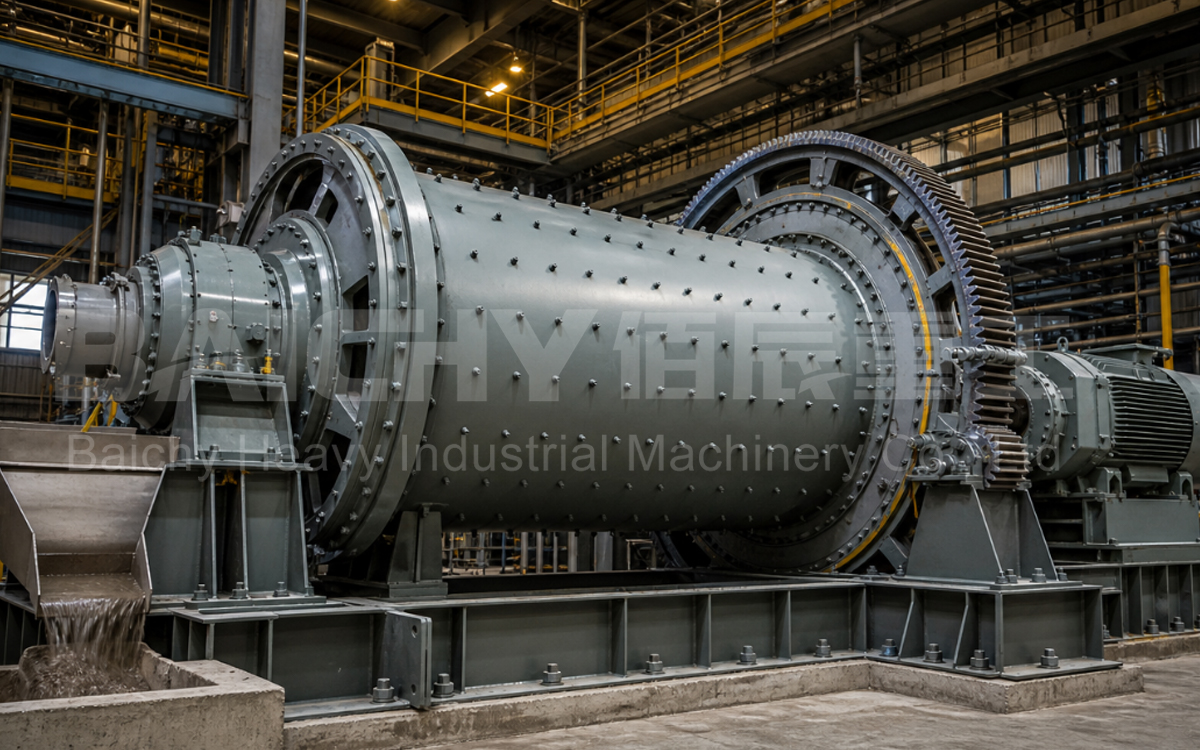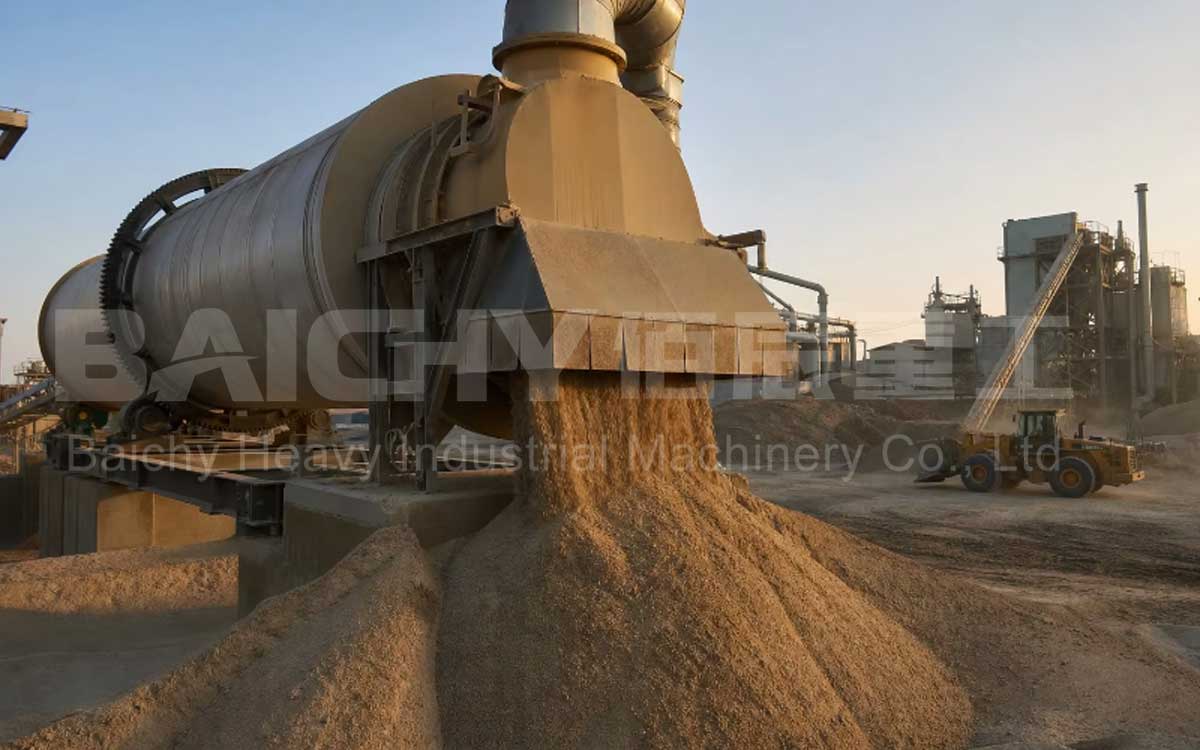
Single-Drum Dryer
The single-drum dryer (single-pass rotary dryer) boasts the simplest structure and the highest single-unit capacity among the entire family of drying equipment: a single φ3.6×25 m unit can handle a wet-basis throughput of 120–200 t/h without the need for parallel units. With no internal mesh belts, air hoods, or spray nozzles, it requires only 3–5 days of scheduled downtime per year. Featuring a shell made of Q245R/Q345R boiler-grade steel and a design life exceeding 25 years, it offers the lowest cost per ton of dried material over its entire lifecycle. Its trade-offs—a larger footprint and slightly lower thermal efficiency compared to triple-drum models—are usually the least significant factors when weighed against the demands for high capacity and reliability.
1. The cost of wet material: You pay three times over, yet receive only a pile of water.
Excessive moisture content is not merely a "quality defect"; it represents a financial loss across three distinct areas:
| Loss Category | Underlying Mechanism | Magnitude Reference |
| Inflated Freight Costs | Freight is settled based on wet weight; 15% moisture means 15 tons of water in every 100-ton railcar | 15 t/car × freight rate = Direct loss |
| Quality Control Failure | Inaccurate water-cement or mix ratios; loss of control over concrete strength, pellet quality, and fertilizer caking | Rejection, price downgrades, rework |
| Storage Caking | Arching and blockages in finished-product silos; manual clearing + downtime | Thousands of dollars lost per clearing operation |
Annual per capita consumption of sand and gravel in the US is 3.3 tons (NSSGA data)—the industry lacks not production volume, but the ability to deliver low-moisture products through industrialized, replicable processes. The single-drum dryer bridges this gap by consistently reducing discharge moisture to 0.5–5%, thereby stopping financial losses in freight, quality control, and storage.
In short: Drying is not merely a cost center; it is a tool for securing pricing power—transforming sales based on "wet tonnage" into sales based on "dry tonnage."
2. Why Choose a Single-Drum Dryer? — A Comparative Analysis of Three Drying Solutions
| Comparison Criteria | Single-Drum Dryer (Single-Pass) | Three-Drum Dryer (Triple-Pass) | Fluidized Bed Dryer |
| Max. Single-Unit Capacity | 200+ t/h | Usually ≤80 t/h (limited by drum diameter) | ≤50 t/h |
| Thermal Efficiency | 60–75% (counter-flow + insulation) | 80%+ (inner drum preheating) | 60–75% |
| Footprint/Length | Longest for same capacity | Length reduced by ~60%, footprint by ~40% | Small |
| Structural Complexity | Lowest; easy access for maintenance | Nested drums; complex inner drum wear/replacement | Air caps & distribution plates prone to clogging |
| Material Suitability | Granules, large lumps, filter cakes, sticky materials, high-temp materials | Lightweight granular materials (sand, sawdust, feed) | Uniform granules |
| Design Lifespan | 25+ years | 20+ years | 10–15 years |
| Annual Scheduled Downtime | 3–5 days | 4–7 days | 7–12 days |
| Investment (Same Capacity) | Low to Medium | Medium to High | Medium |
Selection Conclusion:
• Capacity requirement >50 t/h → Single-drum is the only choice; three-drum and fluidized bed units require parallel configuration, which multiplies power consumption, labor costs, and downtime risks.
• Material is filter cake, sticky sludge, or large lumps → Single-drum (equipped with L-shaped anti-sticking lifters) is the only solution that avoids clogging.
• Extremely limited space, capacity ≤80 t/h, lightweight granular material → Three-drum is more suitable; offers clear advantages in footprint and fuel efficiency.
• The single-drum dryer is not a "stripped-down version" of the three-drum dryer; rather, it is the optimal solution for scenarios prioritizing capacity and reliability.
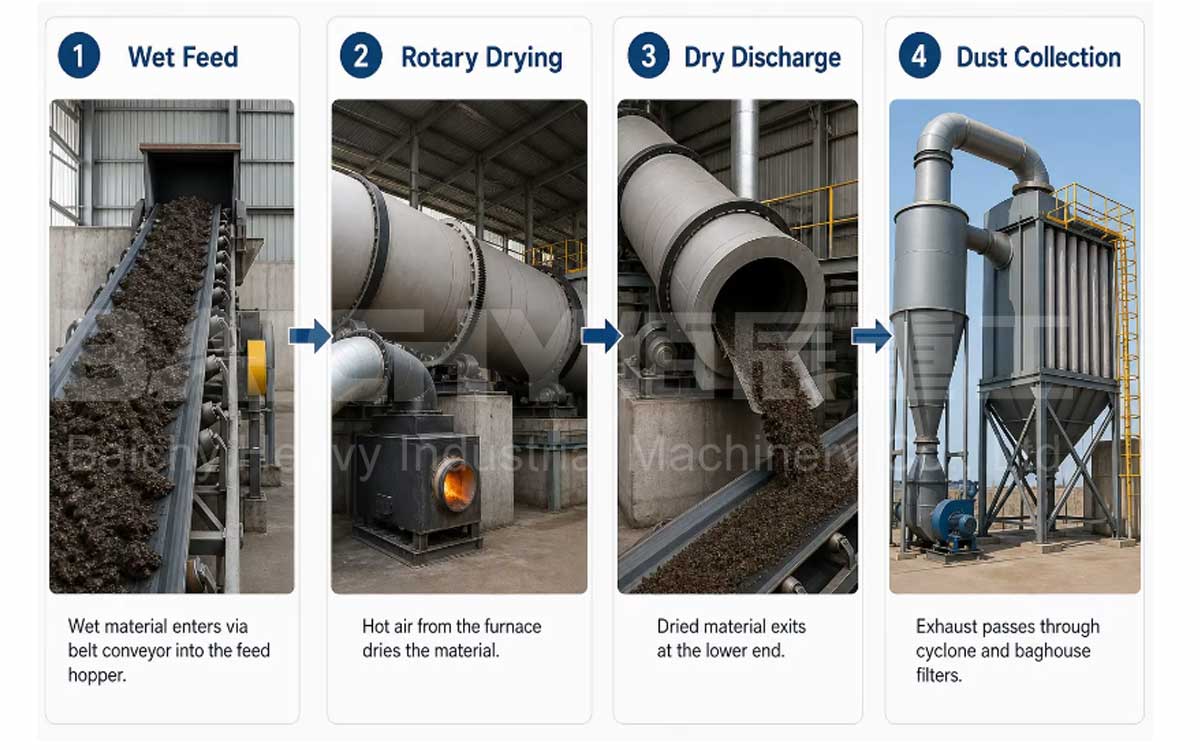
System Process Flow Diagram
3. Key Parameters: Model vs. Capacity Comparison
3.1 Main Unit Specifications (Sand/Gravel Materials; Wet-Basis Capacity)
| Model Specification | Capacity (10% → 0.5% Moisture) | Capacity (20% → 0.5% Moisture) | Motor Power | System Footprint (incl. Hot Air Furnace + Dust Collector) |
| φ1.5 × 12 m | 8–15 t/h | 5–8 t/h | 15 kW | ~120 m² |
| φ2.0 × 16 m | 20–35 t/h | 12–20 t/h | 22 kW | ~180 m² |
| φ2.4 × 18 m | 35–55 t/h | 22–35 t/h | 37 kW | ~240 m² |
| φ2.8 × 20 m | 55–85 t/h | 35–55 t/h | 55 kW | ~300 m² |
| φ3.0 × 22 m | 70–110 t/h | 45–70 t/h | 75 kW | ~360 m² |
| φ3.6 × 25 m | 120–200 t/h | 80–130 t/h | 132 kW | ~460 m² |
Note: The table above is based on quartz sand (loose bulk density approx. 1.6 t/m³), counter-current operation, and an inlet air temperature of 600–700°C. Capacities for iron ore concentrate and mineral powder differ based on density adjustments; the higher the initial moisture content, the lower the actual capacity for a given specification. Baichy offers free material drying tests, providing moisture curves and specification recommendations within 5 working days—final specifications are determined by sample testing, not by guesswork based on experience.
3.2 Key Operating Parameters
| Parameter | Value Range | Impact on Product Quality |
| Drum Rotation Speed Drum Inclination Angle | 2–5° | Angle ↑ → Material flow rate ↑ → Production capacity ↑; but residence time ↓ |
| Inlet Air Temperature | 400–800°C | Temperature ↑ → Evaporation rate ↑; risk of crystalline phase transition for quartz sand above 870°C |
| Outlet Air Temperature | 80–150°C | <80°C: Condensation & bag blinding; >150°C: Excessive heat loss |
| Material Residence Time | 15–40 minutes | Adjusted based on initial moisture content and target final moisture |
| In-Drum Air Velocity | 2–5 m/s | >5 m/s: Fine particles (<0.5 mm) drawn into dust collection system; product yield decreases |
3.3 Co-current vs. Counter-current: What Determines Your Fuel Bill
| Comparison Dimension | Co-current (Same direction) | Counter-current (Opposite direction) |
| Material Contact at High-Temp End | Wettest material | Driest material |
| Discharge Temperature | Lower (60–80°C) | Higher (90–120°C) |
| Thermal Efficiency | 55–65% | 65–80% |
| Suitable Materials | Heat-sensitive materials (fertilizers, distillers' grains, biomass) | Sand/gravel, mineral powder, iron ore concentrate (high-temp resistant materials) |
| Baichy Recommended Scenarios | Fertilizers/biomass/organic materials | Sand & gravel/mining/construction materials |
Key Takeaway: Sand, gravel, and mineral powders are not heat-sensitive (quartz sand softens above 1000°C); choosing counter-current flow yields a "free" 15–25% gain in thermal efficiency. A 15% difference in thermal efficiency translates to a 15% higher annual fuel bill—for a 100 t/h unit, this represents a difference of tens of thousands of dollars per year.
4. One machine, five industries: Material adaptability is the cornerstone of the single-drum dryer.
| Industry | Typical Materials | Configuration Highlights | Wet-Basis Capacity |
| Mining/Construction Materials | Quartz sand, river sand, manufactured sand, limestone, mineral powder | Counter-current flow, wear-resistant liners, coal/gas heat source | 30–200 t/h |
| Iron & Steel/Mineral Processing | Iron ore concentrate (hematite/magnetite/limonite), copper concentrate | Counter-current flow, anti-caking lifting flights, high capacity | 30–200 t/h |
| Environmental Engineering | Municipal sludge, industrial sludge, FGD desulfurization gypsum | Anti-sticking lifting flights + sealing system + wet scrubbing tower for odor control | 3–30 t/h |
| Fertilizers/Chemicals | NPK compound fertilizer, ammonium sulfate, soda ash | | Co-current flow, closed-loop temperature control via thermocouples | 5–30 t/h |
| Biomass/Agriculture | Wood chips, sawdust, straw, distillers' grains | Low-temperature (<300°C) co-current flow; indirect heating option available | 3–20 t/h |
The single-drum dryer's versatility regarding materials stems from three adjustable variables: drum speed, air temperature, and feed rate. Switching material batches requires no hardware changes; the same machine can transition from 0.1–5 mm quartz sand to filter cake with 60% moisture content simply by adjusting parameters, without altering the mechanical structure.
Other drying technologies (spray, belt, fluidized bed) each have their own "picky" limitations—spray drying requires pumpable slurry, belt dryers struggle with irregular particle shapes, and fluidized beds are prone to issues with sticky materials. The single-drum dryer handles them all. For factories with multiple product lines, this means a single piece of equipment covers all drying needs, requiring only one set of spare parts inventory and one operator training program.
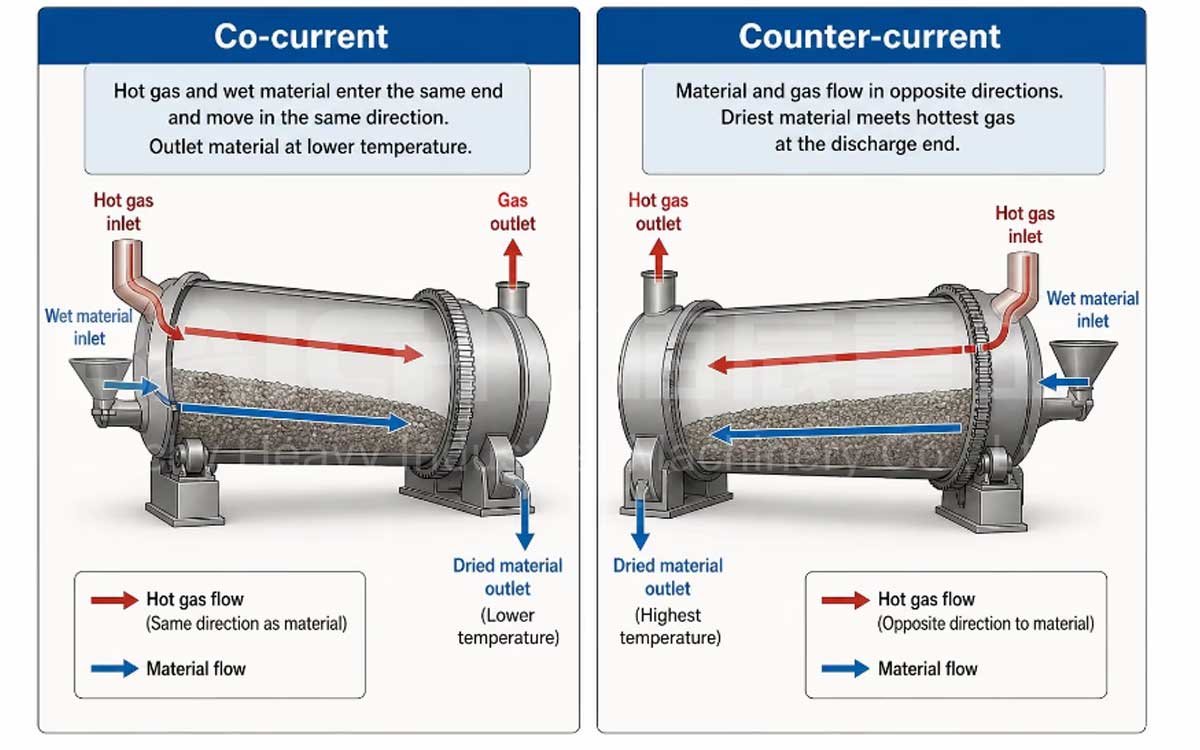
Comparison diagram: Downstream vs. Upstream
5. Heat Source & Dust Removal: Decisions based on local energy prices; no reliance on a single heat source type.
5.1 Choice of Four Heat Sources
| Heat Source Type | Fuel Cost per Ton of Material (Ref.) | Heating Speed | Temp. Control Precision | Suitable Scenarios |
| Coal-fired Hot Air Furnace | $0.5–1.2 | Slow (30–60 min) | Low (±50°C) | Coal-producing regions; areas with lenient environmental regulations |
| Natural Gas Burner | $0.8–2.0 | Fast (5–10 min) | High (±10°C) | Areas with pipeline gas access; strict emission standards |
| Biomass Pellet Furnace | $0.4–1.0 | Slow (20–40 min) | Medium (±30°C) | Agricultural regions; need for carbon neutrality certification |
| Heavy Oil/Diesel | $1.5–3.0 | Fast (10–15 min) | Medium (±20°C) | Remote mining areas lacking coal or gas pipeline infrastructure |
Decision Process: ① Obtain local coal/gas/electricity prices → ② Calculate fuel cost per ton of water evaporated → ③ Add environmental compliance costs (investment & operation for desulfurization/denitrification) → ④ Select the option with the lowest total cost of ownership. Baichy is not tied to any single heat source; we configure the most economical combustion system based on your specific energy prices and environmental standards at the time of delivery.
5.2 Dust Removal: Standard Configuration + Upgrade Path
| Dust Removal Stage | Equipment | Capture Efficiency | Outlet Concentration |
| Stage 1 | Cyclone Dust Collector | ≥90% (coarse particles) | 1–5 g/Nm³ |
| Stage 2 | Pulse-Jet Baghouse | ≥99% (fine particles) | <50 mg/Nm³ |
| Stage 3 (Optional) | Wet Scrubber | ≥95% (ultrafine particles + acidic gases) | <30 mg/Nm³ |
• Standard aggregate drying: Cyclone + Baghouse suffices for most regional emission standards
• EU/North America (<20 mg/Nm³ requirement): Add wet scrubber
• Coal-fired option: FGD desulfurization system must be specified during the quotation stage
6. Total Lifecycle Cost: Why "Expensive" Equipment Offers the Lowest Total Cost of Ownership
| Cost Item | Single-Drum Dryer (1 unit) | Fluidized Bed (4 units in parallel) | Notes |
| Equipment Investment | $80,000–$400,000 | $120,000–$350,000 | Single-drum is a one-time investment; no parallel setup needed |
| Annual Fuel Cost (100 t/h, Natural Gas) | $250,000–$400,000 | $300,000–$480,000 | 15% difference in thermal efficiency; >15% difference in fuel cost |
| Annual Electricity Cost (100 t/h) | $30,000–$50,000 | $45,000–$70,000 | 1 large fan vs. 4 fans |
| Number of Operators | 1 person/shift | 2–3 people/shift | Higher level of automation |
| Annual Wear Part Replacement | $5,000–$15,000 | $10,000–$25,000 | Lifting flights vs. air caps + mesh belts |
| Scheduled Downtime | 3–5 days/year | 7–12 days/year | High frequency of blockage clearing required for fluidized beds |
| Design life | 25+ years | 10–15 years | Q245R| Boiler steel shell vs. stainless steel mesh belt |
Over a 20-year lifecycle, the total cost of ownership per ton of material for a single-drum dryer is 25–35% lower than that of four fluidized bed dryers operating in parallel. The savings come not from the equipment cost itself, but from reduced fuel expenses, labor costs, and losses due to downtime—these three factors constitute the bulk of actual costs in a drying facility.
ROI Calculation Example (South American iron ore scenario): A single-drum dryer (φ2.4 × 18 m) processing 50 t/h of hematite concentrate (reducing moisture from 12% to <1%) can recoup the equipment investment within 12–18 months through freight savings alone—excluding additional gains from improved pelletizing yields and moisture-related price premiums at steel mills.
7. Key Design Features of the Single-Drum Dryer
7.1 Three-Stage Lifter Design (Crucial for preventing adhesion with high-moisture materials)
Standard straight-plate lifters tend to cause material buildup ("wall sticking") when handling wet materials with >15% moisture, leading to a continuous decline in material curtain density. Baichy’s single-drum dryers come standard with a three-stage combination: L-shaped (feed section) + curved parabolic (middle section) + straight-plate (discharge section):
• L-shaped feed section: Increases initial contact area, prevents sticking/buildup, and rapidly breaks up wet material clumps.
• Curved middle section: Creates a uniform material curtain, maximizing high-temperature gas penetration efficiency.
• Straight-plate discharge section: Lowers the drop height, reducing dust loss from dried material.
7.2 Wear-Resistant Lining (Essential for abrasive materials)
Sand, gravel, and mineral powders are highly abrasive. Replaceable wear-resistant liners (high-chrome cast iron or ceramic composite plates) are installed in the feed section and lifter zones to protect the dryer shell from direct wear. The liners are bolted in sections; replacing a single section takes only 2–4 hours, eliminating the need for a full system shutdown to replace the drum. 7.3 Durable Main Body
• Shell: Q245R/Q345R boiler-grade steel; wall thickness 8–25 mm (increased thickness for larger diameters)
• Support: Forged steel riding rings + hardened support rollers
• Sealing: Labyrinth seal at the feed end / graphite block seal at the discharge end
• Drive System: Variable frequency drive (VFD) with stepless speed regulation (2–8 rpm)
8. Pitfalls in Model Selection: Five Common Mistakes
1. Quoting only "nominal capacity" without specifying the initial moisture content. For the same φ2.8×20 m dryer, capacity drops from 55–85 t/h (with 10% feed moisture) to just 35–55 t/h (with 20% feed moisture). When inquiring, you must provide four key details: material type, initial moisture content, target moisture content, and hourly output. Missing any one of these renders the quote useless.
2. Assuming "close enough" based on samples. Even with quartz sand, the drying rate differs by over 30% between 0–3 mm fine sand and 3–20 mm coarse sand. Free testing of a 5–10 kg representative sample—with results available in 5 working days—is the only reliable way to select the right model.
3. Ignoring electrical standards. Confirm the on-site power supply: 380V/50Hz, 460V/60Hz, or high-voltage 6kV/10kV (for large motors >75 kW). Baichy customizes electrical solutions for export markets; simply specify your requirements during the inquiry.
4. Comparing single-drum and triple-drum dryers directly. For the same capacity, their structures, footprints, thermal efficiencies, and prices differ vastly; you must determine the technical approach before comparing costs.
5. Overlooking the environmental protection budget. For coal-fired systems, if local regulations require desulfurization, the cost of an FGD (Flue Gas Desulfurization) unit can approach that of the main machine itself. This must be clarified during the quoting stage to avoid unexpected additional costs after delivery.
9. FAQ
Q1: How do I choose between a single-drum dryer and a three-drum (triple-pass) dryer?
Choose a single-drum dryer if: capacity exceeds 50 t/h; materials are highly viscous or large in size; or simplicity of structure and ease of maintenance are priorities. A three-drum dryer is more suitable if: capacity is ≤80 t/h; site space is limited; and materials are lightweight and granular (e.g., sand, sawdust, animal feed). Three-drum dryers offer thermal efficiency exceeding 80%, require about 60% less length for the same capacity, and reduce the footprint by approximately 40%. These are not mutually exclusive alternatives but rather the right solutions for different operating conditions.
Q2: What final moisture level can a single-drum dryer achieve? What determines the final moisture content?
The standard target final moisture content is 0.5–5%, though levels below 0.5% can be consistently achieved for sand and gravel materials. Key factors include: inlet air temperature, residence time (determined by drum speed and inclination angle), initial moisture content, material particle size, and heat sensitivity. Achieving lower moisture levels requires only parameter adjustments rather than equipment replacement—though capacity will decrease accordingly. Final specifications are based on material test data.
Q3: Can a single-drum dryer process viscous materials like sludge or filter cakes?
Yes; this is a key advantage of single-drum dryers over fluidized bed or belt dryers. Filter cakes with 60% moisture content can be processed using L-shaped anti-sticking lifters and a sealing system. For municipal sludge applications, a wet scrubbing tower is added to address odor issues. When processing viscous materials, it is advisable to maintain a margin in rotational speed to facilitate online de-sticking.
Q4: What are the approximate investment and operating costs for a single-drum dryer?
Equipment investment for the main system (dryer, hot air furnace, dust removal, conveying, and electrical control) ranges from approximately 80,000 to 400,000, depending on specifications and the heat source type. Fuel accounts for the bulk of operating costs: approximately 0.5–1.2 per ton of material for coal, 0.8–2.0 for natural gas, and 0.4–1.0 for biomass. Over a 20-year lifecycle, the total cost of ownership per ton of material for a single-drum dryer is 25–35% lower than that of a parallel system using four fluidized bed dryers.
Q5: Why does the single-drum dryer have a service life of up to 25 years?
The main body consists of a Q245R/Q345R boiler-grade steel shell (with a wall thickness of 8–25 mm); the high-temperature section does not come into direct contact with the material (being protected by wear-resistant liners), and the rotating components feature forged steel tires and hardened support rollers. It lacks consumable core components such as mesh belts or air caps. Wear from abrasive materials is entirely absorbed by replaceable liners, which can be swapped out section by section in just 2–4 hours. Scheduled annual downtime is limited to only 3–5 days, and the maintenance checklist comprises just three items: weekly checks of tire lubrication, monthly checks of support roller alignment and seals, and annual replacement of liners in high-impact zones.
Q6: How long does installation and commissioning take? How much manpower is required?
For a standard system (dryer, hot-blast stove, dust removal unit, conveying system, and electrical controls), the timeline from equipment delivery to commissioning and material output is 30–60 days, depending on the progress of on-site foundation construction. Baichy dispatches two installation guidance engineers to oversee shell assembly, drive system adjustment, integrated electrical system testing, and operator training.