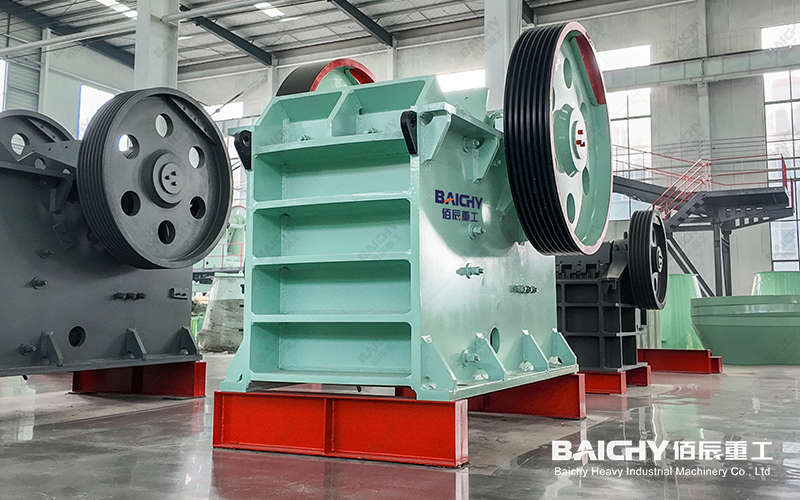
Jaw Crusher for Rock Crushing
The jaw crusher represents the most mature and reliable solution for primary rock crushing. Whether dealing with granite, basalt, or iron ore—provided the rock's compressive strength is within 320 MPa—a jaw crusher with its simple structure can execute the initial step of breaking down large rock masses at the lowest cost per ton. For mining operations, quarries, and infrastructure projects, the jaw crusher is not merely one of many options; it is the default starting point for the vast majority of production lines.
I. Overview: Why the Jaw Crusher is the Preferred Choice for Rock Crushing
Jaw crushers achieve size reduction through the reciprocating compression of two jaw plates: an eccentric shaft drives the movable jaw to periodically approach and retreat from the fixed jaw. Rocks within the deep V-shaped crushing chamber are repeatedly squeezed and split until they are small enough to pass through the discharge opening. This compression-based crushing method makes it naturally suited for hard and highly abrasive rocks; it relies neither on high-speed impact nor on rapidly rotating striking components. Consequently, jaw plate wear remains manageable and failure rates low, making it the most durable machine type for primary hard-rock crushing applications.
The industry consensus on using jaw crushers for rock crushing is based on three key facts:
• Large feed size capability: The PE series can accept blasted run-of-mine rock ranging from 340 mm to 750 mm, allowing most mines to feed material directly without the need for secondary blasting;
• Stable crushing ratio: It offers a single-stage crushing ratio of 4:1 to 6:1, capable of reducing rock to under 100 mm in a single pass and providing suitable feed for subsequent secondary/tertiary crushing and grinding stages;
• Simple, reliable structure: Featuring a cast-steel frame and high-manganese steel jaw plates, it requires minimal maintenance expertise, making it ideal for overseas projects in regions like Africa, Southeast Asia, and Latin America where technical support resources may be limited.
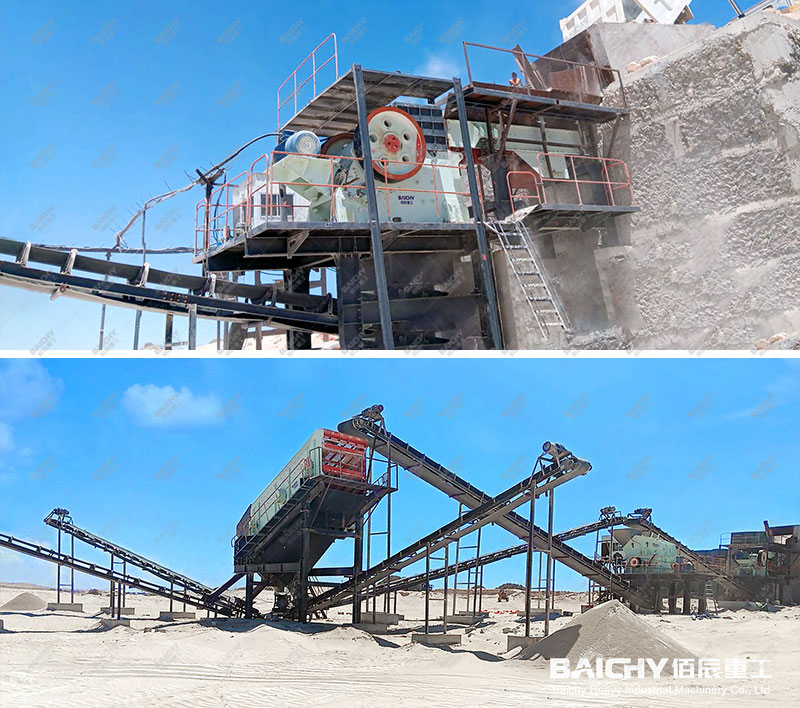
Jaw Crushers for Rock Crushing
II. Key Parameters: A Quick Guide to Selecting a Jaw Crusher
The first step in equipment selection is understanding the parameter specifications. The following table lists specifications for typical models in the Baichy PE series, covering a capacity range of 16–450 t/h:
| Model | Feed Opening (mm) | Max. Feed Size (mm) | Discharge Opening Adjustment Range (mm) | Capacity (t/h) | Motor Power (kW) |
|---|---|---|---|---|---|
| PE-400×600 | 400×600 | 340 | 40–100 | 16–65 | 30 |
| PE-500×750 | 500×750 | 425 | 50–100 | 45–100 | 55 |
| PE-600×900 | 600×900 | 500 | 65–160 | 50–160 | 55–75 |
| PE-750×1060 | 750×1060 | 630 | 80–140 | 110–320 | 90–110 |
| PE-900×1200 | 900×1200 | 750 | 95–165 | 220–450 | 110–132 |
Parameter Interpretation (Practical Insights): The capacities listed are rated based on medium-hardness limestone (bulk density approx. 1.6 t/m³). When crushing hard rock such as granite or basalt, actual capacity is approximately 70%–85% of the rated value; therefore, when selecting a model, it is crucial to factor in a margin by calculating "nominal capacity × 0.8"—a common pitfall in production line projects worldwide. Additionally, the jaw crusher's motor can be customized (380V/400V/440V, 50Hz/60Hz) to match the local power grid; this detail directly determines whether the equipment can be commissioned on schedule after arrival, so overseas projects must specify local power standards when requesting a quote. III. Application Scenarios: Where Jaw Crushers Process Rock
3.1 Quarries and Aggregate Production Lines
Projects such as highways, railways, hydropower stations, and airports require large volumes of aggregates in perse specifications. Quarries typically use the jaw crusher as the primary crushing unit, paired with a cone crusher or impact crusher to form a three-stage process: "coarse crushing + secondary crushing + sand making." For a production line with a daily output of 3,000 tons, the combination of a PE-750×1060 jaw crusher and a CS-series cone crusher is the standard configuration for granite processing.
3.2 Primary Crushing of Run-of-Mine (ROM) Ore in Metal Mines
The initial stage of beneficiation processes for iron, copper, gold, and manganese ores relies on jaw crushers. Taking the gold CIL/CIP process as an example—jaw crushing (primary) → cone crushing (secondary) → ball milling (fine grinding)—the uniformity of the primary crusher's output directly determines the stability of the feed size entering the ball mill and the specific energy consumption of the grinding process; thus, the primary crushing stage is a key lever for optimizing total process costs.
3.3 Mobile Crushing Stations and Distributed Material Sources
By integrating a jaw crusher into a YDPZ-series tracked or wheeled mobile station, the equipment can be driven directly to the mine face or construction waste site. This enables an integrated "extraction-crushing-transport" workflow, making it ideal for infrastructure and river remediation projects that involve dispersed sites and frequent relocation, thereby significantly reducing transport distances.
3.4 Construction Waste and Recycled Aggregates
Jaw crushers perform primary crushing on medium-hard recycled materials, such as concrete blocks and reclaimed asphalt pavement (RAP). The resulting material undergoes secondary crushing to produce recycled aggregates. This practice aligns with policies promoting the recycling of construction waste while providing an on-site material source for urban renewal projects.
IV. Core Advantages: From Specifications to Profitability
4.1 Large Feed Opening and High Reduction Ratio: Minimizing Upfront Costs
A feed opening in the 630–750mm range, combined with a deep-cavity, compound-pendulum design, allows the jaw crusher to process blasted run-of-mine rock directly, eliminating the need for secondary blasting or pre-screening stages. A crushing ratio of 4:1–6:1 means that, in some scenarios, the secondary crushing stage can be eliminated; removing a piece of equipment eliminates a potential point of failure, as well as associated electricity and maintenance costs.
4.2 High-manganese steel jaw plates reduce consumable costs per ton
The jaw plates are made of high-manganese steel (ZGMn13/Mn13Cr2), offering a service life of 6–12 months when processing moderately abrasive rock. Featuring a symmetrical design, the plates can be flipped end-for-end after wear, effectively doubling the lifespan of a single set. Based on an hourly output of 200 tons and 300 operating days per year, annual consumable costs for hard rock applications amount to approximately 3%–5% of the total equipment price—significantly lower than that of impact crushers.
4.3 Rapid commissioning and low maintenance requirements
The simple structure allows for a short installation cycle, with commissioning and production startup achievable within one week of positioning. Routine maintenance focuses only on lubrication, fasteners, and toggle plate clearance; no highly skilled operators are required, making it particularly suitable for overseas projects with limited O&M resources.
4.4 Controllable Total Cost of Ownership (TCO)
The 110kW motor consumes approximately 88 kWh at full load; based on an hourly output of 200 tons, the energy consumption is roughly 0.44 kWh per ton, making it one of the most energy-efficient units in the entire production line. Compared to impact or cone crusher configurations of similar capacity, the jaw crusher's primary crushing stage offers a 15%–20% lower cost per ton. It represents the primary crushing option with the fastest investment payback and is the first stage validated when assessing the production line's ROI.
5. Real-World Case Studies
5.1 Southeast Asia Granite Quarry (PE-600×900 + PF-1214)
| Project Item | Details |
|---|---|
| Material | Granite; compressive strength: 180–220 MPa |
| Primary Crusher | 1 × PE-600×900 Jaw Crusher |
| Secondary Crusher | 1 × PF-1214 Impact Crusher |
| Design Capacity | 100–150 t/h |
| Actual Capacity | 145 t/h (capacity achievement rate: ~97%) |
The production line reached full capacity in its first month of operation; the primary crushing stage averaged 520 operating hours per month, and a single set of jaw plates lasted 9 months. The client reported a ~20% reduction in crushing cost per ton compared to previously used imported second-hand equipment, with the equipment investment recouped within 18 months.
5.2 Ethiopia Basalt Mine (PE-400×600)
A PE-400×600 unit was selected for an airport aggregate project in East Africa. Configured for the local 380V/50Hz power supply, it was commissioned within one week of installation, delivering a stable output that met the feed requirements for the downstream impact crusher. Based on this performance, the project owner included a second unit of the same model in their expansion plan—a classic example of how jaw crusher reliability drives repeat business in the hard-rock market.
5.3 Mexico Four-Unit Mobile Station (PE-500×750)
The client integrated the jaw crusher into a mobile station configured for 60Hz power standards, enabling flexible relocation between multiple scattered material sources. The time from contract signing to material output was just a few weeks, validating the suitability of the "mobile primary crushing + on-site processing" model for the Latin American market.
VI. Recommended Related Equipment
Jaw crushers typically do not operate in isolation; the following are recommendations for a complete rock crushing system setup:
| Stage | Recommended Equipment | Rationale |
|---|---|---|
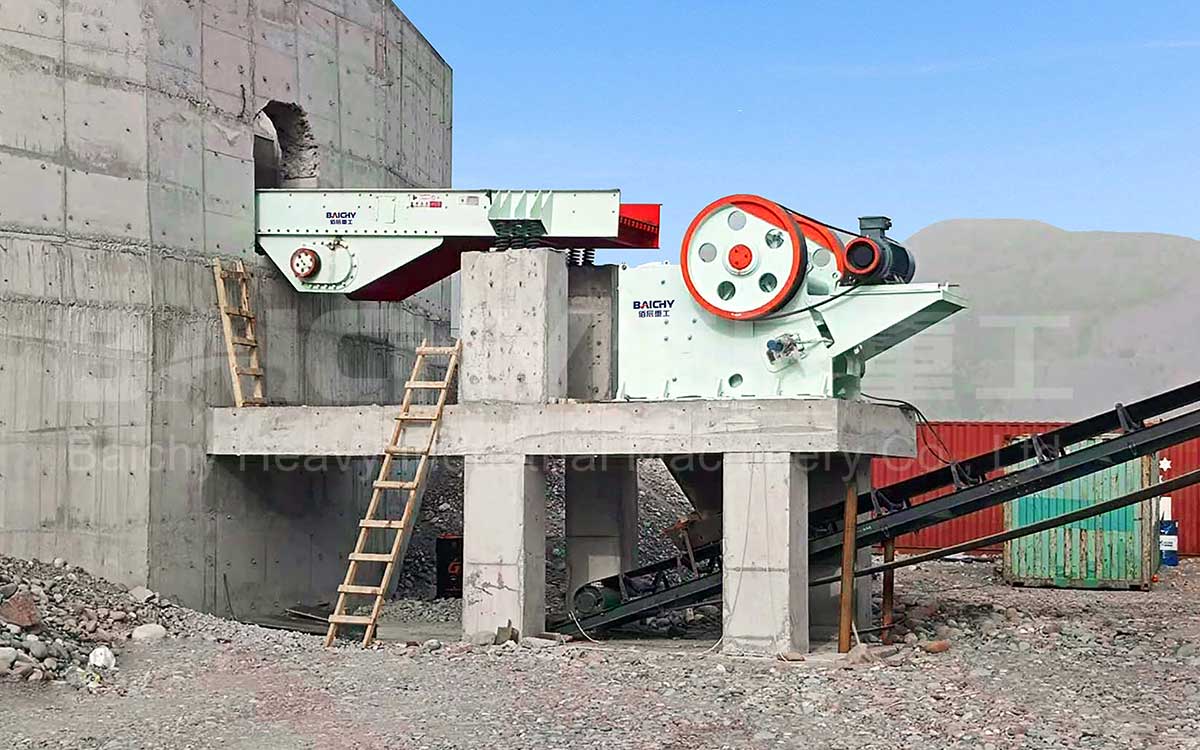
| Feeding | ZSW Vibrating Feeder | Ensures uniform feeding and pre-screening (soil removal); protects the jaw crusher from material impact. |
| Secondary Crushing | CS/HP Series Cone Crusher | Secondary crushing for hard rock (granite, basalt, iron ore); wear-resistant with stable output. |
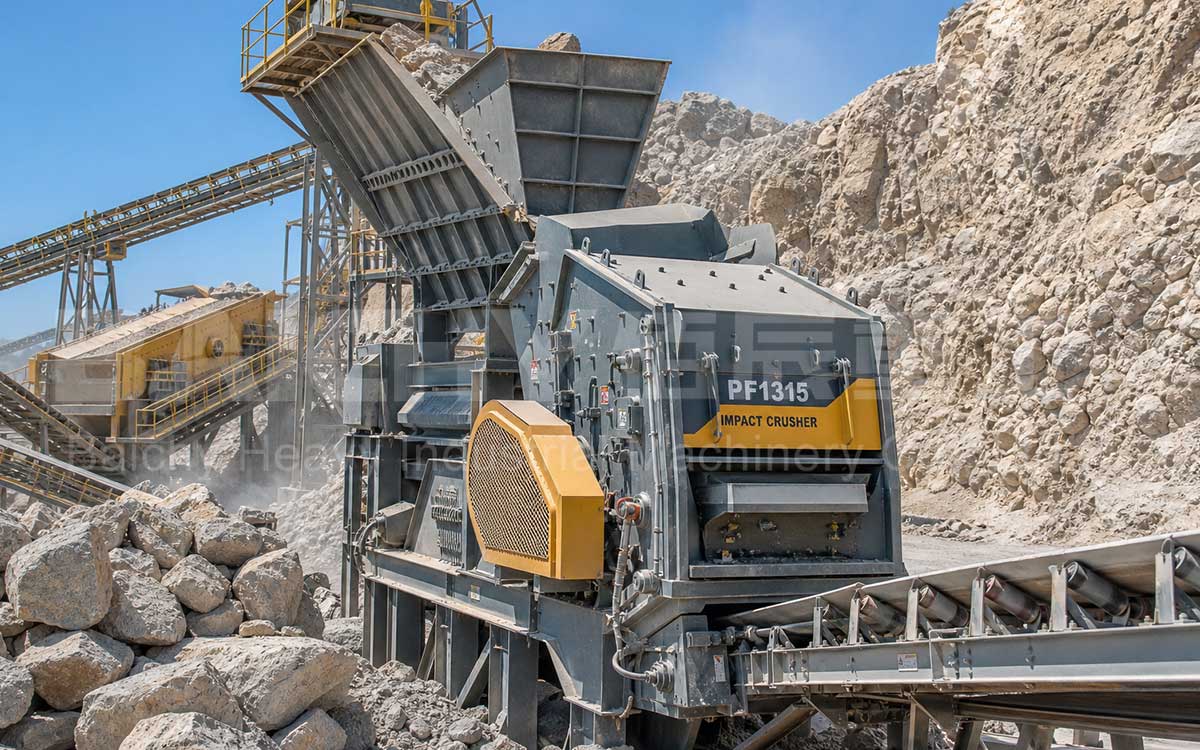
| Secondary Crushing | PF Series Impact Crusher | For medium-soft rock; offers particle shaping capabilities and lower cost per ton. |
| Sand Making | VSI Sand-Making Machine | Closed-circuit sand making; produces 0–5mm manufactured sand. |
| Screening | YK Circular Vibrating Screen | Material grading; enables simultaneous sales of multiple product specifications. |
| Mobile Solution | YDPZ Mobile Crushing Station | Integrated jaw crusher; ready for immediate production upon arrival; ideal for projects requiring relocation. |
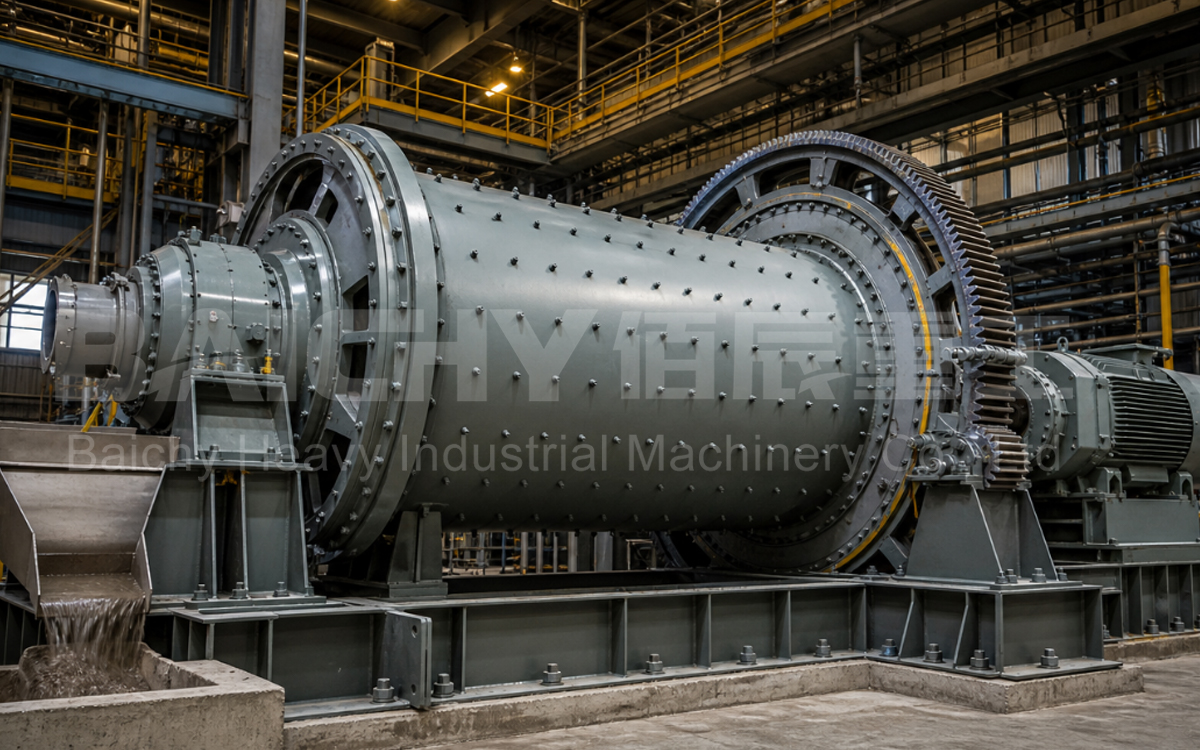
| Grinding Integration | Ball Mill / Wet Gold Grinding Mill | For the fine grinding stage in mineral processing workflows. |
Selection Advice: For hard rock, prioritize the "Jaw Crusher + Cone Crusher + VSI" combination. For medium-soft rock (limestone, dolomite, river pebbles), the lower-cost "Jaw Crusher + Impact Crusher" combination can be used, potentially reducing the cost per ton by another 8%–12%.
VII. FAQ
Q1: How hard of a rock can the jaw crusher process?
It is suitable for various rock types with a compressive strength of ≤320 MPa, covering the vast majority of common applications such as granite (180–250 MPa), basalt (200–300 MPa), iron ore, and limestone (60–120 MPa). For extremely hard rock exceeding 320 MPa (e.g., certain types of diabase or quartzite), a gyratory crusher is recommended, or a customized assessment involving adjustments to the crushing chamber profile and jaw plate material should be conducted.
Q2: How many tons of rock can the jaw crusher process per hour?
Under standard operating conditions (medium-hard material, 100mm discharge opening), the processing capacity for models ranging from PE-400×600 to PE-900×1200 spans 16–450 t/h. When crushing hard rock such as granite, the rated capacity should be adjusted to 70%–85% of the tabulated values; for instance, while the nominal capacity of the PE-600×900 is 50–160 t/h, its stable capacity when processing hard rock is approximately 80–120 t/h. A wider discharge opening yields higher capacity but results in coarser product sizing; therefore, the setting must align with the capacity of the downstream secondary crusher.
Q3: Should I choose a jaw crusher or an impact crusher for rock crushing?
It depends on material hardness and process positioning: Jaw crushers handle primary (coarse) crushing—accepting large feed sizes, withstanding hard rock, and offering long jaw plate longevity—serving as the production line's "first line of defense." Impact crushers handle secondary crushing and shape optimization, producing excellent particle shapes, though their blow bars wear rapidly when processing highly abrasive hard rock. The correct pision of labor is "jaw crusher for primary crushing + impact/cone crusher for secondary crushing," utilizing cone crushers for hard rock and impact crushers for medium-to-soft rock; a mindset of simply "substituting" one machine for another often leads to suboptimal results regarding both capacity and cost.
Conclusion
The true value of a jaw crusher lies not merely in the figures on a specification sheet, but in its ability to consistently meet production targets under the harshest mining conditions. When selecting equipment, evaluate options based on four key criteria: material hardness, target capacity, power standards, and total lifecycle cost; conducting crushing tests with actual rock samples is recommended when necessary. If you require a crushing test report based on your specific samples and a configuration proposal including CAPEX/OPEX estimates, please contact Baichy Heavy Industry. We provide one-stop solutions for mining crushing, grinding, and mineral processing, ranging from inpidual machines to complete EPC production lines.
Baichy Heavy Industry
Baichy Heavy Industry is a high-tech mining equipment company integrating R&D, manufacturing, sales, and after-sales service. Focusing on crushing, grinding, and mineral processing equipment, we provide professional solutions to our customers. We are ISO9001:2015 、certified, and our products include mobile crushing palnts, crawler crushing plant, construction waste crushing plants, jaw crushers, sand making machines, cone crushers, fine crushers, grinding mills, ball mills, etc., all with reliable performance to meet diverse project needs.
Baichy Heavy Industry – Your Trusted Partner
To ensure optimal performance of your equipment, Baichy Heavy Industry offers:
- Professional on-site installation guidance
- Comprehensive operator training
- 24/7 technical support & maintenance services
Our complete after-sales service system guarantees long-term, stable operation of your machinery with minimal downtime.
Protect Your Rights – Only Use Official Channels
To avoid scams and ensure authentic support, contact us exclusively through:
• Official Website: www.baichychina.com
• WhatsApp: +8615093222637
• Email: [email protected]
Your satisfaction is our priority – expect prompt, professional service every time.
(Note: Beware of unauthorized third parties claiming to represent Baichy. Always verify through official contacts.)