
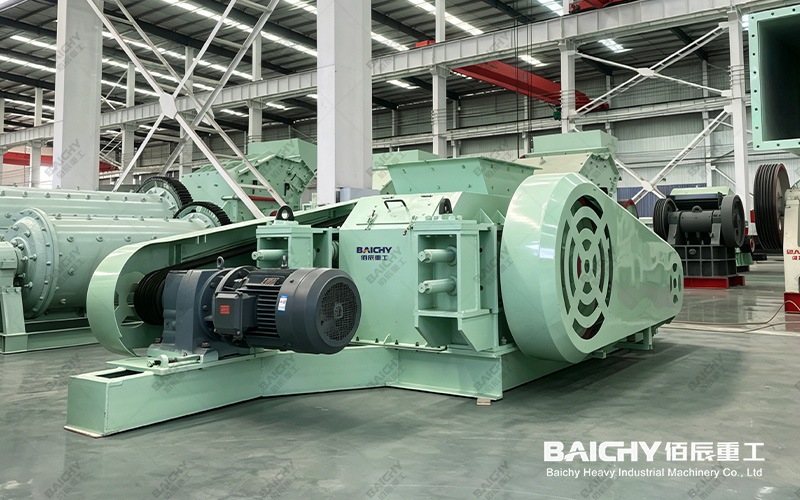
Double Roller Crusher
A double roll crusher for gold ore is a compression machine, not an impact machine: two counter-rotating rolls pull the ore into the gap and break it by squeezing and shearing. That explains both when a gold plant should use one and when it should not. It wins where you need tight top-size control and fewest fines before the mill; it loses to a cone crusher on hard, abrasive ore at high tonnage.
Where a roll crusher belongs in a gold ore circuit?
A roll crusher is a tertiary or fine crushing unit: it sits after a jaw crusher and a secondary cone, immediately ahead of the mill. Its job is not maximum reduction; it is a controlled, uniform feed to grinding.
Grinding is where a gold plant spends most of its energy and where variation hurts most. Fed on pre-reduced ore, it discharges a product from a few millimetres up to roughly 20 mm, depending on model and gap setting (double roller crusher specifications). Where coarse gold is recovered, this stage also keeps free gold from being flattened into the fine fraction before the concentrator sees it (gold concentrator).
Is a double roll crusher suitable for gold ore?
Check three things before you specify one.
Ore strength and abrasiveness. Roll crushers suit medium-hard, brittle feed. Quartz-rich, high-abrasion hard-rock ore wears the shells quickly and raises maintenance cost; that ore normally belongs in a cone crusher, as it does in iron ore crushing. A capacity table tells you what the machine can pass, not what your ore will do to it, so test the ore.
Moisture and clay. Smooth rolls lose grip on wet, sticky feed. If your deposit has a clay-rich or weathered zone, plan for grooved or toothed rolls and pre-screening.
Required tonnage. Roll crushers cover low to moderate tonnage well and can be set precisely. Above a certain throughput, a cone wins on cost per tonne.
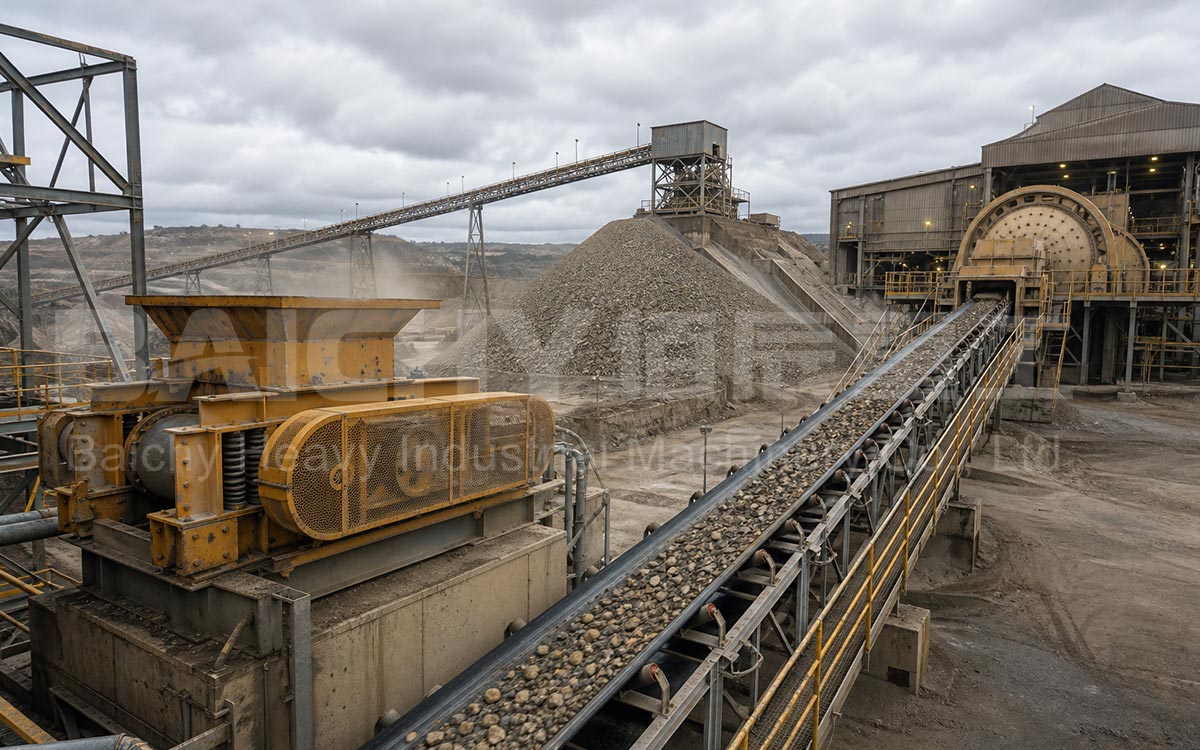
Double Roll Crusher for Gold Ore
Roll crusher vs cone crusher for gold ore
| What decides the choice | Double roll crusher | Cone crusher |
|---|---|---|
| Ore hardness | Medium-hard, brittle | Hard, abrasive, competent |
| Product size control | Set directly by the roll gap | Set by closed side setting |
| Fines generation | Low: compression only | Moderate |
| Wet or clay-rich feed | Poor with smooth rolls; use grooved or toothed shells | Better |
| Feed opening | Small: needs primary crushing upstream | Accepts coarser feed |
| Best duty | Size-critical, low to moderate tonnage | High tonnage, hard ore |
Read the table as a filter, not a verdict: medium-hard ore at moderate tonnage with a size-critical product favours the roll crusher, while hard abrasive ore at high tonnage favours the cone.
Why over-crushing costs you recovery?
Over-crushing is the failure mode that matters most in gold circuits: every unnecessary fine has to be handled downstream. Crushing by compression makes less fines and less dust than a hammer or impact crusher on the same feed, and gives a more regular particle shape (roll crushing principles).
The economics differ by route. In gravity circuits, coarse free gold can end up in the fines and slimes stream, where a shaking table or centrifuge recovers it far less efficiently. In flotation, it is sulphide liberation that grinding controls. In CIL and CIP you must grind fine enough to expose the gold, but crushing ore to powder before the mill adds power cost without adding liberation. In all three, the contribution of a roll crusher is narrow and real: a tighter, more uniform mill feed with less over-crushing.
How to set the roll gap for your target size?
The gap between the rolls controls product size, and there are two ways to change it. The mechanical system uses shims or thrust bearings between the frame and the movable bearing: adding or removing them widens or narrows the gap. Hydraulic models use cylinders and add auto-retreat protection, so an uncrushable piece pushes the movable roll back instead of damaging the frame.
Set it in steps rather than by calculation: start wider than target, run your own ore, sieve a sample, then close the gap one increment at a time and re-check size and throughput. Closing the gap costs capacity, so watch motor load. The machine also has a floor: for a very fine product, use a toothed-roll or roller-press model, not a smooth roll crusher pushed to its limit.
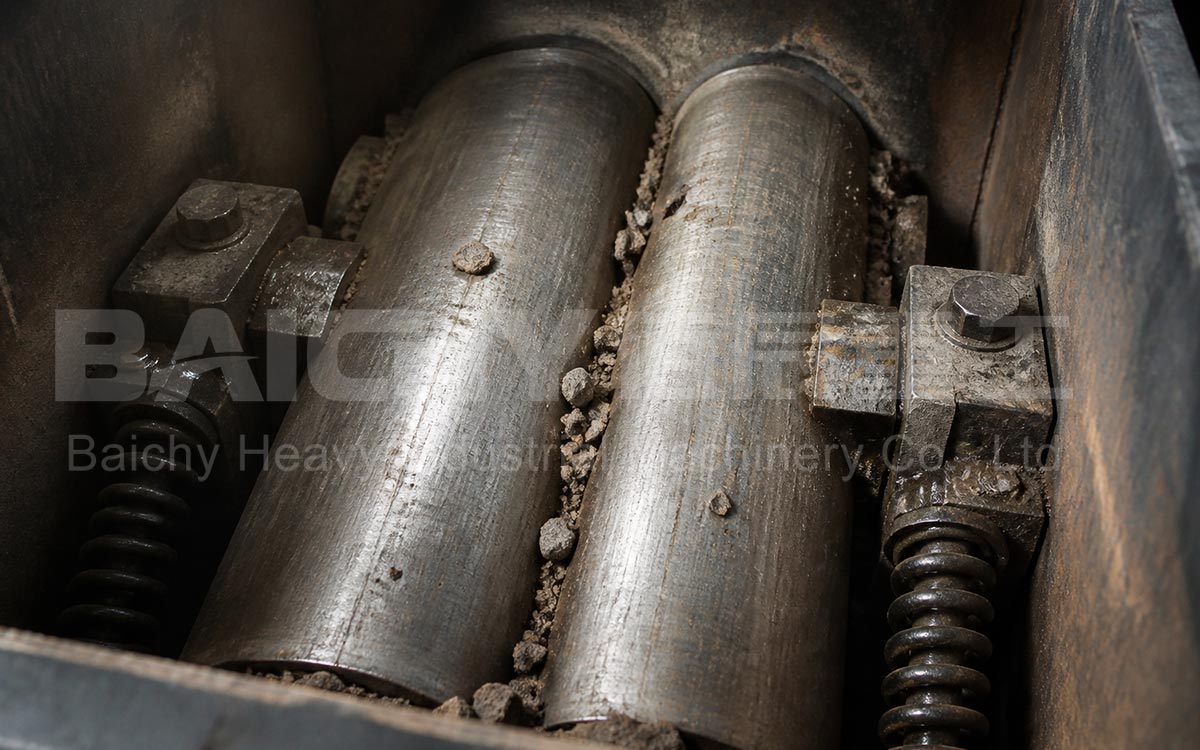
Internal Structure of a Roller Crusher
Wet, clay-rich gold ore: clogging and fixes
Roll crushers can clog, and smooth rolls are the worst case: high-moisture or high-mud feed makes the rolls slip instead of grip, material packs in the gap, throughput drops and product size becomes uneven.
Fix it cheapest first: control feed moisture; pre-screen to remove fines and mud ahead of the crusher; switch to grooved or toothed roll shells; fit guide or sweeping devices that keep the roll faces clean. If a clay zone is a large share of your reserve, question the machine rather than the setting: a circuit that removes the wet fraction ahead of the crusher usually beats forcing the crusher to cope.
Roll shell wear: what actually extends life
Roll shells are the main wear part and the main operating cost. Life varies widely and can differ several-fold between sites running the same model, driven by ore abrasiveness, hardness and mud content, shell material (high-manganese steel, hardfacing, high-chromium alloy) and the precision of assembly.
Four habits extend it: feed evenly across the full roll width and avoid eccentric loading; never run the machine empty at speed; keep the gap and the rolls parallel; and rebuild or hardface the shell as soon as grooves appear, not when it fails. Manage wear by measurement, not by calendar: record shell thickness at fixed intervals and let the trend set the replacement date.
Model and capacity reference
Published reference range for Baichy double roller crushers. Output figures vary with material, feed size and required fineness, so use them for sizing rather than as a promise. Feed size is the binding constraint here: the largest lump the rolls should ever see, and it is far smaller than a jaw or cone crusher will accept.
| Model | Roller diameter × length (mm) | Max feed size (mm) | Capacity (t/h) | Motor power (kW) |
|---|---|---|---|---|
| 2PG400×250 | 400 × 250 | 25 | 2–10 | 5.5 × 2 |
| 2PG610×400 | 610 × 400 | 30 | 5–20 | 15 × 2 |
| 2PG800×600 | 800 × 600 | 40 | 12–50 | 22 × 2 |
| 2PG900×900 | 900 × 900 | 50 | 50–100 | 37 × 2 |
| 2PG1800×1000 | 1800 × 1000 | 100 | 130–220 | 220 × 2 |
FAQ
1. How fine can a double roll crusher crush gold ore?
Finished size normally runs from a few millimetres up to about 20 mm, set by the roll gap. Below that, a toothed-roll or roller-press model is the right machine.
2. Is a roll crusher or a cone crusher better for gold ore?
It depends on hardness and tonnage. Medium-hard brittle ore at moderate tonnage with a size-critical product favours the roll crusher; hard, abrasive ore at high tonnage favours the cone.
3. Can a roll crusher handle wet, sticky gold ore?
Not well with smooth rolls, which slip and pack. It can work with grooved or toothed shells, moisture control, pre-screening and cleaning devices on the roll faces.
4. Does a roll crusher need a jaw crusher ahead of it?
Usually yes. The feed opening is small and the machine is not built for large blocks, so primary crushing ahead of it is standard practice.
5. Why is my product coarser than the gap I set?
Two usual causes: the gap has worn wider than the setting, or the drive belt is slipping so the rolls are not holding speed. Check gap and wear first, then lubrication and drive.
6. How do I decide when to replace the roll shells?
By measurement, not by calendar. Record shell thickness at fixed intervals and rebuild or hardface as soon as grooves appear; running a shell to failure costs more in lost throughput.
Sizing a fine crushing stage starts with your ore data: compressive strength or Bond work index, moisture and clay content, mill feed target and required tonnes per hour. Baichy's engineers will return a circuit configuration and a double roll crusher for gold ore matched to that duty.
Baichy Heavy Industry
Baichy Heavy Industry is a high-tech mining equipment company integrating R&D, manufacturing, sales, and after-sales service. Focusing on crushing, grinding, and mineral processing equipment, we provide professional solutions to our customers. We are ISO9001:2015 、certified, and our products include mobile crushing palnts, crawler crushing plant, construction waste crushing plants, jaw crushers, sand making machines, cone crushers, fine crushers, grinding mills, ball mills, etc., all with reliable performance to meet diverse project needs.
Baichy Heavy Industry – Your Trusted Partner
To ensure optimal performance of your equipment, Baichy Heavy Industry offers:
- Professional on-site installation guidance
- Comprehensive operator training
- 24/7 technical support & maintenance services
Our complete after-sales service system guarantees long-term, stable operation of your machinery with minimal downtime.
Protect Your Rights – Only Use Official Channels
To avoid scams and ensure authentic support, contact us exclusively through:
• Official Website: www.baichychina.com
• WhatsApp: +8615093222637
• Email: [email protected]
Your satisfaction is our priority – expect prompt, professional service every time.
(Note: Beware of unauthorized third parties claiming to represent Baichy. Always verify through official contacts.)