
150 tph Hard Rock Aggregate Crushing Line
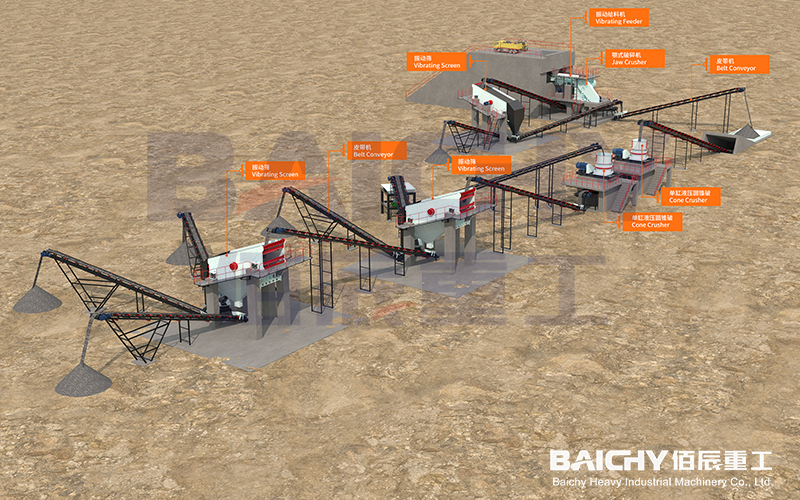
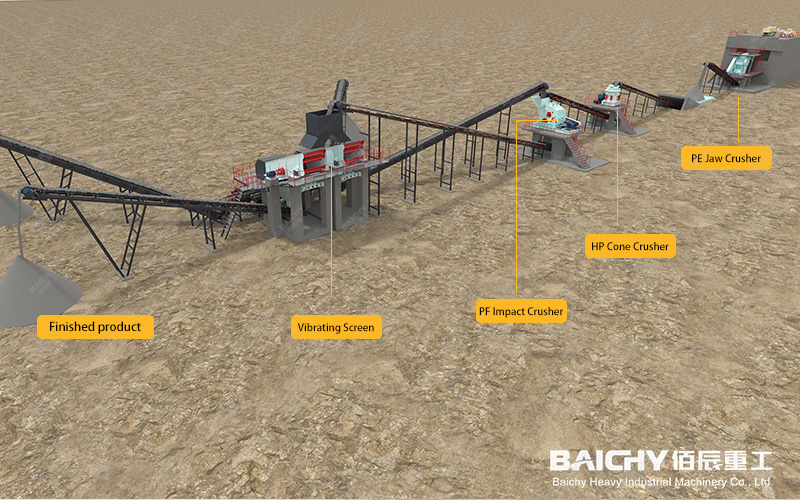
A 150 tph hard rock crushing line is built as a three-stage compression circuit: a PE600x900 jaw crusher published at 90-180 t/h, a CH430 single-cylinder cone crusher published at 69-208 t/h, and 3YK2160 screens cutting 0-5 mm, 5-10 mm, 10-20 mm and 20-40 mm aggregate. Granite and basalt feed of up to 500 mm is the design case Baichy publishes for this capacity band.
Site and Material Conditions Behind a 150 tph Hard Rock Line
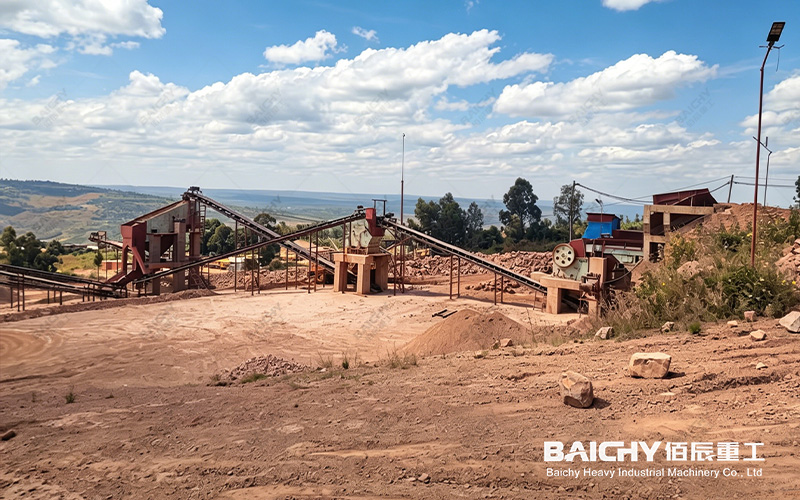
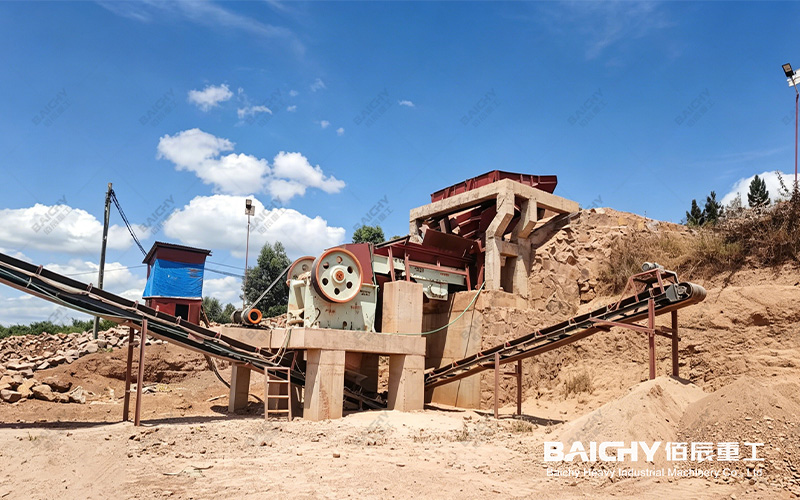
Three published figures decide the configuration of a 150 tph hard rock line: the top size of the feed, the compressive strength of the rock, and the product sizes the local market buys. Baichy covers this band with a 100-150 tph stone crusher plant and an installed granite reference line in East Africa.
| Condition | Published value | Published source |
|---|---|---|
| Material | Granite, basalt, river pebble (hard rock) | 100–150 tph plant page; East Africa case |
| Maximum feed size | 500 mm | PE jaw crusher page; 100–150 tph plant page |
| Jaw stage output | About 150–200 mm | East Africa granite case page |
| Product sizes | 0–5 mm, 5–10 mm, 10–20 mm, 20–40 mm | East Africa granite case page |
| Target capacity | 100–150 t/h, published as 800–1,200 tons per shift | 100–150 tph plant page |
| Compressive strength | Up to 350 MPa (Symons cone); up to 320 MPa (PF impact series) | Symons cone page; impact crusher page |
| Power supply | [To be confirmed] site voltage and frequency | To be confirmed per project |
| Dust control | Pulse-jet baghouse, emissions under 20 mg/m³ | 100–150 tph plant page |
Product grades are set by the screen decks, not by the crusher. The 100-150 tph plant page publishes 20-31.5 mm as its coarse cut, while the East Africa granite case publishes 20-40 mm on the same equipment train, so treat the gradation as a project decision rather than a fixed plant property.
150 tph Hard Rock Aggregate Crushing Line at 0-40 mm Output
What Does Hard Rock Demand from a 150 tph Line?
Hard rock changes two decisions in a 150 tph line: the secondary stage is a cone crusher rather than an impact crusher, and the circuit is closed so oversize returns to that cone. Both changes follow from abrasion and from product shape, not from capacity.
Why a Cone Crusher Instead of an Impact Crusher at 150 tph
A cone crusher reduces rock by laminar compression between a mantle and a bowl liner. Baichy publishes two consequences on the symons cone crusher page: the cubical proportion in the product rises, and needle-like particles are reduced. The same page publishes suitability for materials with compressive strength up to 350 MPa, and lists granite among the reference applications.
The PF series impact crusher is published for medium-hard materials with compressive strength not higher than 320 MPa. Baichy's impact crusher selection guidance separates soft rock (limestone, coal gangue) from hard rock (granite, basalt), and points hard rock at a high-chromium alloy hammer configuration rather than a standard one. For a 150 tph granite line, the compression route removes that wear question entirely.
What Feed Size Should the Jaw Stage Accept?
The PE600x900 jaw crusher is published with a 600 x 900 mm feed opening, a 500 mm maximum feed size and a discharge range of 60-125 mm. A 500 mm top size is therefore the working limit of the jaw stage in a 150 tph hard rock line, and the figure to measure is the top size that actually leaves the loader bucket, not the deposit's nominal gradation.
Where the Closed Circuit Changes the Tonnage
Screen oversize returns to the cone, so the circulating load on the secondary stage, not the jaw's throughput, sets finished tonnage. The 100-150 tph plant page publishes closed-circuit operation as the mechanism that keeps material utilisation and output per shift up. The East Africa granite plant runs two screens in tandem — one cuts aggregate after the cone, the second sizes sand after the sand maker.
Equipment Configuration for a 150 tph Hard Rock Line
Every figure below is published on the corresponding Baichy product page for the named model; the configuration follows the 100-150 t/h band on the plant page and the installed East Africa granite reference line.
| Stage | Machine | Model | Published capacity | Motor | Product or setting |
|---|---|---|---|---|---|
| Feeding | ZSW vibrating feeder | ZSW-1100×4200 (plant page names ZSW1149; case page names ZSW1142) | 200–430 t/h | 15 kW | Max feed 1,000 mm |
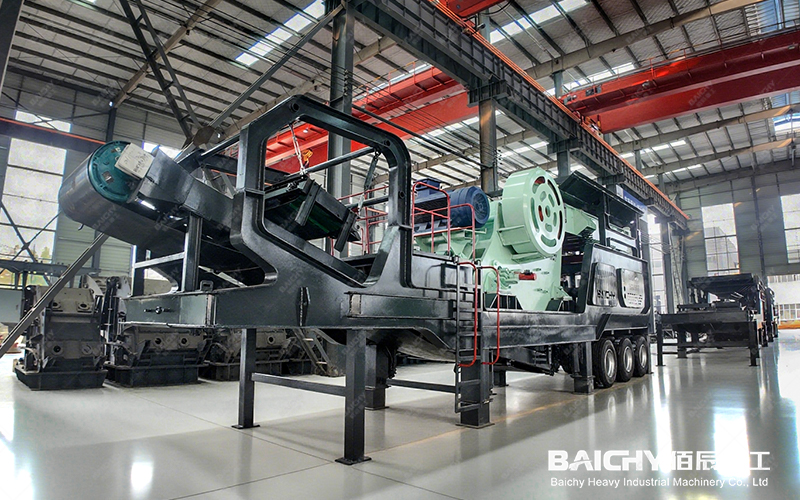
| Primary | Jaw crusher | PE600×900 | 90–180 t/h at CSS 60–125 mm | 55 kW | 500 mm max feed |
| Secondary | Single-cylinder hydraulic cone | CH430 (DG200), extra coarse cavity | 69–208 t/h at CSS 13–38 mm | 160 kW | 185 mm max feeding |
| Tertiary, optional | VSI sand making machine | VSI-9526 | 150–190 t/h centre feeding | 2 × 132 kW | Hard material feed under 40 mm |
| Screening | YK circular vibrating screen | 3YK2160 | 81–720 t/h | 30 kW | 3 decks, 6,000 × 2,100 mm |
| Conveying | Belt conveyor | 800 mm belt | 120–200 t/h at 1.3–1.6 m/s | 5.5–30 kW | Between every stage |
| Dust control | Pulse-jet baghouse | [To be confirmed] | Emissions under 20 mg/m³ | [To be confirmed] | Published on the plant page |
Two notes on the table. The feeder is published as ZSW-1100x4200 (trough 1,100 x 4,200 mm) on the ZSW vibrating feeder page, while the 100-150 tph plant page writes ZSW1149 and the East Africa case page writes ZSW1142 for the same duty — confirm the final model code on the quotation. The optional VSI stage is the sand-making variant of this line, not a requirement of a pure aggregate line.
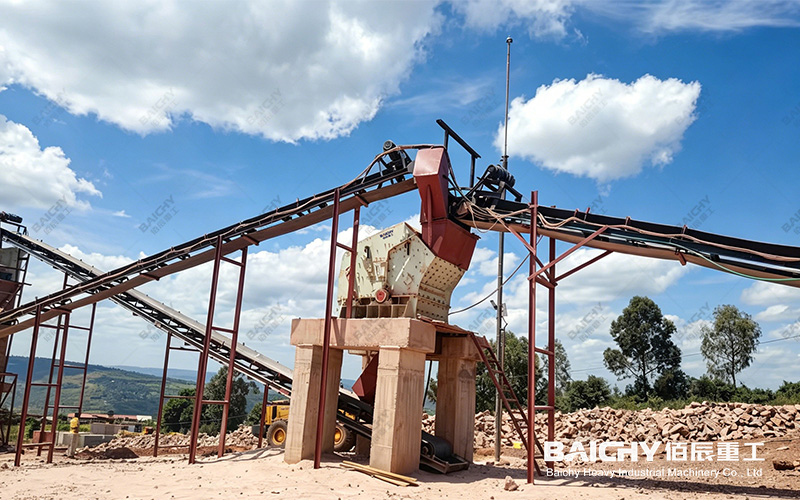
aggregate crushing plant configuration
Which Secondary Crusher for 150 tph of Granite: Cone or Impact?
Five secondary machines are published inside the capacity band a 150 tph hard rock line needs, and the deciding variable is abrasion resistance rather than throughput. The table below lists every option with its published figures.
| Secondary option | Model and cavity | Published capacity | Setting range | Motor |
|---|---|---|---|---|
| Single-cylinder hydraulic cone | CH430 (DG200), extra coarse | 69–208 t/h | CSS 13–38 mm | 160 kW |
| Multi-cylinder hydraulic cone | HP200, extra coarse | 145–250 t/h | Min discharge 19 mm | 160 kW |
| Symons cone | CS160, coarse | 172–349 t/h | CSS 19–50 mm | 160 kW (baichy.com) / 132 kW (baichychina.com) |
| Spring cone | PYB-1200 | 110–200 t/h | Outlet 20–50 mm | 110 kW |
| Impact | PFW-1315 | 130–220 t/h | Max feed 350 mm | 200 kW |
The single-cylinder CH430 cone crusher is the secondary stage in Baichy's installed 150 t/h granite reference plant. Its capacity band of 69-208 t/h covers 150 t/h with the extra coarse cavity at CSS 13-38 mm, and the hydraulic support system adjusts the discharge opening under load, so the finished cut can be moved without stopping the line.
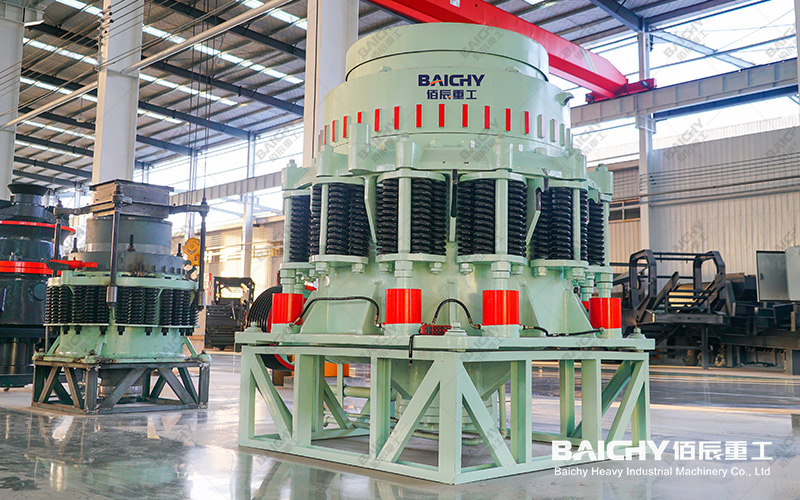
Symons Cone Crusher
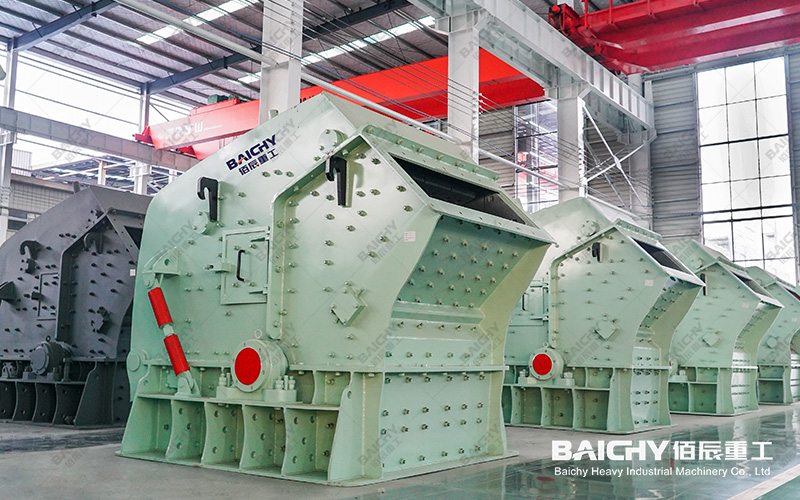
PF Impact Crusher
The HP200 multi-cylinder cone crusher and the Symons CS160 are the published alternatives when the buyer wants a wider setting range or more reserve capacity. The PFW-1315 impact crusher is published at 130-220 t/h with a 350 mm maximum feed, which sits in the right capacity band but leaves the wear question of an abrasive granite feed open.
Abrasion, not strength, decides the wear bill. Before a wear-part grade is named for a granite or basalt line, Baichy asks for the Los Angeles abrasion loss of the deposit and its measured compressive strength; without those two measured numbers, a wear cost per ton for the deposit is an assumption rather than a calculation.
Do You Need a VSI Stage for Manufactured Sand?
Only add the VSI stage if the market buys manufactured sand: the 150t/h granite plant in East Africa runs a VSI9526 after the cone for exactly that reason, and the sand stage needs its own screen.
The VSI-9526 sand making machine is published at 150-190 t/h with centre feeding and 300-360 t/h with cascade plus centre feeding, a rotor speed of 1,360-1,510 r/min, 2 x 132 kW of motor power and a maximum hard-material feed size under 40 mm. In the East Africa plant the VSI takes cone output and works rock-on-rock, which is the stage that produces the manufactured sand fraction.
Where the market buys only coarse and fine aggregate, the same jaw and cone train runs without the VSI, and the plant becomes a two-stage circuit with one screen.
Site Layout, Foundations and Conveying
The 100-150 tph band is published as a modular structure that installs with minimal civil work, so the layout follows each machine footprint rather than a fixed building. Three published dimensions set the envelope: the PE600x900 jaw crusher occupies 2,500 x 2,010 x 2,350 mm, the 3YK2160 screen surface measures 6,000 x 2,100 mm, and the plant page publishes 800 mm wide belt conveyors for inter-stage transfer.
Foundation load in t/m2, plant footprint in m2 and transformer capacity in kVA are set by the final layout drawing and are marked [待确认] here because Baichy does not publish a per-capacity figure. Dust control is a pulse-jet baghouse published at under 20 mg/m3 of emissions on the plant page, with enclosed conveyors.
What Changes If the Capacity or the Material Changes
Two substitutions move this configuration to an adjacent duty, and both are published in the same ranges. Moving up in capacity sets the primary stage to a PE750x1060 jaw crusher (110-380 t/h at CSS 60-150 mm, 110 kW) and the secondary stage to a CS220 cone crusher (210-530 t/h with the coarse cavity) or an HP300 cone crusher (220-445 t/h with the extra coarse cavity).
Switching from granite to limestone opens the impact route, because the PF series is published for materials up to 320 MPa and the 100-150 tph plant page lists an impact crusher as a secondary option for the same band.
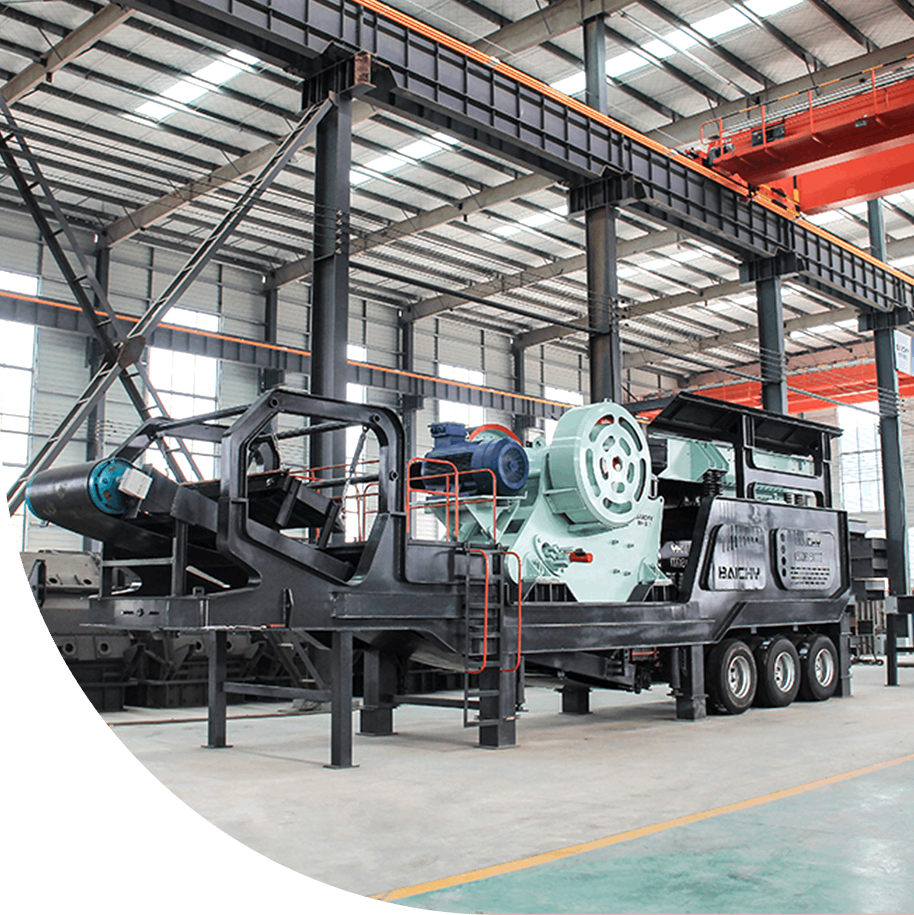
Where the deposit is small or the site moves, the same band is published as mobile plant, for example the 150tph Mobile Stone Crusher Plant In Namibia for granite at 100-150 tph, and the 150 tph Mobile Basalt Crusher Plant in Honduras at 100-150 tph.
FAQ: 150 tph Hard Rock Crushing Line
How many crushing stages does a 150 tph hard rock crushing line need?
A 150 tph hard rock crushing line normally runs three stages: jaw crushing, cone crushing and screening, with a VSI stage added only if manufactured sand is part of the product mix. A two-stage jaw and cone circuit is published for the same capacity where the market buys coarse and fine aggregate only.
What is the maximum feed size for a 150 tph granite crushing plant?
The PE600x900 jaw crusher is published with a 500 mm maximum feed size against a 600 x 900 mm feed opening and a 60-125 mm discharge range. Measure the top size on the material leaving the loader bucket, since bucket spillage and deposit gradation both affect what reaches the jaw.
Should I use a cone or an impact crusher as the secondary stage at 150 tph?
Use a cone crusher for granite and basalt. A cone crusher reduces rock by laminar compression and is published for materials up to 350 MPa, while the PF impact series is published for materials up to 320 MPa and needs a high-chromium alloy hammer configuration on hard rock.
Which vibrating screen size suits 0-5, 5-10, 10-20 and 20-40 mm aggregate?
The 3YK2160 three-deck circular vibrating screen is published at 81-720 t/h with a 6,000 x 2,100 mm screen surface, 30 kW of motor power and a double amplitude of 5-9 mm. Three decks give three cuts in one pass, and oversize returns to the cone in closed circuit.
Can a 150 tph hard rock line also produce manufactured sand?
Yes. Adding a VSI-9526 after the cone stage is the published configuration of Baichy's 150 t/h granite plant in East Africa. The VSI-9526 is published at 150-190 t/h with centre feeding and 300-360 t/h with cascade plus centre feeding, and needs a second screen for sand sizing.
What information do I need to send for a 150 tph crushing line quotation?
Send the material type, the maximum feed size in mm, the target capacity in t/h, the product sizes in mm, and the site power supply in V and Hz. Baichy prices a crushing line by configuration rather than publishing a list price, because the screen decks, belt lengths and wear-part grade each move the figure.
Baichy Heavy Industry
Baichy Heavy Industry is a high-tech mining equipment company integrating R&D, manufacturing, sales, and after-sales service. Focusing on crushing, grinding, and mineral processing equipment, we provide professional solutions to our customers. We are ISO9001:2015 、certified, and our products include mobile crushing palnts, crawler crushing plant, construction waste crushing plants, jaw crushers, sand making machines, cone crushers, fine crushers, grinding mills, ball mills, etc., all with reliable performance to meet diverse project needs.
Baichy Heavy Industry – Your Trusted Partner
To ensure optimal performance of your equipment, Baichy Heavy Industry offers:
- Professional on-site installation guidance
- Comprehensive operator training
- 24/7 technical support & maintenance services
Our complete after-sales service system guarantees long-term, stable operation of your machinery with minimal downtime.
Protect Your Rights – Only Use Official Channels
To avoid scams and ensure authentic support, contact us exclusively through:
• Official Website: www.baichychina.com
• WhatsApp: +8615093222637
• Email: [email protected]
Your satisfaction is our priority – expect prompt, professional service every time.
(Note: Beware of unauthorized third parties claiming to represent Baichy. Always verify through official contacts.)