
300–350 t/h Basalt Crushing Production Line
Based on our preliminary discussions, your specific requirements are as follows:
Project Plan: Stone crushing line with an hourly output of 300 tons
Raw Material: Basalt
Raw Material Specifications: Feed size up to 60 cm
Finished Product Requirements: Four distinct output sizes suitable for concrete batching plants; the complete solution targets the following aggregate gradations: 0–5 mm, 5–10 mm, 10–20 mm, and 20–31.5 mm.
Project Plan: Stone crushing line with an hourly output of 300–350 tons
| NO. | Equipment Name | Equipment Model | Powder |
| 1 | Vibrating feeder | ZSW1300×4900 | 22 |
| 2 | C Series Jaw Crusher | C125 | 160 |
| 3 | Motorized Vibrating Feeder | GZG125-4 | 2x1.5 |
| 4 | Motorized Vibrating Feeder | GZG100-4 | 2x1.1 |
| 5 | CH Cone Crusher | CH440 | 220 |
| 6 | HP Cone Crusher | HP300 | 220 |
| 7 | Vibraing Screen | 2YK3070 | 37 |
| 8 | Vibraing Screen | 2YK3070 | 37 |
Process Overview:
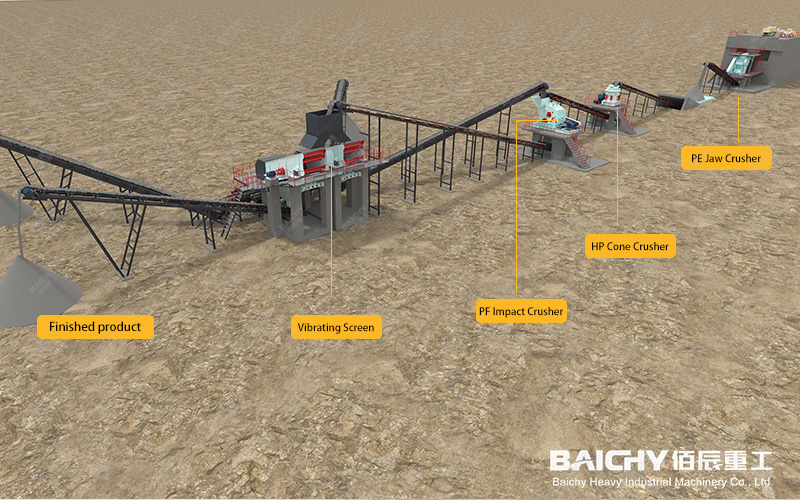
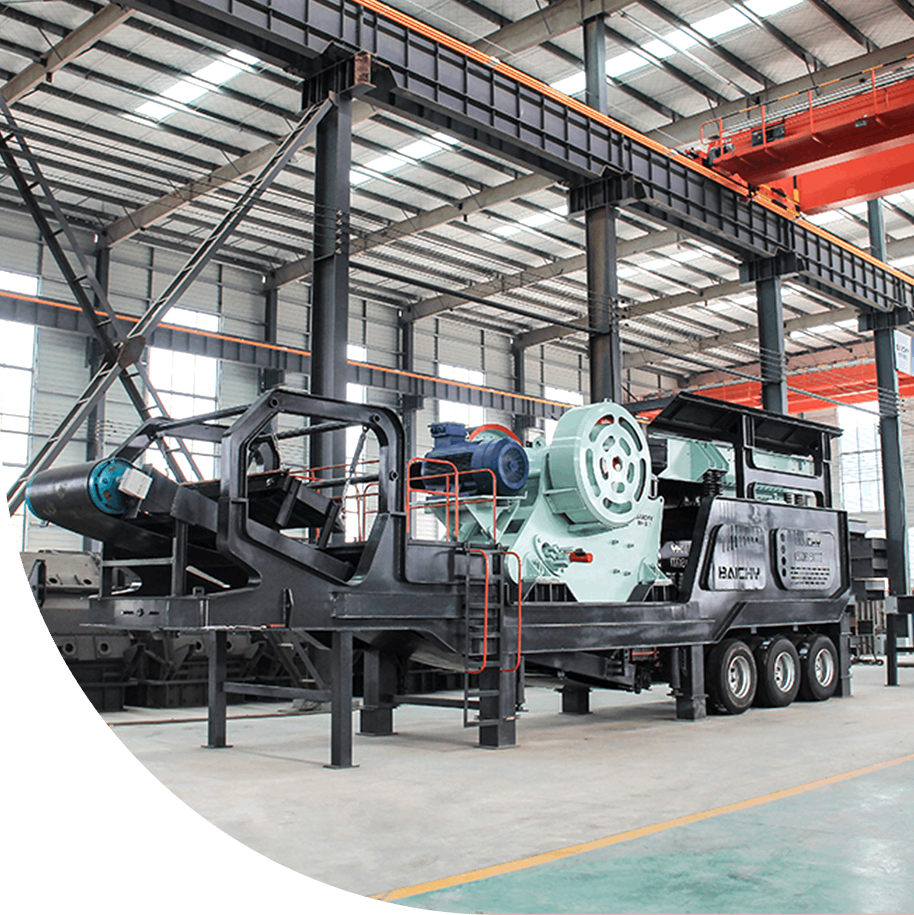
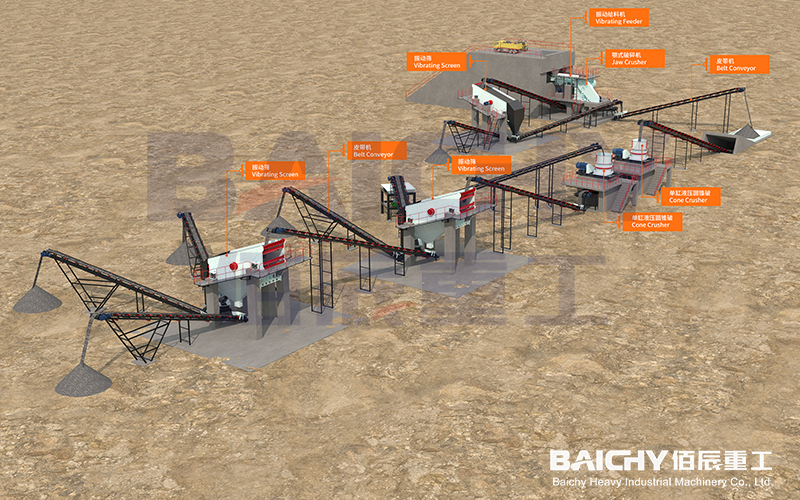
The designed crushing capacity is 300–350 tons per hour. The primary material to be crushed is basalt rock. The core equipment configuration consists of a jaw crusher, two hydraulic cone crushers, and two vibrating screens. This setup is characterized by high wear resistance, high operational efficiency, and a low frequency of wear-part replacement. Our company's proprietary European-style jaw crushers and cone crushers possess exceptional crushing capabilities, resulting in finished aggregates with excellent particle shape and ensuring high overall production output.

Baichy E-Catalog PDF,Download ↓↓↓
I. The Pivotal Role of Basalt Aggregate in Infrastructure Engineering
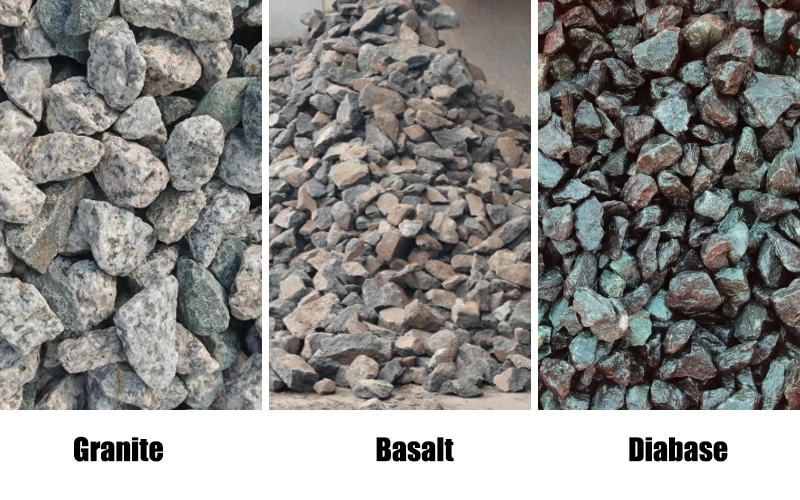
Hrad Srone : Granite/ Basalt / Diabase
As a type of basic extrusive igneous rock, basalt has become the preferred coarse aggregate for highways, bridges, and high-performance concrete (C50/C60+) applications. This preference stems from its superior physical properties, including high compressive strength, low crushing value, minimal abrasion loss, and extremely low water absorption rate. However, given that its Mohs hardness typically ranges between 5 and 7—and due to its high silica content—basalt is classified as a material of inherently high hardness and high abrasiveness. In the planning of large-scale production lines with an hourly output of 300–350 tons, balancing "high output" with "low energy consumption/low wear" is the core issue of greatest concern to investors. Based on the practical requirements of processing 60cm feed material and producing four distinct finished product specifications, this article will break down this "Golden Combination" for hard rock crushing.
II. Raw Materials and Finished Products: A Rigorous Clash of Supply and Demand
• Raw Material Challenges: The feed particle size reaches up to 600mm (60cm), meaning that the primary crushing stage (coarse crushing) must possess an exceptionally large intake opening and immense crushing force.
• Finished Product Standards: Commercial concrete mixing plants impose extremely stringent requirements regarding aggregate gradation. The four particle sizes designed for this solution (0–5mm, 5–10mm, 10–20mm, and 20–31.5mm) must cover the full spectrum from fine aggregates to coarse aggregates; furthermore, the content of flaky and elongated particles must be strictly controlled within a range of 5% to 8%.
III. Detailed Analysis of Core Equipment: The "Overwhelming Advantage" of European-Style Jaw Crushers and Hydraulic Cone Crushers
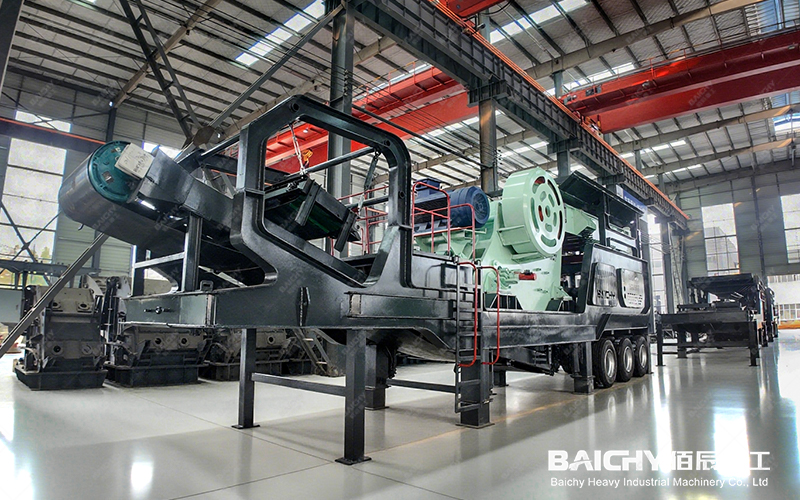
3.1 European-Style Jaw Crusher: The Powerhouse of the Coarse Crushing Stage
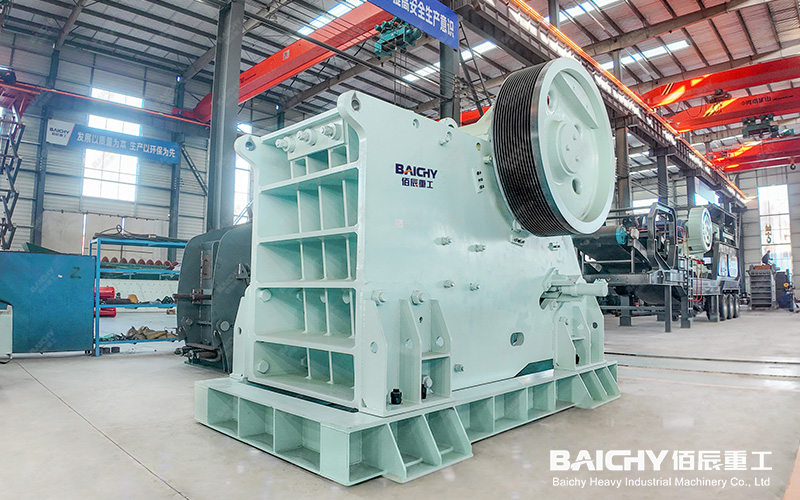
European-Style Jaw Crusher
When confronted with "boulders" measuring 60cm, standard jaw crushers often encounter issues such as material regurgitation and structural fatigue. The European-style jaw crusher series we have selected offers the following technical advantages:
• V-shaped Crushing Chamber Structure: The actual feed opening width corresponds precisely to the nominal width, thereby maximizing the crushing ratio.
• Integrated Cast Steel Bearing Housing: This component fits seamlessly with the machine frame, enhancing the radial strength of the bearing housing and ensuring rock-solid stability—even when crushing extremely hard materials such as basalt.
• Automated Adjustment: The discharge opening is adjusted using a wedge-block mechanism; this method is significantly faster than traditional shim-based adjustment, thereby substantially reducing maintenance downtime.
3.2 Dual Hydraulic Cone Crushers in Parallel Configuration: Balancing Efficiency and Cost
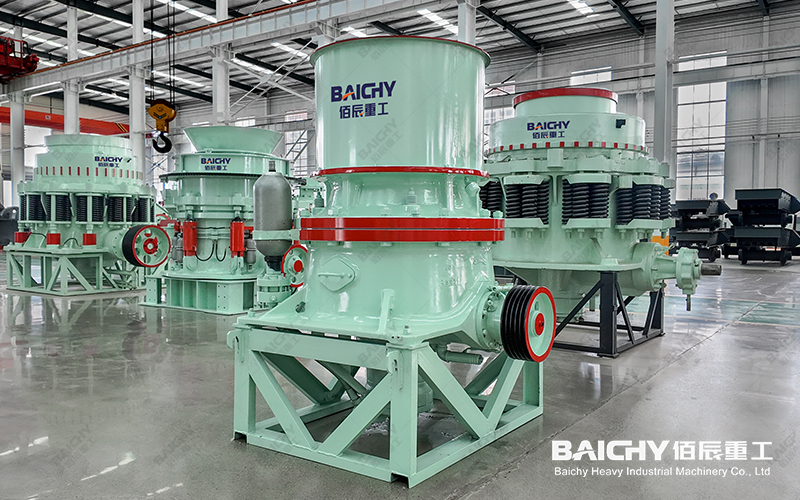
Hydraulic Cone Crushers
At a throughput rate of 300–350 tons per hour (tph), a single cone crusher often operates precariously close to the brink of overload. The decision to employ two hydraulic cone crushers in parallel is based on a dual consideration of "flexible production" and "economic efficiency":
• Laminated Crushing Principle: Cone crushers utilize a "stone-on-stone" laminated crushing mechanism; the resulting aggregate is predominantly cubical in shape, offering superior particle shape compared to traditional compression crushing methods.
• Hydraulic Cavity Clearing and Protection: During the crushing of basalt, the entry of uncrushable objects (such as metal parts) is inevitable. The hydraulic protection system automatically ejects these foreign objects and enables "one-touch" cavity clearing, thereby significantly reducing the intensity of manual maintenance.
• Optimized Wear Part Lifespan: To address the highly abrasive nature of basalt, the cone crusher liners are fabricated from specialized high-manganese steel. This material, combined with an optimized crushing chamber design, ensures more uniform wear; consequently, the service life of a single set of liners is extended by 4 to 6 times compared to those used in impact crushers.
IV. Process Flow: Closed-Circuit Circulation and Precise Screening
Raw materials are fed into a European-style jaw crusher for primary crushing after passing through a ZSW series vibrating feeder, which removes soil and fines. The semi-finished product from the primary crushing stage is transported via conveyor belt to an intermediate stockpile (serving as a buffer), before entering the two hydraulic cone crushers. The discharge from the cone crushers is directed into two large, parallel-mounted circular vibrating screens. Any oversized, non-conforming material (larger than 31.5 mm) is returned to the cone crushers, establishing a closed-circuit crushing loop.
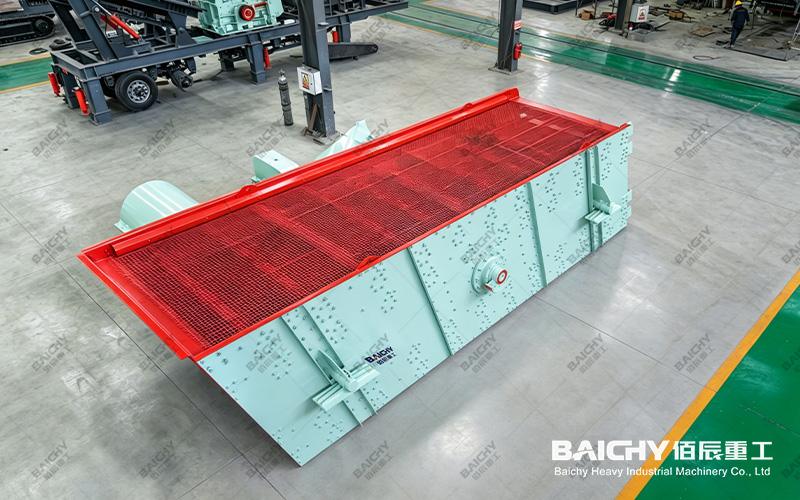
Vibrating Screen
• First Screen Deck: Separates 20–31.5 mm aggregate;
• Second Screen Deck: Separates 10–20 mm aggregate;
• Third Screen Deck: Separates 5–10 mm aggregate;
• Undersize Material: Consists of high-quality manufactured sand ranging from 0 to 5 mm.
V. Economic Analysis: Why is this Configuration "Cost-Effective"?
Although the initial capital investment for cone crushers is higher than that for impact crushers, consider the example of basalt: the blow bars in an impact crusher may require replacement every 2 to 3 days, whereas the liners in a cone crusher can last for 2 to 3 months. Over the long term, the maintenance cost per ton of processed stone can be reduced by 30% to 50%.
Frequently Asked Questions (FAQ)
1. Why are impact crushers not recommended for crushing basalt?
Answer: Basalt is extremely hard. Impact crushers process material through high-speed impact; consequently, the direct collision between the blow bars and the hard rock results in severe wear and tear. Using an impact crusher for this application leads to frequent replacement of wear parts, high production line downtime, and an extremely uneconomical cost per ton.
2. What specific requirements does a 60 cm feed size impose on a jaw crusher?
Answer: A 60 cm feed size requires the jaw crusher's feed opening to measure at least 750 mm (e.g., models such as the PEW860 or PE900x1200). We recommend utilizing a European-style jaw crusher, as its deep crushing chamber and absence of "dead zones" prevent large blocks from "bridging" across the chamber opening, thereby avoiding blockages.
3. Why does the proposed solution specify two cone crushers rather than a single large one?
Answer: A parallel configuration offers greater operational flexibility. When one cone crusher undergoes routine maintenance (such as an oil change or minor repairs), the other unit can continue to operate at 50–60% of full capacity, ensuring an uninterrupted supply of material. Furthermore, two medium-sized machines allow for more precise control over product gradation compared to a single, oversized machine.
About of Baichy Heavy Industry
Baichy Heavy Industry is a high-tech mining equipment company integrating R&D, manufacturing, sales, and after-sales service. Focusing on crushing, grinding, and mineral processing equipment, we provide professional solutions to our customers. We are ISO9001:2015 、certified, and our products include mobile crushing palnts, crawler crushing plant, construction waste crushing plants, jaw crushers, sand making machines, cone crushers, fine crushers, grinding mills, ball mills, etc., all with reliable performance to meet diverse project needs.
Our advantages:
• Professional pre-sales support: Free project design and comprehensive solutions to help you accurately select the right equipment;
• Comprehensive on-site service: Providing installation guidance and worker training to ensure smooth equipment commissioning;
• Reliable after-sales guarantee: A complete after-sales system, timely response to technical inquiries and equipment maintenance, ensuring long-term stable operation.
To protect your rights, please contact us through the following official channels for professional service:
Official Website Customer Service
https://wa.me/+8615093222637
Email: [email protected]
We are committed to providing high-quality equipment and full-cycle services to deliver comprehensive intelligent solutions for the global mining industry!