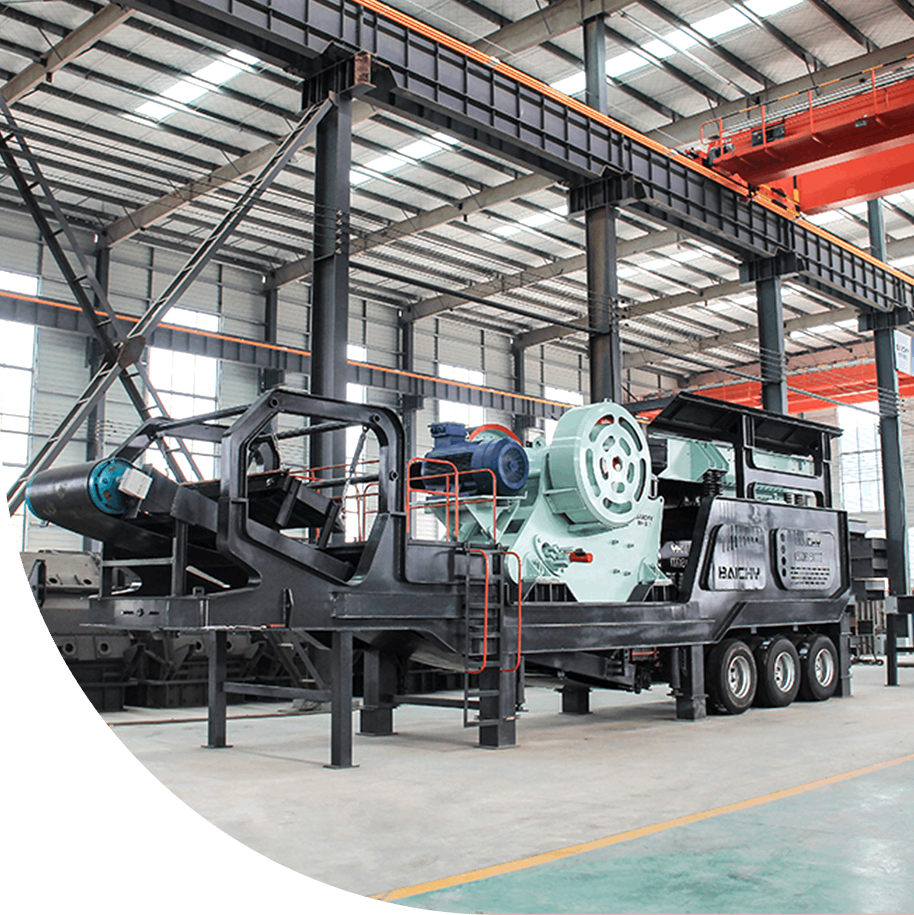

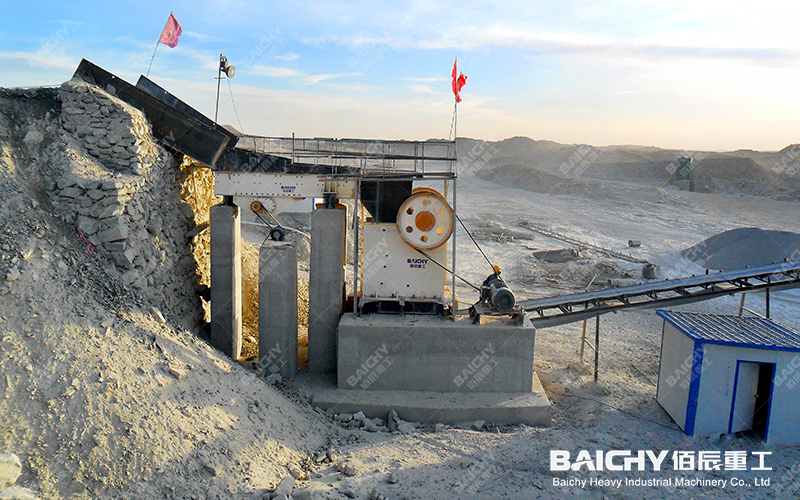
100–130 t/h Crushing and Screening Production Line Configuration
For a crushing and screening production line with an hourly capacity of 100–130 tons, the initial decision point lies not with the equipment itself, but with the capacity categories: the standard stationary production lines are classified into 80–120 t/h and 120–150 t/h tiers, and the 100–130 t/h range straddles the 120 t/h piding line. Once the range is determined, the configuration actually becomes straightforward: both tiers utilize the same PE600×900 jaw crusher for primary crushing (rated at 90–180 t/h, with a maximum feed size of 500mm and 55kW installed power)—neither tier requires the larger PE750×1060 model. The only point of pergence is the secondary crushing stage: the 80–120 t/h tier is equipped with a CS110 cone crusher, while the 120–150 t/h tier uses a CS160 cone crusher.
I. The 100–130 t/h range is a transitional zone between two tiers, not a distinct capacity category itself.
Standard stationary crushing and screening lines are categorized into eight capacity tiers: 30–50, 50–80, 80–120, 120–150, 150–200, 200–250, 250–300, and 500–600 t/h. The 100–130 t/h range does not fall squarely into any single tier; its lower end overlaps with the 80–120 t/h tier, its upper end touches the 120–150 t/h tier, and the entire range straddles the 120 t/h mark. Consequently, the debate regarding equipment selection for this line begins with the question: "Should we base the configuration on the 100 t/h figure or the 130 t/h figure?"
The process involves first determining the design capacity point, and then selecting the corresponding tier. For the 200 t/h capacity tier, the official website specifies a design margin: to ensure a stable output of 200 t/h, equipment is typically designed with a capacity of approximately 220–250 t/h. This translates to a multiplier of 1.10 to 1.25 (i.e., 220 &pide; 200 = 1.10 and 250 &pide; 200 = 1.25). Applying the same formula to a 130 t/h finished product target yields a required design capacity of 143–162.5 t/h (130 × 1.10 = 143; 130 × 1.25 = 162.5). Note: This margin figure originates from the official website's case study on a 200 t/h coal gangue processing line; the derivation here follows the same logic but does not constitute an official commitment regarding the 130 t/h line.
The direction is clear: the design point should be set at the upper limit of the range (130 t/h) rather than the midpoint or the lower bound. The range spans 30 tons (130 − 100 = 30); by sizing for 130 t/h, operations remain within limits across the entire range. Conversely, if sized for 100 t/h, an increase in output beyond 120 t/h would result in both the secondary crusher and the screening machine becoming undersized for the load.
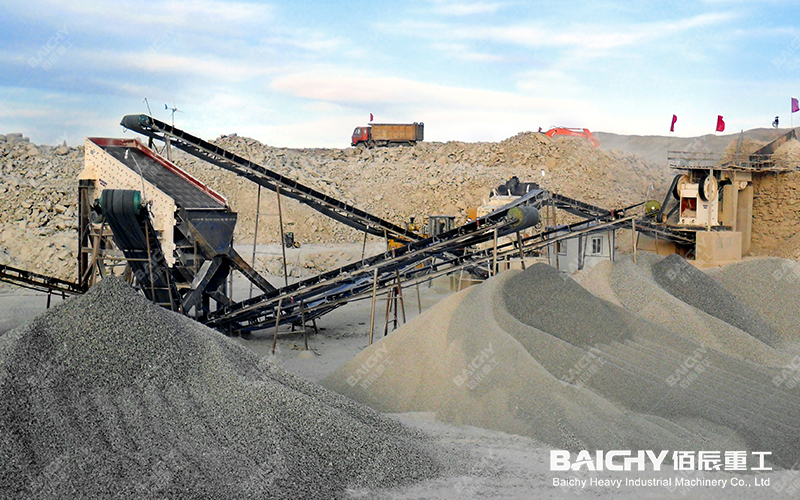
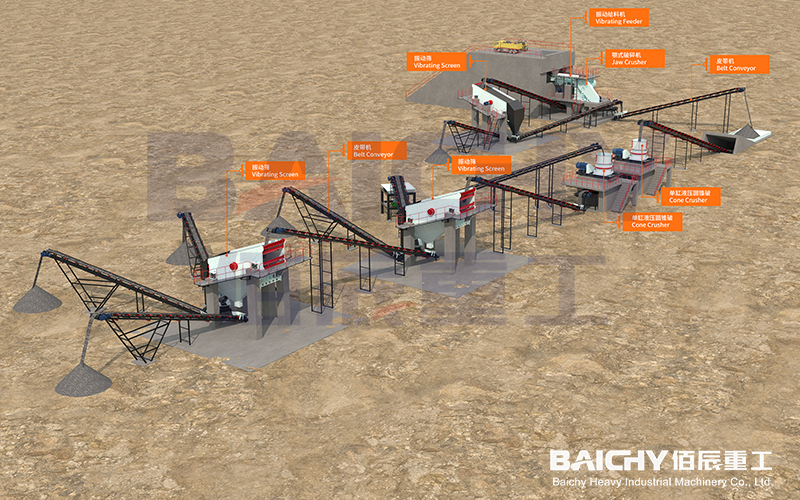
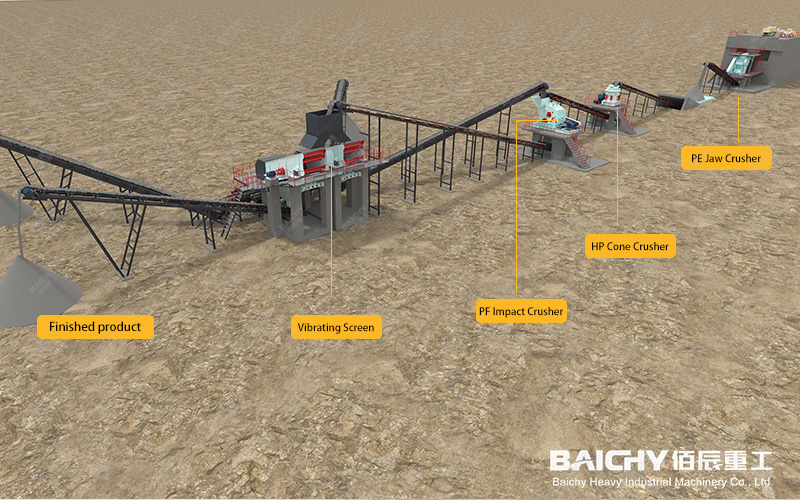
Crushing and screening production line
II. No Change in Primary Crusher Model: Both Tiers Start with the PE600×900
The primary equipment lists for both the 80–120 t/h and 120–150 t/h tiers begin with the same model: the PE600×900 jaw crusher. Both tiers also specify a maximum feed size of ≤500 mm. The listed specifications include a feed opening of 600×900 mm, a maximum feed size of 500 mm, a discharge opening of 60–125 mm, a rated capacity of 90–180 t/h, and a motor power of 55 kW. Stepping down a tier, the primary crusher for the 50–80 t/h range is the PE500×750 (rated at 40–130 t/h); stepping up, the 150–200 t/h range requires upgrading to the PE750×1060 (rated at 110–380 t/h; max feed size: 630mm; installed power: 110kW). Across the entire production range from 80 to 150 tons, a single jaw crusher model suffices.
The reason lies in the numerator of the calculation: a primary crusher processes the feed input, and the upper limit of this input is determined by design capacity. The 143–163 t/h range falls within the PE600×900’s rated interval of 90–180 t/h, leaving a margin of 17 t/h (180 − 163) at the upper end; conversely, the PE500×750’s upper limit of 130 t/h sits exactly at that design point (130 &pide; 130 = 1.00, zero margin), meaning any increase beyond that necessitates a model change.
What truly dictates whether to switch models is not the production volume itself, but the hard constraint of the 500mm feed opening: if blasted rock fragments exceed 500mm, one must upgrade to the PE750×1060 (with a 630mm feed limit), regardless of how low the production volume is. This is the jaw crusher most prone to incorrect upgrade decisions on this type of production line.
Standard configurations found on the Chinese site align with this conclusion: for both limestone and diabase lines in the 100–120 t/h range, the primary crusher is the PE600×900 (paired with a 9638 feeder), while the secondary crushing stages utilize the PF1214 impact crusher and CS110 cone crusher, respectively—meaning that for the same production tier and primary crusher, the difference lies solely in the secondary stage. While the specific numerical metrics for the two plants are not interchangeable, the structural assessment remains consistent.
III. The Deciding Factor for the Secondary Stage: CS110 or CS160?
The choice of the secondary stage unit represents the only real point of pergence for the 100–130 t/h capacity requirement. The rated capacities for CS series cone crushers vary by crushing chamber configuration: the CS110 (Medium chamber) is rated at 80–180 t/h (max feed size ≤130 mm, 110 kW motor), while the Coarse chamber is rated at 110–250 t/h (max feed size ≤180 mm); the CS160 (Medium chamber) is rated at 132–253 t/h (max feed size ≤178 mm, 132 kW motor), while the Coarse chamber is rated at 172–349 t/h (max feed size ≤205 mm). The allocation between the two tiers is clear-cut: the 80–120 t/h range pairs with the CS110, while the 120–150 t/h range pairs with the CS160.
Comparing this against the design requirement of 143–163 t/h: the CS110 Medium chamber’s upper limit of 180 t/h is sufficient, though the middle of its operating range is somewhat tight; conversely, the CS160 Medium chamber’s lower limit of 132 t/h sits right near the 130 t/h design target, with its full 132–253 t/h range covering the design requirements. This illustrates the practical difference between operating at the upper versus lower ends of a capacity range: if the design target is 100 t/h, the CS110 offers ample headroom; if the target is 130 t/h, the CS160 is the appropriate choice.
One additional technical detail must be pinned down: the secondary stage processes not just the final product output, but the total feed entering the screen—comprising the primary crusher's discharge plus the recirculated oversize material—meaning the actual load is inherently higher than the final product output. The official English website’s page for the YK circular vibrating screen cites an efficiency improvement of "over 15%"—a figure representing the gain relative to similar products rather than an absolute efficiency value; attempting to deduce the recirculation ratio from this figure would lead to an incorrect calculation of the circulating load. The official website does not disclose the material recirculation ratio for this line; therefore, this report introduces no self-derived percentages and instead provides a comparative benchmark: based on the design requirement of 143–163 t/h, the CS110 is adequate at the upper end of the range but tight in the middle, whereas only the CS160 offers sufficient margin.
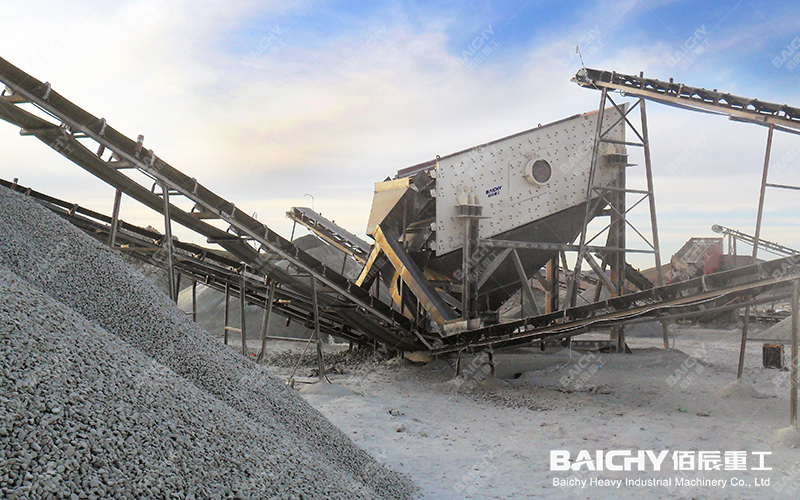
circular vibrating screen
IV. Configuration Table for 100–130 t/h Crushing and Screening Production Line
Two process routes are listed side-by-side; the "Criteria" column indicates the basis for model selection:
| Process | Model | Quantity | Power (kW) | Role of Criteria in the Production Line |
|---|---|---|---|---|
| Feeding | ZSW960×3800 | 1 | 11 | Rated capacity 120–210 t/h, max feed size 820 mm; covers the 500 mm feed limit and the 143–163 t/h design requirement; ZSW850×3000 has a 120 t/h limit, which is below the design point. |
| Primary Crushing | PE600×900 | 1 | 55 | Rated capacity 90–180 t/h, max feed size 500 mm, discharge opening 60–125 mm; both capacity tiers use this model; upper margin is 180 − 163 = 17 t/h. |
| Secondary/Fine Crushing (Route A: 80–120 t/h tier) | CS110 (Medium Cavity) | 1 | 110 | Medium cavity rated at 80–180 t/h, feed size ≤130 mm; sufficient for the upper end of the 143–163 t/h design requirement, though tight in the middle of the range. |
| Secondary/Fine Crushing (Route B: 120–150 t/h tier) | CS160 (Medium Cavity) | 1 | 132 | Medium cavity rated at 132–253 t/h, feed size ≤178 mm; lower limit of 132 t/h is close to the design point; covers the entire range. |
| Screening (Route A) | 2YK1860 + 3YK1848 | 1+1 | 18.5+18.5 | 80–120 t/h tier configuration; two circular vibrating screens in series for grading; rated capacities of 65–586 t/h and 56–330 t/h. |
| Screening (Route B) | 4YK2160 | 1 | 37 | Official model for the 120–150 t/h range; 4-deck screen, aperture 3–100 mm, rated capacity 81–720 t/h; produces four aggregate gradations in a single pass. |
| Conveying (Main Line) | B800 | Per drawing | 5.5–18.5 | Rated capacity 120–200 t/h; B650 (upper limit 120 t/h) falls below the design point and is suitable only for branch lines. |
| Conveying (Branch Line) | B650 / B500 | Per drawing | 4–15 / 4–11 | Rated capacity 80–120 t/h and 40–100 t/h, corresponding to finished product and material return branch lines, respectively. |
| Installed Power (Route A) | 11+55+110+18.5+18.5 | — | 213 | 11+55+110+18.5+18.5 = 213 kW (excluding conveying and dust removal); 213 ÷ 130 = 1.64 kW/(t·h⁻¹); this is not specific energy consumption per tonne. |
| Installed Power (Route B) | 11+55+132+37 | — | 235 | 11+55+132+37 = 235 kW (excluding conveying and dust removal); 235 ÷ 130 = 1.81 kW/(t·h⁻¹); this is not specific energy consumption per tonne. |
Note: The power column lists the rated installed power of the main equipment; conveyor power varies by section based on conveying length—actual values depend on the process layout drawing. Production capacity is based on official ratings; if material hardness, feed particle size, or moisture/clay content deviate from rated operating conditions, recalculations must be performed based on on-site trial screening data. The figures of 1.64 and 1.81 kW/(t·h⁻¹) in the table represent rated installed power intensity; they are not calculated on the same basis as the official electricity consumption figure of 1.8–1.9 kWh/t, so they cannot be used to cross-derive one another.
V. Screening units determine product sizing; conveyors set the capacity ceiling; secondary stages determine electricity consumption.
It is the number of decks—not the screen unit itself—that becomes the bottleneck. The 4YK2160 is the circular vibrating screen paired with the 120–150 t/h model range: it features four decks, aperture sizes of 3–100 mm, a screening area of 6000×2100 mm, a rated capacity of 81–720 t/h, and 37 kW of installed power, allowing for the simultaneous separation of four product fractions: 0–5 mm, 5–10 mm, 10–20 mm, and 20–31.5 mm. In contrast, the 80–120 t/h range utilizes two circular vibrating screens—a 2YK1860 and a 3YK1848—arranged in series. For this specific crushing and screening line, an input feed rate of 143–163 t/h falls within the lower end of the 81–720 t/h capacity range, meaning the screening surface area is far from being a bottleneck. Investment should be directed toward the number of decks rather than the screen surface area; if there are too few decks, the fourth product fraction can only be obtained through secondary handling, ultimately driving up the cost per ton and compromising aggregate gradation stability.
Conveyor belts represent the only easily underestimated capacity ceiling on this line. Ratings are based on belt width: B500 handles 40–100 t/h; B650 handles 80–120 t/h; B800 handles 120–200 t/h; and B1000 handles 200–320 t/h. Configuring a B650 conveyor for a "130-ton finished product" output creates a bottleneck: the B650's upper limit of 120 t/h falls short of the 130 t/h design target (a deficit of 10 t/h). Consequently, even a high-performance crusher is constrained by the conveyor's capacity. According to official specifications, the B800 model is used for the main lines across both capacity tiers, while B650 and B500 models are reserved for branch lines; pairing a B800 main line with B650/B500 branch lines ensures alignment with the primary equipment's specifications.
Energy savings are cited specifically for the secondary crushing stage. Route A has a total installed power of 213 kW (11+55+110+18.5+18.5), while Route B totals 235 kW (11+55+132+37); the calculated installed power intensities are 1.64 kW/(t·h⁻¹) and 1.81 kW/(t·h⁻¹), respectively. For the 80–120 t/h tier, the manufacturer claims an energy consumption as low as 1.8 kWh/ton, and a granite processing case study in Southeast Asia recorded 1.9 kWh/ton (at an actual output of 85 t/h). While these figures are of the same order of magnitude as the installed power intensity, they represent different metrics: installed power intensity is based on rated power and design output, whereas specific energy consumption (kWh/ton) accounts for actual load factors; thus, one cannot be directly derived from the other. The claim of 15–20% energy savings applies to the same feature in both tiers: for the 120–150 t/h tier, the use of the CS160 model—utilizing inter-particle (lamination) crushing principles combined with a system-wide energy-saving design—reportedly reduces overall energy consumption by 15–20%; similarly, for the 80–120 t/h tier, the CS110 configuration cites a 15–20% energy saving attributed to the hydraulic adjustment system. These energy-saving figures are based on the manufacturer's own standards; actual values vary depending on feed material hardness, feed particle size, and operating conditions. The CS Series cone crusher and the PE600×900 jaw crusher serve different functions at opposite ends of the process; energy efficiency and production capacity must be evaluated separately for each. The same logic applies to the 4YK2160 circular vibrating screen—its role is to determine product sizing and aggregate gradation, not total output.
VI. FAQ: Common Questions Regarding 100–130 t/h Crushing and Screening Lines
Q1: Should a PE750×1060 jaw crusher be used for primary crushing in a 100–130 t/h line?
No, it is not necessary. According to official specifications, the PE600×900 jaw crusher (rated at 90–180 t/h, with a max feed size of 500mm and 55kW motor) is used for both the 80–120 t/h and 120–150 t/h capacity tiers; the upgrade to the PE750×1060 model occurs only at the 150–200 t/h tier. Calculating based on a 130 t/h target with a 1.10–1.25x safety margin results in a design requirement of 143–163 t/h, which falls within the rated range of the PE600×900. The true limiting factor is the 500mm feed opening—a model upgrade should only be considered if the raw material contains large blocks exceeding 500mm or if the required output exceeds 150 t/h.
Q2: For a 130 t/h line, should the secondary cone crusher be the CS110 or the CS160?
Based on the upper limit of the capacity range, the CS160 is the correct choice. The CS110 (medium cavity) is rated for 80–180 t/h, whereas the CS160 (medium cavity) is rated for 132–253 t/h. The official website assigns these two models to specific production capacity ranges: the 80–120 t/h range uses the CS110, while the 120–150 t/h range uses the CS160. A capacity of 130 t/h exceeds the 120 t/h upper limit of the 80–120 t/h range by 8.3%, so it should fall into the 120–150 t/h category....capacity tier. At a design point of 100 t/h, the CS110’s crushing chamber offers ample capacity; if the design point is raised to 130 t/h, the secondary crusher should be a CS160.
Q3: How should the screening equipment be configured to produce four size fractions (0–5, 5–10, 10–20, and 20–31.5 mm) in a single pass?
Use a 4YK2160 circular vibrating screen. The official configuration for the 120–150 t/h tier uses this model: 4 decks, aperture range of 3–100 mm, screen surface area of 6000 × 2100 mm, rated capacity of 81–720 t/h, and 37 kW installed power—capable of separating four fractions at once. The 80–120 t/h tier uses a 2YK1860 and a 3YK1848 in series. Screen capacity is not a bottleneck here—the 143–163 t/h feed rate falls within the lower end of the 81–720 t/h rating range; investment should focus on the number of decks rather than the screen surface area, as the number of decks determines the aggregate gradation fractions, while the surface area only determines throughput.
Q4: Is a B650 conveyor belt suitable for the main line?
No. The B650 is rated for 80–120 t/h; its upper limit of 120 t/h is below the 130 t/h design point. With a deficit of 10 t/h (130 − 120), the conveyor belt would become a bottleneck, rendering the crusher's high performance irrelevant. For both capacity tiers, the official main line specification is B800 (rated 120–200 t/h), while B650 and B500 belts are used only for branch lines.
Q5: What is the electricity consumption per ton for this line?
For the 80–120 t/h model range, the rated specific energy consumption is as low as 1.8 kWh/t; a granite processing project in Southeast Asia recorded an actual figure of 1.9 kWh/t (at an actual output of 85 t/h). The 120–150 t/h range utilizes the inter-particle (lamination) crushing principle of the CS160 cone crusher combined with a system-wide energy-saving design, resulting in a 15–20% reduction in overall power consumption. These figures are based on Baichy's internal standards; actual values vary depending on feed material hardness, feed particle size, and operating conditions. "Installed power intensity" (rated installed power pided by design output) and "specific energy consumption" (kWh/t) are distinct metrics and cannot be derived from one another.
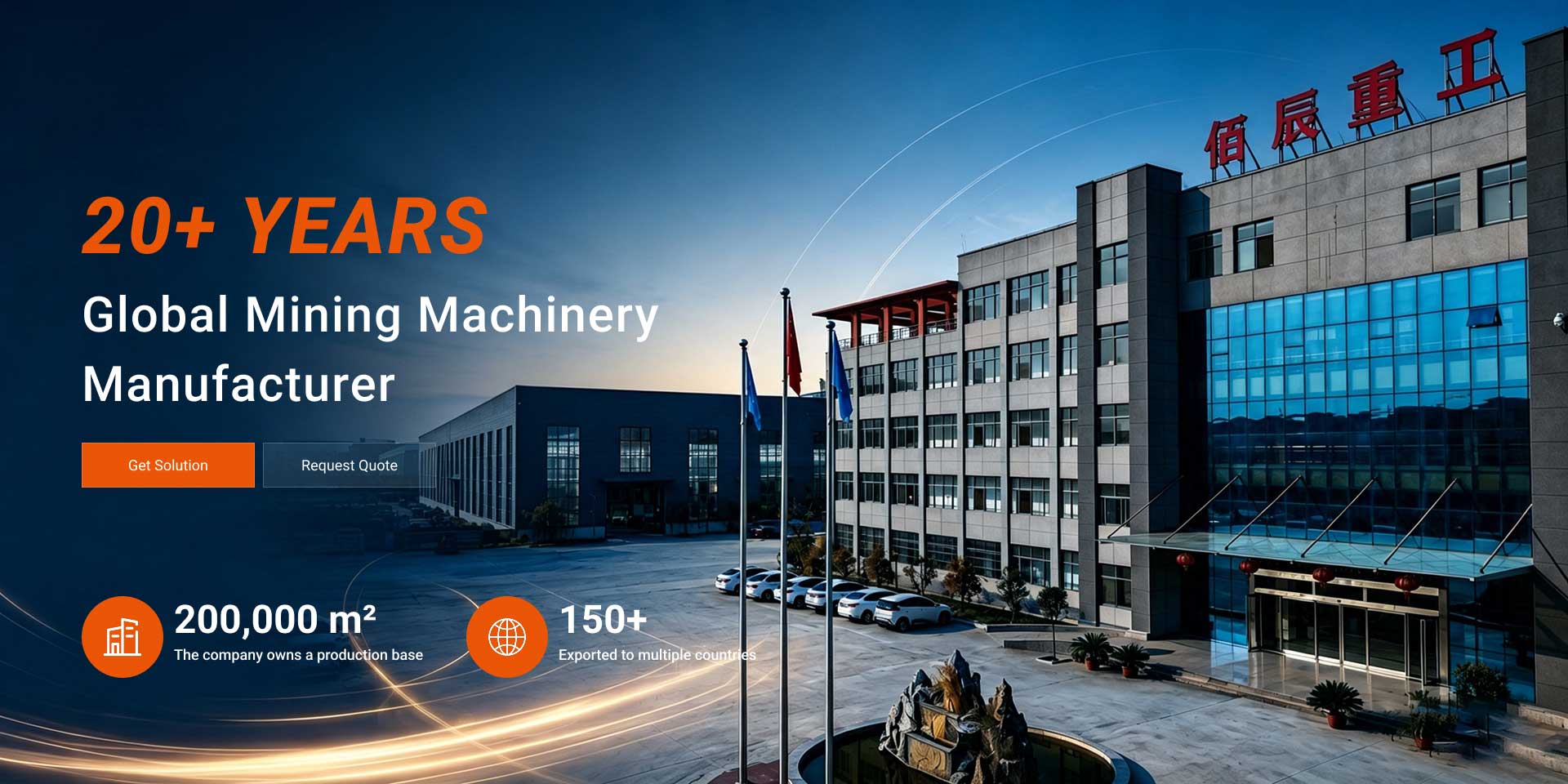
Baichy Heavy Industry
Baichy Heavy Industry is a high-tech mining equipment company integrating R&D, manufacturing, sales, and after-sales service. Focusing on crushing, grinding, and mineral processing equipment, we provide professional solutions to our customers. We are ISO9001:2015 、certified, and our products include mobile crushing palnts, crawler crushing plant, construction waste crushing plants, jaw crushers, sand making machines, cone crushers, fine crushers, grinding mills, ball mills, etc., all with reliable performance to meet diverse project needs.
Baichy Heavy Industry – Your Trusted Partner
To ensure optimal performance of your equipment, Baichy Heavy Industry offers:
- Professional on-site installation guidance
- Comprehensive operator training
- 24/7 technical support & maintenance services
Our complete after-sales service system guarantees long-term, stable operation of your machinery with minimal downtime.
Protect Your Rights – Only Use Official Channels
To avoid scams and ensure authentic support, contact us exclusively through:
• Official Website: www.baichychina.com
• WhatsApp: +8615093222637
• Email: [email protected]
Your satisfaction is our priority – expect prompt, professional service every time.
(Note: Beware of unauthorized third parties claiming to represent Baichy. Always verify through official contacts.)