
Configuration of the 100 tph Mobile Uranium Crushing Plant in Namibia
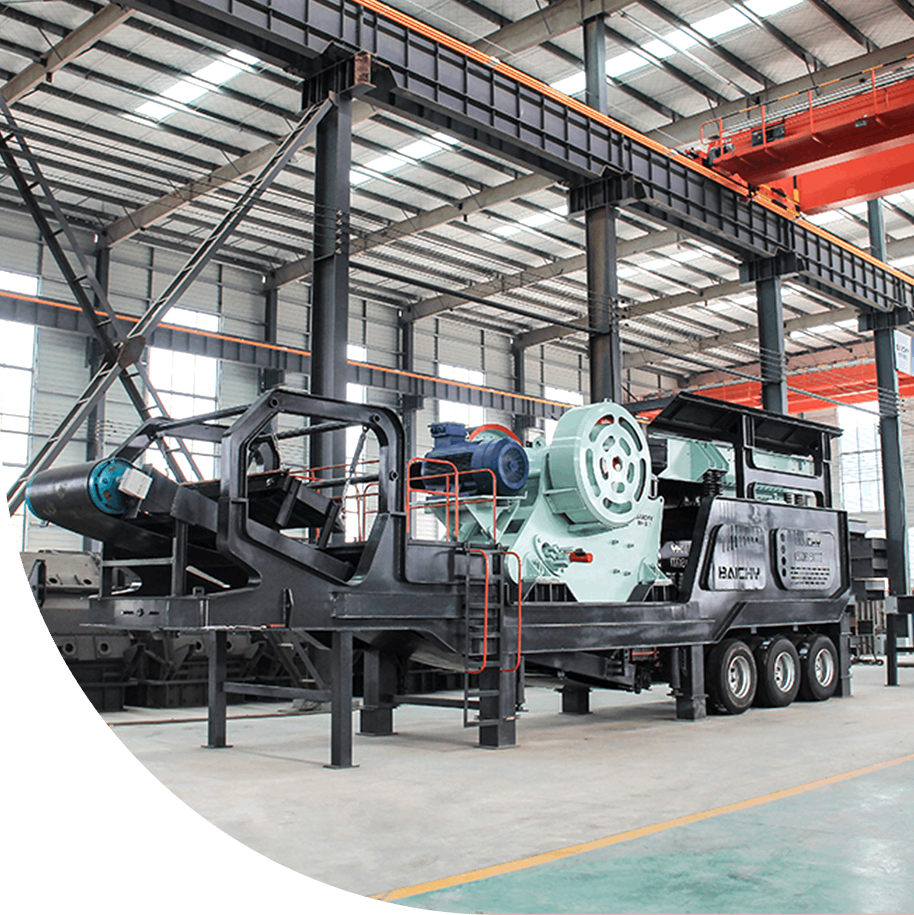
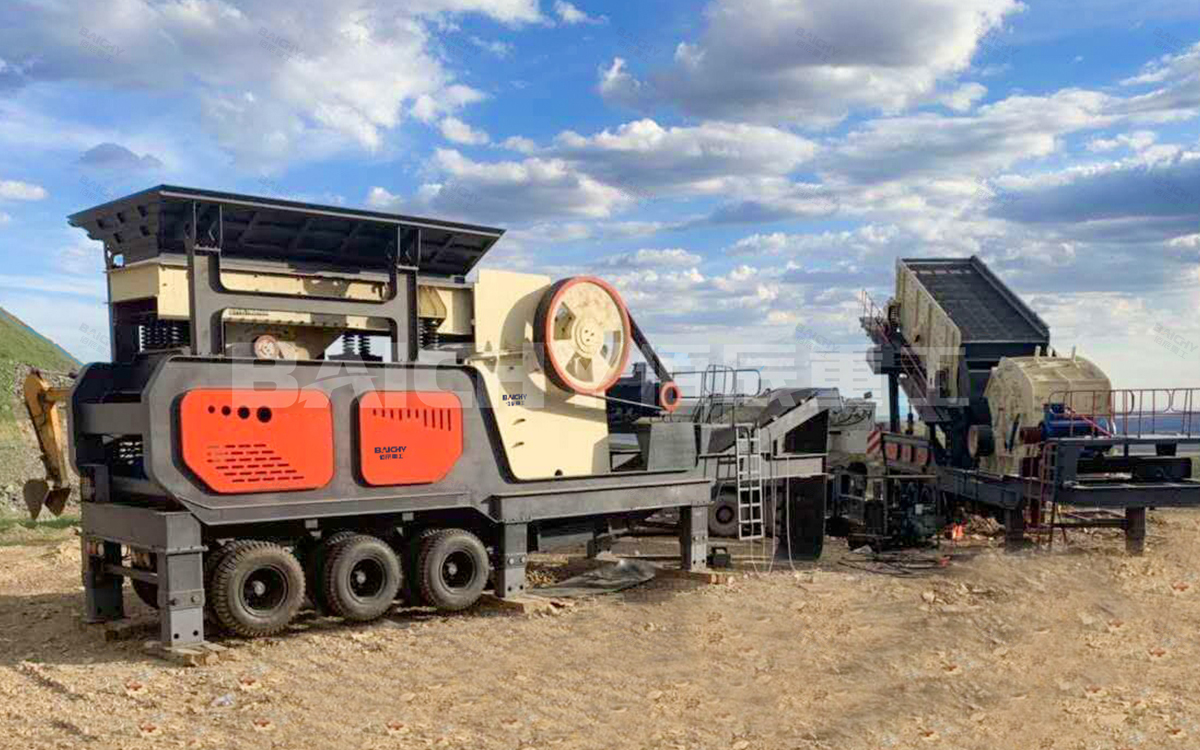
This 100 tph uranium processing line in Namibia handles both primary and secondary/tertiary crushing using just two mobile units—a YDPZ69-9638 mobile jaw crushing station and a YDPZ75-1548 mobile cone crushing station—producing a 0–20 mm finished product without the need for a permanent plant structure. A key takeaway here is that the deciding factor for equipment selection isn't just throughput capacity, but the feed opening size. The YDPZ69-9638 is equipped with a PE600×900 jaw crusher (max feed size ≤500 mm), whereas the next model up in the series, the YDPZ75-1142, features a PE750×1060 crusher (max feed size ≤630 mm). If the raw material includes large chunks exceeding 500 mm, a different model is required, regardless of the production capacity.
I. Why this Namibian uranium line uses a "two-stage mobile" setup
The project profile provided by the source is straightforward: the material is uranium ore, capacity is 100 tph, the location is Namibia, the setup utilizes tire-type mobile crushing stations, and the output is 0–20 mm. The context is as follows: as a highly hard and radioactive mineral resource, uranium imposes strict requirements on equipment performance, safety protection, and processing workflows. Namibia is a major global uranium producer, and the Husab mine represents one of the world's largest uranium discoveries in the last decade. Traditional fixed crushing lines struggle to simultaneously meet modern mining demands regarding flexibility, efficiency, and safety. In contrast, a collaborative two-machine system—comprising a mobile jaw crusher and a mobile cone crusher—emerges as the ideal choice for this application due to its adaptability and radiation-shielding design.
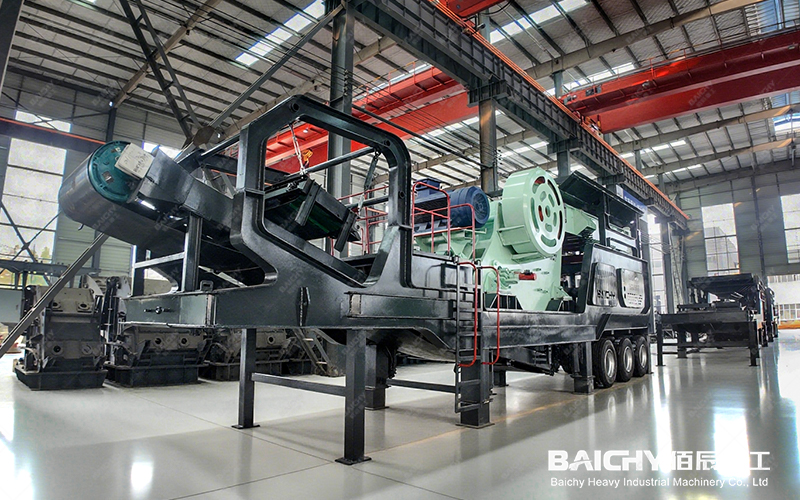
Translating this into equipment configuration leads to a single conclusion: this line eliminates the need for civil engineering investment associated with a permanent plant. The value of mobile crushing and screening stations lies in their integrated design—combining feeding, crushing, and conveying onto a single chassis—allowing for immediate operation once the unit arrives on-site and is leveled on its support legs. With one unit for primary crushing and another for secondary/tertiary crushing, the two stages are linked by a conveyor belt, bypassing the need for intermediate stockpiling or transfer steps. Radiation protection for uranium ore is handled via fully enclosed conveying and dust removal systems; these are optional features that do not alter the base model designation.
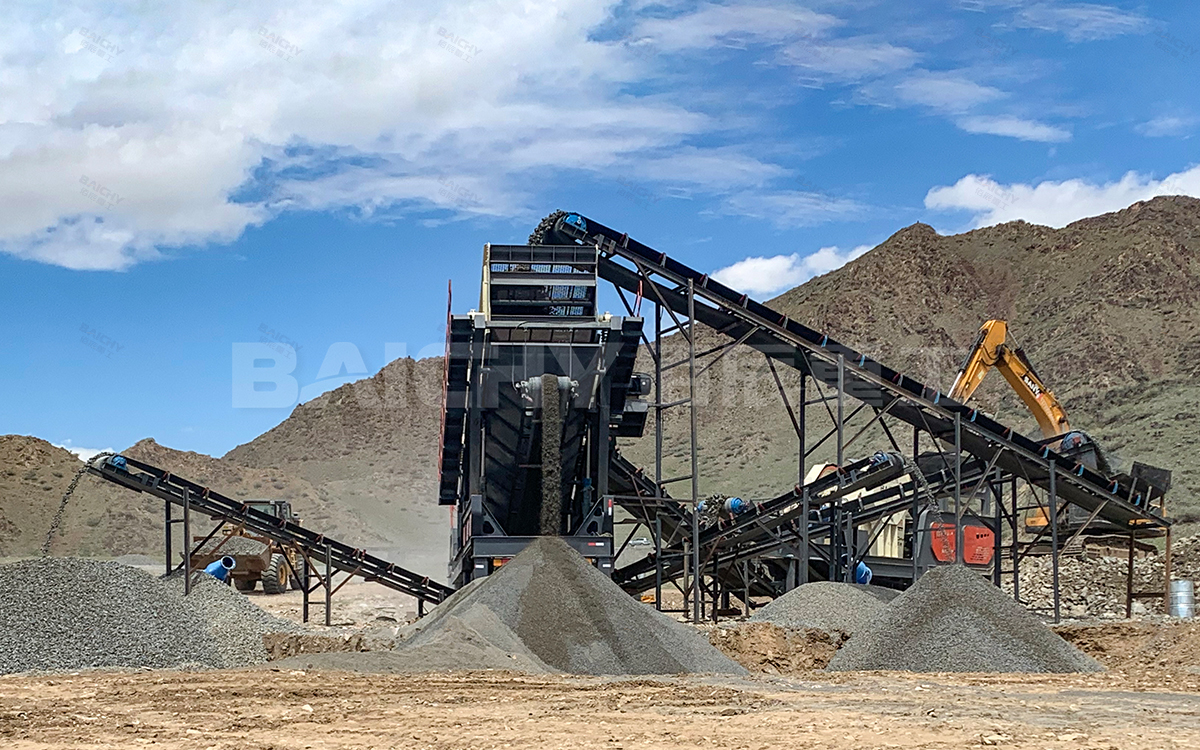
Mobile jaw crushing station
II. Primary Crushing Stage: The hard constraint for the YDPZ69-9638 is its 500mm feed opening.
The YDPZ69-9638 is the third-tier model in the wheeled mobile jaw crushing station series, equipped with a PE jaw crusher. The specifications are as follows:
• Vibrating Feeder ZSW9638: Max feed size 820mm; 11kW motor; feeding capacity 120–210 t/h
• Jaw Crusher PE600×900: Feed size ≤500mm; 55kW motor; rated capacity 90–180 t/h
• Belt Conveyor: B800
• Complete Unit: Rated capacity 90–180 t/h; dimensions 11,500×2,300×4,120mm
Comparing these three lines reveals the limiting factor. The feeder's upper limit of 820mm exceeds the jaw crusher's feed limit of 500mm; thus, the feeding stage is not the bottleneck—the jaw crusher's 500mm limit sets the ceiling for the entire station.
This is the machine on the line most prone to incorrect upgrading decisions: sufficient throughput capacity does not guarantee the ability to process the material. If blasted boulders exceed 500mm, one must step up to the YDPZ75-1142 model (PE750×1060; feed ≤630mm; rated capacity 110–380 t/h).
Capacity requirements, conversely, are easily met: the station is rated for 90–180 t/h, so a requirement of 100 t/h falls well within this range, leaving a margin of 80 t/h (180 − 100) at the upper end.
III. Secondary and Fine Crushing Stage: The main unit of the YDPZ75-1548 is the CS75; the capacity margin lies here.
The case study page on the source site lists this equipment as PYDZ75-1548, whereas the naming convention for the site's mobile cone crushing stations consistently uses the "YDPZ" prefix (e.g., YDPZ110-1860 with CS110, YDPZ160-2160 with CS160, YDPZ220-2460 with CS220), where the first part of the model number corresponds to the main crusher specifications and the latter part to the screen specifications. The "Four-Combination" page on the Chinese site explicitly states: "YDPZ75-1860 mobile cone crushing station, equipped with a CS75 cone crusher." Based on this, YDPZ75-1548 = CS75 cone crusher + 3YK1548 circular vibrating screen. This correspondence is derived from naming conventions rather than a verbatim quote from the source site and has been listed as an item for verification in Section 7.
Comparing the rated specifications of the two main units:
• CS75 cone crusher: Max feed size ≤150mm; rated capacity 27–163 t/h.
• 3YK1548 circular vibrating screen: YK series; screen surface 4800×1500mm; 3 decks; aperture 3–100mm; max feed size 400mm; processing capacity 30–275 t/h.
The calculation regarding the connection between the two stages is the focus of this section: The rated discharge opening range for the PE600×900 is 60–125mm, which falls entirely within the CS75’s maximum feed limit of ≤150mm—meaning that as long as the primary crusher's discharge opening is set within its rated range, the feed conditions for the secondary stage are met. A discrepancy here requires attention: the source site's case study page states that the primary crushing stage reduces material to an intermediate size of ≤200mm, yet 200mm exceeds the CS75’s maximum feed limit of ≤150mm. When considering these three factors together, the 200mm figure should be understood as the approximate upper limit for the intermediate particle size from the primary crushing stage; the actual constraint on feed size is determined by the discharge opening setting, so it is advisable to verify this against the actual setting on-site before final publication.
Comparing capacity margins is even more critical: the rated upper limit for the secondary-stage CS75 is 163 t/h. Against a target finished product output of 100 tph, the margin is 163 − 100 = 63 t/h—a tighter margin than that of the primary crushing stage (180 − 100 = 80 t/h). The reason lies in the total load volume: the secondary stage processes not only the primary crusher's output but also the recirculating oversize material from the screen, meaning the total load naturally exceeds the finished product output. As the source did not disclose the recirculation ratio for this line, this draft avoids introducing any arbitrary percentages; instead, it presents a comparison between the rated capacity range and the margins, with actual equipment selection requiring calculation based on on-site test screening data.
Regarding the radioactivity of the uranium ore, the processing approach outlined in the source case study involves fully enclosed conveying and negative-pressure dust extraction, with optional spray-based dust suppression or bag-type dust collectors to control dust dispersion in compliance with international radiation protection standards. These measures dictate the dust control and operational safety protocols but do not affect the selection of the main machinery—specifically, the PE600×900 and CS75 units—which remain unchanged despite the material's radioactivity.
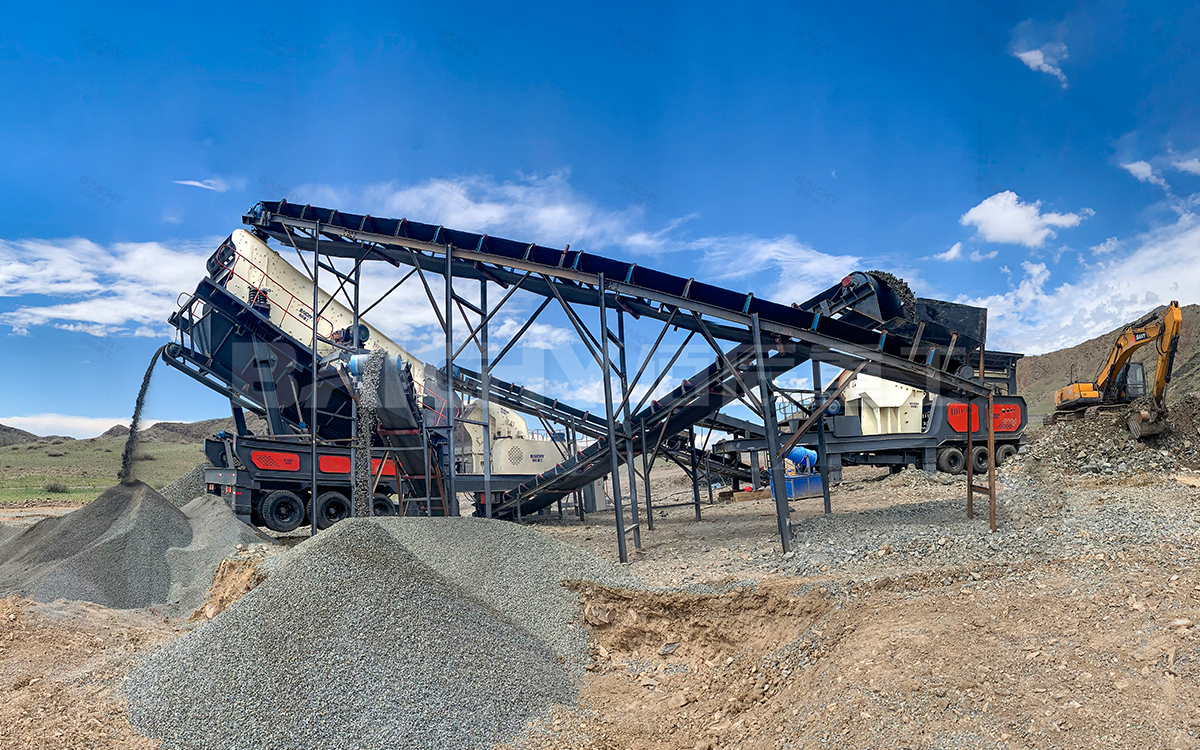
Two-Stage Combination of Jaw and Cone Crushing Units
IV. Configuration Table for Namibia 100 tph Uranium Mobile Crushing Station
| Process Stage | Equipment | Model | Main Unit & Auxiliaries | Key Specifications/Ratings | Criteria for this Project |
|---|---|---|---|---|---|
| Primary Crushing | Mobile Jaw Crushing Station | YDPZ69-9638 | PE600×900 + ZSW9638 Feeder + B800 Belt | Jaw crusher feed size ≤500mm, discharge opening 60–125mm, rated capacity 90–180 t/h; Feeder max feed 820mm, 11kW; Jaw crusher main unit 55kW (4kW additional for station-wide auxiliaries); Overall dimensions 11500×2300×4120mm | 100 tph falls within the rated range; upper margin is 180−100=80 t/h; hard constraint is the 500mm feed opening; if exceeded, must switch to YDPZ75-1142 |
| Secondary/Fine Crushing | Mobile Cone Crushing Station | YDPZ75-1548 | CS75 Cone Crusher + 3YK1548 Circular Vibrating Screen | CS75 max feed ≤150mm, rated capacity 27–163 t/h; Screen deck 4800×1500mm, 3 decks, aperture 3–100mm, processing capacity 30–275 t/h | 100 tph falls within the rated range; upper margin is 163−100=63 t/h; the more critical of the two stages; must be verified against material recirculation volume and test screening data |
| Inter-stage Connection | Conveyor Belt | — | Primary discharge → Secondary feed | Primary discharge opening 60–125mm ⊆ CS75 max feed limit ≤150mm | The condition is met if the discharge opening setting falls within the calibrated range; the "≤200mm" figure on the case study page represents the approximate upper limit of the intermediate product size for the primary crushing stage, not a feed size constraint for the secondary stage. |
| Finished Product | Product Size | — | — | Project product: 0–20mm; the case study notes that the cone crusher product size can be controlled within the 0–30mm range depending on the downstream leaching process. | 0–20mm is the target size for this project; 0–30mm is the controllable range for the station; these figures represent different specifications. |
| Mobility | Tire-mounted | — | Dual-power system: diesel engine + external power supply | No fixed foundation required; towed by a tractor, leveled on-site via hydraulic outriggers; no disassembly needed for relocation | Station moves alongside the advancing uranium mining face, eliminating the need for civil engineering investment associated with fixed plants. |
| Environmental Protection | Dust Control & Enclosure | — | Fully enclosed conveying + negative-pressure dust extraction (optional water spray or bag filter) | Dust dispersion controlled in accordance with international radiation protection standards | Optional configuration for uranium mining applications; does not alter the main equipment model. |
Note: The parameter rows in the table are sourced from the English site's mobile jaw crusher page, the English site's four-unit combination parameter table, the English site's YK circular vibrating screen page, and the corresponding product pages on the Chinese site; see Section 6, "Sources of Foundation Data," for specific source details. The motor power for the 3YK1548 differs between the two sites (15kW on the English site vs. 18.5kW on the Chinese site); this table lists the English site's value based on the source site's specifications, and this value is not used in any calculations within the main text. The correspondence between the CS75 and YDPZ75-1548 is derived from internal naming conventions rather than being a verbatim quote from the source site. Production capacities are based on calibrated conditions; calculations must be adjusted based on actual on-site measurements if material hardness, feed size, or moisture/clay content deviate from the calibrated operating conditions.
V. How the 0–20mm product is produced: The closed-loop process from feed to finished product
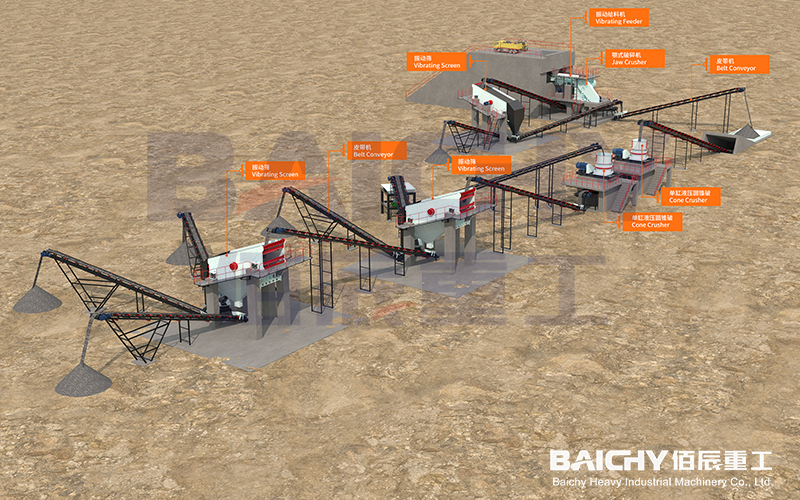
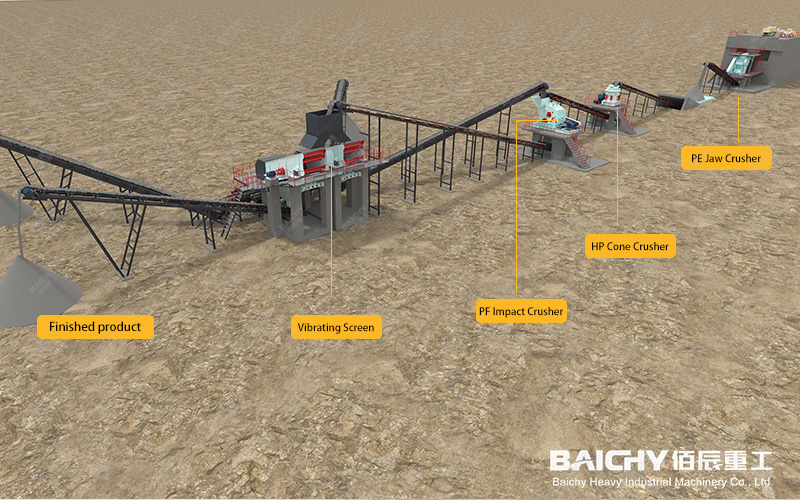
The process flow described on the original case study page consists of three stages, utilizing two mobile crushing stations and one mobile screening unit:
• Primary Crushing: Large chunks of uranium ore are fed by a feeder into a mobile jaw crushing station, where they are crushed to an intermediate size (≤200mm, according to the source).
• Secondary/Fine Crushing: The intermediate material is conveyed to a mobile cone crushing station; utilizing the principle of inter-particle (lamination) crushing, it produces a uniform finished product (controlled within the 0–30mm range to meet subsequent leaching requirements).
• Closed-loop Screening and Dust Removal: Crushed material is graded by a mobile screening station, with oversized material returned to the cone crusher for re-crushing; the entire process takes place in an enclosed environment, integrating a dust removal system to ensure clean production.
Regarding the specific 0–20mm finished product for this project, the closed-loop mechanism operates at two points: first, the 3YK1548 screen at the cone crushing station returns oversized material to the CS75 crusher for further processing; second, the qualified finished product is discharged and stockpiled via the main conveyor belt. This explains why the surplus load is attributed to the second stage—the recirculated material (oversize return) imposes an additional load on the CS75, a burden not borne by the primary crushing stage.
VI. FAQ: Common questions about the 100tph uranium mobile crushing station in Namibia
Q1: What are the specific models of the two mobile stations used in this Namibian project?
The primary crushing unit is the YDPZ69-9638 mobile jaw crushing station (featuring a PE600×900 crusher and ZSW9638 feeder), while the secondary/fine crushing unit is the YDPZ75-1548 mobile cone crushing station (featuring a CS75 crusher and 3YK1548 circular vibrating screen). Although the original case study page lists the latter as PYDZ75-1548, the site's mobile cone crusher series consistently uses the "YDPZ" prefix, so "YDPZ" is adopted here. The project capacity is 100tph, producing a 0–20mm finished product.
Q2: For this 100 tph line, where does the capacity margin lie?
The margin lies in the secondary and tertiary crushing stages. The primary crushing unit (YDPZ69-9638) has a rated capacity of 90–180 t/h, meaning a margin of 180 − 100 = 80 t/h relative to the 100 tph target; the secondary unit (CS75) is rated at 27–163 t/h, with a margin of 163 − 100 = 63 t/h. However, the secondary stage must also handle recirculating material (oversize returned from the screen), so the actual load exceeds the finished product output. Since the manufacturer has not disclosed the recirculation ratio for this line, actual equipment selection must be calculated based on on-site screening test data rather than simply looking at the upper limit of the rated capacity.
Q3: What is the maximum feed size for the mobile jaw crushing station? What happens if this limit is exceeded?
The YDPZ69-9638 is equipped with a PE600×900 crusher, with a maximum feed size of ≤500 mm. The next model up in the series, the YDPZ75-1142, features a PE750×1060 crusher, a maximum feed size of ≤630 mm, and a rated capacity of 110–380 t/h. If blasting results in boulders exceeding 500 mm, one must switch to this larger model—this is a hard constraint for the entire station, independent of production output. The accompanying ZSW9638 feeder supports a maximum feed particle size of 820 mm, so the feeding stage is not the bottleneck.
Q4: How does the radioactivity of uranium ore affect the configuration of this mobile cone crushing station?
The manufacturer's case studies specify a fully enclosed conveying system combined with negative-pressure dust extraction; optional spray-based dust suppression or bag-type dust collectors are available to control dust dispersion in compliance with international radiation protection standards. Radioactivity does not affect the selection of the main crushing unit itself; rather, it influences the configuration of the dust extraction, conveyor enclosure, and operator protection systems.
Q5: Does the wheeled mobile crushing station require disassembly for relocation?
No, it does not. The tire-mounted mobile crushing station is transported by a towing vehicle; upon arrival, it is leveled using hydraulic outriggers and is ready for operation. Regarding specifications, the overall dimensions of the jaw crushing unit are 11,500 × 2,300 × 4,120 mm, while the dimensions for the cone crushing unit have not been disclosed by the manufacturer. The system features a dual-power configuration—diesel engine and external power supply—allowing the diesel engine to be used at sites without grid access.
Baichy Heavy Industry
Baichy Heavy Industry is a high-tech mining equipment company integrating R&D, manufacturing, sales, and after-sales service. Focusing on crushing, grinding, and mineral processing equipment, we provide professional solutions to our customers. We are ISO9001:2015 、certified, and our products include mobile crushing palnts, crawler crushing plant, construction waste crushing plants, jaw crushers, sand making machines, cone crushers, fine crushers, grinding mills, ball mills, etc., all with reliable performance to meet diverse project needs.
Baichy Heavy Industry – Your Trusted Partner
To ensure optimal performance of your equipment, Baichy Heavy Industry offers:
- Professional on-site installation guidance
- Comprehensive operator training
- 24/7 technical support & maintenance services
Our complete after-sales service system guarantees long-term, stable operation of your machinery with minimal downtime.
Protect Your Rights – Only Use Official Channels
To avoid scams and ensure authentic support, contact us exclusively through:
• Official Website: www.baichychina.com
• WhatsApp: +8615093222637
• Email: [email protected]
Your satisfaction is our priority – expect prompt, professional service every time.
(Note: Beware of unauthorized third parties claiming to represent Baichy. Always verify through official contacts.)