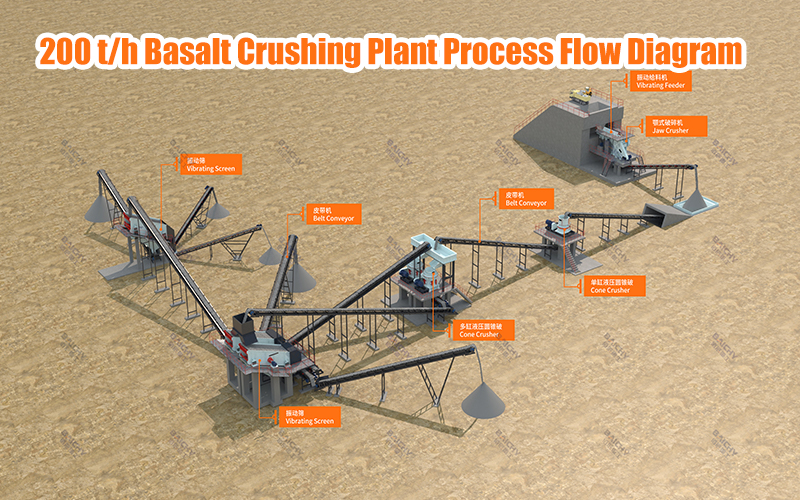
200 t/h Limestone Crushing Production Line
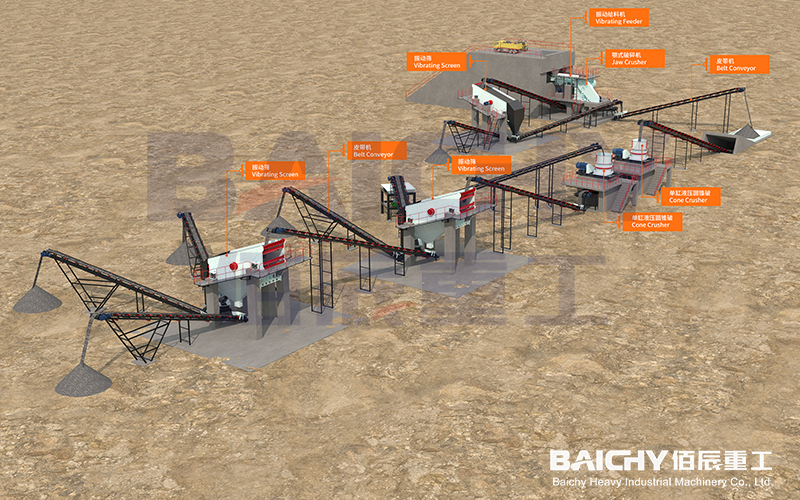
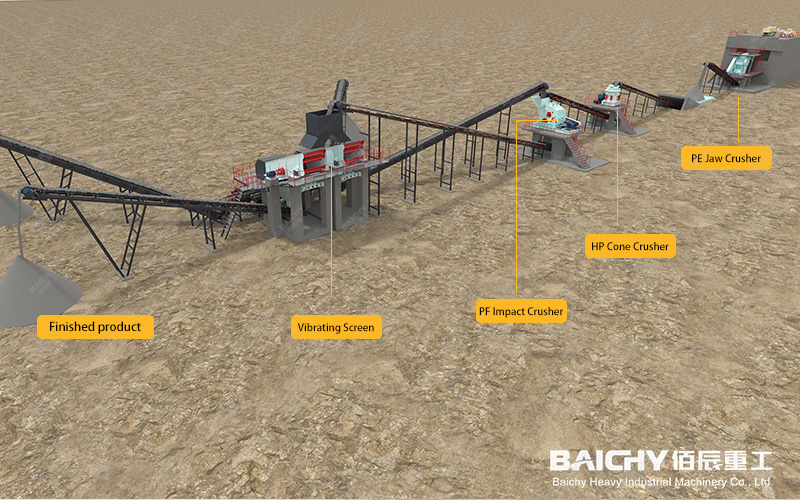
Configuration for a limestone crushing production line with a capacity of 200 tons per hour (tph): ZSW1100×4200 feeder → PE750×1060 jaw crusher → PFW1315 impact crusher → 4YK2160 circular vibrating screen → B1000 main conveyor belt; this setup follows a "two-stage, one-closed-loop" process.
I. How to select equipment for a 200 tph capacity?
To ensure a stable output of 200 tph, equipment is typically designed with a capacity margin, targeting approximately 220–250 tph. Expressed as a calculation, the design redundancy factor ranges from 220&pide;200 (1.10) to 250&pide;200 (1.25)—meaning the capacity is 1.10 to 1.25 times the target output. In other words, the minimum capacity of any single crushing unit should not fall below 220 tph.
Additionally, equipment specification sheets note that actual output varies based on factors such as material characteristics and feed particle size. The capacity listed in the specifications is a nominal rating, not a value measured specifically against your actual material source. Therefore, when selecting a limestone crusher, one must allow for a margin and not treat the upper limit of the rated capacity as a guaranteed performance figure.
II. Limestone uses a "two-stage, one-closed-loop" process; three stages are reserved for hard rock.
The process design for a 150–200 tph limestone aggregate line is "two-stage, one-closed-loop"—consisting of primary crushing followed by a combined secondary/tertiary crushing stage, with oversized material from the screen returned to the circuit (closed-loop) rather than proceeding to a third crushing stage. The reason lies in the material itself: PF-series impact crushers are designed for materials of low to medium hardness with a compressive strength not exceeding 320 MPa. Official product listings cite limestone, clinker, slag, coke, and coal as suitable materials; the specific product page for the PF1214 model further lists limestone, bluestone, dolomite, calcite, gypsum, marl, and coal gangue among the suitable low-to-medium hardness rocks. Official product selection guidelines also directly recommend standard impact crushers for soft rock (such as limestone and coal gangue).
However, a "two-stage" setup is not a one-size-fits-all solution for every 200-ton-per-hour production line. Official guidelines categorize configurations based on throughput: a single impact crusher paired with a vibrating screen is suitable for 50–200 t/h, while a combined jaw crusher and impact crusher line is recommended for 200–500 t/h. Since the 200 t/h capacity sits right on this piding line, it neither fits the "single crusher plus screen" model used for smaller lines nor necessitates the heavier "three-stage" configuration. In contrast, the official hard-rock configuration for the 200–250 t/h range specifies a C100 jaw crusher paired with two CS160 cone crushers; this demonstrates that within the same capacity range, a change in material hardness dictates a complete switch in the primary machinery used. For limestone crushing, these guidelines effectively rule out the three-stage configuration entirely. This illustrates why "200 tons per hour" alone is insufficient to determine the equipment configuration.
III. Configuration Table for a Limestone Crushing Production Line (200 t/h Capacity)
| Process | Model | Quantity | Power (kW) | Role/Criteria in the Production Line |
|---|---|---|---|---|
| Feeding | ZSW1100×4200 | 1 | 15 | Rated capacity 200–430 t/h, max feed size 1000 mm; accommodates the PE750×1060's 630 mm max feed limit and the 220–250 t/h design requirement; the ZSW960×3800 (max 210 t/h) is insufficient. |
| Primary Crushing | PE750×1060 | 1 | 110 | Rated capacity 110–380 t/h, max feed 630 mm, discharge opening 60–150 mm; the PE600×900 (max 180 t/h) falls below the 220 t/h design value. |
| Secondary/Fine Crushing | PFW1315 | 1 | 200 | Rated capacity 130–220 t/h, max feed ≤350 mm; meets the 220 t/h design requirement with zero margin; upgrade to PFW1320 (160–350 t/h, 250 kW) if a safety margin is required. |
| Screening | 4YK2160 | 1 | 37 | 4-deck screen, aperture 3–100 mm, rated capacity 81–720 t/h; the 220–250 t/h feed rate falls well within this range; produces four fractions: 0–5, 5–10, 10–20, and 20–31.5 mm. |
| Conveying (Main Line) | B1000 | As per drawing | 7.5–30 | Rated capacity 200–320 t/h; the B800 (max 200 t/h) offers no margin for the 220–250 t/h design requirement. |
| Conveying (Branch Line) | B650 | — | — | Rated at 80–120 t/h based on Figure 4–15, corresponding to the single-line finished product circuit and the oversize material return circuit. |
| Main unit installed power: 362 kW (15 + 110 + 200 + 37 kW; excluding conveying and dust removal systems); calculated installed power intensity: 362 ÷ 200 = 1.81 kW/(t·h⁻¹). | ||||
Note: The power column lists the rated installed power of the main units; conveyor power varies by section length and depends on the actual process layout. Production capacity is based on official specifications; if material properties, feed size, or moisture/clay content deviate from rated conditions, recalculations based on on-site trial screening data are required.
IV. Three Common Pitfalls in Equipment Selection
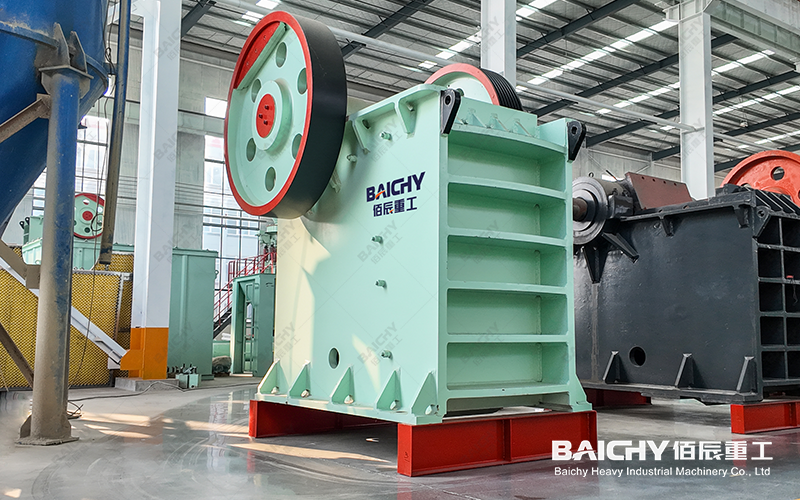
PE750x1060 Jaw Crusher
Skipping a size tier for the primary crusher: The decision is driven not by production volume, but by the "180" figure. The parameter table lists the rated capacity of the PE600×900 as 90–180 t/h, whereas the PE750×1060 offers 110–380 t/h, a maximum feed size of 630 mm, a discharge opening of 60–150 mm, and 110 kW installed power. Given the design requirement of 220–250 t/h, the PE600×900 is immediately ruled out due to its upper capacity limit; furthermore, the maximum feed size must accommodate the 600 mm large blocks commonly found in limestone sources. In standard official configuration tables for 150–200 t/h aggregate lines, the PE750×1060 is the specified primary crusher. It is also the specific limestone crusher most frequently replaced by cheaper alternatives in low-cost proposals.
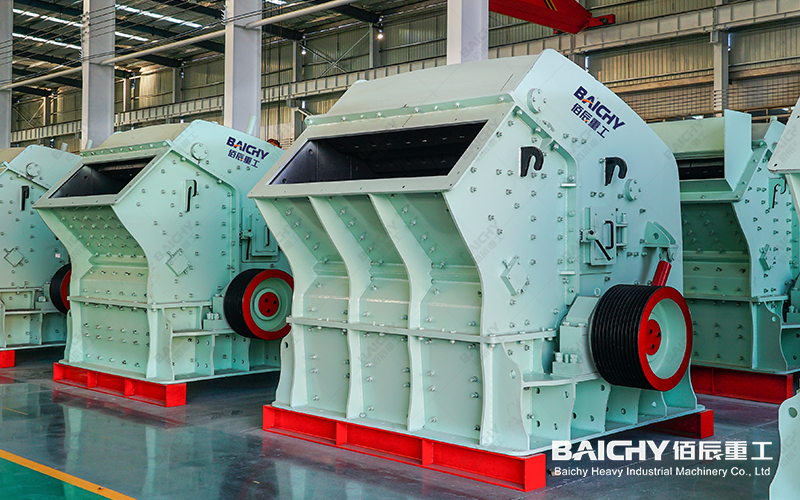
PF1320 Impact Crusher
Secondary impact crusher: Do not select based solely on finished product output. This is the point where one is most likely to make a costly mistake: the secondary stage processes the "primary crusher discharge plus oversize return material," meaning the actual load is inherently higher than the finished product output. According to the specifications, the PF1214 is rated for 100–180 t/h (132–160 kW), the PFW1315 for 130–220 t/h (200 kW), and the PFW1320 for 160–350 t/h (250 kW). The standard 100–120 t/h limestone processing line featured on the official website pairs the PE600×900 with the PF1214; this configuration handles an output of just over 100 tons without issue. However, if the target output is raised to 200 tons, relying on the PF1214—which caps out at 180 t/h—for the secondary crushing stage becomes a critical bottleneck. As the official website does not disclose the material recirculation ratio for limestone lines, this analysis avoids introducing arbitrary figures and relies solely on model specifications: for a design requirement of 220–250 t/h, the PFW1315 is barely adequate at its upper limit, whereas the PFW1320 offers the necessary operational headroom.
Selecting belt conveyors based solely on the final product output creates an invisible ceiling on production capacity. Conveying capacities listed in the specifications are: B500 (40–100 t/h), B650 (80–120 t/h), B800 (120–200 t/h), and B1000 (200–320 t/h). If a B800 conveyor is selected for a 200-ton output, its maximum capacity falls right below the 220–250 t/h design requirement, effectively throttling the system regardless of how powerful the crusher is. Matching the conveyor size to the crusher capacity requires a B1000 for the main line and a B650 for the branch line—a configuration consistent with the official website's 150–200 t/h production line specifications, which utilize a B1000 for the main line and a mix of B650 and B500 for branch lines.
V. Feeding and Screening: Margins at the Ends, Variables in the Middle
The two ends represent the most generous margins within the production line. At the feeding end, the ZSW1100×4200 feeder features a 1100×4200 mm trough, handles a maximum feed size of 1000 mm, offers a rated capacity of 200–430 t/h, and has an installed power of 15 kW; its dimensions accommodate the primary crusher's 630 mm maximum feed size laterally and meet the 220–250 t/h design requirement longitudinally. At the screening end, the 4YK2160 circular vibrating screen features a 6000×2100 mm screening surface, four decks of mesh (apertures ranging from 3 to 100 mm), a rated capacity of 81–720 t/h, and an installed power of 37 kW. The value of the four-deck configuration lies not in "screening speed," but in the ability to separate four product specifications in a single pass, thereby eliminating an entire stage of secondary material handling. Summing the installed power of the main equipment yields 15 + 110 + 200 + 37 = 362 kW; the calculated ratio of 362 &pide; 200 = 1.81 kW/(t·h⁻¹) represents installed power intensity rather than actual electricity consumption per ton, so it cannot be directly equated to an electricity bill.
The factors that truly determine whether this limestone crushing line can consistently maintain a 200 t/h output are the variables in the middle section (note: the mechanistic descriptions regarding clay/moisture content and abrasiveness are based on engineering experience rather than official public specifications; references to blow bar materials and iron removal recommendations come from the official website's case studies page, while the enclosed dust removal feature is cited from the product page): high clay and moisture content cause blinding (clogging) on the fine-grade screen decks, leading to a failure to meet product gradation standards. While the official specifications for the conveying system indicate a capacity to handle 0–300 mm material with up to 15% moisture, no public upper limit for moisture content exists for the screening stage; the optimal operating point must be determined through trial screening of the specific material source. Abrasiveness represents the second key factor: high-purity limestone has low abrasiveness, but the presence of siliceous layers drastically shortens the lifespan of wear parts. For similar 200 t/h capacity projects, the manufacturer specifies blow bars made of ultra-high chromium alloy (Cr26 or higher)—a material offering wear resistance more than three times that of high-manganese steel. While this specification is typically reserved for highly abrasive materials like coal gangue, it is adopted for limestone only when measured abrasiveness levels are high. Additionally, for such production lines, the manufacturer strongly recommends installing a self-discharging magnetic separator on the feeder or infeed conveyor to prevent blasting accessories and metal debris from entering the crushing chamber. Similarly, dust containment hoods and dust extraction ducting are essential—especially where there are multiple transfer points—and should not be omitted. The YK series circular vibrating screens are designed for stable operation and low noise, while the belt conveyors feature an enclosed design to minimize dust emissions.
VI. FAQ: Common Questions Regarding 200 t/h Limestone Crushing Lines
Q1: How many crushing stages are required for a 200 t/h limestone crushing line?
A two-stage, closed-circuit configuration. Primary crushing is handled by a jaw crusher, while secondary/fine crushing uses an impact crusher; oversized material retained on the screen is returned to the circuit, eliminating the need for a third stage. The manufacturer’s standard process design for 150–200 t/h limestone aggregate lines utilizes this two-stage, closed-circuit setup; three-stage configurations are reserved for harder materials or finer product specifications.
Q2: Why isn't the PF1214 model used for this line?
It comes down to capacity specifications. The PF1214 has a rated capacity of 100–180 t/h; its upper limit of 180 t/h falls short of the required design capacity of 220–250 t/h (calculated as 200 t/h × 1.10 = 220 t/h). It is suitable for the standard 100–120 t/h limestone processing line found on the official website; however, to scale up to a 200 t/h output, the PFW1315 (130–220 t/h, 200 kW) should be selected for the secondary crushing stage, or the PFW1320 (160–350 t/h, 250 kW) if a capacity margin is required.
Q3: For a 200 t/h output, is the PE750×1060 jaw crusher mandatory?
Based on the specifications, yes. The PE600×900 is rated for 90–180 t/h with a maximum feed size of 500 mm and 55 kW motor power; its upper limit falls short of the 220 t/h design requirement. In contrast, the PE750×1060 is rated for 110–380 t/h, with a maximum feed size of 630 mm, a discharge opening of 60–150 mm, and 110 kW motor power—making it capable of handling the 220–250 t/h throughput and 600 mm class large feed blocks.
Q4: Why use a B1000 belt for the main line? Wouldn't a B800 suffice?
The B800 has a rated conveying capacity of 120–200 t/h; its upper limit of 200 t/h falls just below the 220–250 t/h design requirement, effectively acting as a hidden bottleneck for the entire line. The B1000 is rated for 200–320 t/h, matching the capacity of the main crushing equipment; branch lines are equipped with B650 belts (80–120 t/h) based on the specific volumes of finished products and recirculated material.
Q5: Should this line use a 4-deck screen?
If the goal is to produce four size fractions—0–5 mm, 5–10 mm, 10–20 mm, and 20–31.5 mm—then a 4-deck screen should be used. The 4YK2160 is a four-deck model with an aperture range of 3–100 mm and a rated capacity of 81–720 t/h; the actual throughput of 220–250 t/h falls within this operating range. Reducing the number of decks by one effectively eliminates a screening stage; the missing stage must be compensated for through secondary material handling, with the associated costs ultimately reflected in the cost per ton.
Baichy Heavy Industry
Baichy Heavy Industry is a high-tech mining equipment company integrating R&D, manufacturing, sales, and after-sales service. Focusing on crushing, grinding, and mineral processing equipment, we provide professional solutions to our customers. We are ISO9001:2015 、certified, and our products include mobile crushing palnts, crawler crushing plant, construction waste crushing plants, jaw crushers, sand making machines, cone crushers, fine crushers, grinding mills, ball mills, etc., all with reliable performance to meet diverse project needs.
Baichy Heavy Industry – Your Trusted Partner
To ensure optimal performance of your equipment, Baichy Heavy Industry offers:
- Professional on-site installation guidance
- Comprehensive operator training
- 24/7 technical support & maintenance services
Our complete after-sales service system guarantees long-term, stable operation of your machinery with minimal downtime.
Protect Your Rights – Only Use Official Channels
To avoid scams and ensure authentic support, contact us exclusively through:
• Official Website: www.baichychina.com
• WhatsApp: +8615093222637
• Email: [email protected]
Your satisfaction is our priority – expect prompt, professional service every time.
(Note: Beware of unauthorized third parties claiming to represent Baichy. Always verify through official contacts.)