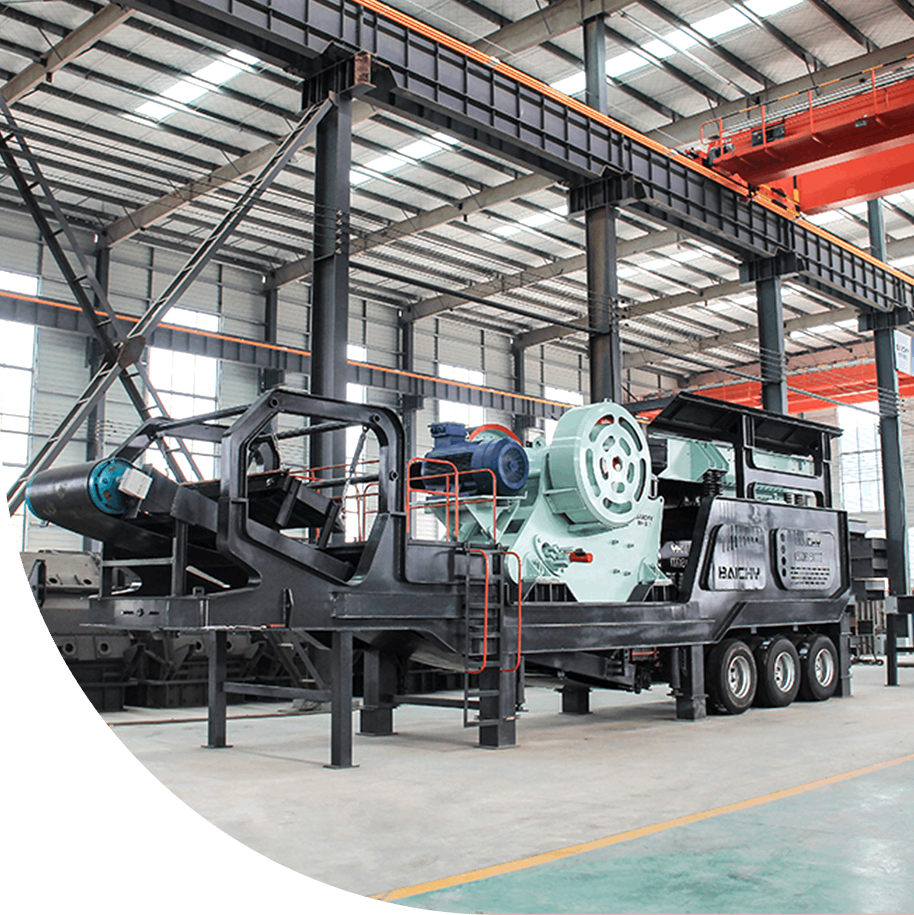

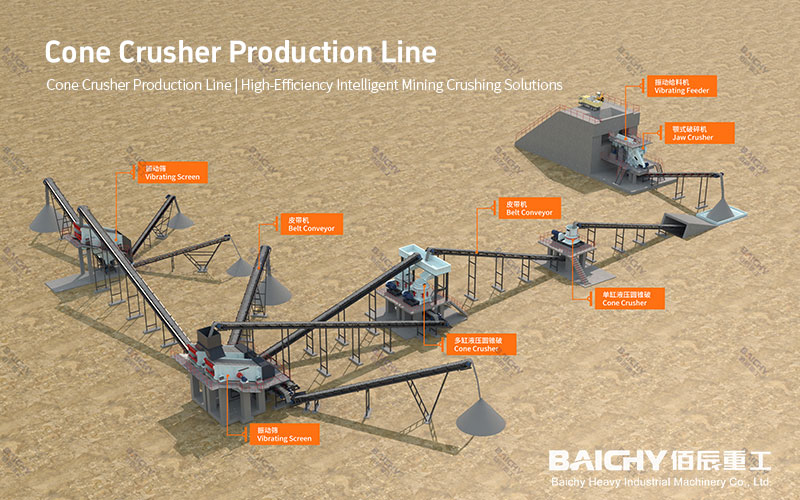
Cone Crushing Plant - Tertiary Crushing
In the sand and aggregate industry, as infrastructure projects impose increasingly stringent requirements on concrete performance, the demand for high-quality aggregates and manufactured sand has become ever more urgent. Traditional three-stage open-circuit crushing processes often suffer from a lack of effective control over particle size and shape; this frequently results in poor aggregate gradation and a high content of flaky and elongated particles, ultimately compromising concrete strength and workability. In contrast, the three-stage closed-circuit crushing process—by incorporating screening equipment to establish a feedback loop—has emerged as the core solution for addressing these critical pain points and achieving both high-quality output and operational efficiency.
Overview of the Closed-Circuit Process
The essence of the three-stage closed-circuit crushing process lies in the concept of a "closed circuit." It refers to a configuration within the three-stage crushing sequence—comprising primary, secondary, and tertiary (or shaping/sand-making) stages—where the final crushing stage forms a continuous loop with the screening equipment. The specific workflow is as follows: material that has undergone the first two stages of crushing enters the third-stage crusher (typically a Vertical Shaft Impact, or VSI, crusher) for further reduction or shaping. The material produced by this stage is not immediately designated as the final product; instead, it is conveyed to a vibrating screen for classification.
• Compliant Fractions: Material retained on the screen that meets the specified final product size requirements is separated out and directed to the finished product stockpile.
• Non-Compliant Fractions: Oversized material retained on the screen (return material), along with undersized material passing through the screen (which, depending on the specific process design, may be partially or entirely included), is recirculated back to the third-stage crusher for further processing until it meets the required specifications.
This "crush-screen-return-re-crush" closed loop constitutes the very core of the three-stage closed-circuit crushing process.
A Direct Comparison with the Open-Circuit Process
| Feature | Three-Stage Closed-Circuit Crushing Process | Three-Stage Open-Circuit Crushing Process |
| Process Control | Includes screening checks, forming a closed feedback loop | No screening checks; open-loop direct discharge |
| Finished Product Grading | Precise and controllable; highly flexible and adjustable | Difficult to control; subject to significant fluctuations |
| Particle Shape (Flakiness/Elongation) | Excellent; multiple impact shaping stages result in low flakiness/elongation content | Inferior; single-stage shaping results in high flakiness/elongation content |
| Output & Energy Consumption | High system output; minimal over-crushing; superior overall energy efficiency | Prone to over-crushing; low yield of qualified product; high energy consumption per unit of output |
| Product Adaptability | Strong; capable of easily producing high-quality aggregates and manufactured sand | Weak; product quality is average; struggles to meet high-standard requirements |
Core Advantages and Application Scenarios
Why Choose a Closed-Circuit Process?
1. Superior Finished Product Shape: Within the closed-circuit loop, materials undergo multiple impacts, friction, and grinding actions within the impact crusher. This effectively "trims" angular and flaky/elongated particles into cubical shapes, significantly enhancing particle shape quality—a critical factor for the formulation of high-strength concrete.
2. Precise Finished Product Grading: By adjusting screen specifications, the particle size distribution of the final product can be precisely controlled to achieve continuous grading. This allows for the fulfillment of specific grading requirements for various engineering projects while minimizing material waste associated with grading adjustments.
3. Higher System Output and Efficiency: The closed-circuit system ensures that all discharged material meets the required size specifications. This eliminates the wasteful phenomenon—common in open-circuit processes—where "qualified and unqualified materials are discharged together," thereby maximizing the crusher's processing capacity and boosting the overall efficiency of the entire production line. For an in-depth look at efficiency optimization, please refer to our article: "How to Select the Right Tertiary Crusher for Your Project?"
4. Reduced Over-Crushing and Energy Consumption: Qualified materials are screened out in a timely manner, preventing them from being over-crushed within the crushing chamber. This not only reduces unnecessary energy consumption but also helps control the content of stone powder (fines), facilitating precise control over fines content during the production of manufactured sand.
Key Application Scenarios
This process is particularly well-suited for projects with strict requirements regarding aggregate particle shape and gradation:
• Production of high-quality concrete aggregates for core infrastructure projects, such as high-speed railways, expressways, and hydraulic dams.
• Supply of premium aggregates and manufactured sand for commercial concrete mixing plants.
• Large-scale, stable production of high-standard manufactured sand for construction purposes.
• Upgrading of existing production lines to incorporate aggregate shaping—improving particle shape to enhance product added value.
Recommended Core Equipment
To achieve an efficient and stable three-stage crushing closed-circuit cycle, the selection of core equipment is critical. The following is our recommended combination of key equipment:
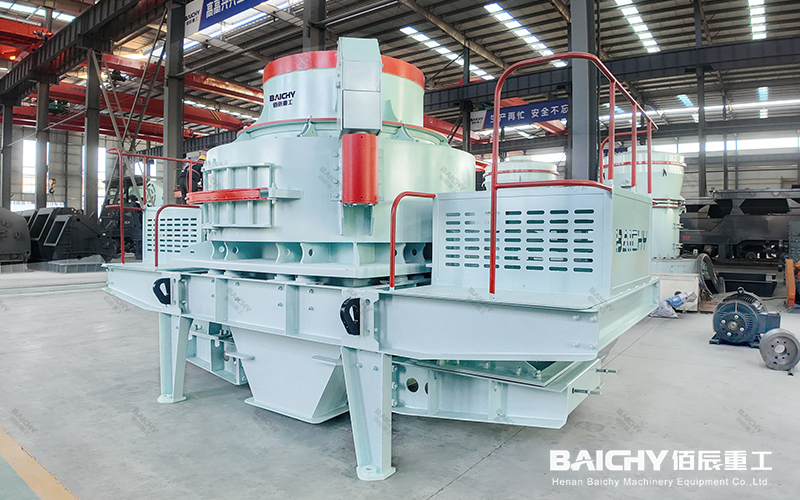
Tertiary Crushing (Shaping & Sand Making)
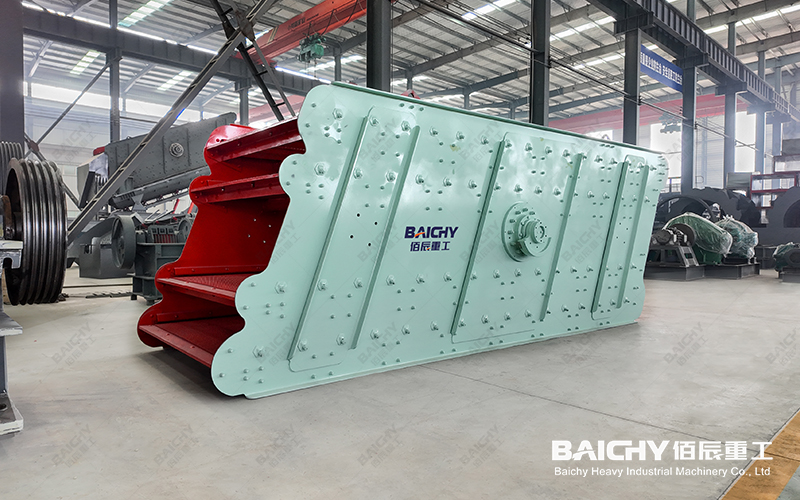
Closed-Circuit Screening
| Stage | Recommended Equipment | Core Function | Role in the Closed Circuit |
| Tertiary Crushing (Shaping & Sand Making) | Vertical Shaft Impact Crusher (VSI) | Implements "stone-on-stone" and "stone-on-iron" crushing principles; combines crushing, shaping, and sand-making functions. | Core Shaper: Responsible for repeatedly impacting returned material to optimize particle shape and produce manufactured sand. |
| Closed-Circuit Screening | Heavy-Duty Circular Vibrating Screen or Multi-Layer Linear Vibrating Screen | Performs precise and efficient classification of crushed materials. | Quality Inspector: Separates qualified products from returned material; serves as the control hub for establishing the closed-circuit cycle. |
| Material Conveying | Belt Conveyor System (including Return Belts) | | Connects various equipment units to ensure stable material transport. | Circulatory System: Ensures that returned material flows stably and smoothly back to the tertiary crusher, thereby sustaining the cycle. |
| Electrical Control System | Intelligent Centralized Control System | Integrates PLC and touch-screen interfaces to monitor equipment operating status and regulate feed rates. | The Brain: Enables automated system operation and ensures the stability and efficiency of the closed-circuit cycle. |
Note: The selection of primary (coarse crushing) and secondary (medium crushing) equipment is equally important, as they provide the qualified feed material for the tertiary crushing stage. For a complete process design, please refer to: Three-Stage Crushing Circuit Design: Full Process Layout.
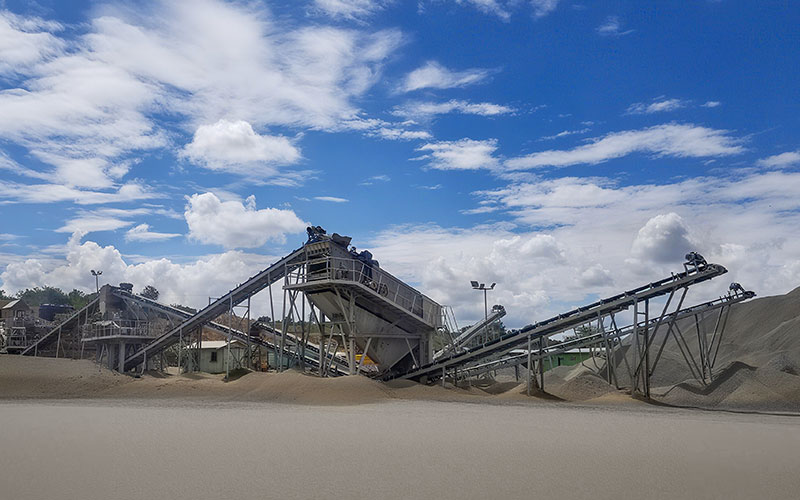
Three-Stage Closed-Circuit Crushing
Frequently Asked Questions (FAQ)
Q1: Are the equipment investment and operating costs for a closed-circuit crushing process significantly higher than those for an open-circuit process?
A: The initial investment is indeed slightly higher due to the addition of screening and conveying equipment. However, from a long-term operational perspective, the closed-circuit process offers a significantly higher Return on Investment (ROI) than the open-circuit process. This is achieved by boosting product yield (potentially exceeding 95%), reducing energy consumption associated with over-crushing, and producing high-value-added products. Typically, the incremental costs associated with this system can be recouped within just one to two years.
Q2: How is the recirculation ratio determined? Is a higher recirculation ratio always better?
A: The recirculation ratio—defined as the ratio of material returned to the crusher relative to the fresh feed input—must be determined through a process of fine-tuning and commissioning. This determination depends on factors such as material hardness, required product particle size, and the crusher's operational capacity; consequently, a higher ratio is not necessarily better. An excessively high recirculation ratio can lead to an overly thick material bed within the crusher chamber, thereby compromising crushing efficiency and accelerating wear on components. In an optimized closed-circuit system, the recirculation ratio is typically maintained within a stable range of 30% to 100%.
Q3: Is it easy to control the stone powder content in manufactured sand produced via the closed-circuit process?
A: It is highly controllable—indeed, this constitutes one of the major advantages of the closed-circuit process. By adjusting the crusher's rotational speed and feed rate, and by integrating high-efficiency air classifiers or air screens, the stone powder content in the finished sand can be controlled with exceptional precision within a specific target range (e.g., 6%–10%). This capability ensures that the produced sand meets the rigorous production requirements for high-performance concrete.
About of Baichy Heavy Industry
Baichy Heavy Industry is a high-tech mining equipment company integrating R&D, manufacturing, sales, and after-sales service. Focusing on crushing, grinding, and mineral processing equipment, we provide professional solutions to our customers. We are ISO9001:2015 、certified, and our products include mobile crushing palnts, crawler crushing plant, construction waste crushing plants, jaw crushers, sand making machines, cone crushers, fine crushers, grinding mills, ball mills, etc., all with reliable performance to meet diverse project needs.
Our advantages:
• Professional pre-sales support: Free project design and comprehensive solutions to help you accurately select the right equipment;
• Comprehensive on-site service: Providing installation guidance and worker training to ensure smooth equipment commissioning;
• Reliable after-sales guarantee: A complete after-sales system, timely response to technical inquiries and equipment maintenance, ensuring long-term stable operation.
To protect your rights, please contact us through the following official channels for professional service:
Official Website Customer Service
https://wa.me/+8615093222637
Email: [email protected]
We are committed to providing high-quality equipment and full-cycle services to deliver comprehensive intelligent solutions for the global mining industry!