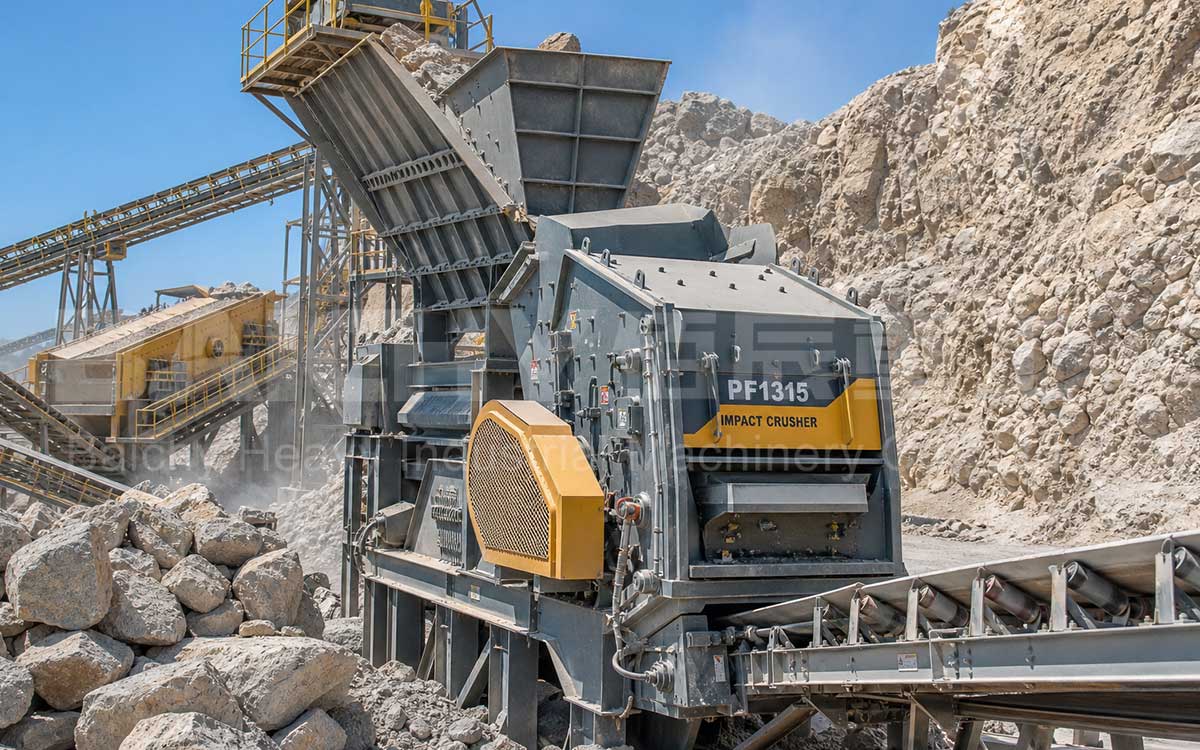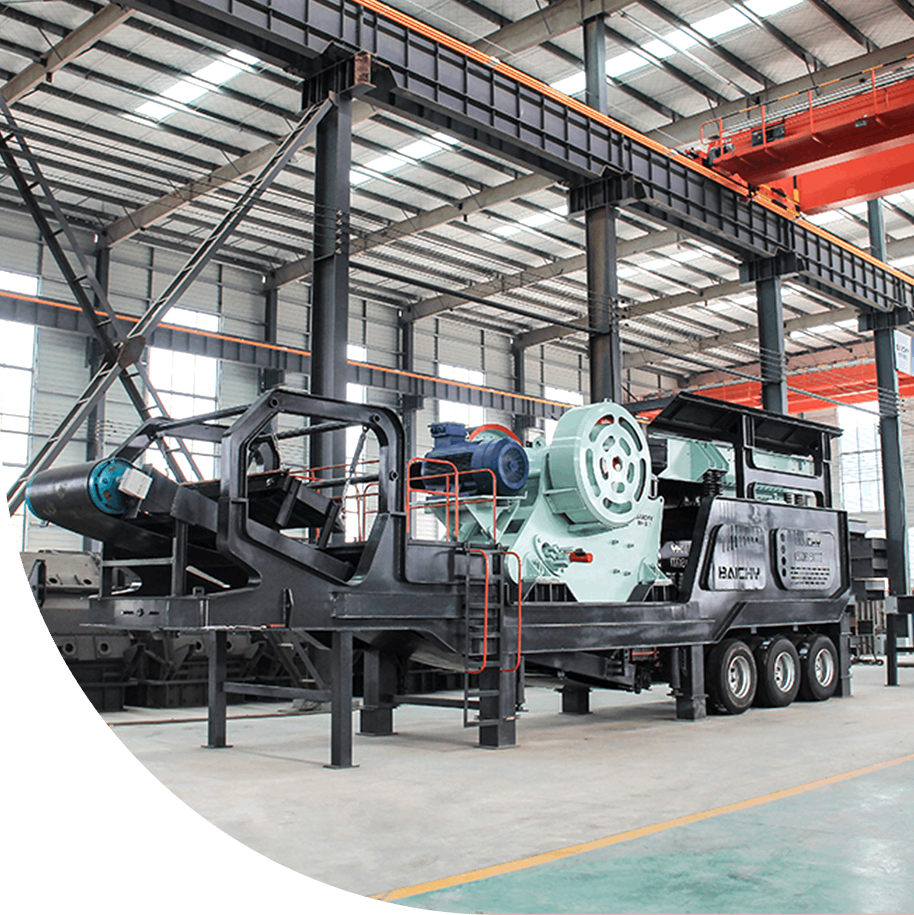

For applications such as laboratory mineral processing tests, small-scale gold or copper pilot production lines, and ceramic raw material processing, the combination of a "PE250×400 Jaw Crusher (for primary crushing) + Φ600×800 Ceramic Ball Mill (for fine grinding)" offers the most cost-effective, rapid-result, and low-maintenance solution. The entire system has a total power rating of just 18 kW (15 kW for the jaw crusher and 3 kW for the ball mill); it operates on standard industrial power without requiring a dedicated high-voltage line, and installation and commissioning can be completed within 15 days.
I. Core Equipment Technical Specifications
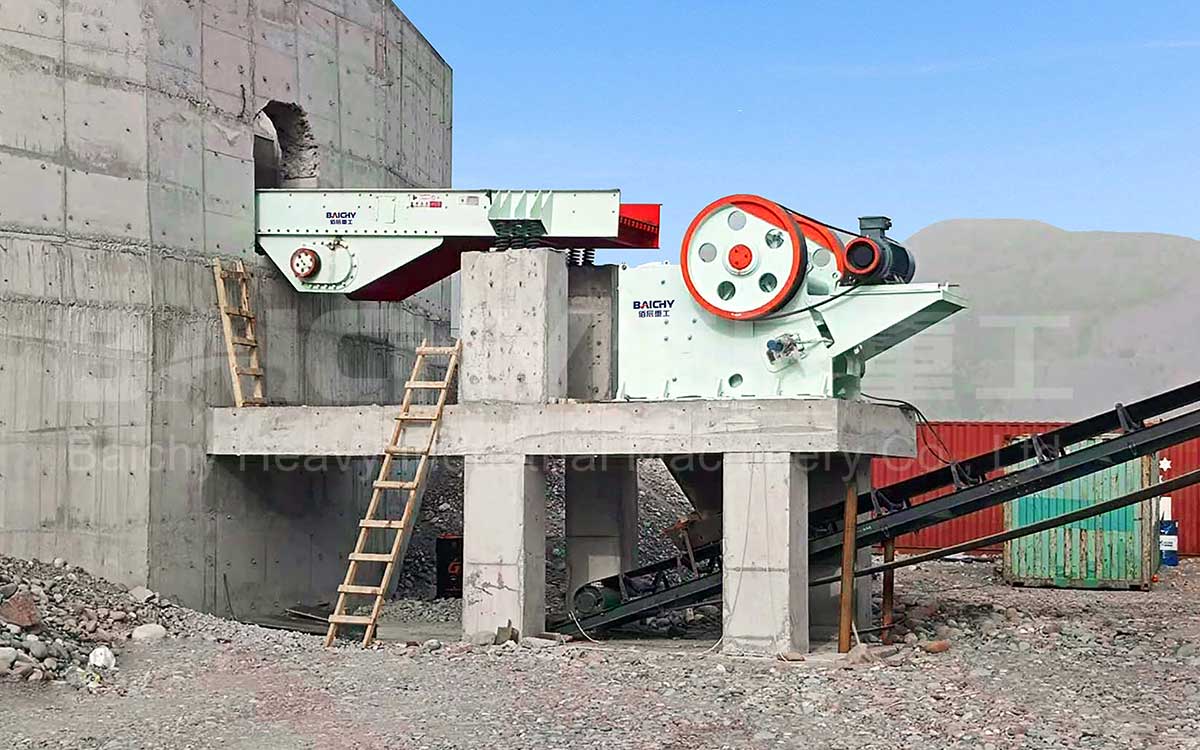
PE250×400 Jaw Crusher — Primary Crushing Unit
<<PE250x400 Jaw Crusher Detalis>>
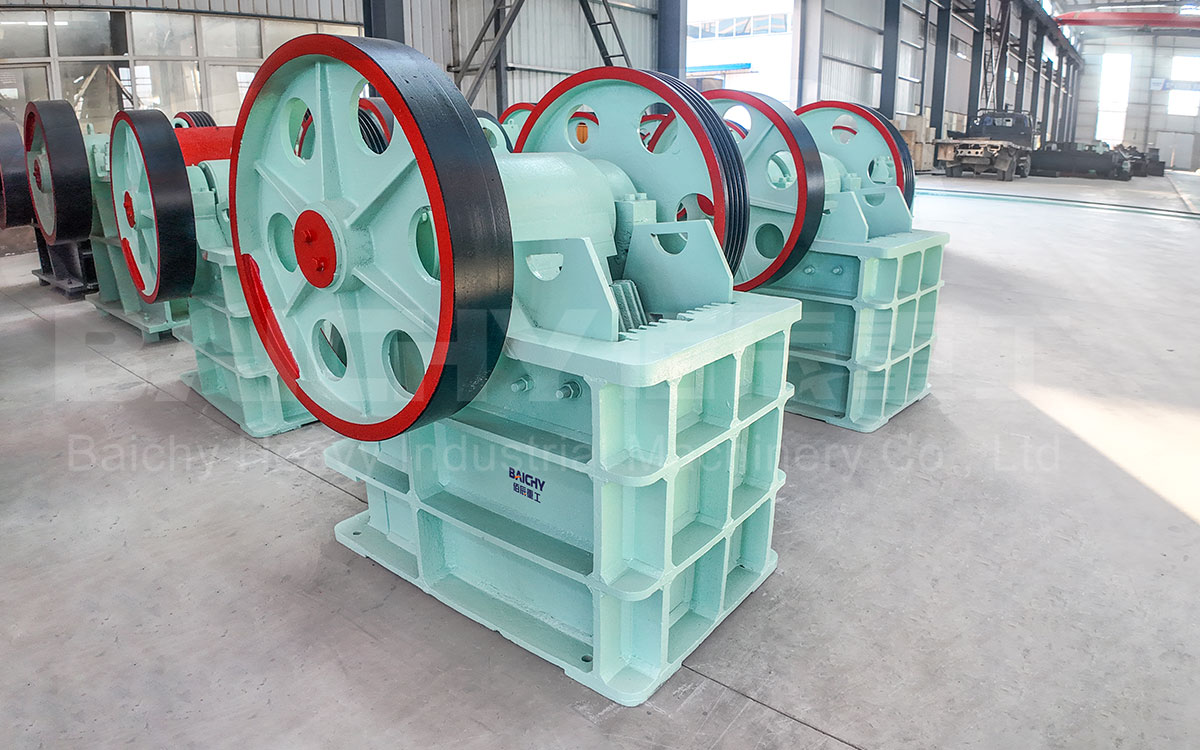
PE250x400-Jaw-Crusher
| Parameter | Specification | Practical Value |
| Feed Opening Size | 250 × 400 mm | Max feed size 210 mm; handles run-of-mine ore directly |
| Discharge Opening Adjustment Range | 20 – 60 mm | Flexibly matches downstream ball mill feed requirements |
| Processing Capacity | 5 – 20 t/h | Capacity far exceeds the ball mill; ensures no bottleneck at the primary stage |
| Eccentric Shaft Speed | 300 r/min | High-frequency impact; efficient crushing of hard rock |
| Motor Power | 15 kW (6-pole) | Low energy consumption; compatible with standard cabling |
| Total Weight | ~2.8 t | Compact structure; easy to move and install quickly |
Φ600×800 Ball Mill — Fine Grinding Core
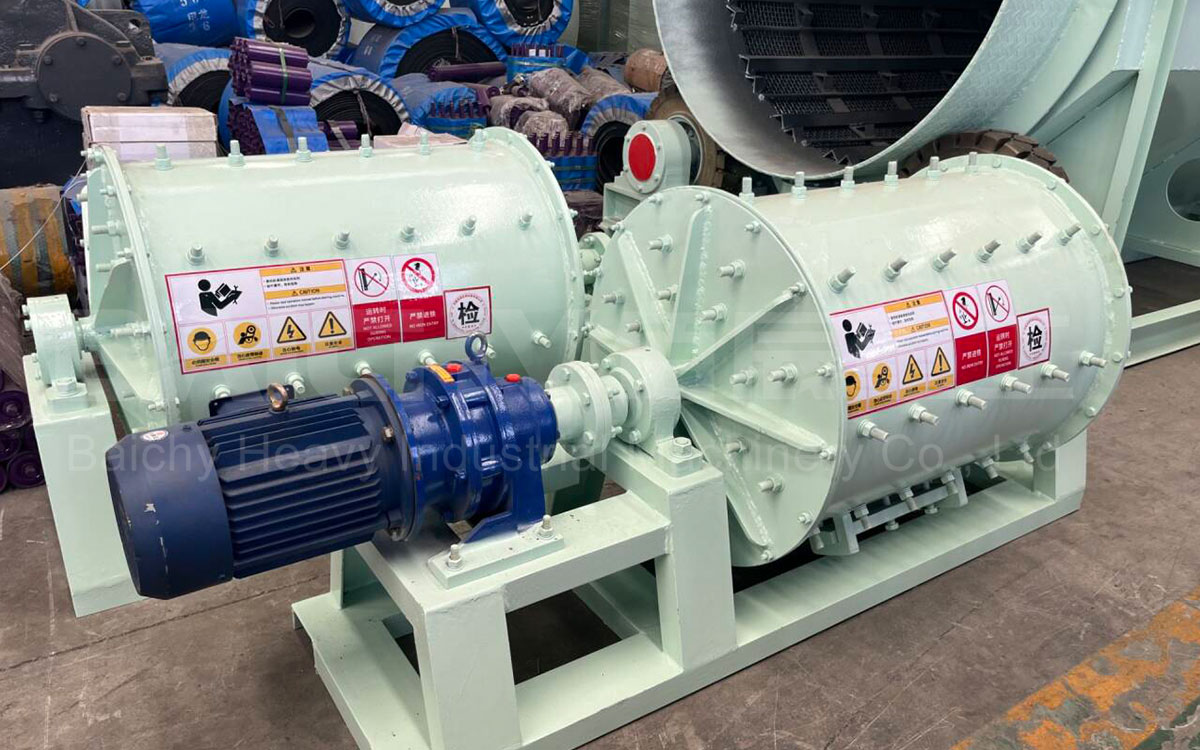
600x800-Ball-Mill
| Parameter | Specification | Practical Value |
| Shell Inner Diameter × Length | Φ600 × 800 mm | Small-scale/laboratory/ceramic grade; footprint <1 m² |
| Shell Rotation Speed | 40 – 50 r/min | Optimized critical speed ratio; maximizes grinding efficiency |
| Charge Load | 0.2 – 0.3 t/batch | Batch or continuous operation; meets small-volume needs |
| Feed Particle Size | ≤25 mm | Perfectly matches jaw crusher discharge; eliminates need for intermediate crushing |
| Discharge Particle Size | 0.074 – 0.4 mm | Adjustable 200-mesh pass rate; meets flotation/gravity separation requirements |
| Output | 0.05 – 0.1 t/h | Daily capacity ~1–2 tons; ideal for pilot-scale testing |
| Motor Power | 2.2 – 3 kW | Compatible with single-phase or three-phase power |
| Liner/Media | Ceramic liners + ceramic balls | Zero iron contamination; ideal for high-purity materials |
| Total Weight | ~1,200 kg | Lightweight design; installation and positioning can be completed by just two people. |
II. Why is this combination the optimal solution for small-scale mineral processing?
1. Seamless particle size transition; eliminates the secondary crushing stage
The traditional three-stage process of "coarse crushing → secondary crushing → fine grinding" represents significant waste for small-scale operations. By adjusting the discharge opening of the PE250×400 crusher to ≤25mm, material feeds directly into the Φ600×800 ball mill, saving on the investment and footprint associated with secondary jaw or hammer crushers:
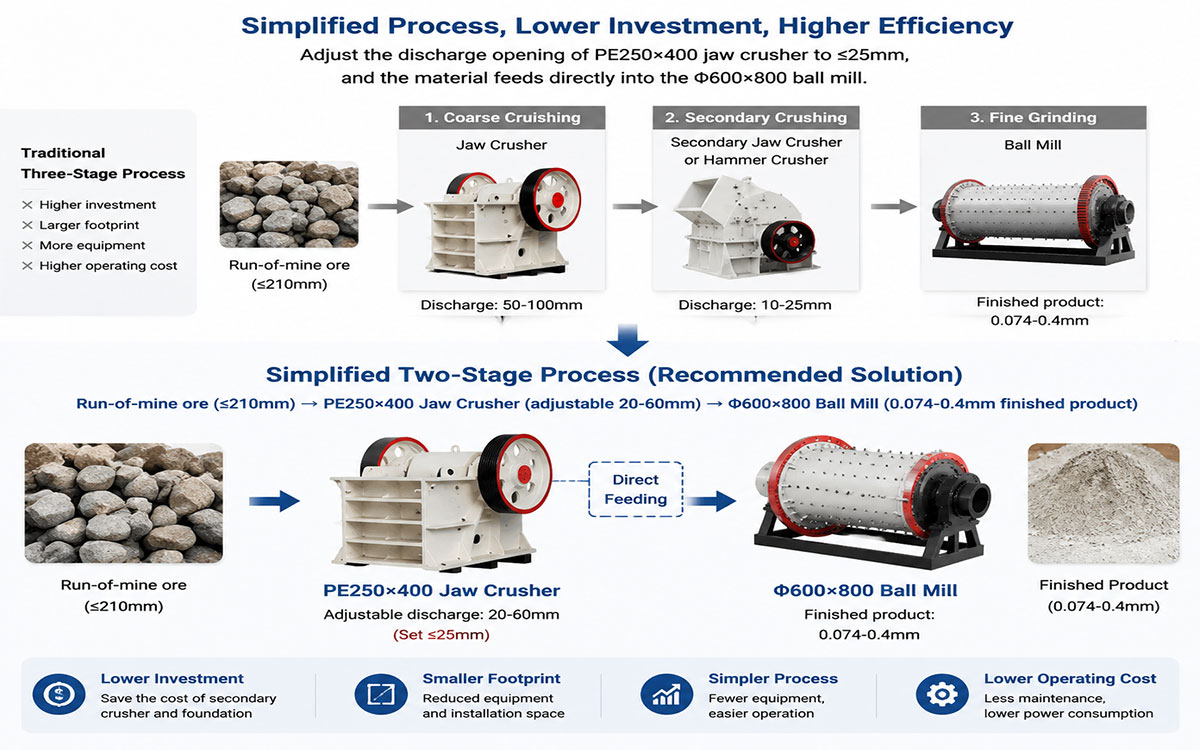
Run-of-mine ore (≤210mm) → PE250×400 Jaw Crusher (adjustable 20-60mm) → Φ600×800 Ball Mill (0.074-0.4mm finished product)
For ores with lower hardness or those that have undergone pre-sorting, this "two-stage" process is sufficient to handle the entire workflow from raw mine ore to flotation feed.
2. Ceramic liners: The cure for "iron contamination anxiety"
In sectors extremely sensitive to iron content—such as high-purity quartz sand, feldspar, kaolin, and ceramic glazes—iron wear from standard steel-lined ball mills can ruin an entire batch of material. The Φ600×800 model utilizes high-alumina ceramic liners and ceramic grinding media to eliminate iron contamination at the source, maintaining a finished product whiteness retention rate of >98%.
3. 18 kW Total Power: No More Worries About Electricity Supply
| Comparison Metric | This Solution | Conventional Φ900×1800 Ball Mill Line |
| Total Installed Power | 18 kW | ~37 kW (Jaw Crusher + Ball Mill) |
| Power Supply Requirements | Standard 380V industrial power | Requires dedicated transformer or capacity upgrade |
| Cable Specifications | 10 mm² sufficient | Requires 16–25 mm² |
| Feasibility for Remote Mining Areas | ✅ Can run on a small diesel generator | ❌ Requires grid connection |
For mining areas in Africa, Southeast Asia, South America, and elsewhere where the power grid is unreliable, the 18 kW requirement means the system can even be powered independently by a single 30 kW diesel generator.
4. Low Investment, Fast Payback, Stress-Free Decision Making
The cost of the complete equipment set (jaw crusher + ball mill + basic accessories) is equivalent to that of just one medium-to-large jaw crusher. Ideal for:
• Beneficiation and metallurgical testing during the exploration phase
• Small-scale validation of tailings reprocessing
• Mineral processing laboratories at universities or research institutes
• In-house raw material processing for ceramic workshops
• The investment payback period is typically no more than 3–6 months. III. Suitable Materials and Application Scenarios
Suitable Materials
| Category | Typical Materials |
| Metal Ores | Gold ore, copper ore, lead-zinc ore, iron ore (small-scale pilot production/tailings reprocessing) |
| Non-metallic Minerals | Quartz sand, feldspar, fluorite, barite, calcite |
| Ceramic Raw Materials | Kaolin, china stone, glaze materials, zirconium silicate |
| Construction Materials | Limestone, gypsum, cement clinker (small-sample testing) |
Application Scenarios
Mineral Exploration/Beneficiation Laboratories: Rapidly evaluate ore beneficiability and provide data to support large-scale investment decisions
• Small-scale Gold Pilot Lines: Used with shaking tables or flotation machines to process 1–2 tons of raw ore per day; cost-effectively verify the value of a deposit
• Ceramic Workshop Raw Material Processing: Grind purchased raw ore in-house to eliminate reliance on suppliers of finished powder
• University Mineral Processing Programs: Compact and intuitive equipment for teaching demonstrations
• Tailings Reprocessing Verification: Conduct on-site small-scale tests on samples to determine the feasibility of recovering residual valuable metals from tailings
IV. Recommended Optional Configurations
If you wish to further improve efficiency or optimize the process, the standard setup can be expanded with the following:
| Optional Equipment | Function | Suitable Scenario |
| Vibrating Feeder (GZ Series) | Ensures uniform feeding; prevents the jaw crusher from stalling | Raw ore with high fines content or sticky/wet material |
| Hammer Crusher (Small) | Further reduces 20–60mm material to ≤10mm | Low-hardness ore requiring higher ball milling efficiency |
| Spiral Classifier / Vibrating Screen | Closed-circuit classification; discharges material meeting size specifications | Strict requirements for discharge fineness |
| Shaking Table / Flotation Machine | Purification via gravity separation or flotation | Recovery of valuable metals such as gold and copper |
V. Frequently Asked Questions (FAQ)
Q: Is the Φ600×800 ball mill a dry-type or wet-type unit?
A: The standard configuration is for wet grinding (adding water to form a slurry); this offers 20–30% higher grinding efficiency than dry grinding and produces no dust. For dry grinding applications (e.g., cement, ceramic dry powder), a dry discharge system can be customized.
Q: How effective is this combination for processing gold ore?
A: For quartz-vein gold ore (Mohs hardness of 7), the PE250×400 is fully capable of primary crushing, and the Φ600×800 ball mill can grind the ore to 100–200 mesh; subsequent processing with a shaking table or flotation machine enables gold recovery. We recommend conducting beneficiation tests first to determine the optimal grinding fineness.
Q: Can the ball mill operate continuously?
A: Yes. With appropriate feeding and discharge systems installed, it supports 24-hour continuous operation. However, for laboratory-scale models, batch operation is recommended to facilitate batch management and sampling.
Q: Is the equipment difficult to transport and install?
A: The complete set weighs approximately 4 tons and fits easily into a standard 20-foot container. The foundation requires only a simple concrete slab, and on-site installation can be completed in 2–3 days.
Q: What is the service life of the ceramic liners? Are they easy to replace?
A: Under normal operating conditions, the ceramic liners last 1–2 years (depending on material hardness). The liners are bolted in place and can be replaced inpidually without requiring factory repairs.
VI. Investment Budget Reference
| Equipment | Reference Price Range (FOB) |
| PE250×400 Jaw Crusher | $3,500 – $5,000 |
| Φ600×800 Ceramic Ball Mill | $2,000 – $3,500 |
| Ceramic Grinding Media (Initial Charge) | $300 – $500 |
| Total | $5,800 – $9,000 |
The above are FOB reference prices; they exclude shipping, customs duties, and on-site installation costs. Actual prices may vary based on configuration (motor brand, liner material, optional accessories). <<Contact us for the latest equipment quotes and complete production line designs>>
Baichy Heavy Industry — 20 years of experience exporting mining machinery, serving over 120 countries and regions worldwide
WhatsApp Online
📧 Email: [email protected]
📱 WhatsApp: +86 150 9322 2637
🌐 Web: www.baichychina.com