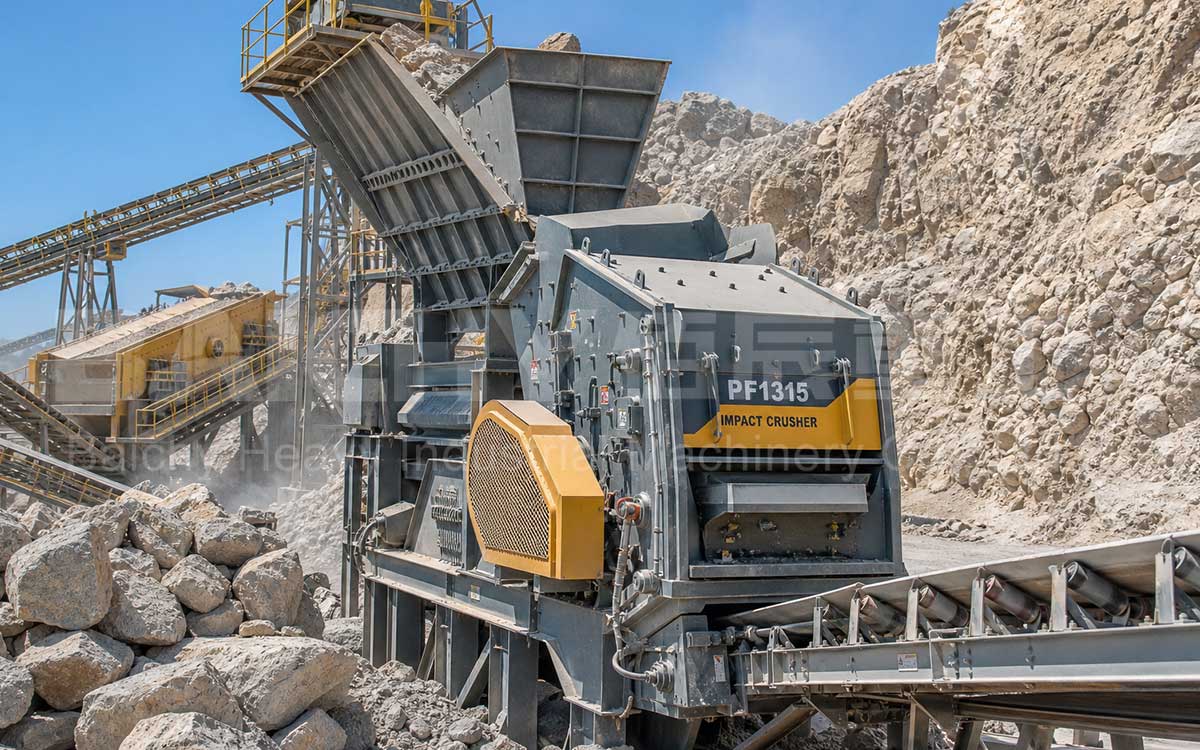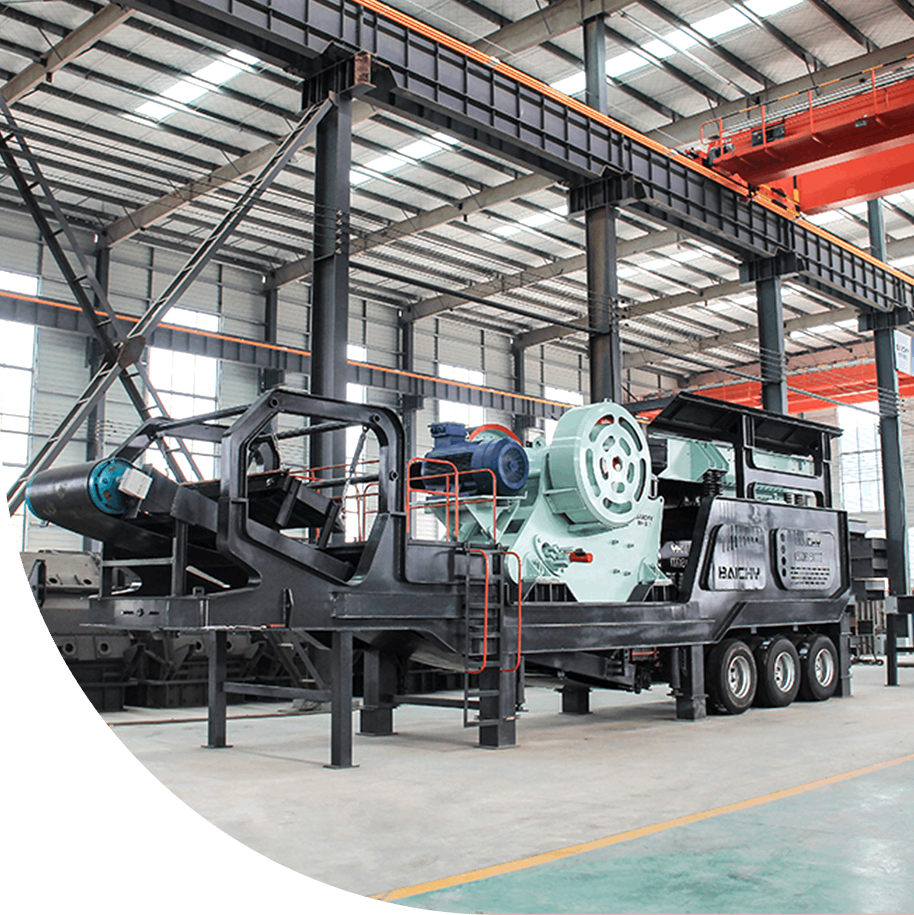


Primary jaw crusher
The primary crusher sets the capacity ceiling and the cost-per-ton floor of every crushing plant above it. If the coarse crushing stage is undersized or mismatched to your material, every ton of throughput below it — screening, secondary crushing, stockpiling — pays for that mistake in lost production and wasted energy. Get the primary crusher right, and the rest of the line runs at design efficiency; get it wrong, and no amount of downstream optimization can fix it.
This guide covers what the coarse crushing stage does, where it earns its keep across industries, how to match it to your rock, the specifications that actually move your P&L, and three real installations where machine selection decided project outcomes. All capacity figures below are rated on limestone at 1.6 t/m³ — always re-rate for your own material density.
What Is a Primary Crusher?
The primary crushing stage is the first size-reduction step in a mineral processing or aggregate production line. It receives run-of-mine (ROM) or quarry-blasted material — typically 300–1,200 mm lumps — and reduces it to a size the downstream circuit can handle, usually 80–250 mm, at a reduction ratio of 4:1 to 6:1.
The primary crushing stage has three non-negotiable jobs:
Accept the full feed — the feed opening must clear the largest lump your trucks, loaders, or feeders deliver, without bridging or stalling;
Protect downstream equipment — it absorbs the impact and abrasion of virgin rock so secondary crushers, screens, and conveyors run on predictable, controlled feed;
Set the plant's throughput rhythm — its discharge rate becomes the reference capacity every downstream stage is sized against.
For hard, abrasive rock (granite, basalt, iron ore, river gravel), the industry-standard choice for the primary stage is the jaw crusher, which compresses material between a fixed and a moving jaw plate. For soft-to-medium materials (limestone, gypsum, recycled concrete), impact crushers and double-rotor hammer crushers can also serve as the primary stage, often with a cubic product shape that saves a downstream pass. The selection logic is simple: match the crushing mechanism to the material's hardness and abrasiveness, then size the machine to the feed and the target tonnage.
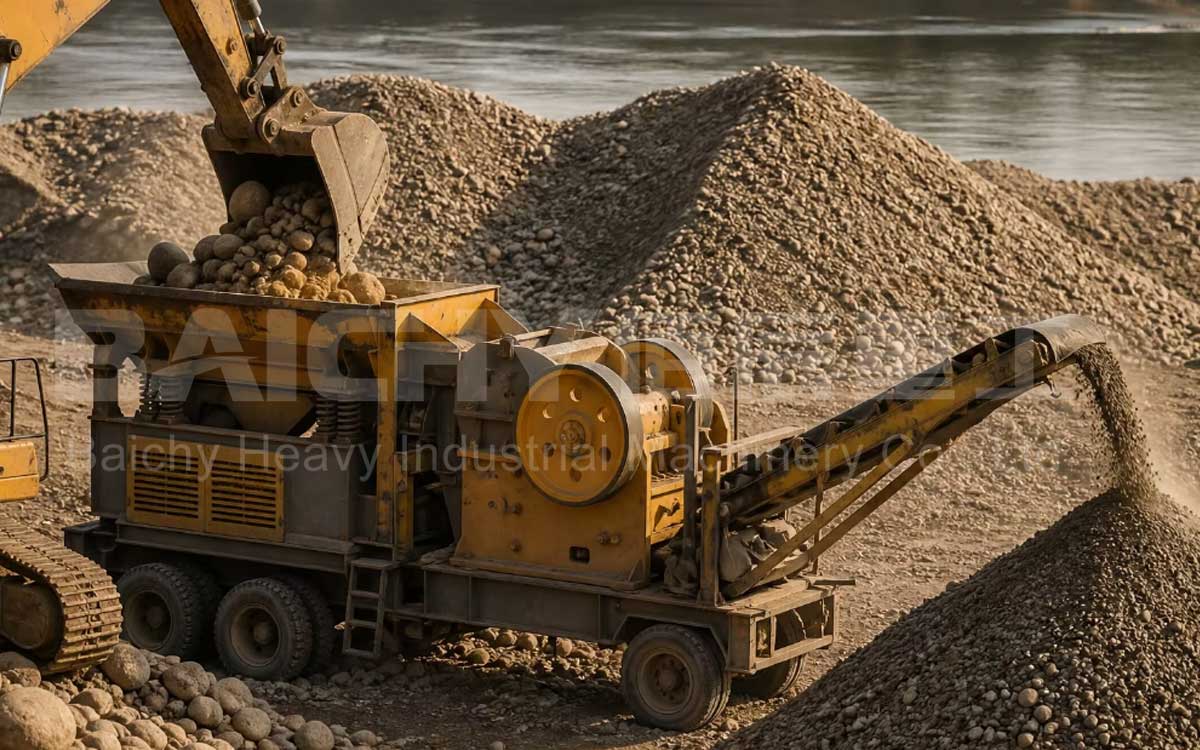
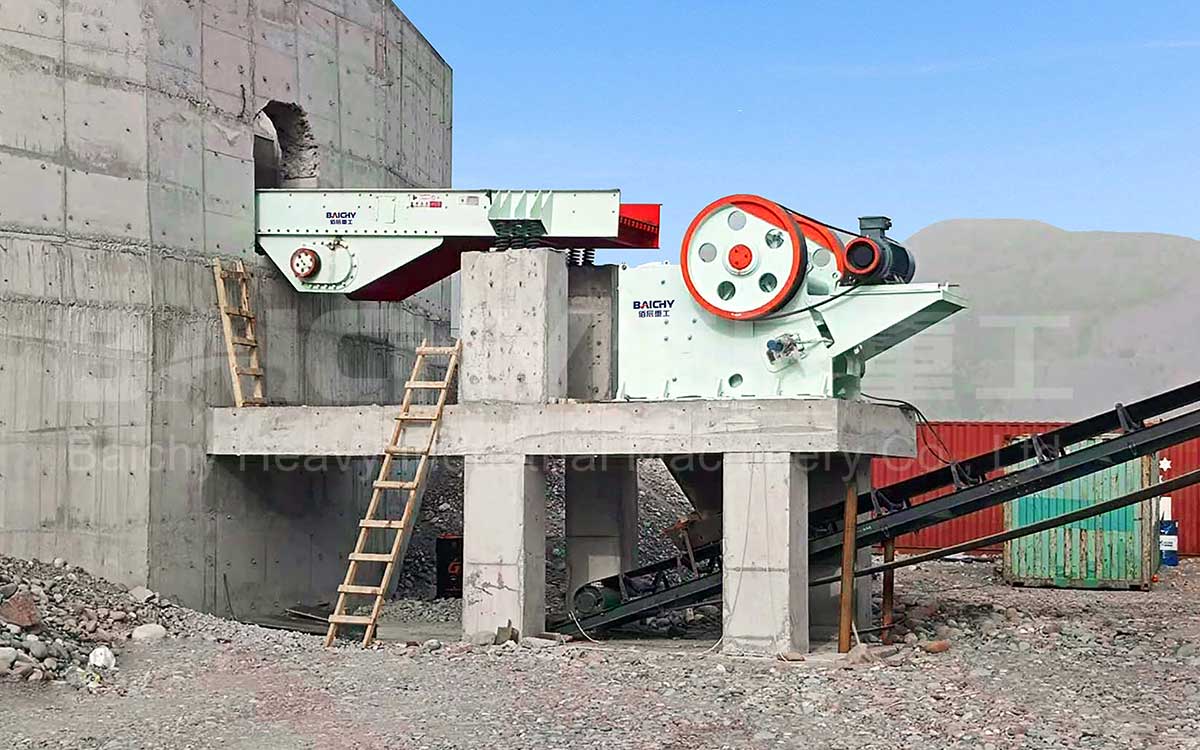
primary crushing plant - mobile jaw crusher
Primary Crushing Applications by Industry
Aggregate and Quarry Production
Quarries feeding concrete and asphalt markets run the largest population of primary jaw crushers worldwide. A typical 100–150 tph granite or basalt line opens with a PE600×900 jaw crusher taking feed up to 500 mm, discharging 65–160 mm material straight onto a conveyor to the secondary stage. Here the coarse crusher's duty cycle is brutal — 10–12 hours a day, year-round — which makes wear-part life and downtime the two numbers that separate profitable quarries from marginal ones.
Metal Mining: Iron, Gold, Copper
Underground and open-pit mines open their circuits with primary crushing to reduce ROM ore before grinding. Iron ore operations favor large jaw crushers or gyratory-class machines because the material is dense and highly abrasive; capacity must be de-rated to roughly 0.7–0.8× of the limestone rating. Small-scale gold operations (ASGM) commonly pair a PE400×600 or PE500×750 jaw crusher with a wet pan mill or ball mill — the jaw crusher taking minus-340 mm ore down to 40–100 mm in one pass, protecting the mill from oversize feed.
Construction and Demolition Waste Recycling
Recycling lines process concrete rubble, asphalt, and mixed demolition waste, where steel rebar and embedded contaminants punish impact-type crushers. Many C&D plants in Southeast Asia and Europe run a jaw crusher as the primary stage for exactly this reason: jaw plates crush through rebar-laced concrete without the catastrophic failure an impact rotor would suffer. The crushed 50–120 mm product feeds a magnetic separator, screens, and an impact crusher that restores a cubical aggregate shape for reuse in road base and backfill.
Industrial Minerals and Cement Raw Material
Cement plants crush limestone — a soft, brittle material — at high tonnage. Here a double-rotor hammer crusher (2PC series) takes feed up to 400 mm and discharges minus-25 mm in one step, eliminating the separate secondary stage entirely and cutting equipment count, floor area, and investment by roughly 40%. Limestone quarries and gypsum producers face the same logic: brittle material + big tonnage = single-stage hammer crushing beats jaw-plus-impact two-stage economics.
How to Select a Primary Crusher: 5 Decision Factors
1. Material Hardness and Abrasiveness
This is the first filter and it is non-negotiable. High-abrasion hard rock (granite, basalt, quartzite, iron ore, river gravel) demands compression crushing — a jaw crusher — because jaw plates outlast impact hammers by a wide margin on abrasive feed. Soft-to-medium materials (limestone, gypsum, dolomite, C&D waste) can go to impact or hammer machines that produce a better product shape in fewer stages. Matching the mechanism to the rock is worth more than any price negotiation.
2. Feed Size (Top Lump Dimension)
Your feed opening must be at least 20% larger than the largest lump entering it. A PE600×900 jaw crusher accepts feed up to 500 mm; if your loader delivers 700 mm boulders, the machine will jam daily and quietly destroy its own throughput. Measure the real top size at the quarry face or ROM pad before selecting — this single measurement decides the correct model more than any other input.
3. Capacity and Reduction Ratio
Nominal capacity figures are rated on limestone at 1.6 t/m³. De-rate for denser material: iron ore ×0.7–0.8, hard basalt ×0.85–0.9. A primary-stage crusher that delivers 100 t/h on limestone will produce roughly 75–85 t/h on basalt — spec your line against the de-rated number, not the brochure number. Also verify the reduction ratio: a 4:1 to 6:1 ratio at the primary stage keeps the secondary crusher's feed within its design envelope and prevents recirculation loops that eat capacity.
4. Moisture and Stickiness
Material above 15% moisture — wet river gravel, sticky laterite, damp clay — bridges crusher chambers and blinds screens. For wet applications, specify a wider discharge setting and consider a vibrating grizzly feeder (ZSW series) ahead of the crusher to scalp fines and route them around the crushing chamber. If your wet season is severe, this pairing is not optional; it is the difference between 300 operating days and 200.
5. Power Standard and Site Infrastructure
Global buyers must match the crusher to local electrical standards — 380V/50Hz (Ethiopia, much of Africa), 400V/50Hz (South Africa), 380V/60Hz (Brazil), 440V/60Hz (parts of Latin America). Baichy configures motors, starters, and control cabinets for each market's standard as standard practice, and can supply diesel-electric or mobile options where grid power is unreliable. Ignoring this factor turns a smooth commissioning into a re-engineering project.
PE Series Primary Jaw Crusher Specification Table
| Model | Feed Opening (mm) | Max Feed (mm) | Discharge Range (mm) | Capacity (t/h)* | Motor Power (kW) | Typical Application |
| PE-250×400 | 250x400 | ≤210 | 20-80 | 5-20 | 15 | Small quarries, ASGM gold, pilot plants |
| PE-400×600 | 400×600 | ≤340 | 40-100 | 16-64 | 30 | 30–60 tph lines, Ethiopia basalt, ASGM |
| PE-500×750 | 500×750 | ≤425 | 50-100 | 45-100 | 55 | Mid-size quarries, 50–100 tph standard |
| PE-600×900 | 600×900 | ≤500 | 65-160 | 50-160 | 75 | International "69 line", 100–150 tph plants |
| PE-750×1060 | 750×1060 | ≤630 | 80-180 | 100-230 | 110 | Direct truck feed, 200+ tph plants |
| PE-900×1200 | 900×1200 | ≤750 | 95-200 | 160-380 | 132 | Large mines, high-tonnage fixed lines |
*Rated on limestone at 1.6 t/m³. De-rate: iron ore ×0.7–0.8, hard basalt ×0.85–0.9.
What these numbers mean for your P&L: the feed opening is your truck-fleet compatibility — the PE750×1060 accepts loader and 50 t truck feed directly, saving the cost of a second blasting round or hydraulic breaker at the face. The discharge range is your secondary crusher's feed spec: the closer the primary discharge matches the secondary's optimum intake, the lower your recirculation load and screening cost. Motor power is your electricity bill — a correctly sized 75 kW motor running at design load draws less per ton than an oversized 110 kW motor loafing at 60% load.
Key Advantages of a Well-Selected Primary Crusher
Higher Real Capacity, Not Brochure Capacity
The measurable advantage of a correctly sized primary crusher is delivered tonnage. A PE600×900 rated 50–160 t/h on limestone, running basalt at 0.85×, still clears 45–135 t/h — enough for a 100 tph basalt line without the secondary crusher starving or the primary stalling. Undersized coarse crushing is the most common cause of "the plant never hits its nameplate," and it is entirely avoidable at the selection stage.
Lower Cost Per Ton Over the Asset Life
Wear parts account for 30–40% of total crushing cost. A jaw crusher's high-manganese steel jaw plates deliver 800–3,000 hours of life depending on abrasiveness — versus impact hammers on the same abrasive feed, which may last a fraction of that. Compression crushing on hard rock is simply the lowest-TCO mechanism: fewer changes, less downtime, lower labor cost. Over a 3–5 year horizon, the jaw primary pays for its premium through wear parts and uptime alone.
Design Uptime and Fast Adjustment
Modern primaries ship with hydraulic or wedge discharge adjustment that re-sets product size in under 10 minutes — versus half a shift with the old mechanical shims. Deep crushing chambers and robust eccentric shafts keep the machine running at full stroke under load. For operators running 300+ days a year, every hour of avoided downtime is worth roughly 100 tons of product at the market price — the arithmetic always favors the more robust machine.
Global Adaptability: Power, Transport, Service
Baichy primary-stage crushers are configured for 50 Hz and 60 Hz markets alike, shipped as full assemblies or knocked-down kits for containerized freight, and supported by a 20+ year export track record across Southeast Asia, Africa, Latin America, and the Middle East. For remote sites or weak grid regions, the same jaw crusher is available on wheeled or tracked mobile stations (YDPZ series) that commission in days, not months.
Real-World Cases: When Primary Crusher Selection Decided the Outcome
Venezuela — River Gravel Mobile Line
A Venezuelan operator processing river gravel needed a plant that could relocate as the deposit advanced and tolerate the rounded, abrasive feed typical of riverbeds. The solution paired a PE600×900 jaw crusher on a wheeled mobile station with a vibrating feeder, discharging 65–160 mm into a secondary cone circuit. The mobile configuration cut civil-works cost to near zero, and the jaw's abrasion resistance handled the river gravel's silica content without the hammer wear an impact primary would have suffered.
Philippines — C90 Stationary Line for River Stone
A Philippine producer running river stone and pebble feed chose a C-series C90 jaw crusher as the primary stage. The C90's deeper crushing chamber and wedge discharge adjustment deliver roughly 15–20% higher single-machine output than the equivalent PE model, with 10-minute product changes between aggregate specs. For a market where river-stone prices and product mix shift monthly, that flexibility converted directly into margin.
Ethiopia — PE400×600 for Basalt at Infrastructure Sites
Ethiopian infrastructure projects — including airport and road construction — demanded a compact, reliable primary crusher on 380V/50Hz power for basalt feed up to 340 mm. The PE400×600 jaw crusher, rated 16–64 t/h on limestone and de-rated to roughly 0.85× for basalt, matched a 30–50 tph mobile line feeding an impact crusher for aggregate. Its simple structure and low maintenance requirement mattered most on sites where skilled mechanics are scarce: fewer moving parts, fewer things to go wrong, faster parts delivery.
Recommended Primary Crushing Equipment
| Equipment | Best For | Why |
| PE Series Jaw Crusher | Hard rock, general purpose, budget-first buyers | Simplest structure, lowest maintenance cost, highest value; the default coarse crusher for 5–380 t/h lines |
| C Series European Jaw Crusher | High-output hard rock, frequent product changes | Deeper chamber + wedge adjustment = 15–20% higher throughput, 10-minute discharge changes |
| YDPZ Wheeled/Tracked Mobile Jaw Station | Relocatable plants, remote sites, weak grid | Container-friendly, commissions in days, diesel-electric options |
| 2PC Double-Rotor Hammer Crusher | Brittle materials at high tonnage (limestone, gypsum, coal) | One-step crushing to minus-25 mm replaces jaw + impact two-stage |
| ZSW Vibrating Grizzly Feeder | Wet/sticky feed, scalping fines ahead of crushing | Shields the coarse crusher from fines and moisture, boosts effective capacity |
Configuring a full line? Primary crushing is stage one of a complete system: feeder → jaw crusher → conveyor → secondary crusher → screens → washing (if required). Baichy engineers each line around your material, feed size, target tonnage, and local power standard, with transparent CAPEX/OPEX estimates — see the PE-series jaw crusher specification page and our jaw crusher knowledge base for deeper background.
FAQ
Q1: What is the difference between a primary crusher and a secondary crusher?
A: The primary crusher receives run-of-mine or blasted rock (300–1,200 mm) and reduces it to 80–250 mm at a 4:1 to 6:1 ratio; the secondary crusher then reduces that product to 10–80 mm for final aggregate or mill feed. The primary absorbs the hardest duty and sets plant capacity, while the secondary controls final product shape and size. On hard rock the primary is almost always a jaw crusher; the secondary is typically a cone or impact crusher.
Q2: Which primary crusher is best for hard rock such as granite and basalt?
A jaw crusher. Compression crushing between fixed and moving jaw plates is the most abrasion-resistant mechanism available, and jaw plates (high-manganese steel) last 800–3,000 hours depending on rock abrasiveness — far longer than impact hammers on the same feed. For 100–150 tph granite or basalt, the standard choice is the PE600×900 (feed ≤500 mm); de-rate its limestone capacity by 0.85–0.9× when budgeting basalt throughput.
Q3: How much does a primary crushing plant cost?
A: A complete primary crushing stage — feeder, jaw crusher, conveyor, and electrical control — typically ranges from roughly USD 30,000 for a compact PE400×600 line to USD 150,000+ for a PE900×1200 heavy-duty installation, before freight and civil works. Total cost of ownership matters more than purchase price: wear parts (30–40% of crushing cost), electricity, and downtime dominate over 3–5 years. Send your material type, top feed size, and target
Baichy Heavy Industry
Baichy Heavy Industry is a high-tech mining equipment company integrating R&D, manufacturing, sales, and after-sales service. Focusing on crushing, grinding, and mineral processing equipment, we provide professional solutions to our customers. We are ISO9001:2015 、certified, and our products include mobile crushing palnts, crawler crushing plant, construction waste crushing plants, jaw crushers, sand making machines, cone crushers, fine crushers, grinding mills, ball mills, etc., all with reliable performance to meet diverse project needs.
Baichy Heavy Industry – Your Trusted Partner
To ensure optimal performance of your equipment, Baichy Heavy Industry offers:
- Professional on-site installation guidance
- Comprehensive operator training
- 24/7 technical support & maintenance services
Our complete after-sales service system guarantees long-term, stable operation of your machinery with minimal downtime.
Protect Your Rights – Only Use Official Channels
To avoid scams and ensure authentic support, contact us exclusively through:
• Official Website: www.baichychina.com
• WhatsApp: +8615093222637
• Email: [email protected]
Your satisfaction is our priority – expect prompt, professional service every time.
(Note: Beware of unauthorized third parties claiming to represent Baichy. Always verify through official contacts.)