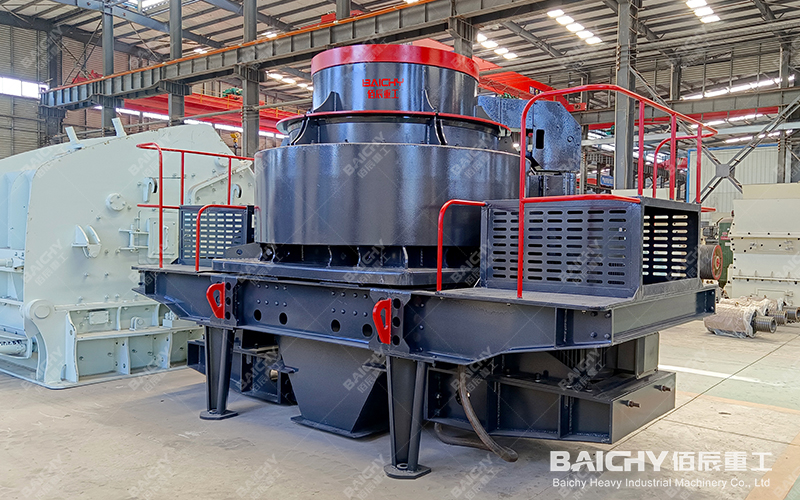
VSI sand-making machine
The VSI sand-making machine is not merely a simple "grinder," but rather a high-precision device that integrates both crushing and shaping functions. Its standard output range is fixed at 0–5 mm; however, by adjusting the spindle speed and feeding method, it can produce particles as fine as 0.075 mm (stone powder) at the lower end, while retaining coarse sand or stone chips under 10 mm at the upper end, depending on specific production requirements.
1. Core Answer: The "Ceiling" and "Floor" of Particle Size
In the field of manufactured sand production, particle size control directly determines the gradation and market price of the finished sand product.
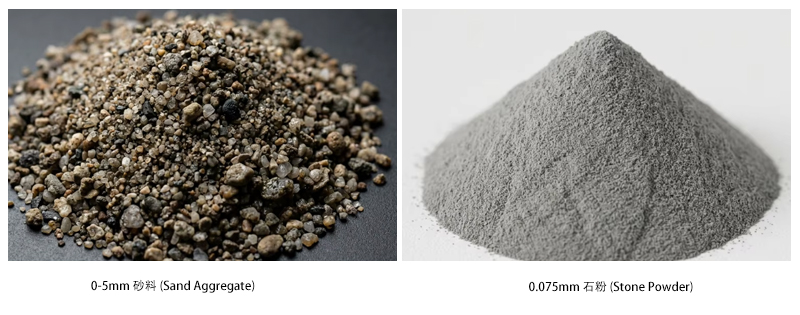
The Effects of Sand and Gravel Aggregates with Different Particle Sizes
• Minimum Particle Size (Min): Approximately 0.075 mm (200-mesh grade). This is typically classified as "stone powder" content. Through high-speed impact (either "stone-on-stone" or "stone-on-iron" crushing), VSI machines generate a certain proportion of ultrafine particles during the fine-crushing stage—a factor crucial for filling voids within concrete mixtures.
• Maximum Particle Size (Max): Typically 5 mm. Although VSI machines are capable of processing feed material ranging from 30 to 50 mm, the upper limit for their final output of "standard manufactured sand" is capped at 5 mm. Any material exceeding this size is typically returned to the crushing circuit for further processing via an external screening system.
2. The Profit Perspective: Why Does "Adjustability" Equal Higher Profit Margins?
The true value of manufactured sand lies not merely in being "crushed," but in being "uniform." The ability to flexibly adjust the output particle size directly impacts the quality of your finished product and your overall yield rate.
| Adjustment Method | What It Means for the Quarry Owner |
| Variable Frequency Speed Control | Efficiency & Cost Savings: Increasing the spindle speed lowers the fineness modulus and boosts sand production rates by 10–15%; it also allows operators to identify the optimal energy-efficiency "sweet spot" for processing stones of varying hardness. |
| Center/Cascade Feeding Ratio | Superior Particle Shape: Adjusting the volume of the "cascade feed" optimizes the reduction of needle-like and flaky particles, resulting in rounder, higher-quality manufactured sand that commands a market premium. |
| External Closed-Circuit Screening System | Precise Gradation Control: By swapping out the screens on the vibrating sieve, operators can precisely separate coarse sand (3–5 mm) from fine sand (0–3 mm), thereby meeting the specific gradation requirements for specialized concrete applications. |
3. Performance Benchmarking: VSI Series Key Parameter Comparison Table
| Parameter Name | VSI7611 (Entry-Level) | VSI9526 (Professional-Grade) | Industry Standard Reference |
| Max. Feed Opening (mm) | 35 (Hard Materials) / 50 (Soft Materials) | 45 (Hard Materials) / 50 (Soft Materials) | Varies based on material hardness |
| Processing Capacity (t/h) | 60 – 150 | 250 – 450 | Essential for high-output production lines |
| Spindle Speed (r/min) | 1700 – 1890 | 1100 – 1490 | Determines impact energy |
| Finished Sand Ratio (0–5 mm) | 40% – 60% (Single-pass rate) | 50% – 70% (Single-pass rate) | Can reach 100% with a closed-circuit system |
| Motor Power (kW) | 55 x 2 | 200 x 2 |
4. Selection Pitfalls: Do You *Really* Need Ultra-Fine Sand?
✅ Recommended Scenarios: Large-scale concrete mixing plants, aggregate production for highways/railways, high-purity processing of quartz sand, raw materials for dry-mix mortar.
❌ Cautionary Scenarios: If your goal is to produce crushed stone larger than 10 mm, using a VSI is overkill (using a sledgehammer to crack a nut). We recommend switching to an impact crusher or cone crusher for shaping purposes instead.
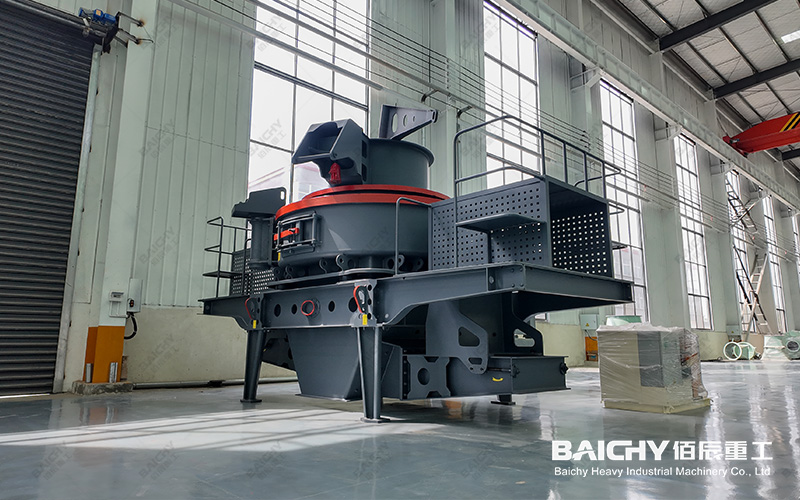
VSI Sand Making Machine
Frequently Asked Questions (FAQ)
Q1: Can the discharge particle size of a VSI sand-making machine be adjusted at any time?
A1: Yes, but it is not as simple as turning a faucet. Adjusting the spindle speed is the most direct method (we recommend opting for a variable frequency drive cabinet); however, to change the actual "maximum particle size" limit, you must shut down the machine and replace the screen mesh on the external vibrating screen.
Q2: Why is my VSI producing too little fine sand and too much coarse gravel?
A2: This is typically related to the "single-pass crushing rate." Check whether the spindle speed has reached its rated value, or try reducing the feed rate to force a greater volume of material into the center of the impeller for high-velocity ejection and impact.
Q3: Does material hardness affect particle size adjustment?
A3: Significantly. Hard rocks such as basalt and granite primarily rely on the "stone-on-stone" crushing principle within the VSI; while the sand-making yield is slightly lower, the resulting particle shape is excellent. Conversely, medium-to-soft materials like limestone produce sand rapidly, though care must be taken to prevent excessive dust generation.
Q4: What proprietary technology does the Baichen VSI sand-making machine employ for particle size control?
A4: We utilize a combination-style diamond-shaped impact block and adjustable flow guide plates. This allows you to fine-tune the trajectory of the material as it is ejected internally, thereby achieving greater precision in fine crushing—even at a constant spindle speed.