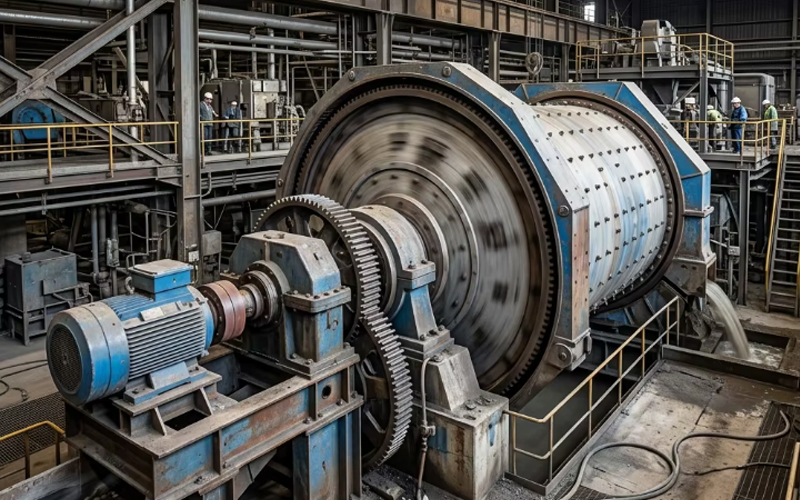
MQG2430 Grate-Type Ball Mill Performance Analysis
Regarding the requirement for a finished product fineness of 80 mesh (approx. 0.18 mm), a ball mill not only easily meets this standard but also demonstrates significant advantages in terms of operational stability and resistance to abrasive materials—particularly under medium-to-large-scale production demands of 30 tons per hour (t/h).
1. Recommended Models: MQG2430 or MQG2436
To ensure a stable production capacity of 30 t/h, we recommend selecting the MQG2430 (Φ2.4m × 3.0m) or its extended version.
| Key Parameters | MQG2430 (Grate Type) | MQG2436 (Grate Type) |
| Shell Dimensions | Φ2400 × 3000 mm | Φ2400 × 3600 mm |
| Matching Power | 245 kW | 280 kW |
| Reference Output | 15 – 48 t/h | 18 – 55 t/h |
| Applicable Fineness | 80–200 mesh (0.074–0.4 mm) | 80–200 mesh (0.074–0.4 mm) |
2. Solution Comparison: Ball Mill vs. Raymond Mill
Within the 80-mesh particle size range, you might also consider a Raymond mill (such as the MTW215); however, the selection logic for the two differs:
• Choose a Ball Mill when: The material hardness is high (e.g., granite, gold ore, iron ore); the process involves subsequent flotation or magnetic separation; 24-hour, high-intensity continuous operation is required; or there is a high demand for the durability of wear parts.
• Choose a Raymond Mill when: The material hardness is medium to low (e.g., limestone, calcite, barite); the requirement is to directly produce a finished dry powder product; site space is limited; or there are extremely strict controls on overall energy consumption.
3. Professional Selection Tips
• Discharge Method: Since 80 mesh is a relatively coarse fineness, we recommend selecting the "Grate Type" discharge mechanism. This method facilitates rapid discharge, effectively prevents "over-grinding," and enhances grinding efficiency.
• Closed-Circuit System: To ensure the required particle size compliance rate at a throughput of 30 t/h, it is recommended to integrate a spiral classifier or a high-frequency screen to form a closed-circuit loop, thereby returning oversized (non-compliant) coarse particles for regrinding.
• Steel Ball Grading: For an 80-mesh finished product, it is recommended to increase the proportion of medium-to-large steel balls (Φ80mm, Φ100mm) to enhance the impact-crushing effect, while simultaneously reducing the proportion of fine balls.
Frequently Asked Questions (FAQ):
Q: What motor size is appropriate for a ball mill in a 30 t/h production line?
A: For the MQG2430 model series, a 245 kW main motor is typically specified. During actual operation, it is recommended to maintain the operating current within 85% of the rated current to ensure a long service life for the motor.
Q: How do I choose between wet grinding and dry grinding?
A: If your material is water-tolerant, wet grinding offers 20–30% higher efficiency than dry grinding; furthermore, it eliminates dust pollution and consumes less energy. However, if the finished product is required to be dry, you should opt for dry grinding combined with an air classification system.
Q: How often do the wear parts of the ball mill need to be replaced?
A: The service life of the liners is typically 6–12 months (depending on the hardness of the material being processed). Steel balls should be added periodically to compensate for wear (typically, 0.5–1.0 kg of steel balls are consumed per ton of ore processed).
Q: What finished product yield (at 80 mesh) can be achieved?
A: In a closed-circuit system, by adjusting the rotational speed of the classifier or the operating pressure of the hydrocyclone, the oversize residue (material retained on an 80-mesh screen) can be controlled to within 5%.
Q: How long does it take to install equipment of this scale?
A: Foundation construction typically requires approximately 15–20 days, while the on-site installation and commissioning of the equipment usually take 10–15 days.