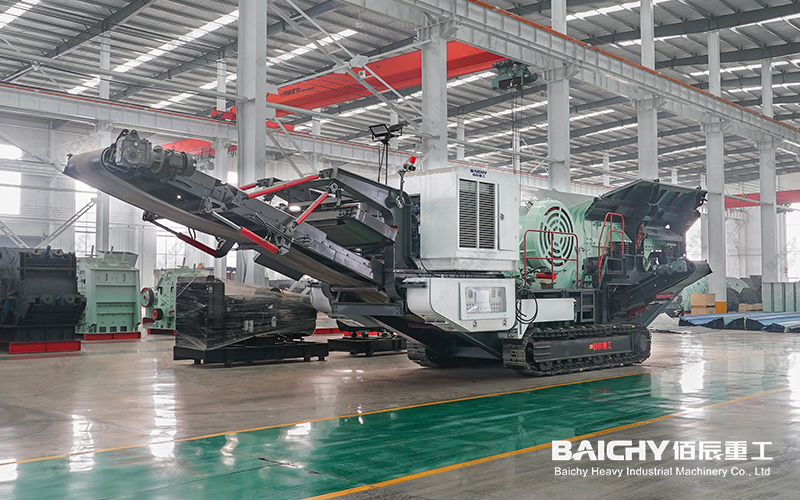
Tracked jaw crusher
In numerous fields such as mining, construction waste treatment, and quarries, tracked jaw crushers have become the core equipment of mobile crushing plants due to their superior mobility and efficient crushing capabilities. However, even the most advanced equipment cannot function without meticulous daily maintenance. Proper maintenance not only ensures continuous and stable operation and maximizes production efficiency but also significantly extends its service life and reduces overall operating costs. This article will systematically analyze the key points of daily maintenance for tracked jaw crushers, helping you safeguard this mobile production line.
I. Core Value Analysis of Daily Maintenance
Daily maintenance is far more than simple "cleaning and lubrication"; it is a preventative and scientific management system. For equipment like tracked jaw crushers, which integrate complex systems such as feeding, crushing, conveying, and movement, neglecting daily maintenance can lead to a series of chain reactions: minor wear may go undetected, evolving into damage to core components; poor lubrication may cause bearings to overheat and seize, resulting in a complete production stoppage; and malfunctions in the walking mechanism may paralyze the equipment on-site, affecting the overall project schedule. Systematic daily maintenance aims to proactively identify and eliminate these potential faults, nipping problems in the bud and ensuring the equipment is always in optimal working condition.
II. Daily Maintenance Checklist Overview
A complete daily maintenance routine should focus on the equipment's critical systems. Operators are advised to perform the following checks and operations before starting work, during operation, and after shutdown each day.
1. Pre-Start Inspection
The pre-start inspection is the first line of defense to ensure safe start-up and trouble-free operation of the equipment.
• Circumferential Inspection: Walk around the equipment, checking for any obvious damage, oil leaks, or water leaks. Remove any debris from the machine body and surrounding area that may affect operation.
• Fastener Inspection: Check major connections, such as jaw plate fixing bolts, frame connecting bolts, and motor base bolts, for looseness.
• Lubrication System Inspection: Check the oil level in the centralized lubrication tank and whether each manual lubrication point (such as bearing housings) needs refilling. Confirm that all lubrication lines are free of damage and leaks.
• Drive System Inspection: Check the oil and coolant levels in the diesel engine or motors (main motor, travel motor). Check the tension and wear of the drive belts or couplings.
• Hydraulic System Inspection: Check the hydraulic oil level in the tank and observe the hydraulic lines and joints for leaks.
• Wear Parts Inspection: Visually inspect the wear of the jaw plates and estimate their remaining service life.
2. In-Process Monitoring
Monitoring during equipment operation relies on the operator's experience and the equipment's instrument displays.
• Sound Localization: Pay attention to whether the equipment's operating sound is smooth and uniform. Abnormal metallic clanging sounds, sharp friction sounds, or violent vibrations may indicate loose parts, wear, or material jamming.
• Instrument Monitoring: Closely monitor all instruments on the control cabinet, including ammeters/voltmeters, hydraulic system pressure gauges, bearing temperature displays, etc., ensuring all parameters are within the normal green range.
• Discharge Monitoring: Observe whether the particle size of the crushed material is uniform and meets requirements. A sudden increase in discharge particle size usually indicates severe wear on the bottom of the jaw plates or a deviation in the adjustment mechanism.
3. Post-Shutdown Maintenance
Post-work maintenance is crucial for bridging the gap between work and production, preparing for the next day's production.
• Thorough Cleaning: After shutdown, allow the equipment to cool fully before cleaning any residual material from the crushing chamber to prevent hardening. Clean the equipment surface and the area under the conveyor belt of accumulated dust and gravel.
• Comprehensive Inspection: Utilize downtime to conduct a more thorough inspection of areas difficult to check before startup, such as the tension and wear of the tracked vehicles and the integrity of all safety devices.
• Record Operating Conditions: Accurately record the shift's operating time, the type and approximate tonnage of the material processed, any abnormalities discovered, and any simple corrective actions taken in the equipment operation log for easy follow-up and management.
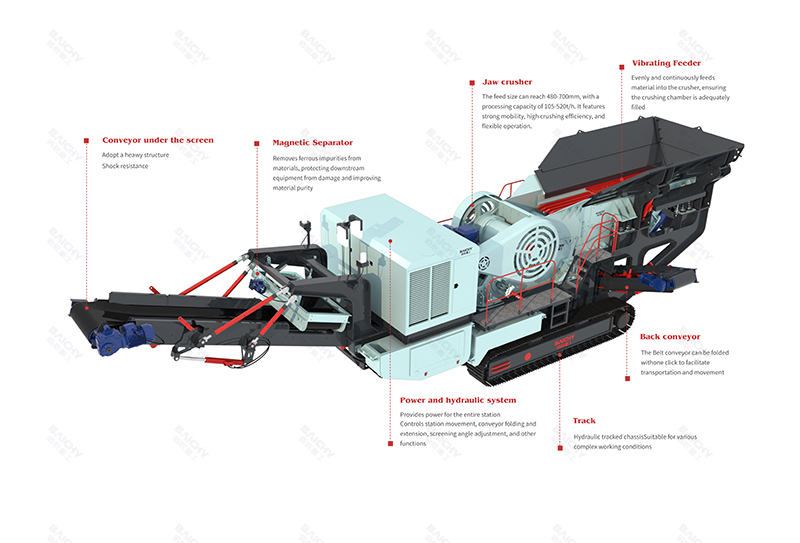
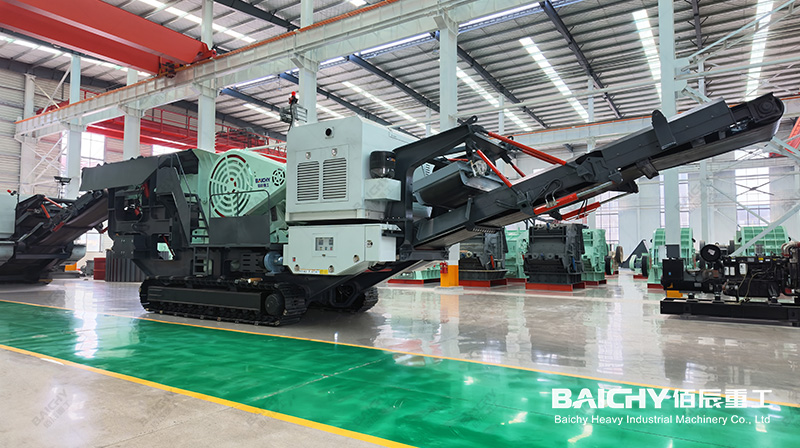
Structural diagram of tracked jaw crusher
III. In-Depth Maintenance Guide for Key Systems
1. Jaw Crusher Core Assembly
This is the heart of the equipment. Maintenance focuses on the jaw plates, eccentric shaft bearings, and adjustment mechanisms.
• Jaw Plate Maintenance: Regularly rotate the jaw plates to even out wear. Replace them promptly when the output particle size exceeds the allowable range. When replacing, ensure the new jaw plates are securely installed and tighten the bolts appropriately during the initial operation phase to compensate for plastic elongation.
• Bearing Maintenance: Bearing lubrication and temperature control are crucial. Use only the specified grade of grease and add it according to the prescribed cycle and amount. Bearing temperature must not exceed 70°C during operation.
• Discharge Port Adjustment: When using shims for adjustment, ensure both sides are synchronized to avoid misalignment. After adjustment, be sure to lock the adjustment mechanism.
2. Tracked Travel System
This ensures the equipment's mobility. Maintenance focuses on the tracks, drive wheels, and track rollers.
• Track Tension: Regularly check and adjust to the appropriate level. Too loose a tension can lead to derailment and abnormal wear, while too tight a tension increases running resistance and fuel consumption.
• Cleaning and Lubrication: Promptly remove dirt and stones embedded in the track links. Lubricate and maintain the travel motor, reducer, etc., according to requirements.
3. Power and Hydraulic System
• Power System: If diesel engine driven, strictly follow the engine maintenance manual for maintenance, including changing engine oil, filters, and fuel filters. • Inspect the fan belt and cooling system.
• Hydraulic System: Maintaining clean hydraulic oil is paramount. Regularly check oil quality and replace hydraulic oil and filters as needed. Pay attention to the sealing performance of hydraulic cylinders to prevent internal leakage that could lead to weak or slow operation.
IV. Advantages and Value of Efficient Maintenance
Implementing systematic daily maintenance can bring immediate returns to enterprises:
• Increased Equipment Availability: Reduces unplanned downtime, ensures continuous and stable production, and directly increases capacity.
• Reduced Overall Costs: Preventative maintenance costs are far lower than the costs of reactive repairs or overhauls, while also saving on lost output due to downtime.
• Extended Equipment Lifespan: Ensures all components operate under ideal conditions, extending the overall machine lifespan by 30%-50%.
• Ensured Operational Safety: Promptly detect and address safety hazards such as structural cracks and loose fasteners, preventing accidents.
V. Maintenance Cycle Example
The table below provides a suggested periodic maintenance schedule under normal operating conditions (processing medium-hard materials). Specific adjustments should be made based on the actual workload of the equipment and the surrounding environment.
| Maintenance Cycle | Maintenance Items | Remarks |
| Every 8 hours/day | Surround inspection, lubrication point inspection, fastener inspection, clear accumulated material from the crushing chamber, record operating data | Completed during shift handover |
| Every 50 hours | Check centralized lubrication system, check drive belt/V-belt tension, check electrical wiring terminals | Approximately once a week |
| Every 250 hours | Replace or clean diesel filter and air filter pre-filter, conduct a comprehensive inspection of jaw plate and side guard plate wear | Approximately once a month |
| Every 500 hours | Change engine oil and oil filter, check hydraulic system oil level and cleanliness, check all safety devices | Requires machine shutdown for maintenance |
| Every 1000 hours | Change hydraulic oil and hydraulic oil filter element, replace centralized lubrication system filter element, check and adjust track tension | Recommended to be assisted by professional service personnel |
| Every 2000 hours | Conduct a comprehensive inspection of bearing condition, check core structural components for cracks, replace drive wheels and track rollers according to wear condition | Comprehensive preventive maintenance |
VI. Recommended Equipment and Tools
To do a good job, one must first have the right tools. Efficient maintenance relies on suitable tools and spare parts.
• Specialized Tools: Specialized hydraulic tools for jaw plate replacement (significantly shortens replacement time and reduces labor intensity), high-precision laser thermometer (non-contact measurement of bearing and motor temperatures), vibration analyzer (for in-depth fault diagnosis).
• Key Spare Parts: It is recommended to keep a set of jaw plates, a set of side guard plates, commonly used hydraulic hoses, and a set of filters (oil filter, fuel filter, hydraulic oil filter) on hand to cope with sudden failures and shorten downtime.
VII. Frequently Asked Questions (FAQ)
Q1: What could be the cause of a regular metallic clanging sound heard in the crushing chamber during equipment operation?
A1: This is usually caused by loose jaw plate fixing bolts or wear and loosening of the toggle plate seat. The machine should be stopped immediately for inspection, and all bolts should be tightened. If the bolts have failed due to plastic deformation, they must be replaced immediately. Also, check the wear condition of the toggle plate and toggle plate seat.
Q2: What could be causing the tracks to veer off course or the equipment to move weakly?
A2: Track veer may be caused by the following: uneven track tension on both sides, severe wear or damage to one track, or a malfunction in the travel motor or reducer leading to uneven speeds on both sides. Weak movement may involve insufficient hydraulic system pressure (pump, valve malfunction, or internal leakage), excessive track tension, or a malfunction in the travel motor itself. Each of these needs to be checked inpidually.
Q3: How to determine if the jaw plates need replacement?
A3: There are three main criteria:
1. Output particle size: When the discharge port is adjusted to its minimum position, the required output particle size still cannot be obtained.
2. Significant decrease in capacity: Under the same operating conditions, the equipment's processing capacity continues to decrease.
3. Visual inspection: The jaw plate teeth are worn flat, or visible cracks or damage appear. It is recommended to start planning replacement when the jaw plates are worn to about 2/3 of their original thickness.
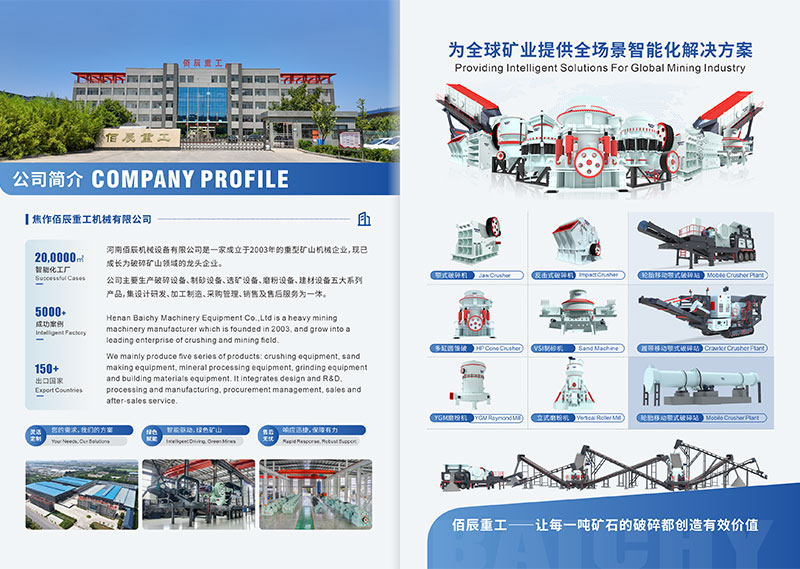
About of Baichy Heavy Industry
Baichy Heavy Industry is a high-tech mining equipment company integrating R&D, manufacturing, sales, and after-sales service. Focusing on crushing, grinding, and mineral processing equipment, we provide professional solutions to our customers. We are ISO9001:2015 、certified, and our products include mobile crushing palnts, crawler crushing plant, construction waste crushing plants, jaw crushers, sand making machines, cone crushers, fine crushers, grinding mills, ball mills, etc., all with reliable performance to meet diverse project needs.
Our advantages:
• Professional pre-sales support: Free project design and comprehensive solutions to help you accurately select the right equipment;
• Comprehensive on-site service: Providing installation guidance and worker training to ensure smooth equipment commissioning;
• Reliable after-sales guarantee: A complete after-sales system, timely response to technical inquiries and equipment maintenance, ensuring long-term stable operation.
To protect your rights, please contact us through the following official channels for professional service:
Official Website Customer Service
WhatsApp: 0086-15093222637
Email: [email protected]
We are committed to providing high-quality equipment and full-cycle services to deliver comprehensive intelligent solutions for the global mining industry!