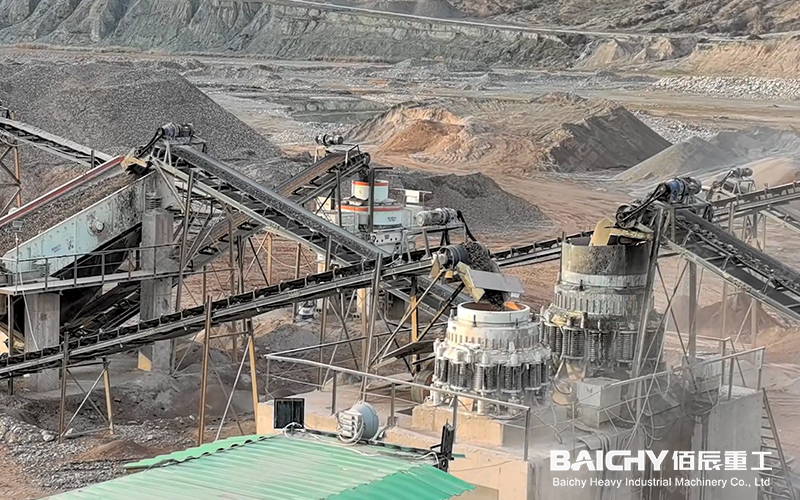
300 tph granite crushing production line
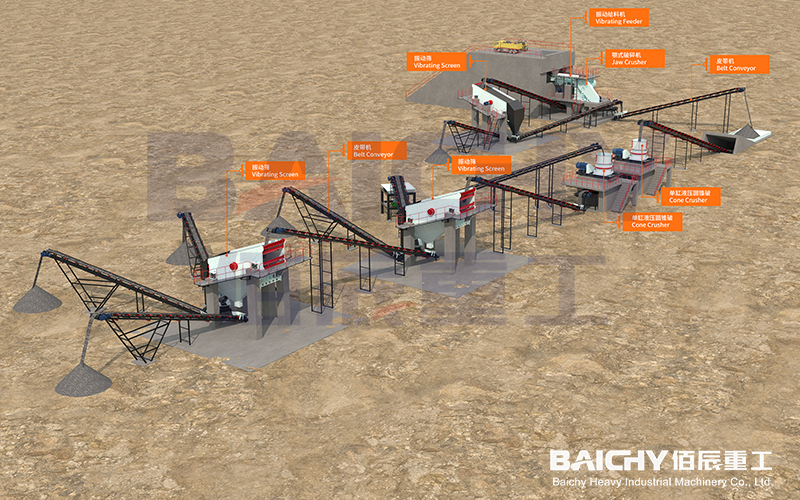
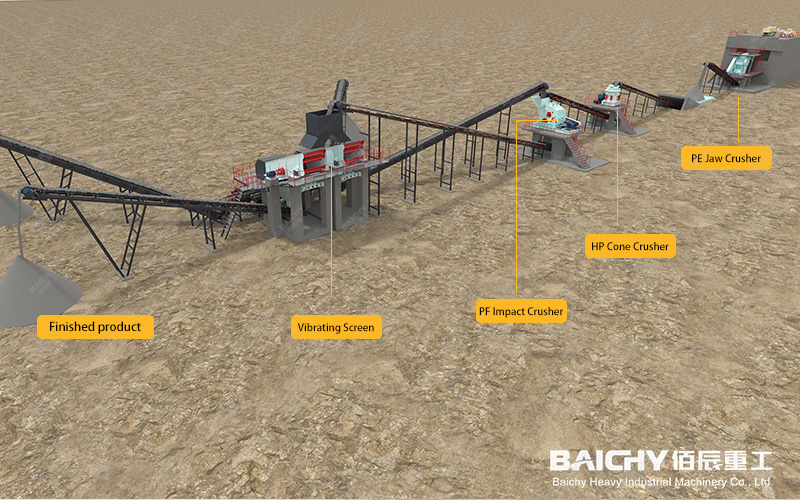
Designing a granite crushing production line with a 300 t/h capacity is not simply a matter of "finding a 300-ton machine"; rather, one must first identify the line's bottleneck—its most restrictive component—and then work backward to determine the upstream requirements. There is only one viable primary configuration for granite: vibrating grizzly feeder → primary jaw crusher → secondary/tertiary cone crusher → closed-circuit classification via a three-deck circular vibrating screen.
I. 300 t/h is a nominal rating; first, apply a conversion factor
Granite is a hard, brittle rock with a compressive strength of 130–250 MPa and a density of 2.63–2.75 g/cm³. Equipment capacity ratings in product brochures are invariably based on medium-hard limestone; when the same machine—with the same motor power—is used for granite, the actual throughput drops. In engineering practice, a conversion factor of 0.75–0.85 is typically applied (the specific value depends on the difference between the rock sample's work index and the brochure's reference conditions; the rock sample test report should be the definitive guide). Using a median factor of 0.8 for calculation:
Target actual capacity: 300 t/h → Required nominal capacity: 300 &pide; 0.8 = 375 t/h
This leads to a crucial conclusion: the secondary/tertiary crushing units must be selected based on a 375 t/h rating, not 300 t/h. If machines are selected based on a 300 t/h rating, the system will underperform from the moment production begins; attempting to compensate through overloading will result in both reduced liner lifespan and increased power consumption.
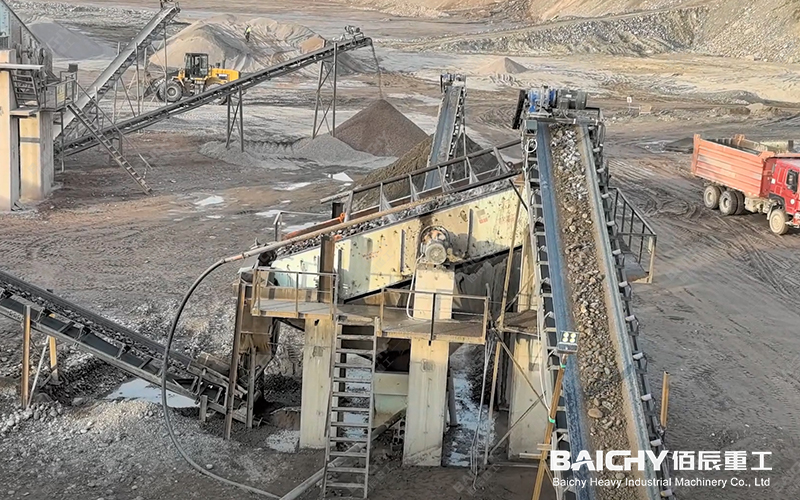
granite crushing line
II. Primary crushing: Model selection is determined by the feed opening, not capacity
The primary constraint when selecting a jaw crusher is not "how many tons it can output," but rather ensuring the feed opening width is at least 1.1–1.2 times the maximum particle size of the raw ore. When the maximum raw ore size is 750 mm, the PE900×1200 model (inlet 900×1200 mm, 132 kW, rated capacity 220–500 t/h) is the appropriate choice to meet the calculated requirement of 375 t/h, while also providing a buffer for the occasional oversized boulders resulting from bench blasting. Conversely, if one selects a smaller jaw crusher based solely on capacity figures, the operational reality becomes a scenario where the machine is underfed yet the inlet is constantly clogged—resulting in impressive capacity numbers but poor equipment utilization rates.
III. Secondary and Tertiary Crushing: Abrasiveness is the Key Criterion, Not Hardness
This stage is the most frequently misunderstood. While hardness determines the reduction ratio and motor power requirements, abrasiveness dictates the annual consumption of wear liners. Granite, characterized by high quartz content and strong abrasiveness, causes rapid wear on impact crusher blow bars, requiring replacement on a weekly basis; in contrast, cone crushers utilize inter-particle (layer) crushing, allowing liners to last for months. Therefore, a combination of jaw and cone crushers is the standard solution for hard rock applications. A single CS250 unit (280 kW, rated capacity 250–650 t/h) can handle the calculated requirement of 375 t/h; however, if downtime for a single unit is unacceptable, a parallel configuration of two CS160 units can be used—allowing one unit to maintain most of the production capacity while the other undergoes maintenance. The additional investment buys higher equipment utilization, not merely raw capacity.
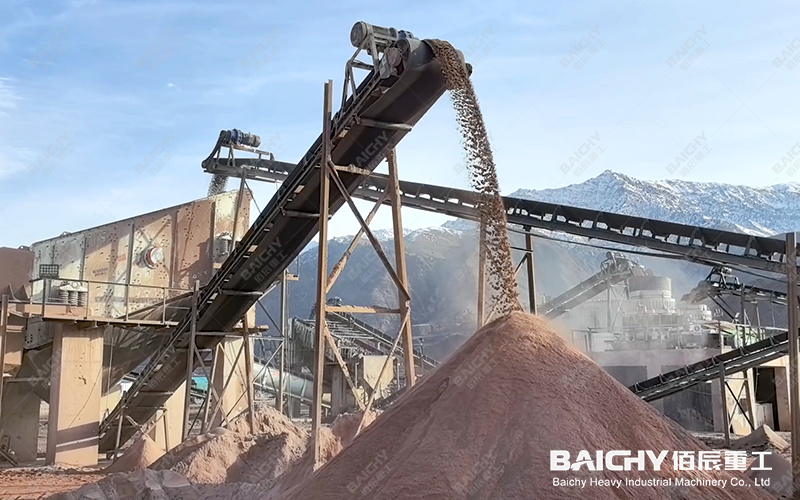
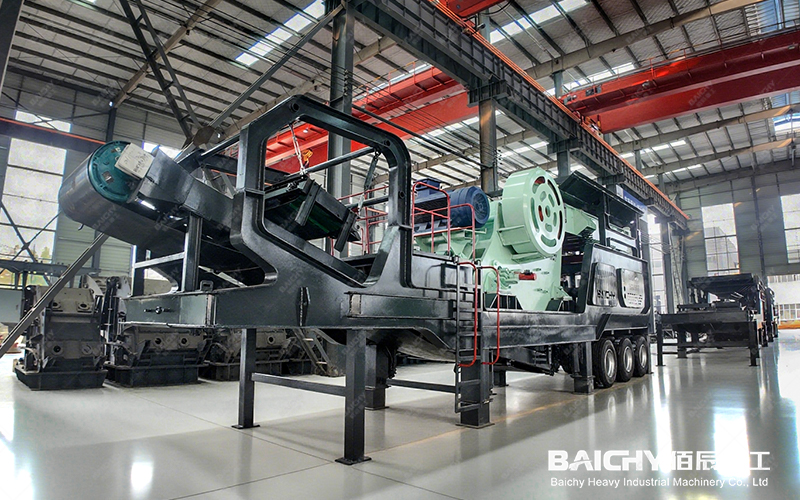
granite jaw crusher and cone crusher
IV. Screening and Conveying: The True "Invisible Bottleneck" at 300 Tons
① Screening: In a closed-circuit system, oversized material is recirculated to the cone crusher. Consequently, the screen deck must handle both the finished product and the recirculating load; therefore, the screen surface area cannot be sized based solely on the finished product tonnage. Feed rate to the screen surface = 300 × (1 + circulating load ratio). Since there is no universal value for the circulating load ratio, it must be calculated for each specific operating scenario based on material properties and screening efficiency. In a published example, with 70% undersize material and 100% screening efficiency, the circulating load was 42.9%; reducing the screening efficiency to 90% in the same example caused the load to rise to 50.3%. Based on this magnitude, the screen capacity should be configured for 300 × 1.43–1.50 ≈ 430–450 t/h. Two 3YK2470 screens (37 kW per unit, 74 kW total, triple-deck) are used to separate the material into 0–5, 5–10, 10–20, and 20–31.5 mm fractions in a single pass. Given granite's high crushing ratio and tendency to produce elongated or flaky particles, a closed-circuit configuration is not merely an option but a necessity.
② Conveying: Production bottlenecks most frequently occur at the conveyors rather than the main processing equipment. If parameters such as belt width, belt speed, or inclination angle are selected based on average capacity, the peak throughput will be restricted at the conveyor stage; therefore, verification calculations must be based on peak throughput.
V. Cost per Ton: Breakdown of Electricity Consumption
The total installed power capacity listed in the configuration is approximately 561 kW. Estimating based on a load factor of 70%–80%, the actual power consumption of the entire line is approximately 393–449 kW, translating to the following electricity consumption per ton:
561 × 0.70 &pide; 300 ≈ 1.3 kWh/t; 561 × 0.80 &pide; 300 ≈ 1.5 kWh/t (including conveying)
This represents the largest—and most controllable—component of the cost per ton for granite processing, provided that the main equipment does not idle excessively or operate under-loaded for extended periods. The figures above are estimates; actual values must be determined based on on-site electricity meter readings. VI. Stationary vs. Wheeled: Three Criteria (Ignore the Price Quote)
Mining rights exceeding 5 years, a fixed material source, and a strategy prioritizing low cost-per-ton → **Stationary**. Scattered mining sites, contract durations of 1–3 years, and working faces that advance with blasting operations → **Wheeled** (a three-unit combination of mobile jaw crusher, mobile cone crusher, and mobile screening station). Wheeled systems effectively convert "mobility" into a cost-per-ton premium; they are only economical when there is a genuine need to relocate between sites.
VII. Two Often-Overlooked Site Constraints
Clay Content and Weathered Layers: The surface weathered layer of granite exhibits sharply reduced strength and high clay content; it must be mined and crushed separately from fresh rock to prevent repeated clogging of the secondary and tertiary crushing chambers. If the client imposes limits on clay content in the finished product (commercial concrete aggregate typically requires <1%), a wheel-bucket sand washer and fine sand recovery unit should be added after screening. Clarified overflow water from the sand washer is recycled via a settling tank; system make-up water is estimated at 5%–10% of the circulating volume (accounting for evaporation and moisture carried away by the product), though actual requirements should be determined by a water balance calculation.
Electrical and Control Systems: Electrical systems should be customized for the target market (e.g., 380V/50Hz, 400V/50Hz, or 60Hz), featuring centralized control cabinets for interlocking start/stop functions and overload protection. Investing in these systems buys you continuous uptime rather than mere "regulatory compliance"—for a 300-ton-per-hour production line, the cost of a single shutdown to clear a jammed crushing chamber far outweighs the price difference of the control cabinet itself.
VIII. Equipment Configuration Table for 300 TPH Granite Crushing Production Line
| Process | Model | Quantity | Power (kW) | Selection Criteria for the Production Line |
|---|---|---|---|---|
| Feeding | ZSW490×110 Grizzly Feeder | 1 | 15 | Grizzly bar spacing set to ≤80mm; fines bypass the screen deck to avoid unnecessary processing in the primary crusher. |
| Primary Crushing | PE900×1200 Jaw Crusher | 1 | 132 | Feed opening width ≥ 1.1–1.2 times the maximum raw ore particle size. |
| Secondary/Fine Crushing | CS250 Cone Crusher | 1 | 280 | Rated capacity ≥ 300 ÷ 0.8 = 375 t/h. |
| Screening | 3YK2470 Triple-deck Circular Vibrating Screen | 2 | 74 | Screen feed rate = 300 × (1 + circulating load ratio); reference cases show 43%–50% → approx. 430–450 t/h. |
| Conveying | Customized conveyors based on site layout | — | Approx. 60 | Verify belt width, speed, and inclination angle based on peak throughput. |
| Total | — | — | Approx. 561 | ×0.70–0.80 load factor → approx. 1.3–1.5 kWh/t. |
IX. FAQ: 5 Most Frequently Asked Questions by Buyers
Q1: Why isn't an impact crusher used for the secondary crushing stage of a 300 tph granite production line?
A1: Because the key criterion for granite is abrasiveness, not hardness. When quartz content is high, the replacement cycle for impact crusher blow bars is measured in weeks, whereas the liner lifespan for cone crushers (utilizing inter-particle/lamination crushing) is measured in months. The correct approach is not to listen to claims of which is "cheaper," but to calculate the annual cost of wear parts for both options based on the rock sample's abrasion index, and then compare this against the difference in initial purchase price—many projects discover at this stage that the option with the higher upfront cost is actually the more economical choice.
Q2: Can the nominal capacity of 300 tph be directly written into the acceptance criteria?
A2: No. Rated capacities are based on medium-hardness limestone; for granite, you must apply a conversion factor of 0.75–0.85. The standard approach is to select the main machinery based on a rated capacity of 375 t/h while targeting an actual operational output of 300 t/h for acceptance, and to clearly specify the testing conditions in the contract (maximum raw ore particle size, clay content, product gradation, and continuous run time). Without clearly defined operating conditions, both parties can justify their own claims regarding capacity.
Q3: How much does a granite crushing production line with an hourly output of 300 tons cost?
A3: Any "flat-rate" quote is unreliable—total investment varies significantly based on the level of automation, wear-part materials, electrical standards (380V/50Hz, 400V/50Hz, or 60Hz), and site civil engineering conditions. It is recommended to request an itemized quote and compare the Total Cost of Ownership (TCO) based on "equipment cost + annual wear-part costs + annual electricity costs + civil works and installation." The real cost differentiators are the second and third items, not the first.
Q4: In a 300-ton granite crushing setup, which stage is most likely to cause a drop in capacity?
A4: Screening and conveying—usually not the main crushing machinery. Closed-circuit recirculation increases the feed load on the screen surface to 300 × (1 + circulating load ratio) (typically 43%–50% based on case studies); if the screen surface is sized only for the final product tonnage, it will clog first. Similarly, if conveyors are sized based on average capacity, peak throughput will cause bottlenecks. Both instances represent cases of "saving a little money upfront but losing production output."
Q5: What should be done if the raw ore has large particle sizes and high clay content?
A5: Address two separate issues. Particle size: The jaw crusher's feed opening must be at least 1.1–1.2 times the maximum particle size; do not expect oversized rocks to simply pass through after getting stuck momentarily. Handling clay content: Weathered layers and fresh rock are mined and crushed separately; if the lower screen deck of the grizzly feeder is prone to clogging, pre-screening or ore washing is implemented, and anti-clogging polyurethane screens can be installed. If there are specific requirements for clay content in the final product, a wheel-type sand washer and a fine sand recovery unit are added after the screening stage.
Baichy Heavy Industry
Baichy Heavy Industry is a high-tech mining equipment company integrating R&D, manufacturing, sales, and after-sales service. Focusing on crushing, grinding, and mineral processing equipment, we provide professional solutions to our customers. We are ISO9001:2015 、certified, and our products include mobile crushing palnts, crawler crushing plant, construction waste crushing plants, jaw crushers, sand making machines, cone crushers, fine crushers, grinding mills, ball mills, etc., all with reliable performance to meet diverse project needs.
Baichy Heavy Industry – Your Trusted Partner
To ensure optimal performance of your equipment, Baichy Heavy Industry offers:
- Professional on-site installation guidance
- Comprehensive operator training
- 24/7 technical support & maintenance services
Our complete after-sales service system guarantees long-term, stable operation of your machinery with minimal downtime.
Protect Your Rights – Only Use Official Channels
To avoid scams and ensure authentic support, contact us exclusively through:
• Official Website: www.baichychina.com
• WhatsApp: +8615093222637
• Email: [email protected]
Your satisfaction is our priority – expect prompt, professional service every time.
(Note: Beware of unauthorized third parties claiming to represent Baichy. Always verify through official contacts.)