
Gold Ore Crushing and Processing
The sole design objective of gold ore crushing and processing is to consistently deliver ore within the particle size range suitable for leaching and beneficiation, rather than simply maximizing the throughput of the crushing circuit. By reducing the feed size for the grinding mill from 50 mm to 10–15 mm, the specific energy consumption of the ball mill drops from 18–22 kWh/t to 12–15 kWh/t, while the fine crusher itself consumes only an additional 0.5–0.8 kWh/t—this constitutes the entire economic rationale for the "crush more, grind less" strategy.
I. Four Criteria for Gold Ore Crushing Processes: Hardness Is Not the Top Priority
1. Hardness → Determines the crushing method, not the equipment class. PE jaw crushers and PYZ/CS cone crushers handle hardness up to 320 MPa; typical gold ores (Mohs hardness 6–7) fall well within this range, making most ores suitable for these machines. The real distinction lies in hard quartz-vein ores (with intense silicification), which require inter-particle (lamination) crushing, versus weathered crusts and oxidized ores, which can be processed into the final product in a single pass using impact-type fine crushers.
2. Clay and Moisture Content → Determine the process flow configuration. High clay content can blind screens in a closed-circuit setup, causing screening efficiency to plummet from ≥85% and leading to a loss of control over the mill feed size. Such ores require pre-screening or washing before primary crushing; hammer crushers with grizzly bars should be avoided, as the cost of downtime caused by clogging far exceeds the cost of higher electricity consumption.
3. Abrasiveness → Determines the cost per ton, not equipment suitability. Mn13Cr2 hammer heads last 800–1,200 hours on oxidized ore but only 200–350 hours on quartz-vein ore; Mn18Cr2 jaw plates last 4–8 months, and Mn18 concave liners last 3–6 months—this is the true cost impact of abrasiveness.
4. Gold Dissemination Size → Determines the P80 value for the mill feed. Grinding fineness must ensure the liberation of gold particles. The task of the crushing stage is to reduce the P80 size to a level compatible with the mill's design capacity; the target particle size for crushing and processing is determined by working backward from downstream leaching rate requirements, rather than being arbitrarily set based on the crusher's discharge opening.
Gold Ore Crushing and Processing
II. Selection of Gold Crushing Equipment: pergent Routes for Three Typical Scenarios
| Ore Type | Key Variable | Recommended Crushing Route | Mill Feed P80 | Key Parts & Lifespan | Main Risks |
|---|---|---|---|---|---|
| Oxidized Ore / Weathered Crust Ore | High clay content; fluctuating moisture | Pre-screening or washing → Jaw crusher → Cone crusher (or single-stage impact fine crusher) | ≤15mm | Mn13Cr2 hammer: 800–1,200h | Screen blinding and material blockage leading to uncontrolled feed size |
| Quartz Vein Hard Rock | Highly abrasive (Mohs 6–7; silicified) | Jaw crusher → Closed-circuit cone crushing (inter-particle crushing) | ≤15mm | Cr20 high-chrome cast iron: 200–350h | Part replacement costs eroding profit per ton |
| Sulfide Ore / Arsenic-bearing Ore | Requires fine grinding for liberation; associated harmful elements | Three-stage closed-circuit (Jaw + Cone + Closed-circuit screen) | ≤10–15mm | Mn18 concave liner: 3–6 months | Over-grinding/sliming increasing cyanide consumption and reducing recovery rates |
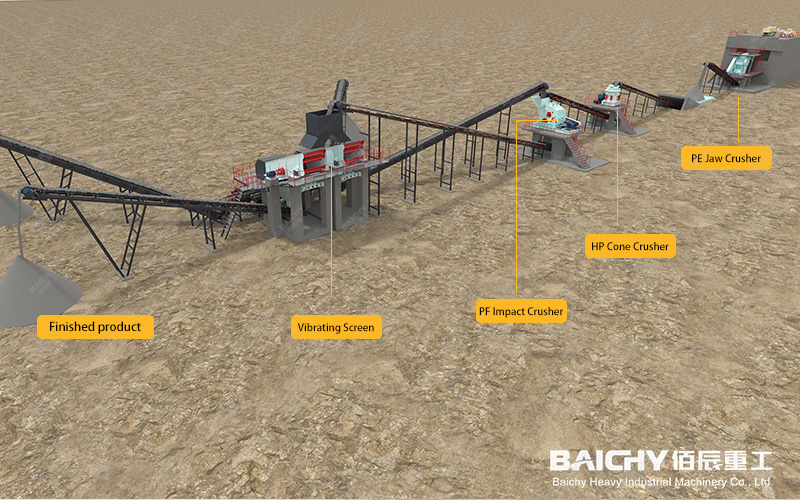
A common feature of all three routes is the closed-circuit configuration; without a closed circuit, a stable P80 cannot be maintained.
III. Mill Feed Size Fixed at 10–15mm: The Critical Point for "Crush More, Grind Less"
An often-overlooked fact: the mill feed P80 for a 50 t/d pilot plant is ≤15mm, and the feed size for a 200 t/d processing plant is also set at ≤15mm. Mill feed size is a process parameter that does not change with scale-up; what changes during scaling up are throughput, screening area, and classification area. The calculation is straightforward: specific energy consumption in the grinding stage rises rapidly with fineness (e.g., ~12 kWh/t for 75% passing -200 mesh, vs. ~22 kWh/t for 95% passing). Fine crushing prior to grinding can reduce the mill's specific energy consumption from 18–22 kWh/t to 12–15 kWh/t—a saving of 3–10 kWh/t (median 6.5 kWh/t)—while the fine crusher itself consumes only 0.5–0.8 kWh/t (median 0.65 kWh/t), resulting in a net saving of approximately 5.85 kWh/t. Assuming an electricity price of 0.8 RMB/kWh, this translates to a saving of about 4.7 RMB per tonne of ore; for a 200 t/d processing plant operating 330 days a year, this amounts to an annual saving of approximately 309,000 RMB. The economic viability of gold ore crushing processes is not found in the crusher's nameplate power rating, but rather in those few kilowatt-hours saved between the crushing and grinding stages.
Where is the critical point? When the P80 is reduced below 10 mm, steel consumption and investment costs for the fine crushing stage rise non-linearly, while the savings in the grinding stage begin to diminish. Furthermore, a screening efficiency of ≥85% is a prerequisite for a closed-circuit system to function effectively; without adequate screening capacity, the nominal P80 remains merely a theoretical figure. Ultimately, the comparison of gold ore crushing and processing technologies hinges on total specific energy and steel consumption per tonne of ore, not on crusher power ratings. Over-grinding represents a hidden cost: fine slimes will "claw back" the money through higher sodium cyanide consumption during the leaching stage.
IV. Three Interfaces in Gold Ore Processing: Grinding & Classification, Leaching, and Gravity Separation
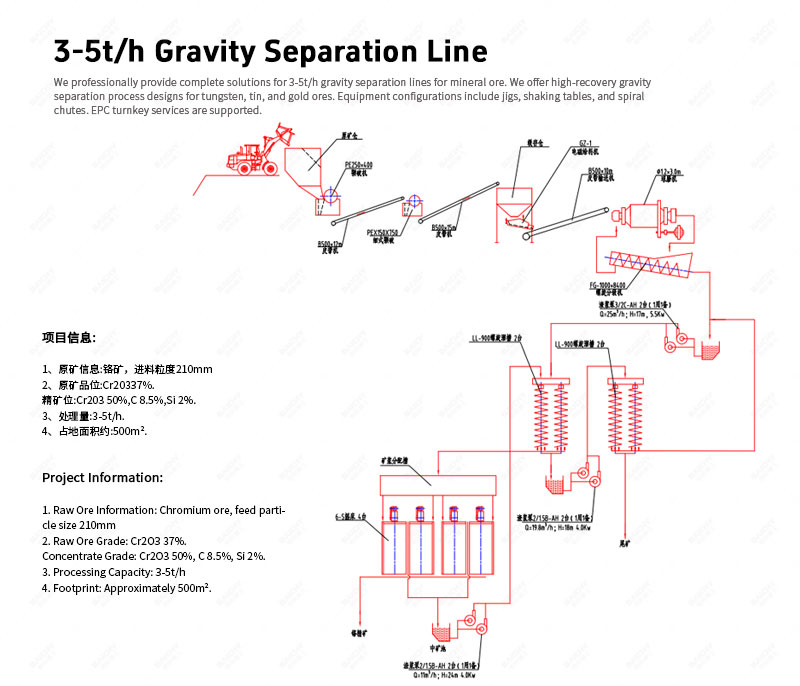
The scope of responsibility for the crushing stage is clearly defined: from the run-of-mine (ROM) ore bin to the classifier overflow discharge. The overflow slurry—typically 85% passing -200 mesh (with a grinding pulp density of 70–75% and a classifier overflow density of 25–35%)—is then passed to the leaching stage. If this stage is not executed properly, all subsequent processes will be forced to compensate for its shortcomings. For whole-ore cyanidation (CIL/CIP), the feed fineness is 85–90% passing 200 mesh; for a 200 t/d plant, assuming a run-of-mine grade of 3 g/t and a 90% recovery rate, monthly gold production is approximately 16.2 kg. The gravity separation/gold milling machine route is common for small-scale operations (10–50 t/d): crushed material (≤20 mm) is fed directly into the gold milling machine, with capacity ranging from 3–5 t/d up to 7–9 t/d. Flotation is used for refractory ores containing sulfur and arsenic; the crushing stage focuses on ensuring mineral liberation rather than achieving extreme fineness.
The differences among these three process routes at the crushing stage lie solely in the P80 value of the mill feed and whether or not over-grinding is permissible.
V. Three Scale Tiers: Screening and Classification Reach Capacity Limits First When Scaling Up
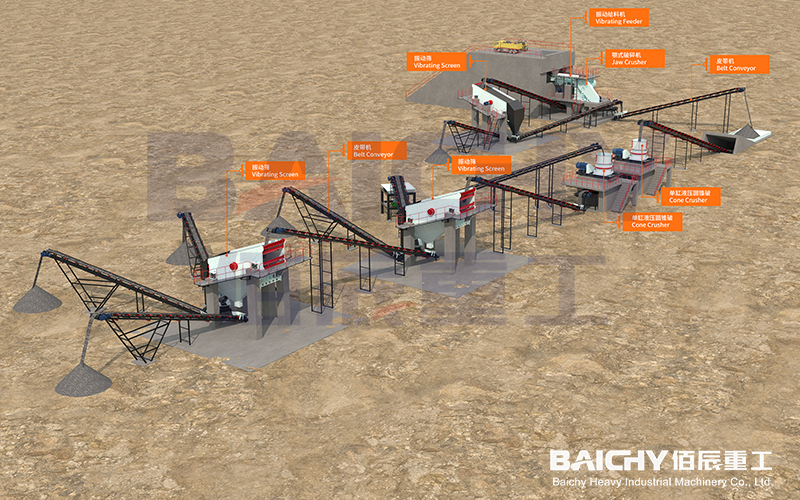
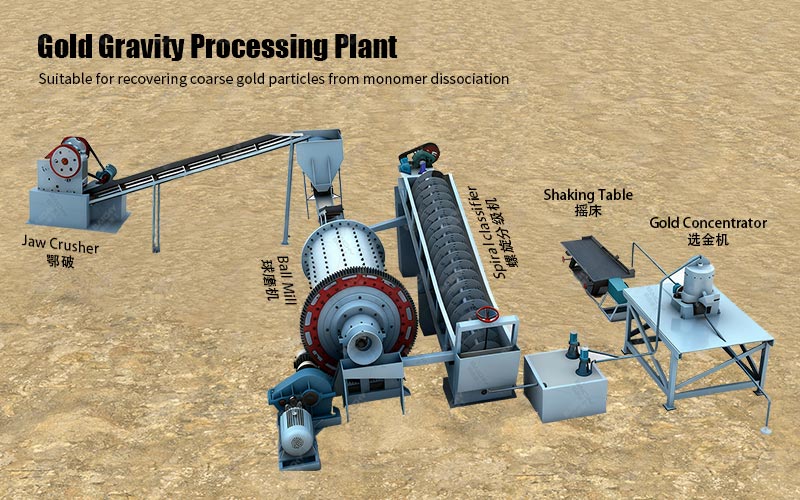
10 t/d (artisanal and small-scale operations): PE250×400 jaw crusher → PC600×400 fine crusher → Model 1100 gold milling machine → 6-S shaking table; investment is approximately US$9,000; the fine crusher requires only 22 kW and can be powered by a single diesel generator.
50 t/d: ZSW380×95 → PE400×600 primary crushing (discharge 40–100 mm) → PYZ900 secondary/fine crushing (discharge 5–20 mm) → 2YK1545 closed-circuit screening → Φ1500×3000 ball mill (8–10 t ball charge) → FG-12 spiral classifier; total installed power is approximately 192 kW; shipment requires two 40HQ containers.
200 t/d: ZSW490×110 → PE750×1060 (feed size ≤630 mm) → CS220 (discharge size 10–38 mm) → 3YK2160 triple-deck closed-circuit screen → MQG2745 ball mill (400 kW) → FX350×4 hydrocyclone cluster; the total installed power for the 14 main units is approximately 1,172 kW, with the ball mill alone accounting for 50–55% of the plant's total power consumption.
When scaling up from 50 t/d to 200 t/d, the jaw crusher is rarely the first bottleneck to be hit—its primary crushing capacity is 80–120 t/h, requiring only 2–3 hours of daily operation, making it the least utilized stage in the plant. The real pressure points are screening and classification: the difference between the closed-circuit circulating load and the final product output places a heavy burden on the screen decks; if screening capacity is insufficient, the target P80 size is immediately compromised. This illustrates the "throughput mismatch" inherent in gold ore crushing and processing: the grinding stage operates continuously, whereas the crushing stage can operate intermittently; therefore, equipment specifications cannot simply be scaled up using a uniform logic.
Gold Ore Crushing and Processing
VI. Frequently Asked Questions (FAQ)
Q1: What is the appropriate feed size for the ball mill in gold ore crushing and processing?
A: For conventional gold ores, a P80 of ≤15 mm is standard; for sulfide ores and ores with fine dissemination sizes, ≤10–15 mm is used. The determining factor is not industry convention but the gold dissemination size: the grinding fineness must ensure mineral liberation, while the crushing stage simply needs to enable the mill to consistently achieve that fineness within its design capacity. If the feed size is reduced below 10 mm, the increase in steel consumption and investment costs in the fine crushing stage outweighs the savings achieved in the grinding stage.
Q2: Can hammer crushers be used for secondary and fine crushing of hard quartz-vein gold ores?
A: Yes, but their specific role and limitations must be clearly defined. For quartz vein ore (Mohs hardness 6–7, high silicification), Cr20 high-chromium cast iron hammerheads have a service life of only 200–350 hours—roughly one-third to one-fifth of the lifespan seen with oxidized ore (using Mn13Cr2 alloy, 800–1,200 hours). While cost-effective for transitional fine crushing, continuous primary operation is better handled by CS/PYZ cone crushers utilizing inter-particle (choke-fed) crushing.
Q3: How should the crushing circuit be modified for high-clay oxidized gold ore?
A: Do not rely solely on closed-circuit screening for particle size control; high clay content causes screen blinding, drastically reducing screening efficiency and leading to uncontrolled mill feed sizes. Recommended approach: Add pre-screening or ore washing before primary crushing to remove sticky fines; prioritize cone crushers for secondary and fine crushing stages rather than hammer crushers with grate bars; and use anti-blinding screen media with slightly larger apertures.
Q4: Does "crush more, grind less" always save electricity?
A: Not necessarily. Fine crushers consume 0.5–0.8 kWh/t, whereas the grinding stage consumes ~12 kWh/t for 75% passing -200 mesh and ~22 kWh/t for 95% passing -200 mesh. Consequently, the strategy of "crushing one stage finer to save on grinding" is highly cost-effective when reducing P80 from 50mm to 15mm: mill energy consumption drops from 18–22 kWh/t to 12–15 kWh/t, resulting in a net saving of ~5.85 kWh/t after accounting for the crusher's own energy use. Pushing for finer sizes yields diminishing returns and incurs additional costs from steel wear and increased cyanide consumption due to over-grinding; the optimal "inflection point" is typically at a P80 of 10–15mm.
Q5: How should the crushing circuit be configured for small-scale gold mines (10–50 t/d)?
A: Configure it for continuous grinding but intermittent crushing. For a 200 t/d processing plant, the primary crushing capacity is 80–120 t/h, requiring only 2–3 hours of daily operation; the same applies to the 50 t/d line, where crushing and screening equipment can be sized based on a 6–8 hour workday rather than being oversized for 24-hour continuous operation.
Baichy Heavy Industry
Baichy Heavy Industry is a high-tech mining equipment company integrating R&D, manufacturing, sales, and after-sales service. Focusing on crushing, grinding, and mineral processing equipment, we provide professional solutions to our customers. We are ISO9001:2015 、certified, and our products include mobile crushing palnts, crawler crushing plant, construction waste crushing plants, jaw crushers, sand making machines, cone crushers, fine crushers, grinding mills, ball mills, etc., all with reliable performance to meet diverse project needs.
Baichy Heavy Industry – Your Trusted Partner
To ensure optimal performance of your equipment, Baichy Heavy Industry offers:
- Professional on-site installation guidance
- Comprehensive operator training
- 24/7 technical support & maintenance services
Our complete after-sales service system guarantees long-term, stable operation of your machinery with minimal downtime.
Protect Your Rights – Only Use Official Channels
To avoid scams and ensure authentic support, contact us exclusively through:
• Official Website: www.baichychina.com
• WhatsApp: +8615093222637
• Email: [email protected]
Your satisfaction is our priority – expect prompt, professional service every time.
(Note: Beware of unauthorized third parties claiming to represent Baichy. Always verify through official contacts.)