
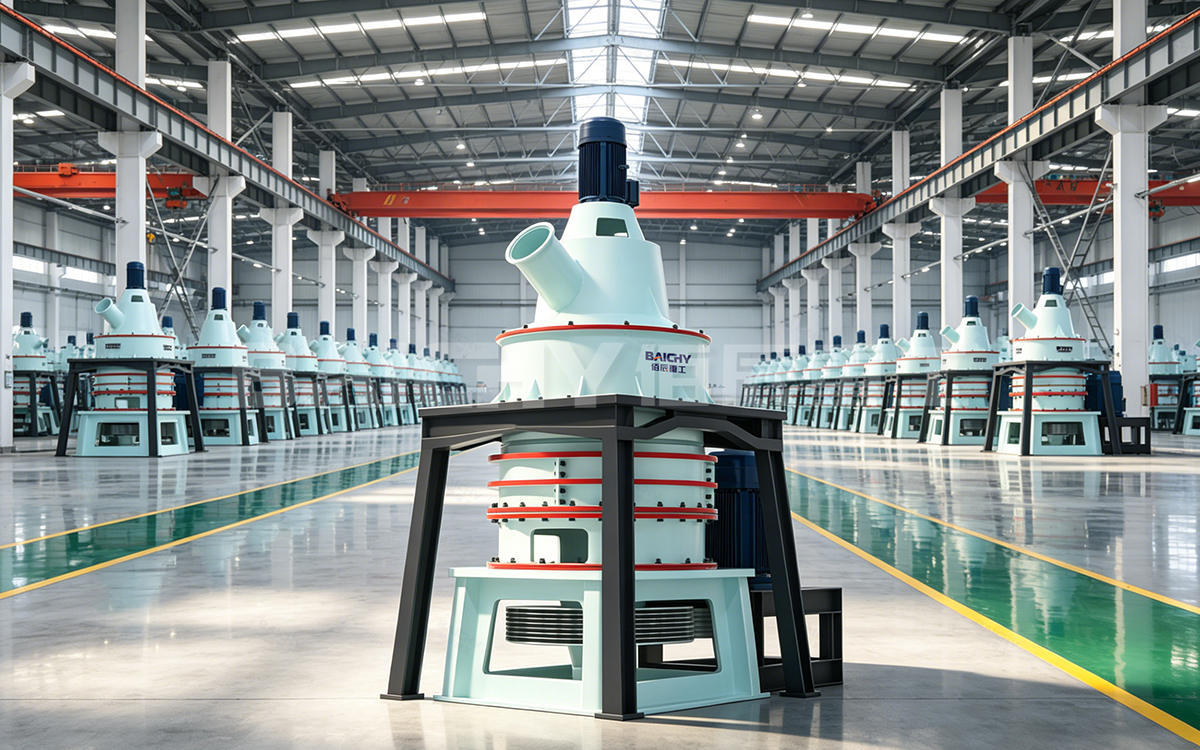
HGM High-Efficiency Ultrafine Grinding Mill
For non-metallic mineral powder projects targeting fineness levels above 800 mesh (including heavy calcium carbonate, kaolin, bentonite, talc, barite, and dolomite), the HGM High-Efficiency Ultrafine Grinding Mill represents a mature dry-processing solution offering the fastest return on investment in the 1–5 t/h capacity range. It utilizes 21 grinding rollers acting sequentially across three grinding rings to reduce raw materials (≤25mm) to a fineness of D97 5–47μm in a single pass; an integrated variable-frequency classifier ensures precise online fineness control, eliminating the need for external secondary classification. Its greatest value lies in bridging the price gap between conventional and ultrafine powders, allowing producers to capture high-margin, high-mesh orders while maintaining controllable grinding costs.
I. Why 800 Mesh is a Watershed: The Pricing Logic of Ultrafine Powder
1.1 Price Steps Up with Each Increase in Fineness
Taking calcium carbonate as an example: 325-mesh powder is primarily used for power plant desulfurization and as a construction material additive—a high-volume, low-price segment. Powders in the 800–1250 mesh range enter markets such as PVC, rubber, coatings, and papermaking fillers, commanding prices 2–3 times higher than conventional powders. Products exceeding 1250 mesh (D97 ≤10μm) fall into the high-value-added functional filler category. USGS statistics consistently rank limestone among the most produced non-metallic minerals in the US; while demand is genuine and sustained, competition is fierce. Success—and pricing power—belongs to those who can minimize the energy and wear costs associated with achieving high mesh counts.
1.2 Fineness Limitations of Traditional Equipment
• Raymond Mills (YGM/5R series): Economical fineness ranges from 80 to 600 mesh. Pushing production beyond 800 mesh results in a precipitous drop in output and excessive over-grinding; internal air classification efficiency is insufficient, leading to high circulating loads of rejected material.
• Ball Mills: While capable of achieving high fineness, the energy consumption per unit for impact and attrition grinding is high. Costs per ton rise almost exponentially with fineness in the ultrafine range, and dry ultrafine processing requires an additional external classification system.
• Jet Mill: Capable of achieving micron-level fineness, but its electricity consumption per ton is often several times that of a roller mill; it is suitable only for small-batch, high-value-added products.
Consequently, many small and medium-sized powder processing plants face a dilemma: installing a Raymond mill prevents them from securing high-profit orders, while the costs of a jet mill are prohibitive. The HGM High-Efficiency Ultrafine Grinding Mill bridges this gap, resolving the conflict between fineness and cost through a combination of "roller-ring material bed grinding" and "high-frequency air classification."
II. Working Principle: Three-stage grinding rings working in relay to optimize energy consumption
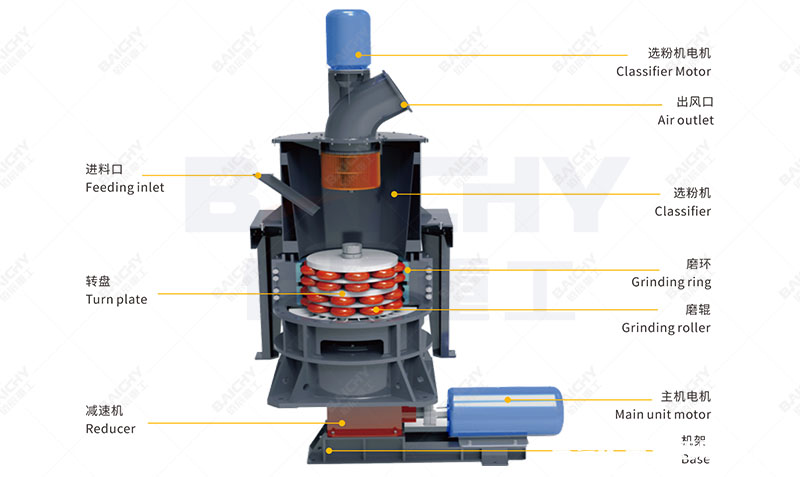
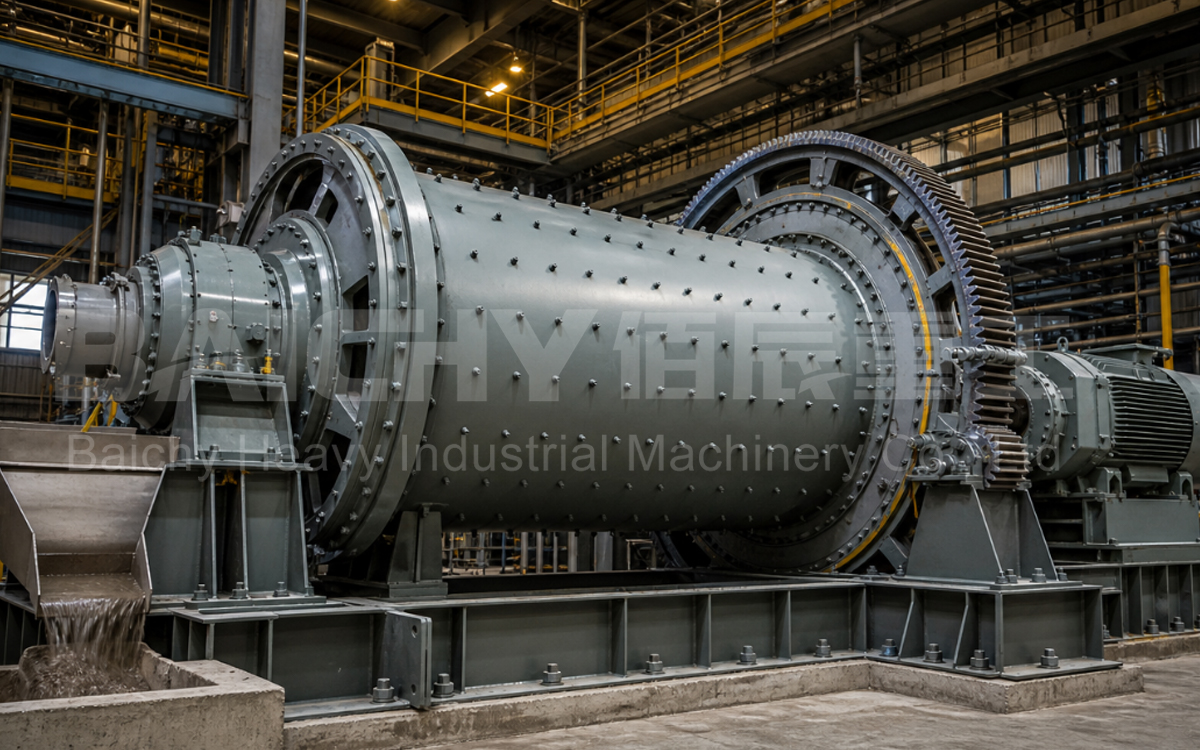
HGM Micro-powder Mill Structure Diagram
2.1 21-Roller, Three-Ring System: Breaking the grinding process into three relay zones
The main unit houses three grinding rings, each paired with seven grinding rollers, creating a total of 21 grinding units. Material is continuously thrown into the gap between the rollers and rings by scrapers; the three rings act as three successive stages of crushing, resulting in more uniform powder output. For a given target fineness, grinding efficiency is significantly higher than that of single-ring centrifugal Raymond mills—this is the mechanism behind the 30–40% reduction in electricity consumption per ton.
2.2 Variable-Frequency Turbine Classification: D97 determined by classifier speed, not mill speed
Product fineness is precisely controlled by the variable-frequency drive of the classifier: one can grind 600-mesh filler powder for construction materials in the morning and switch to producing 2000-mesh raw material for plastic masterbatches in the afternoon without stopping the machine or changing parts. Coarse particles are thrown back into the grinding chamber for further processing, while only powder meeting specifications proceeds to the collection stage—ensuring a narrow particle size distribution and batch consistency, which are key acceptance criteria for filler customers.
2.3 Negative-Pressure Closed-Loop Air System: Balancing environmental compliance and high yield
The entire air system operates under negative pressure: qualified powder travels with the airflow into the cyclone collector, while exhaust gas is filtered through a pulse-jet bag filter before discharge, achieving a product recovery rate of ≥99%. The ultrafine powder captured by the dust collector is itself a marketable product; this design simultaneously addresses the issues of emission compliance and powder loss.
III. Core Specifications (Typical Configuration)
Parameters represent typical values based on calcium carbonate (Mohs hardness 3) under standard operating conditions; applicable to over 100 types of non-metallic minerals with Mohs hardness <6. Actual production capacity varies based on raw material hardness, moisture content, feed size, and target mesh size; please refer to Baichy’s material grinding test report and the technical agreement in the sales contract for definitive figures.
| Parameter Item | Typical Parameters (Represented by HGM80 class; series extends to higher capacities) |
|---|---|
| Applicable Materials | Calcite, limestone, kaolin, bentonite, talc, barite, gypsum, dolomite, wollastonite, etc. (Mohs hardness <6) |
| Feed Size | ≤25 mm (Recommended ≤20 mm) |
| Finished Product Fineness | Adjustable between 150–3000 mesh (D97 5–47 μm); standard production range 325–2500 mesh |
| Grinding Roller Configuration | 21 rollers (3 grinding rings × 7 rollers per ring) |
| Typical Capacity | 1–5 t/h (Based on calcium carbonate; capacity decreases as target mesh fineness increases; larger models cover higher capacity ranges) |
| Main Unit Power | 75–90 kW (HGM80 class) |
| Classification Method | Variable-frequency turbine classifier; stepless online fineness adjustment |
| Dust Collection System | Cyclone collector + pulse-jet bag filter; product recovery rate ≥99% |
| Wear-resistant Parts Lifespan | 8000–12000 hours (CaCO₃ application, Mn13Cr2 material) |
| System Components | Main unit + classifier + powder collector + dust collector + draft fan + piping + PLC control cabinet |
| Power Supply | 380V/50Hz, 400V/50Hz, 440V/60Hz (customized based on market requirements) |
IV. Four Key Considerations Beyond Specifications: Translating Features into Benefits
4.1 One machine, multiple mesh sizes: Order flexibility equals profit flexibility
No need to purchase separate machines for different fineness levels. Today, the plant produces 325-mesh powder for desulfurization orders; tomorrow, by adjusting the classifier speed, it switches to producing 1250-mesh powder for filler orders—with virtually zero switching costs. This translates directly into rapid market responsiveness, serving as the most effective "moat" for powder plants to counter price-cutting pressures associated with single-product reliance.
4.2 Electricity Consumption Analysis: 30–40% Lower than Raymond Mills for the Same Fineness
Based on estimates of continuous production at 3 t/h and 6,000 operating hours per year, the three-ring roller mill system saves approximately 150,000–180,000 kWh annually compared to the traditional Raymond mill grinding process. Electricity is the largest variable cost in the grinding workshop; every kilowatt-hour saved directly boosts the bottom line.
4.3 Narrow Particle Size Distribution and Stable D97: Reduced Returns and Price-Negotiation Losses
"Particle size distribution consistency" is a core acceptance criterion for procurement in the filler industry. A closed-loop classification system ensures that oversized particles are returned for regrinding while qualified powder is collected immediately. This minimizes batch-to-batch variation, making it easier to pass downstream customers' laser particle size analyzer inspections and reducing losses from product returns, financial penalties, and price negotiations.
4.4 Negative-Pressure System + Modular Layout: Controllable Commissioning Timeline
The equipment operates under negative pressure and features comprehensive dust collection, ensuring a dust-free workshop environment. The entire plant utilizes a compact, single-story layout, resulting in a short on-site installation period. For overseas projects, commissioning one month earlier means generating cash flow one month sooner.

HGM Micro-powder Mill: Customer Site in Kenya
V. How to Choose: Determine Fineness First, Then Calculate Capacity, and Finally Select the Model
5.1 Capacity Drops Almost "Exponentially" as Fineness Increases
Using calcium carbonate as a benchmark: production capacity at 600 mesh is approximately 3–5 times that at 2500 mesh. Typical capacities are 3–5 t/h for the 325–600 mesh range, 1.5–2.5 t/h for the 1250 mesh range, and 0.6–1.2 t/h for the 2500 mesh range. If a quote lists capacity based on 325-mesh production but the actual requirement is 1250 mesh, the effective capacity will shrink immediately upon commissioning. The correct procedure is: first determine the target product fineness → calculate the required production capacity → then select the specific model and require the manufacturer to guarantee the output capacity for that target mesh size.
5.2 Three types of raw materials unsuitable for direct feeding into the mill
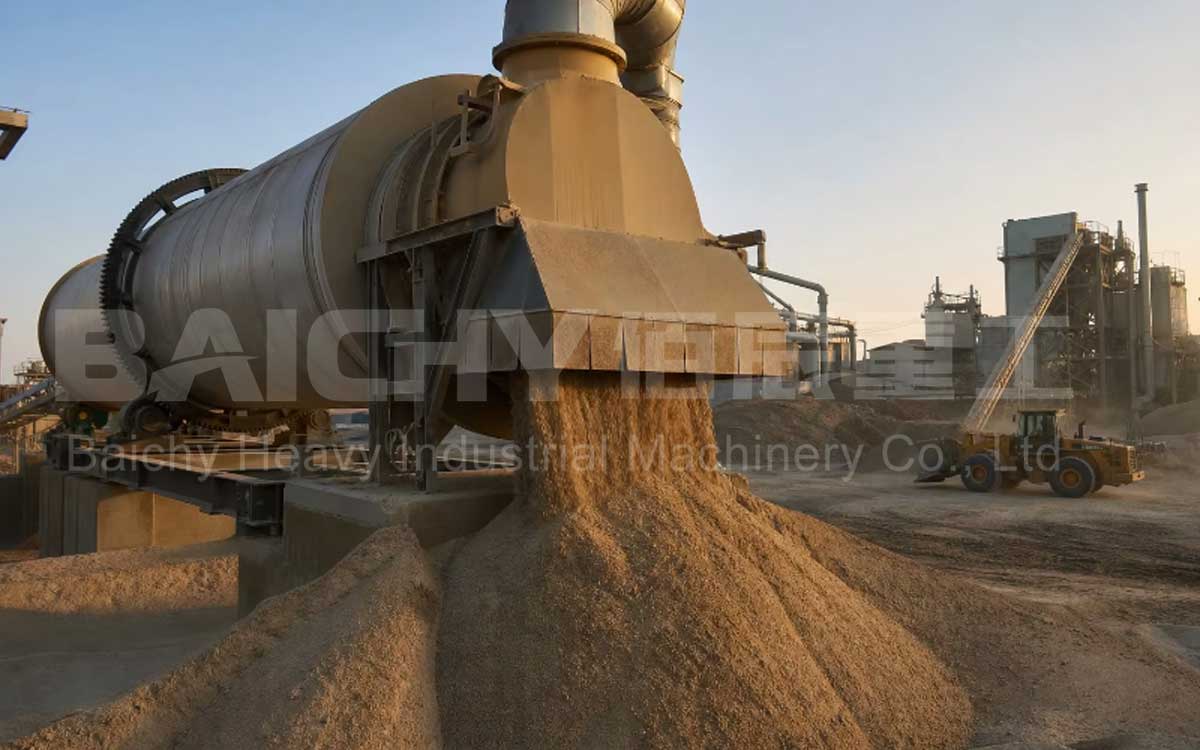
• Wet materials with a moisture content >5% require pre-drying (compatible with Baichy rotary or triple-pass dryers); otherwise, the grinding rollers will become clogged, causing a drastic drop in yield.
• Hard minerals with a Mohs hardness ≥6 or SiO₂ content >3% cause excessive wear on grinding rollers and rings, doubling the cost of wear parts per ton; a ball mill plus classifier setup or an ultrafine vertical mill route should be adopted instead.
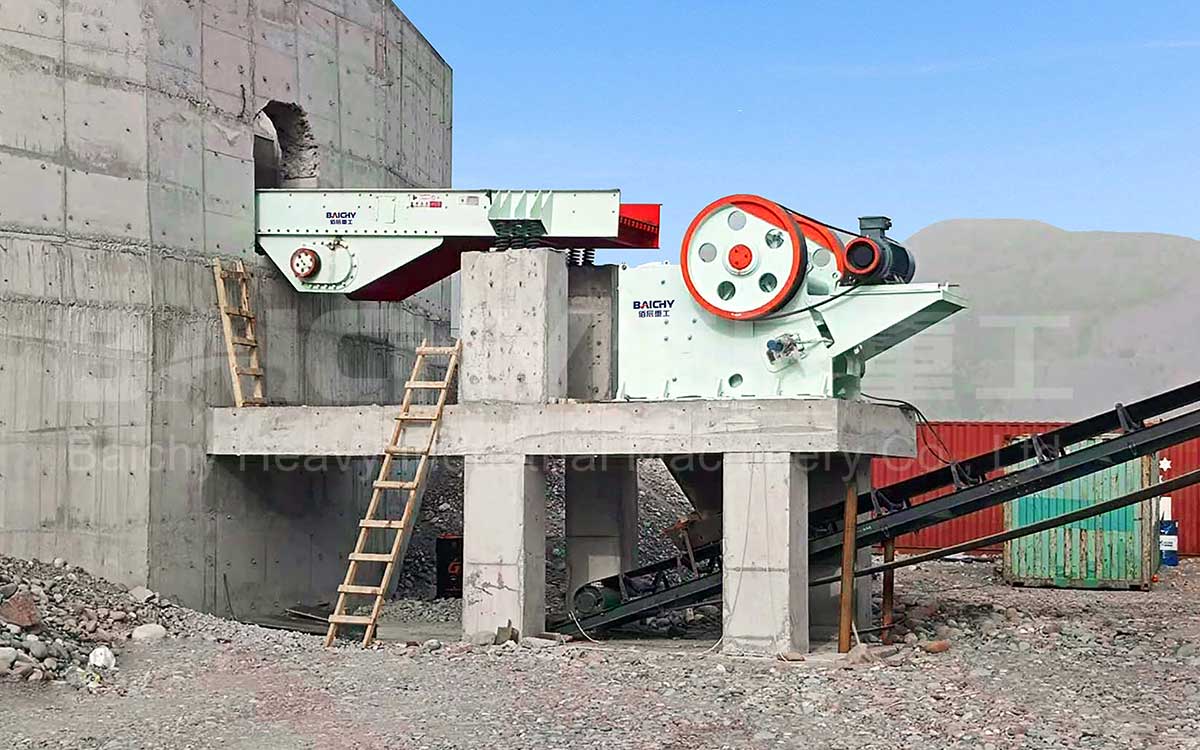
• Large feed particles >25mm can damage the grinding roller assembly; a primary crushing stage (jaw crusher) must be included in the system.
5.3 No on-site modification needed for 60Hz markets
The equipment supports customization for 380V/50Hz, 400V/50Hz, and 440V/60Hz power supplies. For 60Hz markets (such as Latin America and the Middle East), the complete system is configured to local voltage and frequency standards at the factory, allowing for immediate connection and operation upon delivery.
VI. FAQ: Top 3 questions from customers
Q1: How do you distinguish between the HGM Ultrafine Mill and the Raymond Mill?
A1: The piding line is 800 mesh. For conventional filler powders below 600 mesh, the Raymond Mill offers a lower cost per ton. However, for fineness levels above 800 mesh—and especially in the 1250–2500 mesh ultrafine range—the HGM Ultrafine Mill is the mature, mainstream solution. It produces finished powder in a single step with stable D97 particle size distribution and consumes 30–40% less energy for the same fineness. If a plant needs to supply both conventional 325-mesh powder and ultrafine powder, a single HGM mill equipped with a variable-frequency classifier can cover the entire range, eliminating the need to maintain two separate systems.
Q2: How significant is the difference in production capacity between grinding to 325 mesh and 2500 mesh?
A2: Using calcium carbonate as the benchmark, production capacity drops by approximately half to two-thirds for each step-up in fineness: 325–600 mesh yields about 3–5 t/h; 1250 mesh yields about 1.5–2.5 t/h; and 2500 mesh (D97 ≈ 5μm) yields about 0.6–1.2 t/h. Baichy offers free pre-contract material grinding tests, providing D97 particle size reports and guaranteed capacity figures for the target mesh size, thereby eliminating misleading quotes that use 325-mesh performance data to market 2500-mesh capabilities.
Q3: What are the investment and site requirements for an HGM ultrafine grinding production line?
A3: A complete production line comprises coarse crushing, elevating, feeding, the main grinding unit, classification, powder collection, dust removal, and electrical control systems; the main unit has a compact footprint and can be installed on a single level. Regarding investment, the main grinding unit accounts for approximately 60% of the cost, while auxiliary equipment accounts for 40%—cutting corners on auxiliary equipment often leads to doubled costs during the commissioning phase. We recommend submitting three items: a 2–3 kg raw material sample, your target fineness and capacity requirements, and local voltage/frequency specifications. Baichy will then provide a material test report, a production line layout diagram, and a quotation based on the specific target fineness.
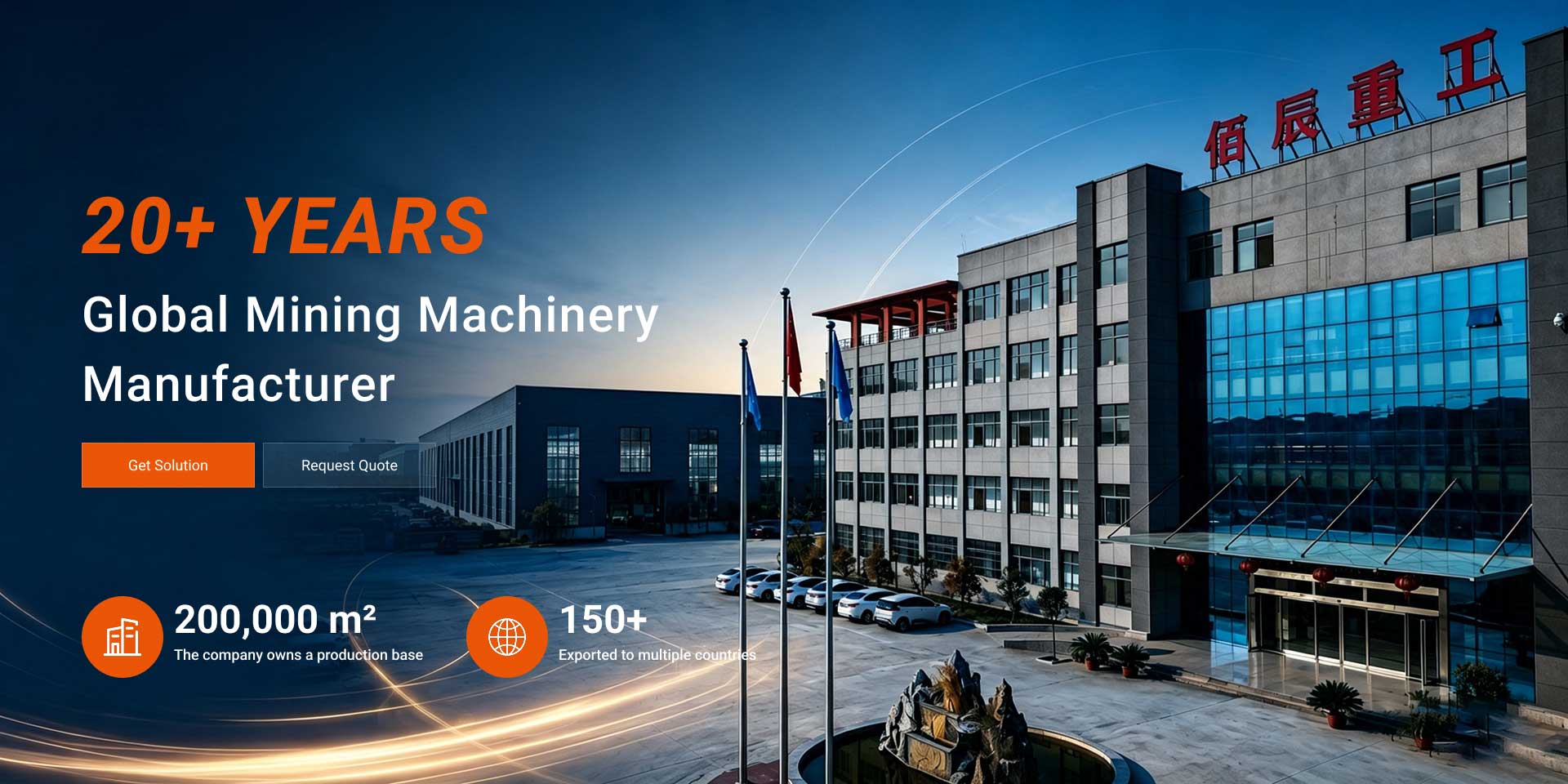
Baichy Heavy Industry
Baichy Heavy Industry is a high-tech mining equipment company integrating R&D, manufacturing, sales, and after-sales service. Focusing on crushing, grinding, and mineral processing equipment, we provide professional solutions to our customers. We are ISO9001:2015 、certified, and our products include mobile crushing palnts, crawler crushing plant, construction waste crushing plants, jaw crushers, sand making machines, cone crushers, fine crushers, grinding mills, ball mills, etc., all with reliable performance to meet diverse project needs.
Baichy Heavy Industry – Your Trusted Partner
To ensure optimal performance of your equipment, Baichy Heavy Industry offers:
- Professional on-site installation guidance
- Comprehensive operator training
- 24/7 technical support & maintenance services
Our complete after-sales service system guarantees long-term, stable operation of your machinery with minimal downtime.
Protect Your Rights – Only Use Official Channels
To avoid scams and ensure authentic support, contact us exclusively through:
• Official Website: www.baichychina.com
• WhatsApp: +8615093222637
• Email: [email protected]
Your satisfaction is our priority – expect prompt, professional service every time.
(Note: Beware of unauthorized third parties claiming to represent Baichy. Always verify through official contacts.)