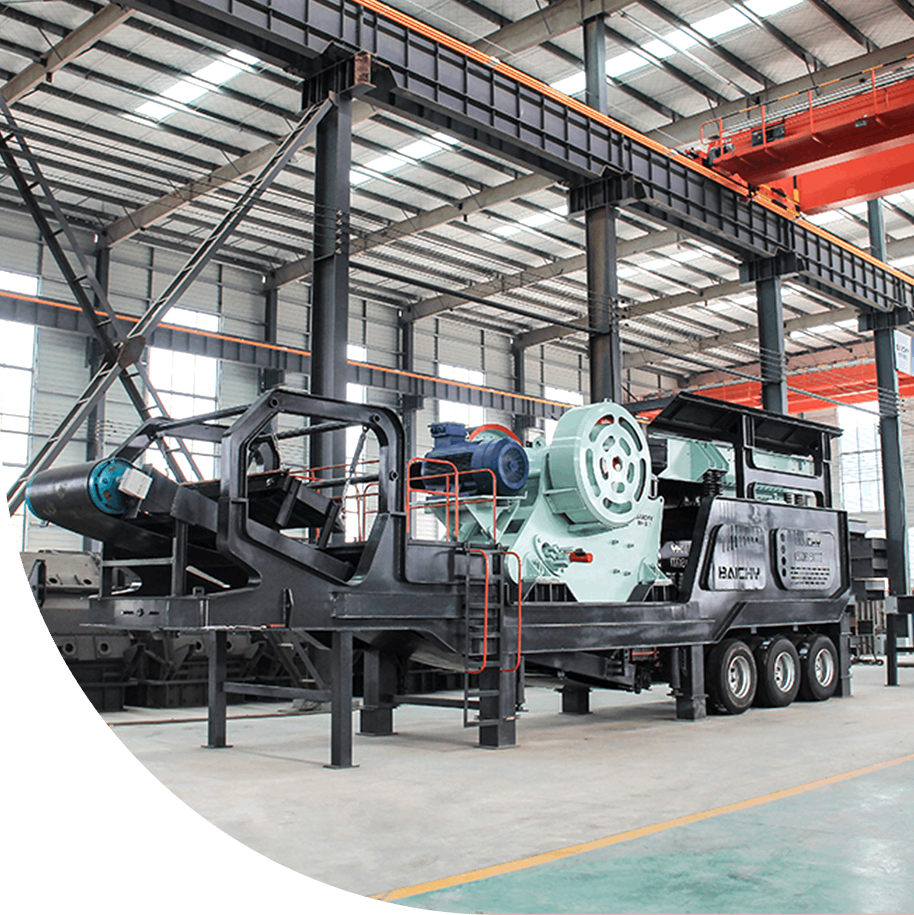


Quartz Sand Washing and Drying Production Line
Whether quartz sand can command a "premium grade" price depends on two critical stages: washing and drying. Washing removes clay and impurities, while drying controls moisture content for shipment—transforming raw sand into a finished product that meets contractual acceptance standards. A typical quartz sand washing and drying production line comprises five stages: feeding and pre-desliming → washing and scrubbing → dewatering and fine sand recovery → rotary drying → cooling and bagging. For delivery meeting glass-grade standards, the clay content can be reduced to below 1%, and the post-drying moisture content stabilized at ≤0.5% without iron contamination; for construction-grade sand, only the first three stages are required before loading. This article traces the process from "raw material intake to finished product bagging," breaking down the equipment selection, operational parameters, and cost logic for each stage.
I. Why "Washing" and "Drying" Must Be Integrated into a Complete Quartz Sand Production Line
1.1 Two Delivery Pitfalls for Raw Sand: Clay Content and Moisture Content
Quarried quartz sand has two inherent flaws that correspond directly to two strict acceptance criteria: clay content and moisture content. High clay content dilutes SiO₂ purity and increases Fe₂O₃ levels, leading to outright rejection by buyers of glass-grade or foundry-grade sand. Unstable moisture content—where free water levels in washed sand fluctuate between 8% and 15% depending on the weather—results in paying for "useless water weight" during tonnage-based shipping, whereas contracts for dried, graded sand often mandate a strict moisture limit of ≤0.5%. Processing any single stage in isolation cannot achieve the value leap from "raw ore" to "graded sand"—which is precisely why an integrated, complete production line is necessary.
1.2 Integrated Line Delivery vs. Piecemeal Procurement: Where the Costs Lie
The hidden costs of piecemeal procurement arise primarily from three areas: downtime caused by capacity mismatches between stages; redundant investment in water and conveying systems; and disputes over commissioning responsibilities among different equipment suppliers. For quartz sand washing and drying lines delivered as complete systems, a single provider handles both process design and equipment matching, with production capacity calculated on a standardized basis (see notes in the §3 parameter table). Commissioning time can typically be reduced by 30%–40%; this is why Baichy insists on "line-based quoting" for glass sand, foundry sand, and fracturing sand projects.
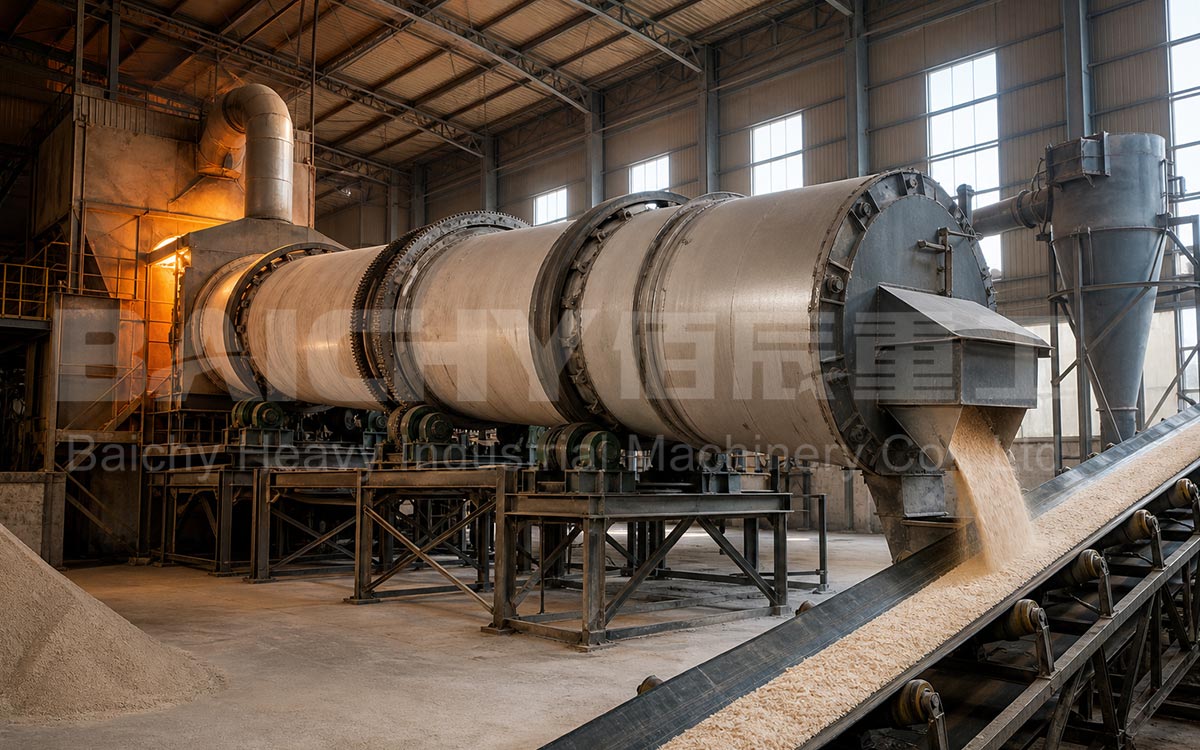
quartz sand washing equipment
II. Process Breakdown: From Raw Material Intake to Final Bagging
2.1 Intake and Pre-desliming: Capturing Mud Clumps and Debris at the Source
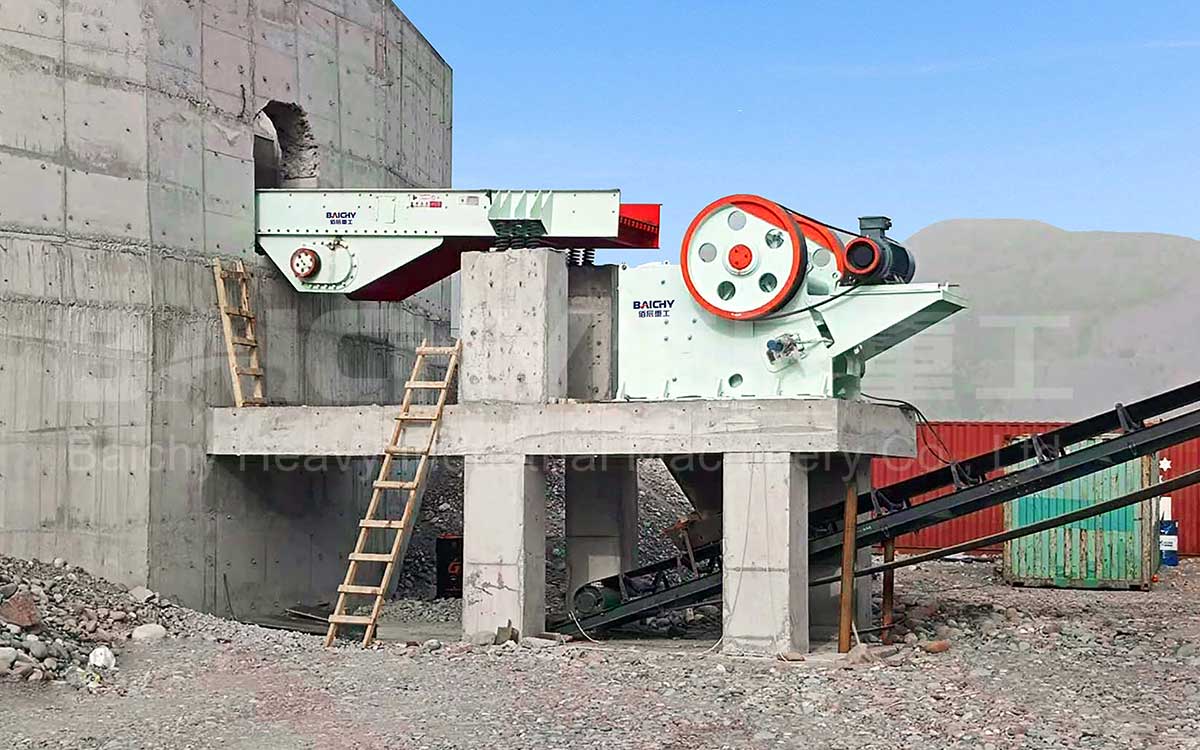
Raw sand enters a vibrating feeder (ZSW series) from the hopper; a grizzly bar section first screens out large chunks and debris like roots. If the mud content exceeds 8% or contains clay clumps, a rotary scrubber/screen is installed at the front end for pre-desliming. The output of this step directly determines the load on subsequent washing stages—without capturing these materials at the source, mud clumps would settle and accumulate inside the sand washer, unnecessarily consuming production capacity.
2.2 Washing and Scrubbing: The Primary Stage for Desliming, Classification, and Fe₂O₃ Reduction
The core equipment is the XSD series wheel-bucket sand washer: sand grains tumble and rub against each other in water driven by the impeller, while mud fines and light impurities are discharged via the overflow, and the washed sand is scooped up by the bucket wheel. The wheel-bucket design retains 0.15–0.5mm fine sand far better than spiral models, keeping the fine sand loss rate under 3%. For applications requiring glass-grade purity or handling raw sand with high mud content, a spiral sand washer (2XL series) can be connected in series for secondary scrubbing to further strip away surface iron oxide films—the thoroughness of the washing stage determines whether the final SiO₂/Fe₂O₃ specifications can meet contractual guarantees.
2.3 Dewatering and Fine Sand Recovery: Retaining Both Water and Fine Sand
The discharge from the sand washer has a moisture content as high as 20%–30%; feeding it directly into the dryer would mean wasting a vast amount of thermal energy on evaporating water. The standard practice involves initial dewatering to a moisture content of 5%–8% using a high-frequency dewatering screen (TS series, installed at a negative angle). The sand-washing overflow (tailwater) is processed by a fine sand recovery system—comprising a hydrocyclone and a dewatering screen—achieving a recovery rate of ≥90% for fine sand particles larger than 0.075 mm; the clarified water is recycled, with make-up water accounting for only 5%–10% of the circulating volume. Fine sand recovery is the most frequently underestimated profit driver in the entire production line, as it simultaneously resolves issues regarding the loss of particle size distribution and the need for desilting sedimentation tanks.
2.4 Rotary Drying: Transforming Moisture Content from a Weather-Dependent Variable into a Quality Acceptance Criterion
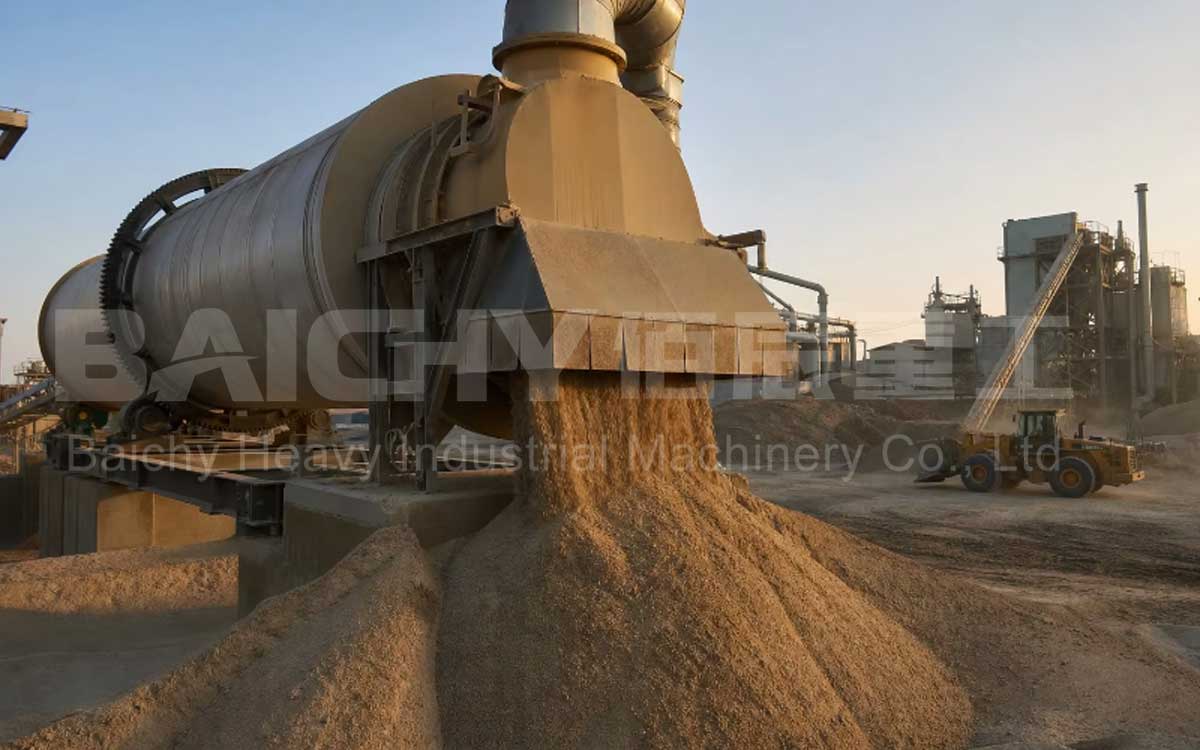
The dewatered wet sand (with a moisture content of approximately 8%) enters a rotary quartz sand dryer. As the inclined drum rotates, lifting flights create a uniform curtain of sand that facilitates efficient heat exchange with the hot air; the output moisture content is stably controlled at ≤0.5% (or ≤0.3% if contract specifications are stricter). For high-purity silica sand sensitive to Fe₂O₃ contamination, an indirect heat-exchange hot-blast stove should be selected to prevent flue gas from coming into direct contact with the sand and increasing iron content; the heat source (natural gas, coal, or biomass) can be chosen based on local energy costs. Where site space is limited, a three-drum dryer serves as an alternative, offering a footprint approximately 60% of the standard size and a thermal efficiency advantage of roughly 45% versus 35%. Ultimately, the essence of the drying stage is to ensure that the moisture content of every ton of sand is consistent, reproducible, and compliant with acceptance standards.
2.5 Cooling, Screening, and Automated Bagging: The Final Stage Before Shipment
The sand exits the dryer at a high temperature and must be cooled to below 60°C—using a cooling conveyor or cooling drum—to prevent condensation and moisture re-absorption inside the bags. If dry classification is required, a linear vibrating screen is installed to separate the sand into specific size fractions, such as 0.1–0.5 mm and 0.5–1.0 mm. Finally, an automatic quantitative packaging machine handles the filling, sealing, and palletizing of 25 kg or 50 kg valve bags or bulk bags (FIBCs). From raw material intake to the bagging of the finished product, the entire process requires the attendance of only 2–3 operators—this is the value delivered by full-line automation.
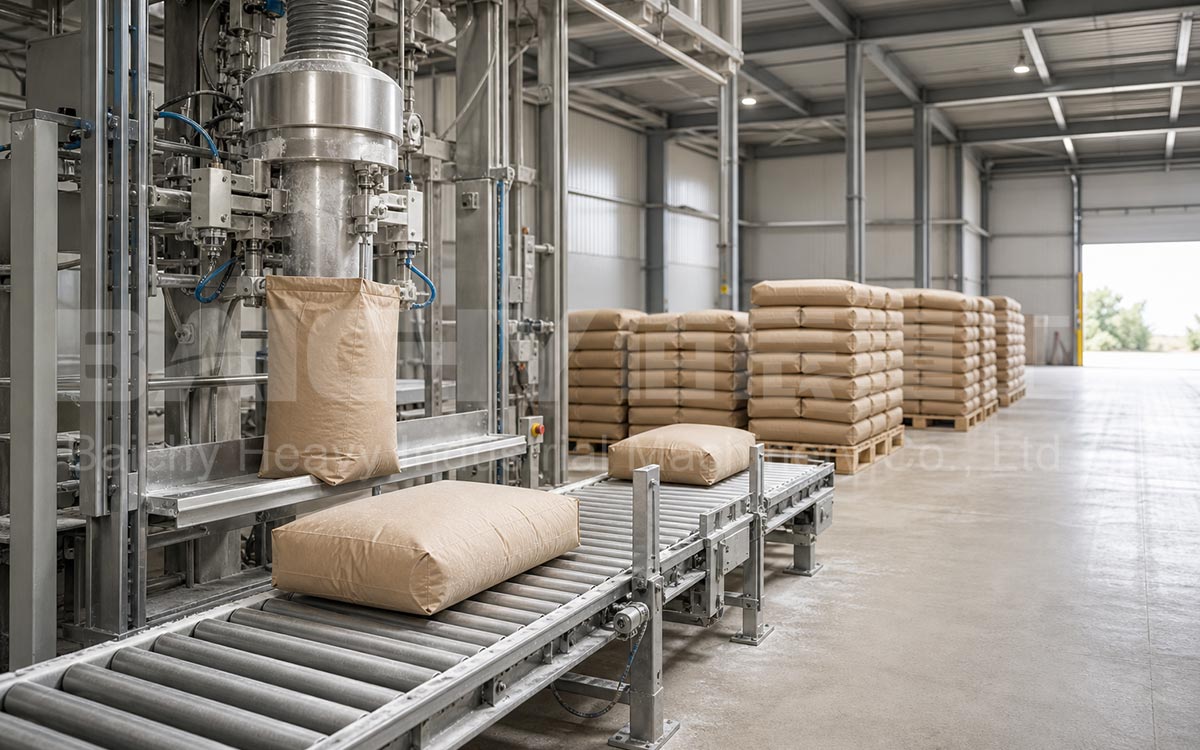
silica sand washing and drying
III. Typical Configuration and Core Specifications (Example: 30–50 t/h Glass-Grade Sand)
The following outlines Baichy’s standard configuration for a 30–50 t/h finished dry sand output (processing wet sand with 8%–12% moisture content down to ≤0.5%). Production capacities are calculated based on the bulk density of quartz sand and test data; final figures are subject to verification through actual material drying tests.
| Process Step | Equipment Unit | Model/Spec | Power (kW) | Key Indicators |
|---|---|---|---|---|
| Feed Pre-desliming | Vibrating Feeder | ZSW380×96 | 11–15 | Grizzly bar pre-screening; rejects oversized rocks and mud clumps |
| Washing (Main) | Wheel-bucket Sand Washer | XSD2610 | 7.5 | 30–80 t/h; mud content <1%; fine sand loss <3% |
| Scrubbing (Optional) | Spiral Sand Washer | 2XL915 (Twin-screw) | 15×2 | Used in series if mud content >8% or Fe₂O₃ reduction is required |
| Dewatering | High-frequency Dewatering Screen | TS Series (e.g., TS1836) | 5.5×2 | Moisture reduced from 20–30% to 5–8% |
| Fine Sand Recovery | Hydrocyclone + Dewatering Screen | DN1530 Class | ~22 (Total) | Recovery rate ≥90% for particles >0.075mm; water recycling |
| Drying | Rotary Sand Dryer (Single-drum) | φ2.2×18m Class (Triple-drum optional) | Main unit: 45–55 | 8–12% → ≤0.5% (adjustable to ≤0.3%); zero Fe₂O₃ increase |
| Heat Source | Heat-exchanging Hot Air Furnace | Natural Gas/Coal/Biomass | — | Indirect heat exchange; flue gas does not contact material flow |
| Cooling | Cooling Conveyor/Cooling Drum | Customized by capacity | 5.5–11 | Discharge temp ≤60°C; prevents condensation in bags |
| Bagging | Automatic Quantitative Packer | 25/50kg Valve Bags or Ton Bags | 3–7.5 | Weighing accuracy ±0.2%; 2–3 operators for the entire line |
Capacity Note: Drying capacity varies significantly based on initial and target moisture levels—for the same φ2.2×18m class machine, capacity is 30–50 t/h at 8% initial moisture, but may be cut in half if initial moisture rises to 15%. When requesting a quote, please provide the following details—all are essential: material type, particle size, initial moisture content, target moisture content, and hourly production capacity.
IV. Key Selection Criteria and Common Pitfalls
1. Determine the finished product grade before deciding on the intensity of the washing process. Construction-grade sand requires only single-stage wheel-bucket washing; glass-grade or foundry-grade sand requires an additional secondary scrubbing stage; for float-glass grade sand (requiring Fe₂O₃ ≤0.10%), it is necessary to evaluate whether to incorporate scrubbing and magnetic separation at the front end.
2. Do not rely solely on "nominal capacity" when selecting a dryer. Calculations must be based on the four key factors—initial moisture, final moisture, and hourly output—and manufacturers should provide test-drying data for the specific material to avoid discrepancies where a unit is "rated at 50 t/h but actually delivers 30 t/h."
3. Dewatering screens and fine sand recovery systems are not optional extras. Omitting the dewatering stage increases thermal energy consumption for drying by over 30%; skipping fine sand recovery results in the loss of the 0.075–0.15 mm fraction, which simply accumulates as waste in the sedimentation tank.
Plan water systems in advance for regions with strict environmental regulations. A sedimentation tank with water recycling is the standard configuration; for zero-discharge requirements, add a plate-and-frame filter press to reduce sludge cake moisture content to below 25% for off-site disposal.
V. FAQ
Q1: What is the approximate investment cost for a quartz sand washing and drying production line, and what is the payback period?
A1: Investment costs depend primarily on capacity and product grade: a 10–20 t/h construction-grade line (washing + dewatering) costs approximately ¥0.8–1.5 million; a 30–50 t/h glass-grade line (including drying and bagging) ranges from approximately ¥3.0–5.0 million. Detailed calculations based on specific operating conditions are required. Payback analysis based on grade premiums: Glass-grade and foundry-grade sands typically command a premium of ¥150–400 per tonne over construction-grade sand. With a daily output of 300 tonnes of dry sand sold entirely as graded product, equipment investment is usually recouped within 12–24 months. Actual payback depends on local sand prices and production capacity; Baichy provides free investment calculations for complete production lines.
Q2: How dry can washed quartz sand get? Does the drying process increase iron content or affect the whiteness of glass-grade sand?
A2: Standard designs consistently control output moisture content at ≤0.5%, with adjustments possible to ≤0.3% if contract requirements are stricter. The risk of iron contamination depends on the heat source: direct flue gas contact can coat sand grains with an iron oxide film at high temperatures. For glass-grade or ceramic-grade sands sensitive to Fe₂O₃, a heat-exchange (indirect) hot-blast stove should be selected to ensure zero Fe₂O₃ increase during drying. When selecting equipment, verify the stove's structural design rather than focusing solely on temperature specifications.
Q3: Can this line simultaneously produce glass-grade, foundry-grade, and fracturing sands? How is production capacity determined?
A3: Yes, but we recommend a planning approach that combines shared washing and drying stages with product-specific downstream processing. The washing, dewatering, and drying sections are shared based on maximum specifications, while different grades are achieved by adjusting particle size screening, scrubbing intensity, and final moisture content. Capacity should be verified against the strictest grade requirements (typically fine-grain float glass sand with ≤0.5% moisture) rather than being rated based on construction sand standards; otherwise, a discrepancy may arise where nominal capacity is sufficient but actual output falls short when switching grades.
Baichy Heavy Industry
Baichy Heavy Industry is a high-tech mining equipment company integrating R&D, manufacturing, sales, and after-sales service. Focusing on crushing, grinding, and mineral processing equipment, we provide professional solutions to our customers. We are ISO9001:2015 、certified, and our products include mobile crushing palnts, crawler crushing plant, construction waste crushing plants, jaw crushers, sand making machines, cone crushers, fine crushers, grinding mills, ball mills, etc., all with reliable performance to meet diverse project needs.
Baichy Heavy Industry – Your Trusted Partner
To ensure optimal performance of your equipment, Baichy Heavy Industry offers:
- Professional on-site installation guidance
- Comprehensive operator training
- 24/7 technical support & maintenance services
Our complete after-sales service system guarantees long-term, stable operation of your machinery with minimal downtime.
Protect Your Rights – Only Use Official Channels
To avoid scams and ensure authentic support, contact us exclusively through:
• Official Website: www.baichychina.com
• WhatsApp: +8615093222637
• Email: [email protected]
Your satisfaction is our priority – expect prompt, professional service every time.
(Note: Beware of unauthorized third parties claiming to represent Baichy. Always verify through official contacts.)