Sand and gravel drying lines
An aggregate sand drying production line is not merely about "buying an extra dryer"; it is a value-added system that transforms washed sand and manufactured sand—previously "low-value wet material"—into "dry sand priced by quality."
For downstream sectors such as dry-mix mortar, asphalt mixing, foundry casting, and fracturing sand, the sand's moisture content directly determines whether a sale can be closed and at what price. While open-air drying can only reduce moisture to 5%–8%—and is at the mercy of the weather—mechanical drying can consistently achieve levels below 0.5%. A well-configured drying line is the key investment for shifting an aggregate business from "tonnage-based competition" to "quality-based premium pricing." Below, we provide a comprehensive overview covering the process, equipment selection, costs, and common pitfalls.
I. Why wet sand must be dried: Four scenarios, one Piding line
1. Dry-mix mortar: Moisture content is part of the formula
The core requirement for sand in dry-mix mortar is "stability." Fluctuations in moisture content cause a loss of control over the binder ratio, finished product strength, and open time; the industry standard requires dried sand to have a moisture content of ≤0.5%. Feeding washed sand directly into the mix is essentially leaving quality up to the weather.
2. Asphalt mixing plants: Every 1% increase in moisture bumps up fuel costs
Asphalt mixing consumes significant thermal energy during the aggregate heating stage. Higher moisture content leads to greater heat consumption for drying, directly eroding the product's gross margin; moisture fluctuations also introduce errors in mixing temperature and aggregate gradation.
3. Foundry sand and fracturing sand: Moisture determines the grade
Resin-coated sand and sodium silicate sand are extremely sensitive to moisture; quartz sand used for hydraulic fracturing requires very low surface moisture to ensure effective proppant transport. These orders are priced based on quality, making drying a prerequisite for market entry.
4. Industrial sands (e.g., for glass): Stable supply secures long-term contracts
Once large industrial users verify the consistent quality of the dry sand, they tend to sign long-term supply contracts. A drying line serves as the hardware-based competitive advantage that qualifies a company to provide such "stable supply."
Why is drying a priority now? Data from the China Sand and Gravel Association's Big Data Center indicates that national sand and gravel production in 2024 was approximately 15.3 billion tons. Tightening supplies of natural sand have driven an increase in the proportion of manufactured sand; however, wet sand washing processes often result in high moisture content in the finished product, causing drying operations to shift from a "niche step" to a "standard requirement." The international market reflects a similar trend: USGS statistics show US construction sand and gravel production at approximately 890 million tons in 2024, with demand for dry sand concentrated in dry-mix mortar and asphalt aggregates, while export orders for specialty sands are further boosting the need for drying.
When should a drying line be installed? There are two key criteria: first, target customers have strict moisture content specifications (e.g., mortar plants, asphalt plants, foundries, or orders for hydraulic fracturing sand); second, daily shipment volumes exceed 50 tons, or there is a requirement for stable, all-weather supply. At this stage, the costs associated with air-drying—such as land use, labor for turning piles, and the risk of contract default—surpass the costs of depreciation and energy consumption for a drying line.
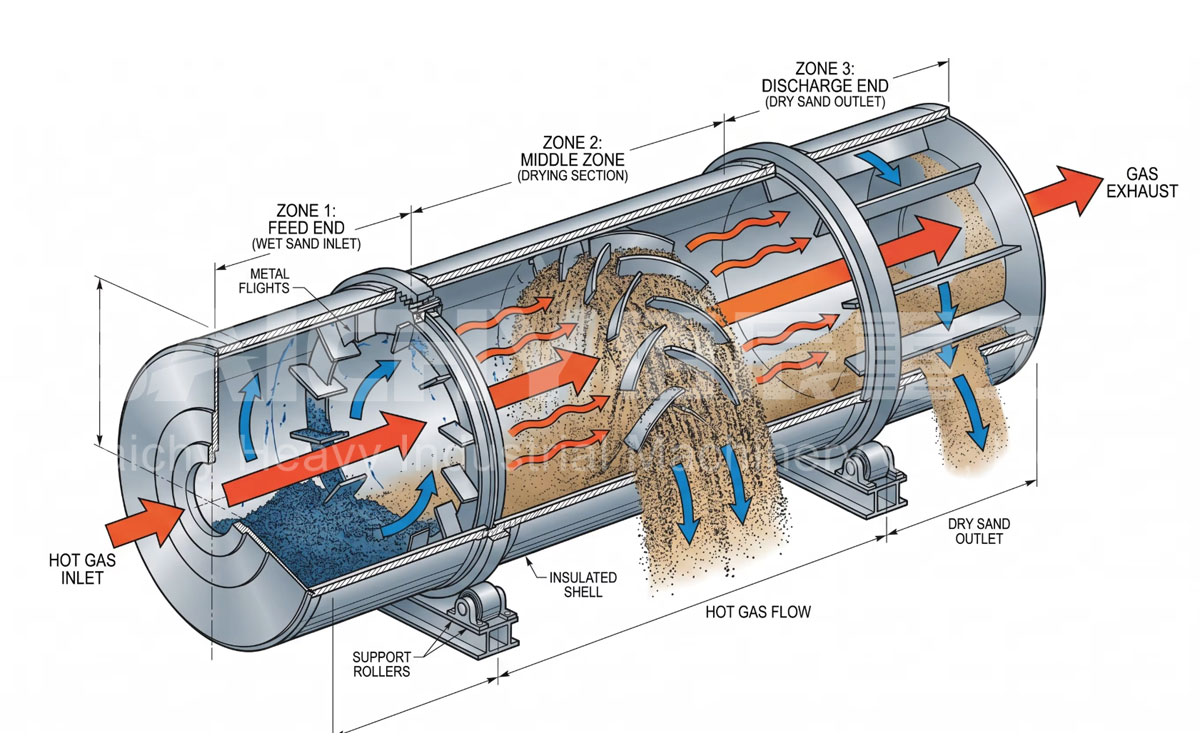
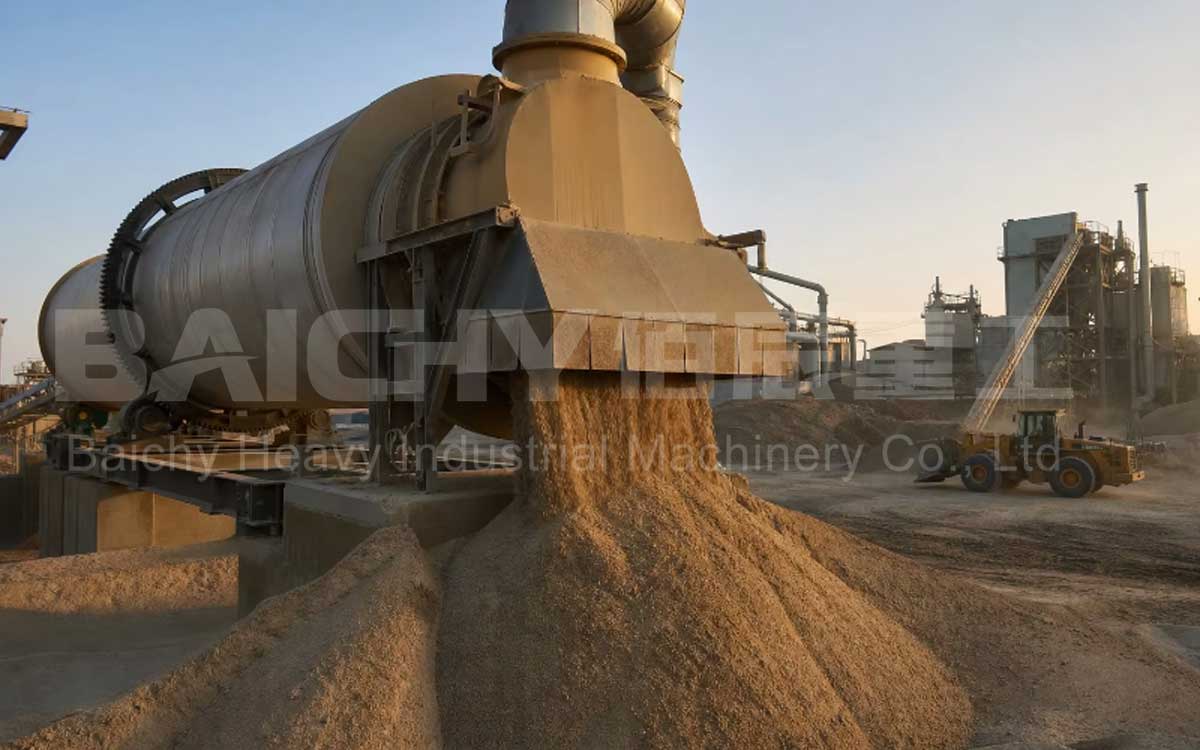
Single-drum dryer: Working principle
II. The Complete Process of a Standard Sand and Gravel Drying Line
Typical workflow: Wet sand stockpile → Feed hopper → Belt conveyor → Hot blast stove (natural gas, coal, biomass, or oil) → Main drying unit (triple-pass or rotary dryer) → Discharge conveyor → Cooling unit (typically a single-drum cooler) → Bucket elevator → Finished product silo / screening and loading.
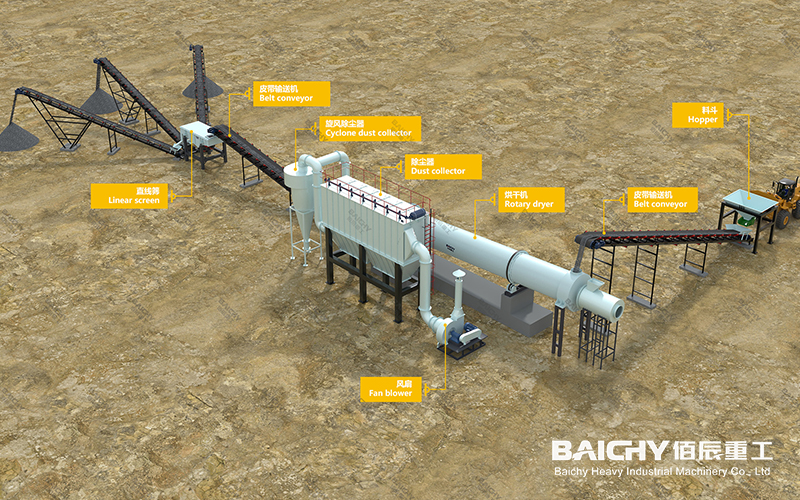
Single-drum dryer: Process flow chart
Auxiliary systems determine the line's operational stability: cyclone and baghouse dust collectors recover dust from exhaust gases; an induced draft fan maintains negative pressure inside the drum; and an online moisture analyzer automatically adjusts the feed rate and hot air temperature.
Three Critical Questions for a Drying Line
• Heat Source: Which energy source is the most cost-effective and compliant with local emission regulations?
• Dust Removal: Can exhaust emissions pass environmental impact assessments or local standards? Does the baghouse dust collector have adequate anti-condensation measures for high-humidity conditions?
• Moisture Control: How can stable output moisture be maintained despite significant fluctuations in input moisture? Material flow and hot air temperature must be interlinked.
III. Core Selection: Triple-Drum Dryer or Single-Drum Rotary Dryer?
The triple-drum dryer is the mainstream choice for sand and gravel (including river sand, manufactured sand, and sand for dry-mixed mortar). Its three-layer concentric design creates a self-insulating structure; the drum length is approximately 60% shorter than that of a single-drum unit, significantly reducing the footprint and civil engineering investment. Materials undergo repeated lifting and dispersion across the inner, middle, and outer drums for heat exchange, achieving a thermal efficiency of about 45% (compared to ~35% for single-drum rotary dryers). A trunnion roller drive replaces the large girth gear, resulting in lower noise and reduced maintenance requirements. Baichy’s triple-drum dryers offer processing capacities ranging from 8 to 100 t/h.
The single-drum rotary dryer is suitable for high-moisture, clay-rich, or sticky materials, as well as applications requiring large-volume capacity. It features a straightforward structure and broad adaptability; internal lifting flights and material-breaking devices can be customized to prevent material from sticking to the drum walls. Baichy’s rotary dryer series ranges from Φ600×6000 to Φ3200×25000, with processing capacities of 0.5–53.6 t/h and maximum inlet air temperatures of 700–800°C.
Baichy Three-Drum Dryer (Specialized for Sand and Gravel) – Full Specification Table
| Model | Outer Drum Diameter × Length (m) | Drum Volume (m³) | Rotation Speed (r/min) | Max. Inlet Air Temp. (°C) | Capacity (t/h) | Installed Power (kW) |
|---|---|---|---|---|---|---|
| Φ2.0×4m | 2.0×4 | 12.56 | 4–10 | 700–750 | 8–15 | 5.5×2 |
| Φ2.2×5m | 2.2×5 | 18.99 | 4–10 | 700–750 | 12–20 | 5.5×2 |
| Φ2.5×6m | 2.5×6 | 29.43 | 4–10 | 700–750 | 18–28 | 7.5×2 |
| Φ2.8×6m | 2.8×6 | 36.92 | 4–10 | 700–750 | 25–35 | 11×2 |
| Φ3.0×6m | 3.0×6 | 42.39 | 4–10 | 700–750 | 30–40 | 7.5×4 |
| Φ3.0×7m | 3.0×7 | 49.45 | 4–10 | 700–750 | 30–45 | 7.5×4 |
| Φ3.2×7m | 3.2×7 | 56.27 | 4–10 | 700–750 | 35–55 | 11×4 |
| Φ3.6×8m | 3.6×8 | 81.39 | 4–10 | 700–750 | 55–75 | 18.5×4 |
| Φ4.0×10m | 4.0×10 | 125.60 | 4–10 | 700–750 | 70–100 | 22×4 |
*Production capacity varies based on material type, particle size, and moisture content; the figures above are for reference only, and actual capacity should be calculated based on specific operating conditions.
IV. Heat Source and Dust Removal: The Area with the Greatest Cost Variance
Heat Source Selection Comparison Table
| Heat Source Type | Cost & Operational Characteristics | Suitable Scenarios | Environmental Considerations |
|---|---|---|---|
| Natural Gas | Higher unit heat cost; high automation and precise temperature control | Areas with low gas prices or strict environmental regulations; near urban centers | Clean emissions; minimal pressure regarding environmental impact assessments |
| Coal (Hot Blast Stove) | Low fuel cost; requires auxiliary dust removal and desulfurization | Areas with low coal prices and lenient environmental regulations | Must be equipped with high-efficiency dust removal; strict monitoring of emission standards required |
| Biomass/Wood Chips | Fuel costs fluctuate; requires stable supply | Areas rich in agricultural and forestry waste | Can be marketed as a carbon-neutral feature |
| Diesel/Heavy Oil | Flexible and mobile; no pipeline network required | Remote job sites; project-based production | Sensitive to fuel costs; requires careful cost calculation |
Dust removal employs a two-stage process—"cyclone pre-collection + bag filter fine collection"—focusing on the recovery of fine sand particles. In northern winters or high-humidity regions, the dust collector and piping must be insulated and managed for dew point control; otherwise, condensation in the exhaust gas will cause the filter bags to clog ("blind"). Meeting emission standards is the baseline for legal operation—when comparing prices, ensure the dust removal system is included in the total cost, rather than comparing only the price of the main unit.
V. Cost Per Ton of Sand and Return on Investment: Drying is a Business of Clear Calculations
Based on standard operating conditions with an input moisture content of 12% and an output of ≤0.5%: approximately 110–120 kg of water must be evaporated per ton of wet material. Estimating a thermal efficiency of about 45% for a triple-pass dryer line, the comprehensive heat consumption per ton of dry sand is approximately 130,000–160,000 kcal (equivalent to about 18–22 kg of standard coal or 15–18 Nm³ of natural gas). Additionally, electricity consumption for fans, dust removal, conveying, etc., is approximately 4–7 kWh per ton.
Processing Cost Structure per Ton of Dry Sand (Estimates)
| Cost Item | Estimated Range | Notes |
|---|---|---|
| Fuel | 18–22 kg standard coal or 15–18 Nm³ natural gas | Varies based on feed moisture content and thermal efficiency |
| Electricity | 4–7 kWh | Main drive + induced draft fan + dust removal + conveying |
| Labor | 2–3 persons/shift | Low maintenance requirement for trunnion roller drive structure |
| Maintenance Consumables | Low | Lifter plates and seals are standard replacement parts |
When evaluating the value of a drying line, do not simply compare equipment prices; instead, compare the "processing cost per ton" against the "price spread between dry and wet sand." There is a significant price difference between sand used for dry-mixed mortar and ordinary washed sand; the profit margin generated by drying is this price spread minus the processing cost per ton. With sufficient production capacity, the equipment investment can typically be recouped within 1–2 peak seasons. The exact payback period depends on local energy prices and regional sand price differentials; be sure to recalculate based on actual prices before placing an order.
VI. Checklist for Avoiding Pitfalls in Sand and Gravel Drying Line Selection
1. Specify "evaporation capacity" first, not just total production capacity. Does the supplier's t/h figure refer to wet or dry material? What is the assumed feed moisture content? These details must be included in the contract's technical annex.
2. Declare sticky materials in advance. Sand with high clay content tends to stick to the drum interior; custom lifter plates and breaking devices are required—do not wait until clogging occurs on-site to make modifications.
3. Incorporate anti-condensation designs for cold and humid regions. Dust collectors, pipeline insulation, and variable frequency drives (VFDs) for induced draft fans are essential; otherwise, filter bags will clog immediately upon startup in winter.
4. Sea sand requires "salt washing before drying." If chloride ions are not removed, the drying equipment, conveying systems, and downstream concrete or mortar will suffer corrosion.
5. The heat source determines long-term costs. Plug local gas, coal, and electricity prices into the cost-per-ton formula and calculate the total cost over three years before finalizing the plan.
6. Increase airflow specifications for high-altitude environments. Air is thinner at high altitudes, requiring increased airflow for induced draft fans and burners; inform the supplier of the site's altitude during equipment selection. 7. Provisions are included for online moisture detection and automatic temperature control interfaces. Stable output quality is the key to premium pricing and the foundation for intelligent system upgrades.
VII. Why Choose Baichy’s Complete Sand and Aggregate Drying Solution?
Baichy Heavy Industry is a full-chain manufacturer of equipment for mining crushing, sand making and washing, grinding, and mineral processing. Our sand and aggregate drying lines can be planned and delivered as a unified package alongside crushing, sand-making, and washing/dewatering equipment, eliminating coordination issues between multiple suppliers. Equipment can be customized to match local grid voltage and frequency (e.g., 380V/50Hz, 400V/50Hz, 440V/60Hz). We also guarantee a 60-second initial response, a technical reply within 30 minutes, and a design proposal within 24 hours.
To receive a configuration proposal, please provide the following details: sand type and source (river sand, manufactured sand, or sea sand), feed moisture content, target moisture content, target production capacity, available heat sources, and site altitude, voltage, and frequency. Once we receive these operating parameters, we will convert them directly into a quotation proposal and a cost-per-ton analysis.
FAQ: Common Questions About Sand and Aggregate Drying
1. To what level can the drying line reduce the sand's moisture content?
Standard designs can stably control output moisture content to below 0.5%, with levels typically reaching 0.3%–0.5% for dry-mixed mortar sand. Performance depends on feed moisture content, particle size, retention time inside the drum, and hot air temperature. Baichy rotary dryers support inlet temperatures of 700–800°C, while three-drum dryers support 700–750°C; closed-loop control is achieved by adjusting rotation speed and feed rates.
2. How do I choose between a three-drum dryer and a single-drum rotary dryer?
The three-drum dryer is the preferred choice for river sand and manufactured sand with uniform particle sizes and loose, free-flowing characteristics. It occupies approximately 60% less space than a single-drum dryer and offers a thermal efficiency of about 45% (compared to ~35% for single-drum models) thanks to its self-insulating structure. It covers mainstream production capacities ranging from 8 to 100 t/h. If the material has extremely high moisture content, contains sticky clay, or requires a large-capacity drum, select a single-drum rotary dryer (0.5–53.6 t/h) equipped with a material-breaking device to prevent wall adhesion. If you are unsure, send a small sample for drying tests before finalizing the plan.
3. What are the approximate investment and payback period for a sand and gravel drying production line?
Investment costs depend on production capacity, the heat source, and environmental protection configurations; there is no "standard price." Components such as the hot-blast stove, dust removal system, conveyors, and storage silos often account for a significant portion of the budget. When assessing the return on investment, do not look solely at the equipment quote; instead, calculate the difference between the processing cost per ton and the price spread between dry and wet sand. Once you provide your operational parameters, Baichy will supply an equipment list and quote within 24 hours and assist in calculating the cost per ton and payback period based on local energy prices.
Baichy Heavy Industry
Baichy Heavy Industry is a high-tech mining equipment company integrating R&D, manufacturing, sales, and after-sales service. Focusing on crushing, grinding, and mineral processing equipment, we provide professional solutions to our customers. We are ISO9001:2015 、certified, and our products include mobile crushing palnts, crawler crushing plant, construction waste crushing plants, jaw crushers, sand making machines, cone crushers, fine crushers, grinding mills, ball mills, etc., all with reliable performance to meet diverse project needs.
Baichy Heavy Industry – Your Trusted Partner
To ensure optimal performance of your equipment, Baichy Heavy Industry offers:
- Professional on-site installation guidance
- Comprehensive operator training
- 24/7 technical support & maintenance services
Our complete after-sales service system guarantees long-term, stable operation of your machinery with minimal downtime.
Protect Your Rights – Only Use Official Channels
To avoid scams and ensure authentic support, contact us exclusively through:
• Official Website: www.baichychina.com
• WhatsApp: +8615093222637
• Email: [email protected]
Your satisfaction is our priority – expect prompt, professional service every time.
(Note: Beware of unauthorized third parties claiming to represent Baichy. Always verify through official contacts.)