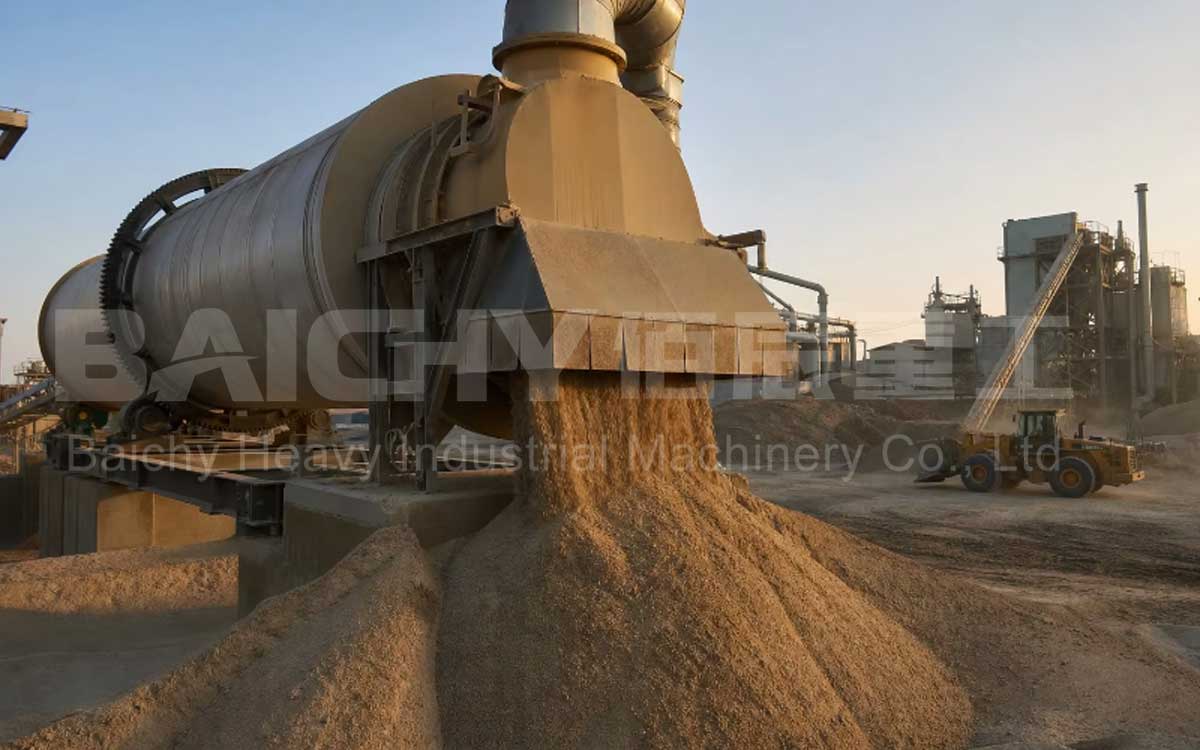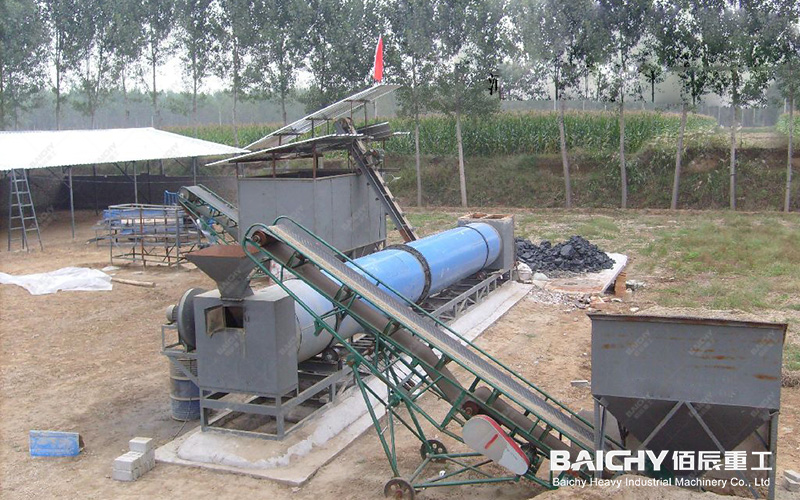
Rotary sawdust dryer
I. Conclusion First: Crunch the Numbers Before Discussing Equipment
Wet sawdust is not waste; it is simply low-moisture fuel in the wrong place—provided it is dried. Wet sawdust common in the wood processing industry has a moisture content of 45%–55%, incurring disposal fees of $15–$30 per ton for waste removal. Once dried to below 10% moisture, it becomes suitable feedstock for pellet fuel, manufactured charcoal, and biomass boilers, valued at $40–$90 per ton. Sawdust Drying is the single process that transforms this price gap into profit.
For continuous production capacities exceeding 1 ton per hour, the rotary sawdust dryer offers a solution characterized by high single-unit capacity, broad material adaptability, and a clear pathway for capacity expansion. This article focuses on three key issues: determining capacity, selecting a heat source, and ensuring safety; all data presented herein can be independently verified.
II. Why Must Sawdust Be Dried? Three Key Calculations and One Standard
Calculation 1: The Calorific Value Account. The dry-basis net calorific value of wood is approximately 18–19 MJ/kg; at 50% moisture, this drops to 8–9 MJ/kg, as nearly half the heat energy is consumed by evaporating water rather than generating power or heat. Fuel buyers price products based on calorific value, meaning wet material is essentially sold at a bargain price.
Calculation 2: The Standards Account. Export-grade pellet fuel must comply with the EN ISO 17225-2 (ENplus A1) standard, which sets a maximum moisture limit of 10%. Exceeding this limit results in the loss of certification and the associated price premium; furthermore, sawdust with moisture content above 15% cannot be successfully pelletized, resulting in loose or cracked pellets.
Calculation 3: The Storage Account. Wet sawdust begins to mold and ferment after just 2–3 weeks of storage, generating heat and unpleasant odors; alongside the loss of quality comes the risk of spontaneous combustion. Dried material can be safely stored and transported over long distances; sawdust with 10%–12% moisture also serves as stable feedstock for MDF (medium-density fiberboard) and particleboard production lines. From a demand perspective, the global wood pellet market continues to expand; research firm Mordor Intelligence projects the market size will exceed $26 billion by 2031, driven primarily by biomass power generation and heating demands in Europe. Drying is the initial value-added step in pellet and machine-made charcoal production lines, directly determining whether the product meets export certification standards. The typical process sequence is: crushing → drying → pulverizing → pelletizing/carbonizing. The dryer acts as a pivotal link between these stages; an incorrect equipment choice can hinder the capacity of the entire production line.
Quantitative basis: Drying 1 ton of wet sawdust (50% moisture content) down to 10% moisture involves evaporating approximately 0.44 tons of water, yielding about 0.56 tons of dry material. When selecting equipment, all capacity and fuel consumption figures are calculated based on "evaporation capacity" rather than wet material weight—a fundamental principle repeatedly emphasized in this article.
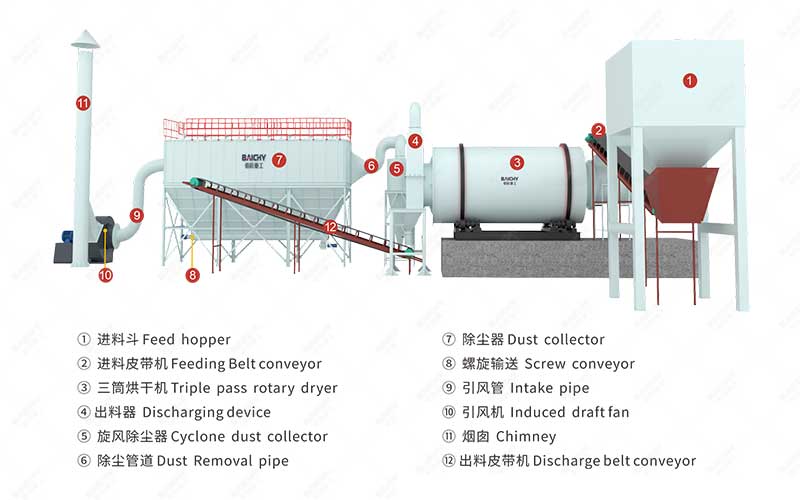
Process flow chart of the single-drum dryer
III. What is a rotary wood chip dryer? Working principles and key advantages
The rotary wood chip dryer (or rotary sawdust dryer) consists of a slightly inclined, slow-rotating drum, internal lifting flights, a roller drive system, inlet/outlet seals, and a hot air system. Wet sawdust enters the drum via a screw feeder; internal lifting flights continuously toss the material to create a "curtain" of particles that comes into concurrent contact with high-temperature flue gas. Moisture evaporates continuously as the material tumbles, and the dried material is discharged from the lower end. This concurrent flow arrangement ensures that wet material first contacts the hottest flue gas; since the wood chips' temperature remains lower than that of the flue gas, the risk of overheating is naturally minimized.
It offers three core advantages: continuous operation (with single-unit hourly capacities ranging from 1 ton to over 10 tons, eliminating batch-to-batch downtime); thorough agitation (maximizing the contact area between material and hot air for uniform drying and minimal moisture fluctuation in the output); and adaptability (high tolerance for variations in input moisture and particle size, capable of processing lightweight biomass such as sawdust, wood chips, wood shavings, bamboo chips, and rice husks). Compared to fluidized bed and flash drying systems, rotary drying equipment offers superior wear resistance and more precise airflow control, making it the preferred choice for biomass fuel plants, manufactured charcoal facilities, and board manufacturing plants.
The complete system typically comprises a hot-air furnace, a screw feeder, an airlock discharge valve, a cyclone separator, a baghouse dust collector, and an induced draft fan. Pre-processing the material—using a rotary screen or hammer mill to reduce particle size to under 10 mm before it enters the dryer—significantly improves drying uniformity and production capacity. For small-scale production lines with capacities under 2 t/h, a compact single-drum configuration can be used to minimize the equipment footprint and initial investment; for large-scale fuel plants exceeding 5 t/h, a "dual-line parallel" setup allows for future capacity expansion while avoiding excessive upfront investment.

biomass drying equipment Shipment
IV. Core Parameter Reference Table: Selection Based on Evaporation Capacity
| Model | Drum Dimensions (Diameter × Length) | Wet Material Throughput (t/h, Initial Moisture ≈45%) | Evaporation Capacity (t/h) | Dry Material Output (t/h, Final Moisture ≈10%) | Inlet Air Temperature (°C) | Main Motor Power (kW) |
|---|---|---|---|---|---|---|
| HG-1200×8000 | φ1.2×8 m | 1.2–1.5 | 0.47–0.58 | 0.7–0.9 | 300–400 | 11 |
| HG-1500×12000 | φ1.5×12 m | 2.0–2.6 | 0.78–1.0 | 1.2–1.6 | 300–400 | 15 |
| HG-1800×14000 | φ1.8×14 m | 3.5–4.5 | 1.4–1.8 | 2.1–2.8 | 300–400 | 22 |
| HG-2200×16000 | φ2.2×16 m | 6.0–8.0 | 2.3–3.1 | 3.7–4.9 | 300–400 | 30–37 |
Note: The table above lists reference values for typical configurations, calculated based on a sawdust bulk density of 150–250 kg/m³, initial moisture of 45%, and final moisture of 10%. Sawdust is extremely lightweight; for the same drum volume, production capacity is far lower than that of sand or gravel materials. Do not directly apply capacity charts intended for other materials based on wet material tonnage. Final specifications are subject to calibration via material drying tests; the final moisture content (8%–15% range) can be adjusted according to downstream processing requirements (e.g., pellets, machine-made charcoal, direct boiler combustion, or board manufacturing).
V. How to Choose a Heat Source? Fuel Costs Determine the Cost Per Ton of Drying
The heat source is the most significant variable in operating costs, accounting for approximately 70% of the cost per ton of drying. Three mainstream solutions:
1. Biomass hot-air furnace (Recommended): Uses dry sawdust and wood scraps as fuel, creating a "waste–heat source–waste" closed loop with the production line. Fuel costs are virtually zero, making it ideal for manufacturers who generate their own sawdust.
2. Gas/Oil burner: Offers precise temperature control, rapid start-stop capabilities, and a compact footprint; suitable for environmentally sensitive areas. However, fuel unit costs are high—roughly 1.5 to 2 times that of coal—making it best suited for high-value-added pellet production lines.
3. Coal-fired hot-air furnace: Offers the lowest fuel cost per ton but requires auxiliary systems for desulfurization, dust removal, and ash handling, necessitating significant upfront environmental investment.
Before selecting a model, align expectations using a quick engineering estimate: evaporating 1 kg of water requires approximately 2.7–3.3 MJ of effective heat. Drying 1 ton of sawdust from 50% moisture content down to 10% requires evaporating about 0.44 tons of water, corresponding to 1.2–1.5 GJ of effective heat. Factoring in a thermal efficiency of 65%–75% for biomass furnaces, this consumes roughly 110–160 kg of biomass fuel (at 15% moisture content). In other words, by using the production line's own dry wood scraps as the heat source, the fuel cost for drying 1 ton of wet sawdust approaches zero, leaving only electricity and labor costs. Applying local fuel prices to this calculation yields the drying cost per ton; multiplying this by annual output reveals the primary variable influencing the 5-year Total Cost of Ownership (TCO) for the heat source solution.
VI. Fire and explosion prevention design for sawdust drying: Temperature is the critical limit
Sawdust is a typical combustible dust, and the drying system represents one of the highest fire-risk areas in the entire plant. Explosion safety is not an optional extra but an essential component of the entire rotary drying solution. Key features include:
• Inlet Air Temperature Interlock: Automatically cuts off the heat source and triggers an alarm if the flue gas temperature exceeds limits, preventing ignition caused by localized overheating;
• Spark Detection and Automatic Suppression: Spark detectors are installed at the feed inlet and upstream of the dust collector; detection of a spark immediately triggers a water mist suppression system;
• Dust Collection System Explosion Venting: Cyclone separators and baghouse dust collectors are equipped with explosion vents, anti-static filter bags, and grounding; explosion-proof electrical components compliant with ATEX/GB standards are selected where necessary;
• Discharge Temperature Monitoring: Alerts the system to abnormalities if the dried material temperature is too high, preventing smoldering of high-temperature material after discharge;
• Storage Coordination: Final moisture content is maintained at no less than 8% to avoid the increased risk of spontaneous combustion associated with over-drying—the idea that "drier is safer" is a common misconception.
A compliant system should also feature centralized monitoring in the control room, displaying temperatures, pressure differentials, and CO concentrations at various points, with remote interlock shutdown capabilities triggered by any abnormality. Buyers in the European market typically require the complete solution to include dust explosion zoning diagrams and explosion venting calculations; it is advisable to include the safety configuration list in the technical agreement during the inquiry stage, rather than trying to retrofit safety measures after production begins.
VII. Avoiding Pitfalls in Equipment Selection: Four Common Mistakes
• Sizing Based on Wet Tonnage: Wet material tonnage does not equal drying capacity; calculations must be based on the evaporation rate (see the standard definition above);
• Ignoring Bulk Density: The bulk density of sawdust is only about one-tenth that of sand or gravel; insufficient drum volume or airflow capacity will severely limit production output;
• Comparing Only the Main Unit Price: Heat sources, dust collection, explosion protection, and installation/infrastructure often account for over 40% of the total project investment; costs outside the main equipment quote often represent the bulk of the expenditure;
• Skimping on Safety Configurations: Omitting spark detection and explosion venting is risky; the financial loss from a single accident far exceeds the cost difference of the equipment.
VIII. FAQ (Frequently Asked Questions)
Q1: To what moisture level can a rotary sawdust dryer reduce the moisture content? Is it suitable for pellet fuel production?
Under standard operating conditions, it can consistently reduce the final moisture content to 8%–12%. For export-grade pellet fuel, the product must meet the EN ISO 17225-2 (ENplus A1) standard requiring a moisture content of ≤10%; the production line can be set to a target of 9%–10%. For machine-made charcoal or direct boiler combustion, 12%–15% is sufficient; excessive drying wastes fuel and increases the risk of spontaneous combustion. The target final moisture content should be clearly defined during the equipment selection phase, as it directly dictates the drum length, airflow volume, and fuel consumption.
Q2: I need to process 2 tons of wet sawdust per hour; what size specification should I choose?
Calculate based on evaporation capacity: Assuming an initial moisture content of 50% and a final content of 10%, approximately 0.44 tons of water must be evaporated per ton of wet material. A throughput of 2 t/h corresponds to an evaporation demand of about 0.9 t/h; referring to the table above, a specification of φ1.5×12 m or larger should be selected. A safer approach is to provide the manufacturer with data on initial moisture, final moisture, bulk density, and particle size to conduct a free drying test and calibrate capacity using empirical data—any capacity figures quoted merely "based on experience" should be viewed with skepticism.
Q3: Can sawdust drying lead to fires or even explosions? What safety measures are in place?
Yes, the combination of sawdust dust and high-temperature flue gas poses a risk of fire and explosion; this is precisely the fundamental difference between a professional solution and a cobbled-together setup. A reliable safety system includes: a co-current drying structure, an interlock system for inlet air over-temperature, spark detection and automatic suppression, dust collection systems with explosion venting and anti-static designs, online monitoring of discharge temperature and CO concentration, and remote interlock shutdown for anomalies. When purchasing, you should require a complete list of safety specifications from the manufacturer rather than accepting a verbal assurance that "temperatures won't get too high."

Baichy Heavy Industry
Baichy Heavy Industry is a high-tech mining equipment company integrating R&D, manufacturing, sales, and after-sales service. Focusing on crushing, grinding, and mineral processing equipment, we provide professional solutions to our customers. We are ISO9001:2015 、certified, and our products include mobile crushing palnts, crawler crushing plant, construction waste crushing plants, jaw crushers, sand making machines, cone crushers, fine crushers, grinding mills, ball mills, etc., all with reliable performance to meet diverse project needs.
Baichy Heavy Industry – Your Trusted Partner
To ensure optimal performance of your equipment, Baichy Heavy Industry offers:
- Professional on-site installation guidance
- Comprehensive operator training
- 24/7 technical support & maintenance services
Our complete after-sales service system guarantees long-term, stable operation of your machinery with minimal downtime.
Protect Your Rights – Only Use Official Channels
To avoid scams and ensure authentic support, contact us exclusively through:
• Official Website: www.baichychina.com
• WhatsApp: +8615093222637
• Email: [email protected]
Your satisfaction is our priority – expect prompt, professional service every time.
(Note: Beware of unauthorized third parties claiming to represent Baichy. Always verify through official contacts.)