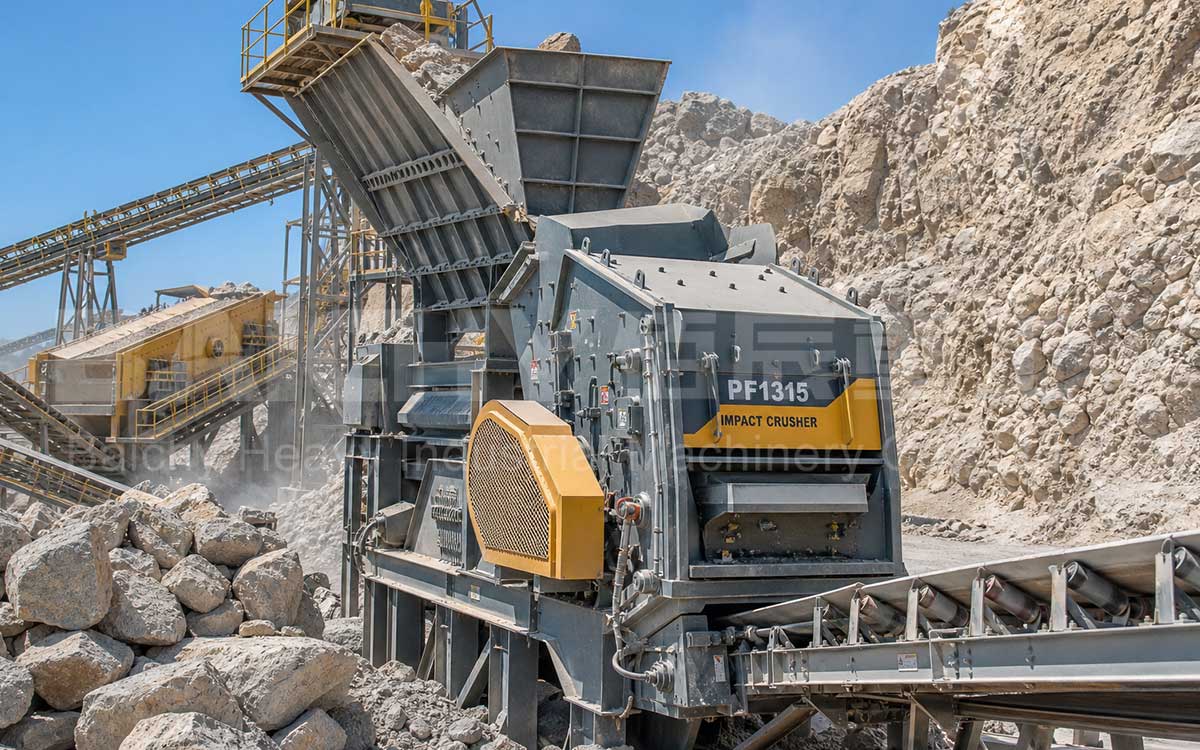

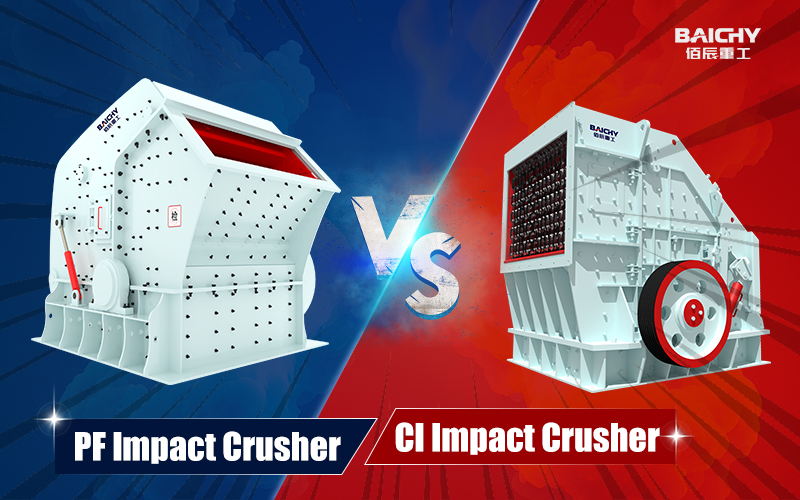
PF Impact Crusher vs. CI Impact Crusher
The PF Series Impact Crusher (Standard Type) and the Large-Mouth Impact Crusher (often referred to as a primary impact crusher or coarse impact crusher—such as the CI series) are widely prevalent in the field of mining machinery. Although both fall under the category of impact crushers, they exhibit significant differences in their intended design purpose and specific operational performance.
The following is a detailed comparative analysis of the two:
1. Core Distinctions
| Feature | PF Series Impact Crusher (Standard Type) | Large-Mouth Impact Crusher (Coarse/Primary Type) |
| Feed Opening Size | Relatively small. Primarily designed for medium-sized materials that have already undergone primary crushing. | Massive. Features a wide and tall feed opening capable of directly ingesting large-volume rocks. |
| Maximum Feed Size | Typically, the maximum feed size ranges between 300–500 mm. | Capable of processing large-block materials measuring 700–1000 mm or even larger. |
| Crushing Chamber Design | Typically features a two- or three-chamber design, emphasizing multiple impacts within the chamber to ensure superior product shape (cubicity). | Features a taller and deeper chamber with a greater distance between the rotor and the feed opening, providing ample crushing space for large-block materials. |
| Rotor Weight | The rotor is relatively lighter with a higher rotational speed, focusing on the impact force's role in fine crushing. | Extremely heavy rotor. Leverages massive rotational inertia to pulverize large ore blocks; features superior structural strength. |
| Output Profile | Primarily produces medium-to-fine aggregates, with an extremely low content of needle-like or flaky particles. | Offers an exceptionally high crushing ratio, capable of achieving a "one machine replaces two" effect (serving as a substitute for a jaw crusher + impact crusher combination). |
2. What Are The Specific Application Scenarios For Impact Crushers?
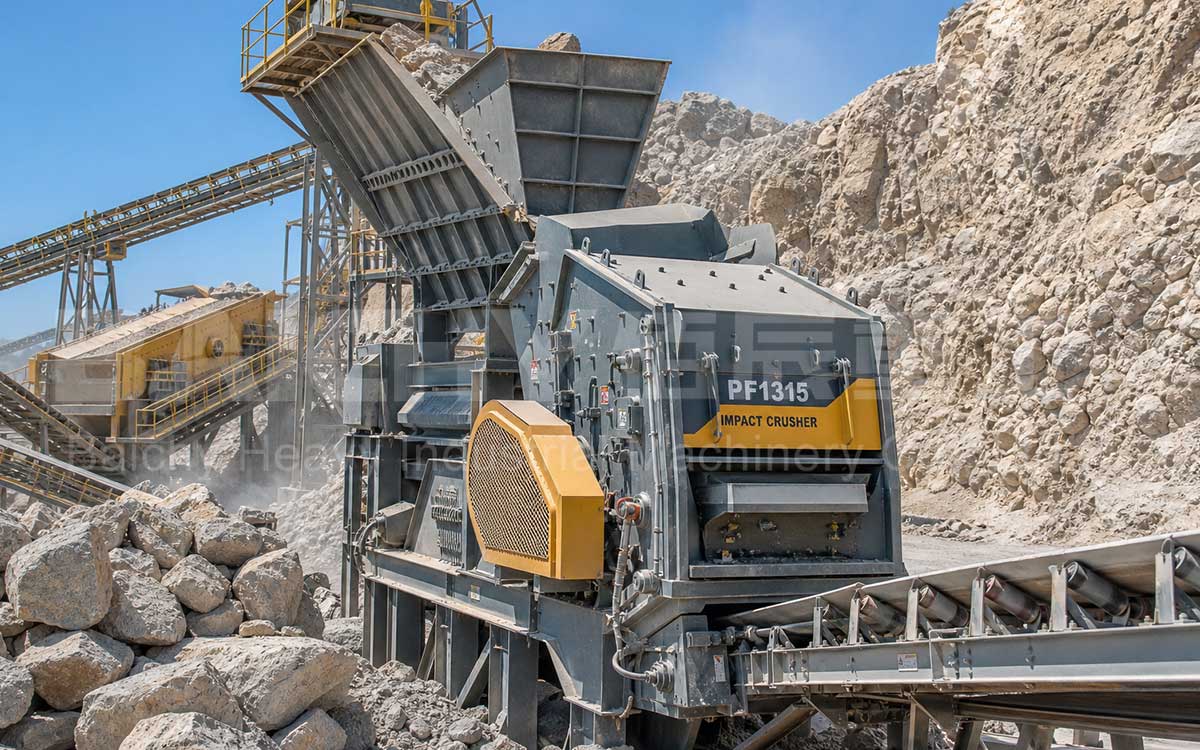
PF Impact Crusher (Standard Type):
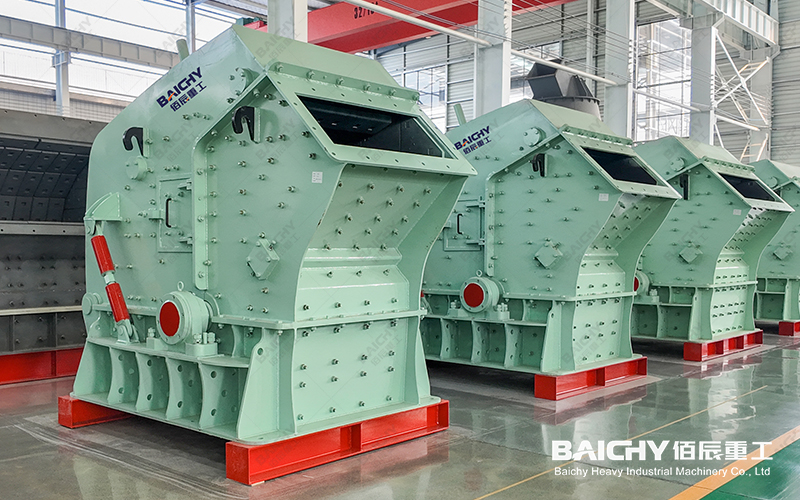
PF Impact Crusher (Standard Type)
Secondary/Tertiary Crushing: Typically configured downstream of a jaw crusher (primary crusher) to serve as equipment for intermediate and fine crushing. High-Standard Construction Material Production: Widely used for producing high-grade aggregates for highways, railways, and water conservancy projects, as it yields finished products with a highly rounded, cubical shape.
Moderately Hard Materials: Suitable for crushing medium-hardness, brittle materials such as limestone, gypsum, and recycled concrete.
Large-Mouth Impact Crusher (Coarse Crushing Type):
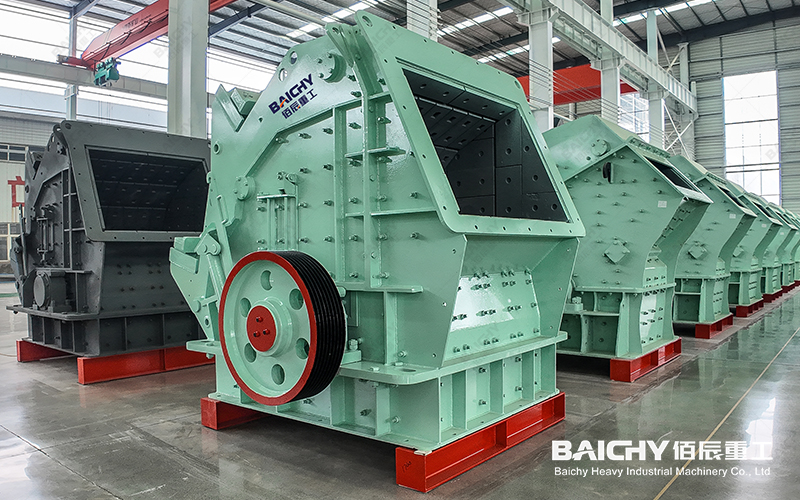
Large-Mouth Impact Crusher (Coarse Crushing Type)
Primary Crushing: When material hardness is relatively low (e.g., limestone, shale), it can serve directly as the primary crushing stage.
Construction Waste Processing: Capable of processing waste containing large blocks of reinforced concrete; the large feed opening effectively prevents clogging.
Large-Scale Stone Quarries: Used for directly crushing large blocks of soft rock when the goal is to simplify the process flow and reduce equipment investment and maintenance costs.
3. How to Choose the Right Impact Crusher?
The core logic behind the selection process centers on two factors: "What is the feed size?" and "What is the hardness?"
1. Consider Raw Material Size:
If your raw ore diameter exceeds 500mm (e.g., 800mm blasted rock), prioritize the Large-Mouth Impact Crusher or a "Jaw Crusher + PF Impact Crusher" combination.
If the raw material is already under 400mm, or if a jaw crusher is already in place upstream, selecting the PF Impact Crusher yields better results and a higher finished product yield.
2. Consider Process Requirements:
Prioritizing Finished Product Quality: The multi-cavity design of the PF Impact Crusher ensures a more uniform discharge product.
Prioritizing Process Simplification: If the material is relatively soft (hardness < 150MPa), the Large-Mouth Impact Crusher can eliminate the need for a jaw crusher, thereby simplifying the production line.
3. Consider Material Hardness:
Impact crushers are generally not recommended for crushing extremely hard materials (e.g., granite, basalt), as this leads to extremely rapid wear of the blow bars. For hard rock applications, a cone crusher is recommended instead.
4. The Working Principle of the Impact Crusher
The fundamental crushing principle for both types is identical: "Impact Crushing":
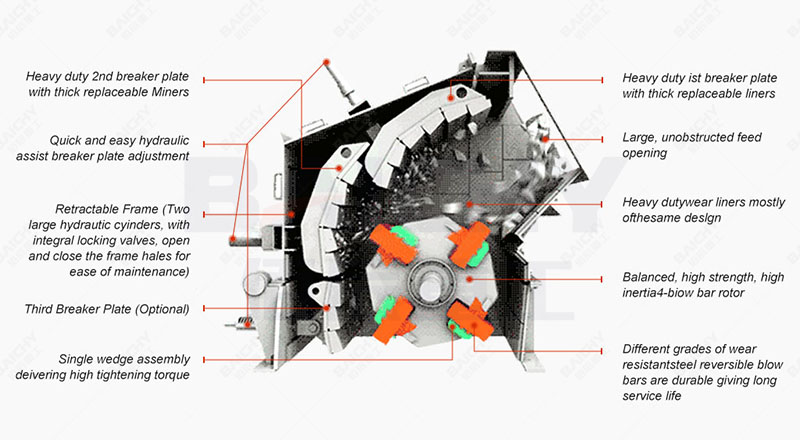
PF Impact Crusher Structure Diagram
1. Striking Stage: Upon entering the crushing chamber, the material is subjected to high-speed impact from the blow bars (hammers) mounted on a rapidly rotating rotor.
2. Impact Stage: The material, having acquired kinetic energy, flies at extremely high velocity toward the impact plates, where it strikes and shatters.
3. Internal Grinding/Collision: The material rebounds repeatedly within the chamber and collides in mid-air with subsequently entering material, undergoing further fragmentation.
Specific Features of the Large-Inlet Impact Crusher:
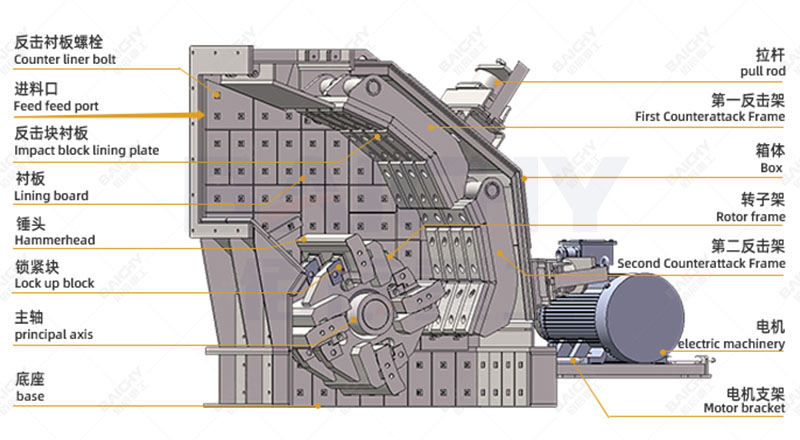
CI Large-Feed Impact Crusher: Structural Diagram
Due to its capacity to handle extremely large feed sizes, the blow bars in a large-inlet impact crusher typically feature a heavy-duty design, and the positioning and angles of the impact plates are specially optimized. It accomplishes the vast majority of the volume reduction work (coarse crushing) within the first chamber, whereas the standard PF impact crusher distributes the crushing pressure more evenly across multiple chambers.
About of Baichy Heavy Industry
Baichy Heavy Industry is a high-tech mining equipment company integrating R&D, manufacturing, sales, and after-sales service. Focusing on crushing, grinding, and mineral processing equipment, we provide professional solutions to our customers. We are ISO9001:2015 、certified, and our products include mobile crushing palnts, crawler crushing plant, construction waste crushing plants, jaw crushers, sand making machines, cone crushers, fine crushers, grinding mills, ball mills, etc., all with reliable performance to meet diverse project needs.
Our advantages:
• Professional pre-sales support: Free project design and comprehensive solutions to help you accurately select the right equipment;
• Comprehensive on-site service: Providing installation guidance and worker training to ensure smooth equipment commissioning;
• Reliable after-sales guarantee: A complete after-sales system, timely response to technical inquiries and equipment maintenance, ensuring long-term stable operation.
To protect your rights, please contact us through the following official channels for professional service:
Official Website Customer Service
https://wa.me/+8615093222637
Email: [email protected]
We are committed to providing high-quality equipment and full-cycle services to deliver comprehensive intelligent solutions for the global mining industry!
Frequently Asked Questions (FAQ)
1. Can the large-inlet impact crusher truly serve as a complete substitute for the "Jaw Crusher + Standard Impact Crusher" combination?
A: It depends on the hardness of the material. When processing materials of low to medium hardness (such as limestone, bluestone, or construction waste), the large-inlet impact crusher—thanks to its massive feed opening and heavy-duty rotor—can effectively perform both primary coarse crushing and secondary medium crushing in a single unit, thereby simplifying the process flow and reducing infrastructure costs. However, if the material hardness is high, the compressive crushing action of a jaw crusher offers distinct advantages; attempting a forced substitution in such cases would lead to a drastic increase in wear costs for the impact crusher's blow bars.
2. Why is the finished product shape (grain shape) from the PF series impact crusher typically superior to that of the large-inlet impact crusher?
A: The PF series typically employs a three-chamber crushing design, meaning the material undergoes a greater number of impacts and rebounds within the crushing chamber. Furthermore, the structural geometry of the chamber is more conducive to the material's "self-crushing" effect. As a result, the aggregates produced by the PF series exhibit fewer sharp edges and a more rounded, cubical shape, thereby meeting the rigorous quality standards required for high-grade construction aggregates.
3. Are the wear parts (blow bars, liner plates) interchangeable between the two types?
A: Generally, they are not interchangeable. The blow bars in the large-feed impact crusher (coarse crushing type) are thicker and heavier, designed to withstand the direct impact of large-sized materials; conversely, the blow bars in the PF series (medium-to-fine crushing type) are designed with a greater emphasis on wear-resistant surface area and impact frequency. Users are advised to contact the original manufacturer to purchase replacement parts based on their specific equipment model; under no circumstances should parts be intermixed, as doing so may result in damage to the rotor.