
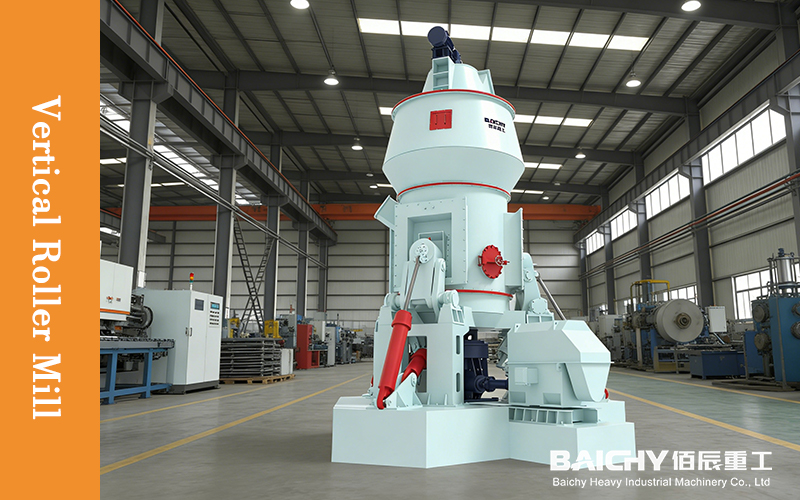
Vertical Roller Mill
Thanks to energy consumption that is 40–50% lower than that of ball mills and a footprint that is only 50% as large, the Vertical Roller Mill (VRM) has become the mainstream grinding equipment for processing bulk materials in the cement, power, and metallurgical industries.
Faced with increasingly stringent environmental regulations and mounting production cost pressures, traditional ball mill systems are gradually losing ground due to their "high energy consumption, large footprint, and difficulty in processing wet materials." This article will analyze—from the three dimensions of technical principles, application scenarios, and economic benefits—why the VRM is the inevitable choice for the modernization and upgrading of industrial plants.
I. Structural Advantages: Compact Design Solves Site Constraints
The VRM adopts a vertical, integrated layout, occupying only 50–60% of the footprint required by a ball mill; furthermore, it features excellent sealing performance, allowing it to be installed directly in an open-air environment.
Unlike the linear layout of horizontal ball mills, the VRM stacks functional modules vertically within a confined space:
1. Doubled Space Utilization: The grinding table rotates horizontally while the grinding rollers apply vertical pressure; this design significantly reduces the required infrastructure area per unit of production capacity.
2. Integrated Sealing: The mill casing integrates both airflow and material conveying channels, allowing the entire system to operate under negative pressure; consequently, the rate of dust leakage remains far below the national standard (GB 4915-2013).
| Layout Comparison Item | Traditional Ball Mill System | Vertical Roller Mill (VRM) | Data Source/Standard |
| Footprint | 100% (Baseline) | 50% – 60% | Actual Factory Survey Data |
| System Sealing | Partial Sealing | Full-System Negative Pressure Sealing | GB 50455-2008 |
| Installation Method | Requires Enclosed Building | Can Be Installed Outdoors | Engineering Design Specifications |
II. Working Principle: How Does "Material Bed Grinding" Achieve 50% Energy Savings?
By utilizing the principle of "hydraulic pressurization combined with non-contact material bed grinding," the Vertical Roller Mill (VRM) eliminates the inefficient metal-to-metal collisions inherent in traditional mills, thereby reducing grinding-related electricity consumption by 40–50%.
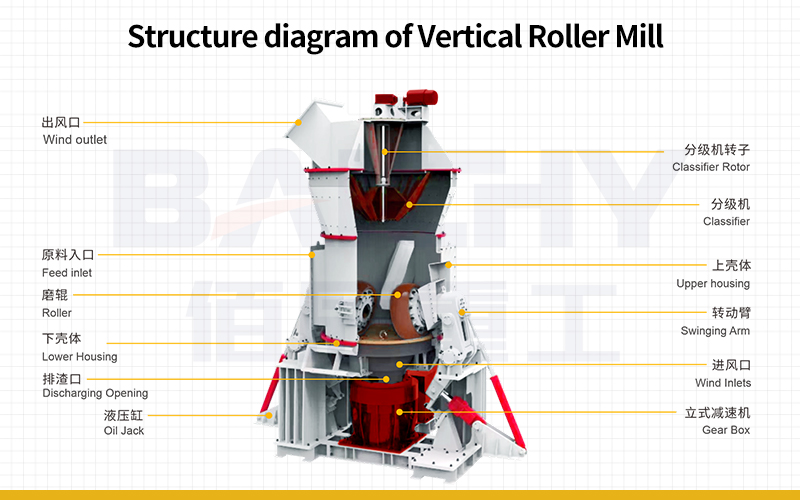
Structure diagram of Vertical Roller Mill
1. Core Grinding Mechanism
The equipment consists of a grinding table located at the bottom and grinding rollers positioned above it:
• Grinding Table: Driven to rotate by a motor via a reducer; the table surface features high-chromium cast iron liners (compliant with the ISO 21988 abrasion resistance standard).
• Grinding Rollers: Fixed to the machine frame via rocker arms, with pressure supplied by a hydraulic station.
• Key Distinction: During operation, the grinding rollers and the grinding table are separated by a layer of material (avoiding direct contact); material is crushed through a combination of shearing and compression, significantly reducing metal wear.
2. Process Flow Advantages
• Simultaneous Grinding and Drying: Hot air at temperatures up to 350°C can be introduced into the mill; the moisture content of the feed material is permitted to be as high as 15%, while the moisture content of the finished product can be controlled to below 1%.
• Dynamic Classification: The top-mounted classifier utilizes variable frequency speed control to precisely regulate the fineness of the finished product within the range of 70–325 mesh (45–212 μm).
3. Application Scenarios: Covering the Full Spectrum of Materials—From Wet Sludge to Hard Rock
VRMs have been successfully applied to a wide variety of materials, including cement raw meal, blast furnace slag, and iron ore. They possess particularly indispensable advantages when processing high-moisture waste residues.
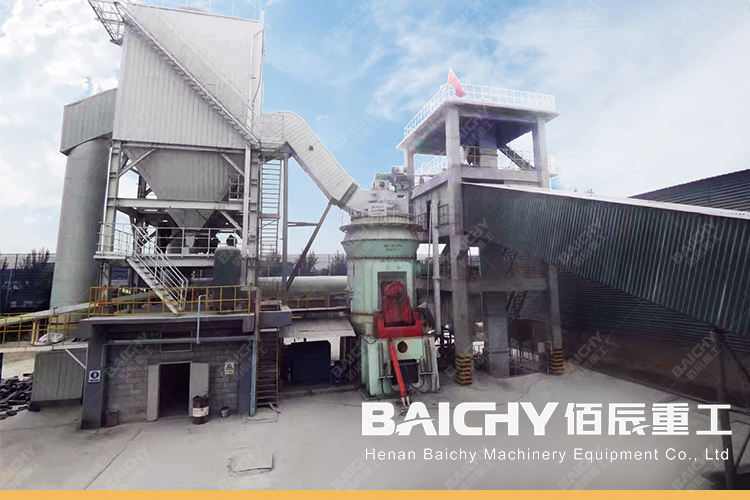
Vertical Roller Mill Grinding Site
1. Cement Industry: Resource Utilization of Waste Residues
• Application Scenario: A cement plant utilizes a VRM to process blast furnace slag with a moisture content of 12%.
• Technical Performance: No pre-drying is required; the material is fed directly into the mill. The finished product achieves a specific surface area of ≥ 420 m²/kg, fully meeting the standards for Grade S95 slag powder (GB/T 18046-2017).
2. Metallurgy & Mining: Hard Rock Crushing and Protection
• Application Scenario: An iron ore beneficiation plant processes raw ore with a particle size of ≤ 38 mm.
• Technical Performance: The hydraulic system features an "iron protection" function; upon encountering foreign objects, the rollers automatically lift to prevent damage to core components.
3. Chemicals & Building Materials: Fine Classification
• Application Scenario: Pulverizing heavy calcium carbonate (calcite).
• Technical Performance: By adjusting the classifier speed, a concentrated product particle size distribution is achieved (D97 = 45 μm). The product exhibits excellent flowability, making it highly suitable as a filler for high-end coatings.
IV. Technical Parameter Table for Model Selection
Within a production capacity range of 10 to 120 t/h, the motor power configuration of the Vertical Roller Mill (VRM)—ranging from 185 to 1000 kW—demonstrates significant superiority over ball mills of equivalent capacity.
| Technical Parameter | Specification Range | Remarks |
| Max. Feed Particle Size | ≤ 38 mm | Requires pre-processing with a jaw crusher |
| Product Fineness | 45 – 212 μm (70–325 Mesh) | Adjustable |
| Single-Unit Capacity | 10 – 120 t/h | Varies based on material grindability |
| Motor Power | 185 – 1000 kW | Saves over 40% electricity compared to ball mills |
| Feed Moisture Content | ≤ 15% | Product Moisture Content ≤ 1% |
Frequently Asked Questions (FAQ)
1. What are the biggest advantages of the Vertical Roller Mill (VRM) compared to a ball mill?
A: The most fundamental advantages lie in energy efficiency and footprint. The specific grinding power consumption of a VRM is 40–50% lower than that of a ball mill, and its footprint is only 50–60% of that required by a ball mill system. Furthermore, it is capable of processing materials with higher moisture content.
2. Can the VRM directly process wet slag?
A: Yes. This is a key strength of the VRM. Hot air—reaching temperatures of up to 350°C—can be introduced into the grinding chamber. For materials with a feed moisture content as high as 15% (such as blast furnace slag or wet clay), the drying process can be completed simultaneously with grinding, reducing the final product moisture content to below 1%.
3. Will the equipment be damaged if a piece of iron enters the grinding chamber?
A: No. The VRM is equipped with a hydraulic buffering protection system. When an uncrushable foreign object (such as a piece of iron) enters the grinding chamber, the hydraulic system automatically releases pressure, causing the grinding rollers to lift. The foreign object then falls to the bottom of the chamber and is discharged, thereby protecting the grinding rollers and grinding table from damage.
4. Is the fineness of the finished product adjustable? What is the adjustable range?
A: Yes, it is adjustable. By regulating the rotor speed of the classifier located at the top of the mill, the fineness of the finished product can be precisely controlled within the range of 70 to 325 mesh (i.e., 212 μm to 45 μm).
5. Is this equipment suitable for my existing plant retrofit project?
A: It is highly suitable. Given its compact structure and capability for open-air installation, the VRM (Vertical Roller Mill) is frequently utilized in the capacity replacement and energy-saving retrofitting of aging production lines. This allows for the maximum utilization of the existing site while minimizing civil engineering investment.
Authoritative Reference Standards:
• Standard for Wear-Resistant Materials: ISO 21988:2006
• Emission Standard of Air Pollutants for the Cement Industry: GB 4915-2013
• Ground Granulated Blast Furnace Slag Used in Cement and Concrete: GB/T 18046-2017
• Engineering Design Code: GB 50455-2008 — Code for Design of Waste Heat Power Generation in Cement Plants (specifically regarding the utilization of hot air)
Note: The data presented herein is based on tests conducted on standard models manufactured by Baichy Heavy Industry. Actual operating parameters may be subject to slight adjustments depending on specific material characteristics and operating conditions.