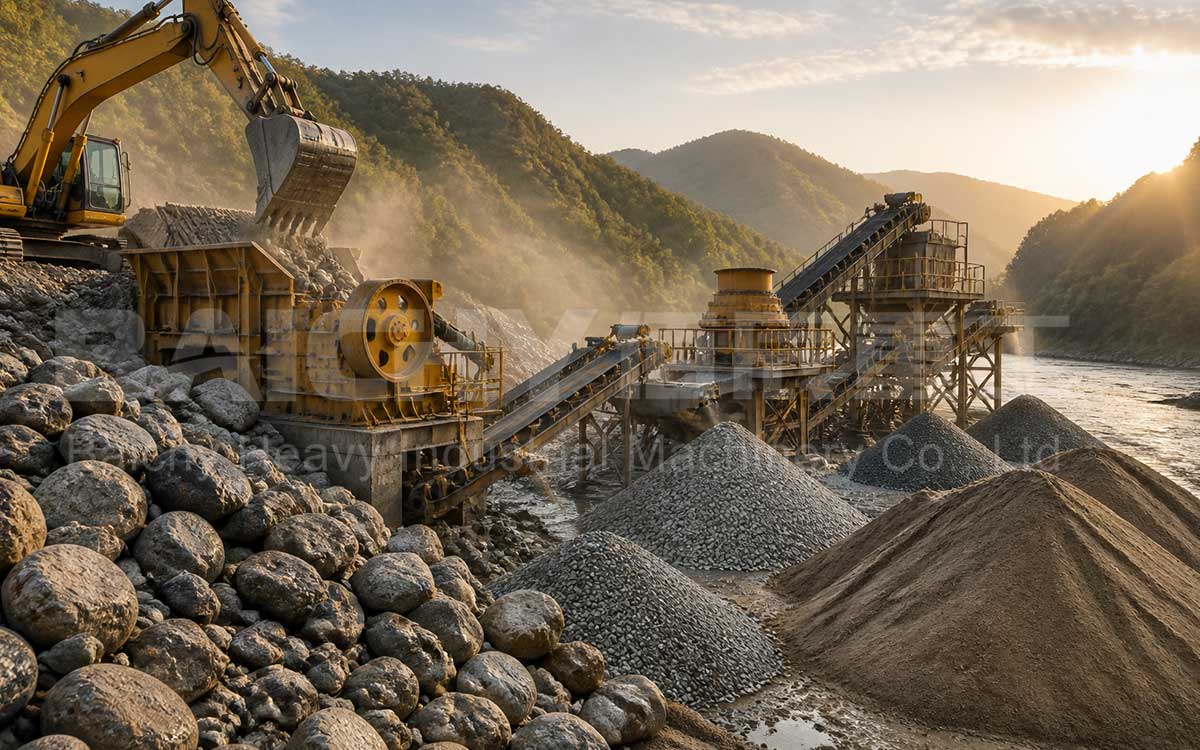
River Pebble Crusher Selection Guide
River pebbles (cobblestones) command one of the highest market prices among natural raw materials for aggregates, yet they are also among the most abrasive—featuring an SiO₂ content of 65%–75%, a Mohs hardness of 7–8, and a compressive strength of 200–300 MPa. There is only one straightforward path for equipment selection: use a jaw crusher (PE series) for primary crushing and a cone crusher for secondary crushing; for the sand-making stage, choose between a double-roll crusher and a VSI crusher based on your budget. Using impact crushers or hammer crushers for river pebbles is a classic "cheap to buy, expensive to operate" trap, as blow bars and hammer heads typically wear out after just 200–500 hours of use.
Keep these three hard rules in mind before proceeding:
1. Primary crushing: Choose only a jaw crusher — Compression crushing is non-selective regarding material properties; manganese steel jaw plates last 1,500–3,000 hours when processing river pebbles, and the equipment features a simple structure with minimal maintenance requirements.
2. Secondary crushing: Choose only a cone crusher — Field data from a river stone project in the Philippines showed that blow bars on a PF1007 impact crusher failed after 280 hours, whereas the liners on a replacement PYB900 cone crusher lasted over 1,200 hours—a more than fourfold difference in service life.
3. Capacity calculation: Apply a 0.70–0.80 conversion factor — Nominal capacities for all models are based on limestone (bulk density of 1.6 t/m³); actual capacity for river pebbles must be adjusted using this factor, followed by the addition of a 15–25% design margin—otherwise, the plant will face a production shortfall immediately upon commissioning.
I. Basic Material Parameters: Understanding the Material to Be Crushed
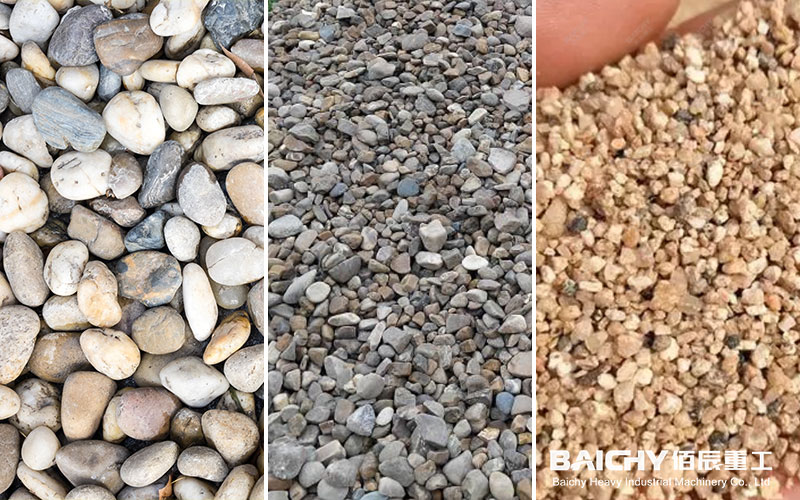
river stone crushing
1.1 Five Key Parameters of River Pebbles
• SiO₂ content: 65%–75% — Highly abrasive; directly determines the choice of secondary crusher model and wear-part materials.
• Mohs hardness: 7–8 — Comparable to quartz; wear rates on impact-type equipment increase exponentially.
• Compressive strength: 200–300 MPa — Exceeds the economic crushing limit for impact crushers; approaches the level of basalt.
• Bulk density: 1.6–1.7 t/m³ — Close to the nominal capacity baseline (1.6), but hardness-based adjustments cannot be omitted.
• Moisture content (as-mined): 5%–15% — Affects screening efficiency and causes conveyor belt slippage; requires dewatering and spraying systems.
1.2 Capacity Conversion Factors (River Pebbles ≠ Limestone)
• Limestone (80–140 MPa): Factor 1.00 (nominal capacity baseline); longest wear-part lifespan.
• River pebbles (200–300 MPa): Factor 0.70–0.80; wear-part lifespan is relatively short.
• Granite (140–250 MPa): Factor 0.75–0.85; wear-part lifespan is moderate.
• Basalt (180–300 MPa): Factor 0.70–0.80; wear-part lifespan is relatively short.
A crusher with a nominal capacity of 100 t/h will yield an actual stable capacity of only 70–80 t/h when processing river pebbles. When selecting equipment, calculate the required nominal capacity by piding the target output by 0.75–0.85: for a target output of 60 t/h of finished river pebble product, select a model with a nominal capacity of approximately 94 t/h.
II. Comparison of Options: Four Machine Types, Three Operating Conditions
2.1 Primary Crushing Stage: Jaw Crusher is the Only Optimal Solution
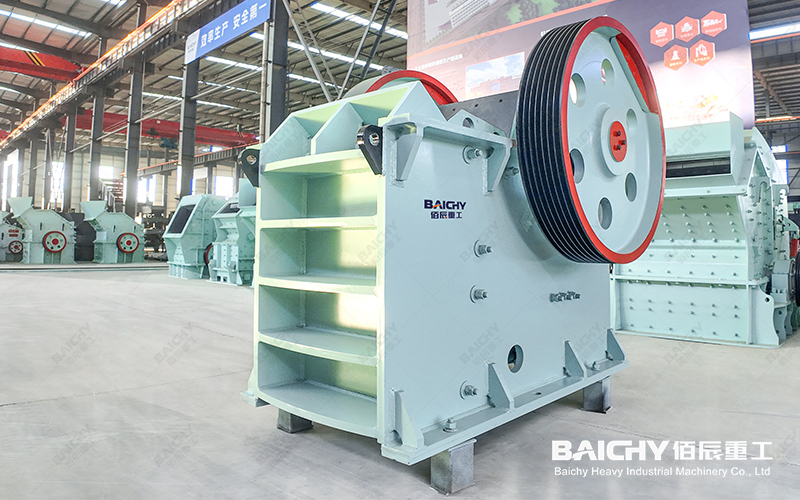
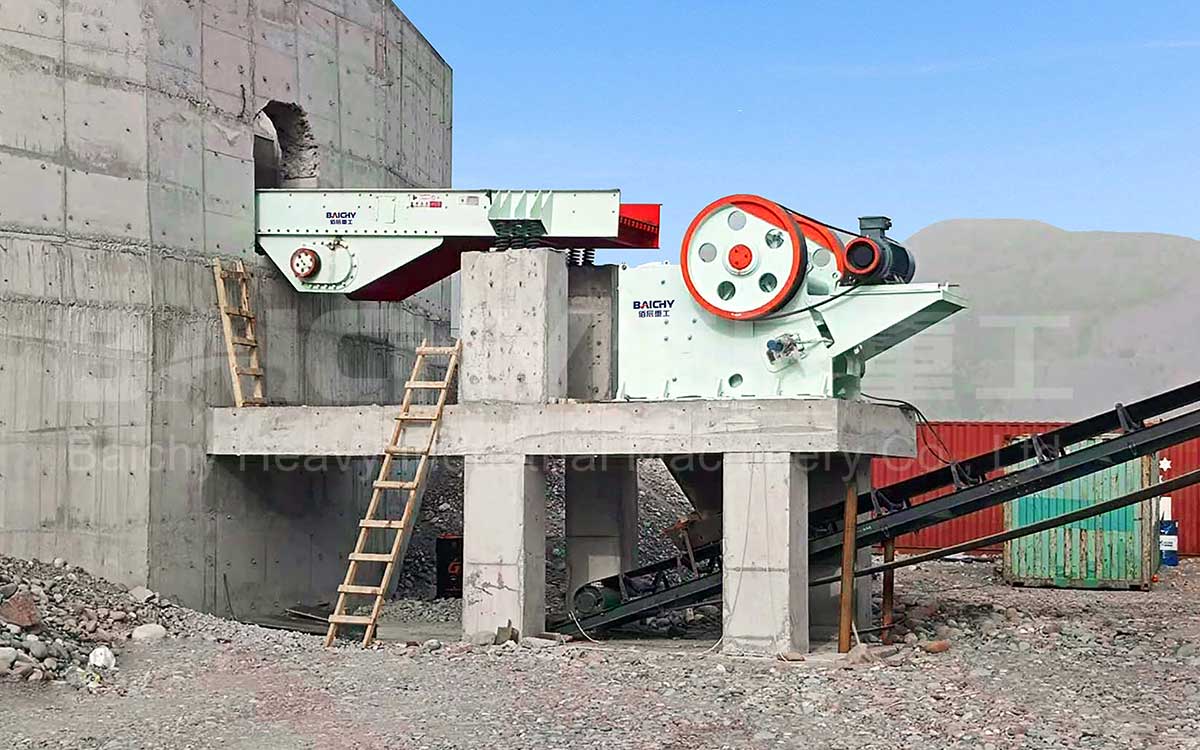
Primary Jaw Crusher
• Compound Pendulum Jaw Crusher (PE) — ✅ Preferred choice: Uses compression crushing; non-selective regarding material type; max feed size is 80–85% of the feed opening's short side; crushing ratio 4–6:1.
• Gyratory Crusher — ⚠️ Economical only for large-scale mines: Suitable for river stone; handles very large feed sizes; crushing ratio 6–8:1.
• Impact Crusher (Primary) — ❌ Not recommended: Blow bar wear is excessive; feed size typically ≤500mm.
Selection Tip: Max lump size &pide; 0.85 = Required short side of feed opening. Max lump size 500mm → Short side ≥ 590mm → Select PE-600×900 or larger. Refer to the Jaw Crusher Selection Guide for details.
2.2 Secondary Crushing: Cone Crusher vs. Impact Crusher vs. Hammer Crusher (The most critical section of this guide)
• Cone Crusher (PYB/CS/HP) — ✅ The only correct choice: Inter-particle (lamination) crushing; manganese steel liners last 800–1,500 hours; produces good particle shape; capable of closed-circuit output of ≤19mm.
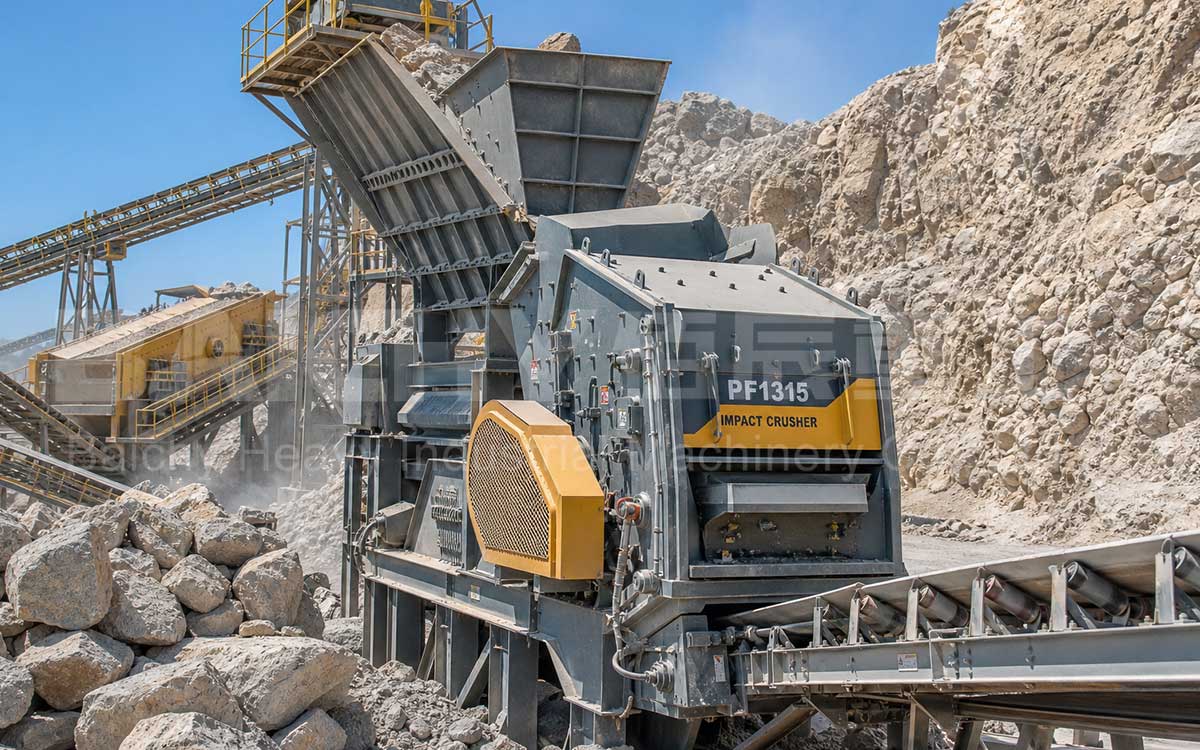
• Impact Crusher (PF) — ❌ Prohibitive wear costs: Impact crushing; blow bars last 200–400 hours; best particle shape but unsuitable for river stone applications.
• Hammer Crusher (PC/PCH) — ❌ Suitable only for soft, brittle materials: Impact + grinding action; hammer heads last 300–500 hours.
Field Data (Philippines River Stone Project): When using a PF1007 impact crusher for river stone, blow bar lifespan was only 280 hours, requiring 2–3 shutdowns per month for replacement; after switching to a PYB900 cone crusher, liner lifespan exceeded 1,200 hours, and annual replacement frequency dropped from over 10 times to 2–3 times. Why impact crushers fail prematurely when processing river stone: Impact crushers rely on rotor kinetic energy to hurl material against blow bars and impact plates. The blow bars strike siliceous pebbles (Mohs hardness 7–8) directly at linear speeds of 40–80 m/s; the wear mechanism is "hard-on-hard" cutting, meaning no equipment can achieve a long service life under these conditions. In contrast, cone crushers crush material via inter-particle compression (layer crushing) against the liners, utilizing a "rock-on-rock" buffering effect; their service life is an order of magnitude longer.
2.3 Sand-making stage (0–5mm finished product): Double-roll crusher vs. VSI
• Double-roll crusher (2PG): Uses compression crushing; wear is controllable and costs are low-to-moderate; suitable for budget-sensitive production lines with low sand-to-aggregate ratio requirements.
• VSI sand maker: Uses the "rock-on-rock" principle and produces superior particle shapes; however, liners and throwing tips wear out quickly with river stone, resulting in high wear costs; suitable for high-grade concrete sand or scenarios where particle shape commands a premium price.
Recommendation: For lines requiring a sand-to-aggregate ratio (sand:crushed stone) of ≤1:2, a secondary closed-circuit cone crusher followed by a fine-crushing cone crusher can naturally produce sufficient sand without needing an additional sand-making machine; introduce a VSI or double-roll crusher as a third stage only if the ratio is ≥1:1 or if the customer has strict particle shape requirements.
2.4 Layout configuration: Fixed line vs. Mobile station
Fixed crushing line: Suitable for sites with stable mining rights and fixed quarry locations; requires concrete foundations (1–2 months to build); relocation involves disassembly and hoisting, taking weeks; lower cost per ton (due to high equipment utilization); powered by the fixed grid or plant distribution system.
Mobile crushing station (YDPZ): Suitable for sites involving rotational mining across multiple pits or frequent relocation between job sites; requires no foundation and is ready for immediate operation upon arrival; relocation via towing takes 1–2 days; slightly higher cost per ton, but saves on foundation and relocation expenses; can be equipped with diesel generator sets and supports 380V/400V/440V/60Hz power standards.
Selection Criteria: Stable operation at the same site for over 3 years → Fixed plant; quarry changes every 1–2 years or requires bidding across multiple sites → Mobile station. For a reference case, please consult the documentation on the Venezuela river stone mobile crushing line.
III. Recommended Solutions: Model Selection Based on Production Capacity
The following recommendations are based on river stone processing conditions (using a 0.75 conversion factor and a 15–25% safety margin); nominal capacities are based on limestone standards:
| Target Output (River Stone) | Primary Crushing (Jaw Crusher) | Secondary Crushing (Cone Crusher) | Sand Making (Optional) | Typical Configuration |
| ≤50 t/h | PE400×600 | PYB900 | - | Fixed plant or YDPZ mobile station |
| 50–100 t/h | PE500×750 | CS75 / CS110 | 2PG Double-roll crusher | Fixed plant or mobile station |
| 100–200 t/h | PE600×900 | CS160 / HP200 | VSI-9526 | Fixed plant (Recommended) |
| >200 t/h | PE750×1060 or larger | HP300 class | Dual VSI units | Large-scale fixed line; requires specialized design. |
Note: "Target Output" in the table refers to the stable finished product output after adjusting for river stone characteristics. Example: If you require 60 t/h of finished river stone, select equipment from the 100–200 t/h category (PE600×900 + CS110 class) rather than the PE500×750 model from the 50–100 t/h category.
4.1 3-Year TCO Comparison: Cone Crusher vs. Impact Crusher (Example: 50–80 t/h River Stone Line)
Calculation Basis: 3,000 operating hours per year (10 hours/day × 300 days); finished product output calculated at 60 t/h.
| Cost Item | PF1214 Impact Crusher | PYB900 Cone Crusher |
| Wear part lifespan (river stone field test) | 280 hours/set | 1,200+ hours/set |
| Annual replacement frequency | ~11 sets | ~2.5 sets |
| Unit price of wear parts (estimated) | $5,000–$6,000/set | $8,000–$10,000/set |
| Annual wear part cost | $55,000–$66,000 | $20,000–$25,000 |
| Annual downtime (replacement + commissioning) | ~110 hours | ~20 hours |
| Downtime loss (based on assumed $8/t gross profit) | ~$52,800 | ~$9,600 |
| 3-year total cost difference | Over $150,000 in additional expense | - |
Unit prices and gross profit figures are industry estimates and assumptions provided for order-of-magnitude reference; actual costs depend on local procurement prices. The core conclusion remains unchanged: when processing river stone, the cone crusher’s total 3-year cost is $150,000–$250,000 lower than that of the impact crusher (calculated based on the annual difference of $78k–$84k shown above × 3 years), and production output is more stable. V. Auxiliary Equipment Recommendations: Don't Let Ancillary Gear Drag Down the Main Unit
• Feeding — Vibrating Grizzly Feeder: Pre-screens natural sand/fines to reduce useless material entering the crushing chamber; boosts jaw crusher capacity by 10–15%.
• Screening — 2–3 Deck Circular Vibrating Screen: Grades material into 0–5mm, 5–19mm, and >19mm fractions; material >19mm is returned to the cone crusher in a closed-loop circuit.
• Sand Washing — Spiral or Wheel-type (XSD) Sand Washer: Dredged river stones often contain mud; finished products exceeding mud content limits will be rejected by concrete batching plants.
• Dust Control — Spray System + Sealed Chutes: Ensures compliance with local environmental inspections; dust suppression also extends equipment lifespan.
• Power — Electric vs. Diesel (Based on Grid Stability): In areas with grid fluctuations exceeding ±15%, prioritize diesel generator sets or dual-power (diesel-electric) systems.
VI. Risk Warnings: Four "Hidden" Pitfalls
1. Moisture Content Trap: Freshly dredged river stones have 5–15% moisture, causing screening efficiency to plummet and fines to clump. The process design must include a dewatering stage; during the rainy season, capacity estimates should be further discounted by a factor of 0.85.
2. Oversized Material Issues: Uneven feeding by upstream loaders/excavators allows oversized rocks to enter the crushing chamber directly, causing jams or shaft breakage. A grizzly feeder or grizzly screen is mandatory.
3. Weathered Stone Contamination: Mixing surface-layer weathered stones (strength <100 MPa) with hard river stones disrupts capacity ratings and particle shape consistency; separate stockpiling and crushing are recommended.
4. Inflated "Nominal Capacity": Some manufacturers quote figures based on limestone or even "peak instantaneous capacity." Before signing a contract, specify the reference material for conversion and include acceptance clauses based on continuous, stable operating capacity.
VII. FAQ
Q1: Can an impact crusher be used for river pebbles?
It cannot serve as the primary secondary crushing unit. Impact crusher blow bars typically wear out after 200–400 hours when processing river stone; actual performance on a project in the Philippines showed a lifespan of only 280 hours, requiring replacement more than ten times a year—resulting in downtime losses that exceeded the price difference of the equipment itself. For the secondary crushing stage of river stone, only cone crushers are economically viable.
Q2: Should a VSI or a double-roll crusher be used for pebble sand making?
If there are high requirements for the sand-to-stone ratio and particle shape (e.g., for high-grade concrete) → VSI; if the budget is tight and the sand-to-stone ratio is ≤1:2 → double-roll crusher or a closed-circuit cone crushing setup for natural sand generation. VSIs incur high wear costs with river stone, so OPEX must be factored into the decision.
Q3: Why does actual production capacity often fall short of the nominal rating?
Nominal capacity is based on limestone (density: 1.6 t/m³). River pebbles have a compressive strength of 200–300 MPa, requiring a conversion factor of 0.70–0.80; accounting for feed fluctuations and maintenance downtime, equipment selection should be calculated by piding the target output by 0.75 and then by 0.85.
Q4: How do I choose between a stationary line and a mobile station?
Choose a stationary line for stable extraction at a single site for over three years (lower cost per ton); choose a mobile station for rotating quarry sites or bidding across multiple locations (no foundation required, immediate startup upon arrival, and relocation takes only 1–2 days). Mobile stations have a slightly higher cost per ton but eliminate foundation construction and relocation expenses.
Q5: Electric or diesel power?
It depends on grid stability. In regions with voltage fluctuations exceeding ±15% or frequent power rationing (e.g., Venezuela), diesel units are a necessity rather than an option; where the grid is stable, electric operation offers lower costs.
Q6: Does a river pebble production line require a sand washer?
Yes. River stone extraction involves clay/silt content; if the finished product exceeds clay limits, concrete mixing plants will reject it. A spiral sand washer or wheel-bucket sand washer (XSD) is recommended, as these can also perform dewatering.
Q7: What discharge size from the jaw crusher is suitable for feeding the cone crusher?
The feed size for cone crushers typically ranges from ≤75 mm to 200 mm (depending on the model). The discharge opening of the jaw crusher must be set in coordination with the feed requirements of the secondary crushing stage; a mismatch here is a common bottleneck in production line design—no matter how high the primary crushing capacity is, it is wasted if the secondary stage cannot handle the output.
Q8: How often should wear parts be replaced?
For river stone applications: jaw plates last 1,500–3,000 hours; cone crusher liners last 800–1,500 hours (replace when wear prevents further adjustment of the discharge opening); and VSI thrower tips/liners last 300–800 hours, depending on the model. It is recommended to purchase a spare set of wear parts at the same time to avoid downtime while waiting for replacements.