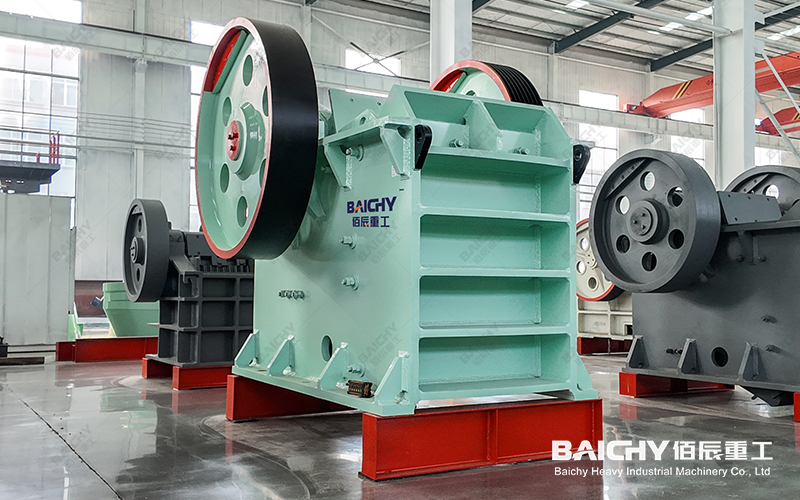
Jaw Crusher
Conclusion first: A jaw crusher crushes rock by compressing it between two angled plates — one fixed, one oscillating — in a wedge-shaped chamber that narrows toward the discharge. That single mechanical idea, repeated 2–4 times per second, is what turns 500 mm boulders into 50–100 mm feed for the next crushing stage. If you understand this principle, you can predict a crusher's capacity, its wear cost, and the exact model your plant needs — without relying on a sales pitch.
1. What Is a Jaw Crusher?
A jaw crusher is a primary (coarse) crushing machine that reduces large rocks — typically 300–1000 mm feed — to a size suitable for downstream processing. It is the workhorse of hard-rock circuits: granite, basalt, river pebble, iron ore, gold ore. Typical reduction ratio: 4:1 to 6:1 (feed size &pide; discharge size).
Core components:
| Part | Role |
| Fixed jaw plate | Stationary crushing surface, bolted to the frame |
| Moving jaw plate | Oscillating surface that does the crushing work |
| Eccentric shaft + flywheel | Converts motor rotation into reciprocating motion; flywheel stores kinetic energy |
| Toggle plate | Transmits thrust to the frame; engineered weak point for overload protection |
| Discharge opening | Width-adjustable; sets the maximum product size |
2. How Does a Jaw Crusher Work? The 3-Stage Cycle
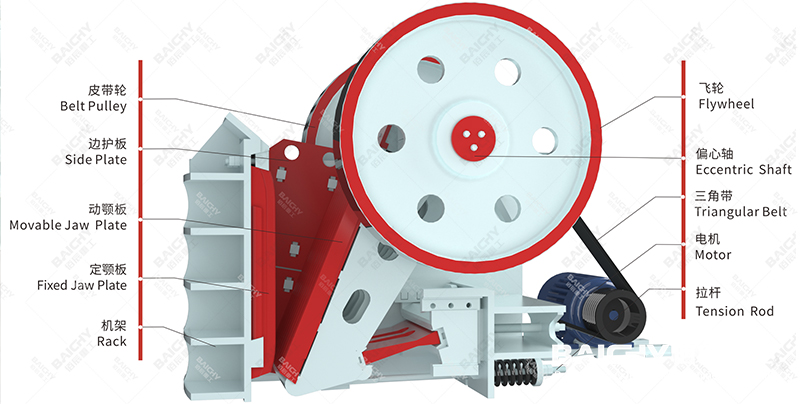
Structural Diagram of PE Jaw Crusher
Each crushing cycle has two strokes:
Stroke 1 — Crushing (closing stroke). The motor drives the eccentric shaft via V-belts. As the shaft rotates, the top of the moving jaw travels in a small orbit while the bottom swings on the toggle plate pivot. The moving jaw closes against the fixed jaw, and the material between them is crushed by compression — the dominant breakage mechanism for hard rock.
Stroke 2 — Discharge (opening stroke). The jaw retreats. Crushed material falls under gravity into the narrower zone below, and new feed enters from the top. The cycle repeats at roughly 250–350 rpm (small models up to ~400 rpm), producing continuous discharge.
Why the chamber is wedge-shaped: the gap is widest at the feed opening and narrowest at the discharge. Material therefore experiences progressive crushing — large blocks fracture in the upper chamber, then smaller fragments continue down. Nothing can exit until it is smaller than the discharge setting, which is why product top size is hard-controlled by the CSS.
Design variant: single-toggle (the global mainstream for 95%+ of PE-series units) — the moving jaw is suspended directly from the eccentric shaft, giving an elliptical motion: aggressive at the top, strong horizontal squeeze at the bottom. Double-toggle — the jaw pivots on a fixed hinge and moves in a pure vertical arc; higher force, lower throughput, used mainly for very hard, abrasive rock at small settings.
3. What the Principle Means for Your Bottom Line
Every mechanical feature translates into money. Buyers who read only the spec sheet miss these:
• Flywheel energy storage → the jaw draws less current on the idle stroke; on a 75 kW motor this typically cuts specific electricity cost by 8–12% vs. designs without proper flywheel sizing — measurable savings on a 3-shift operation.
• Adjustable CSS → discharge size directly controls the load on your secondary crusher. Opening the CSS by 10–15 mm can lift primary throughput 10–20%, at the cost of coarser secondary feed — a trade-off you can tune to your circuit.
• Toggle plate overload protection → if uncrushable steel enters the chamber, the toggle plate breaks first. Replacement cost is a fraction of a cracked frame or damaged eccentric shaft; more importantly, downtime is hours, not weeks.
• Wear cost is predictable — jaw plates are the only major consumable. In abrasive granite, liner life is typically 3–6 months at 10–12 h/day; this is the single largest OPEX line after electricity, and it scales with feed size and silica content, not with machine age.
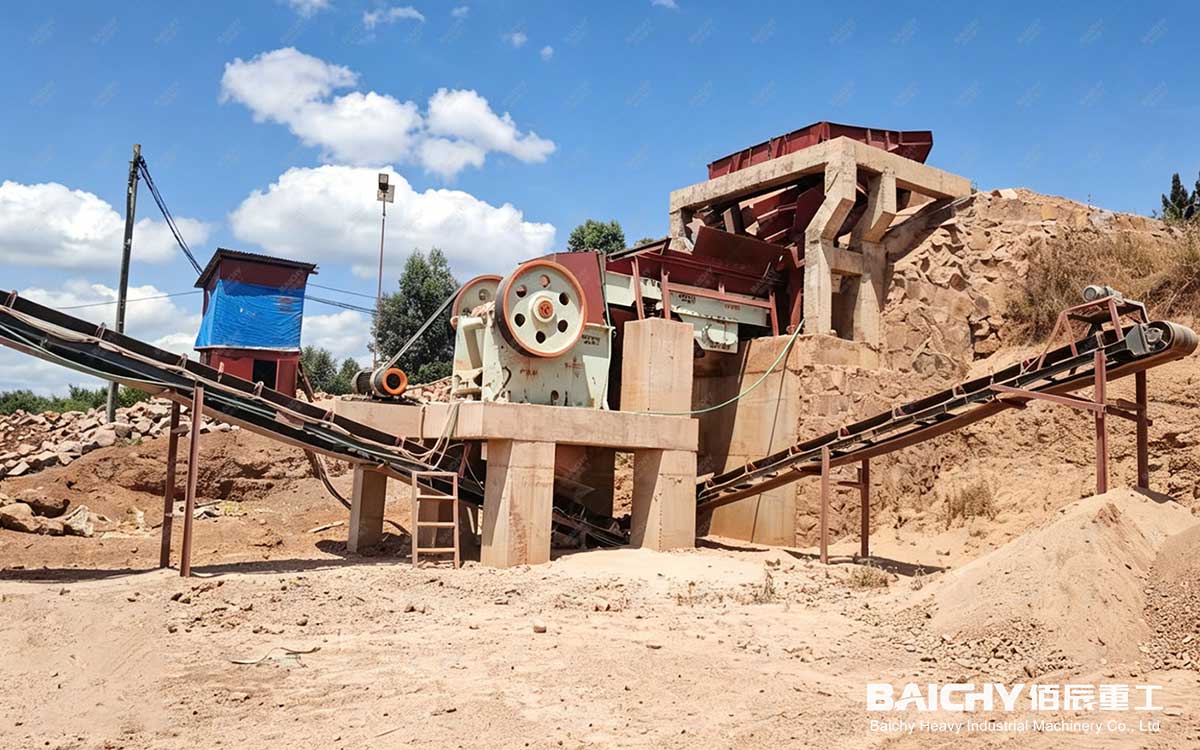
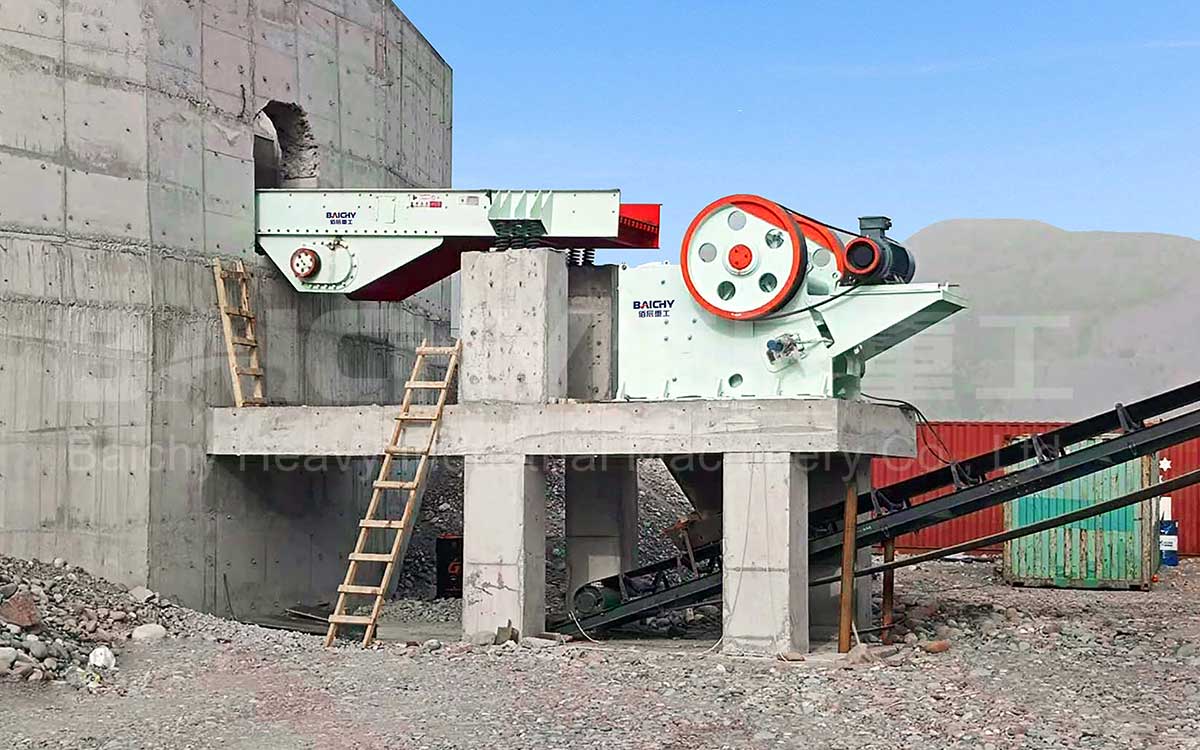
Customer site of a jaw crusher production line in Rwanda
4. Reading Specs Correctly
Capacity figures are quoted for medium-hard limestone at a bulk density of ≈1.6 t/m³. Real output varies with material:
| Material | Density factor vs. limestone |
| Granite / basalt (2.6–2.8 t/m³) | ×0.80–0.90 |
| Iron ore (2.5–3.5 t/m³) | ×0.75–0.85 |
| River pebble | ×0.85–0.95 |
| Coke / coal (0.4–0.6 t/m³) | ×0.45–0.55 |
Typical parameter ranges (verify against the manufacturer's nameplate — these are industry norms, not Baichy-specific values):
| Model example | Feed opening | Max feed size | CSS range | Capacity* | Motor |
| PE-400×600 | 400×600 mm | ~350 mm | 40–100 mm | 16–60 t/h | 30 kW |
| PE-500×750 | 500×750 mm | ~425 mm | 50–100 mm | 40–110 t/h | 55 kW |
| PE-600×900 | 600×900 mm | ~500 mm | 65–160 mm | 60–180 t/h | 75 kW |
* At 1.6 t/m³ limestone basis. For your material, multiply by the factor above — a granite "90 t/h" machine realistically delivers 72–81 t/h. Always size for the downstream stage, not the brochure.
5. Selection Pitfalls
Don't buy on feed opening alone — the real limits are max feed size (a cube check: the largest block must pass the opening) and the CSS you actually need for your secondary crusher's feed requirement.
1. Match CSS to the next machine. A cone crusher typically wants 0–200 mm feed; a secondary impact crusher wants 0–120 mm. Setting your jaw's CSS wrong either starves the secondary (under-use) or chokes it (over-load).
2. Ask about jaw plate alloy. Manganese steel (Mn13–Mn18) is standard; high-chromium or composite plates double liner life in silica-rich rock. Price per ton of crushed rock, not per plate.
3. Check power-standard compatibility. For 60 Hz markets (Americas, parts of the Middle East) or 400 V / 380 V / 440 V grids, motor and V-belt drive must match local supply — a mismatch means derating or a full re-motor cost at installation.
6. FAQ
Q1: What is the working principle of a jaw crusher?
A: Compression. A moving jaw plate oscillates against a fixed jaw plate, squeezing rock in a wedge-shaped chamber until fragments fall through the adjustable discharge opening. The cycle runs at 250–400 rpm, producing continuous primary crushed product.
Q2: Single-toggle vs double-toggle — which is better?
A: Single-toggle is the mainstream choice: higher throughput, lighter frame, simpler maintenance, elliptical crushing motion. Double-toggle delivers higher peak force and a more uniform stroke for extremely hard, abrasive rock, but at lower capacity and higher cost per ton. For 95% of aggregate and ore plants, single-toggle wins.
Q3: What is the reduction ratio of a jaw crusher?
A: Typically 4:1 to 6:1. This means a 500 mm feed produces 80–125 mm product at a 5:1 ratio. One jaw crusher cannot do the work of a two-stage circuit; it is a primary machine by design.
Q4: How do I choose the right jaw crusher model?
A: Define three numbers first: maximum feed block size (→ opening size), target throughput in t/h (→ capacity, corrected for your material density), and the CSS your secondary crusher needs (→ discharge range). Then match motor power to your local grid standard.
Q5: What determines jaw crusher output size?
A: The closed-side setting (CSS) — the narrowest gap between the jaw plates at the discharge. Widening the CSS increases capacity and product top size; narrowing it does the reverse. CSS is adjustable from the outside on most models, usually by shims or a hydraulic wedge.