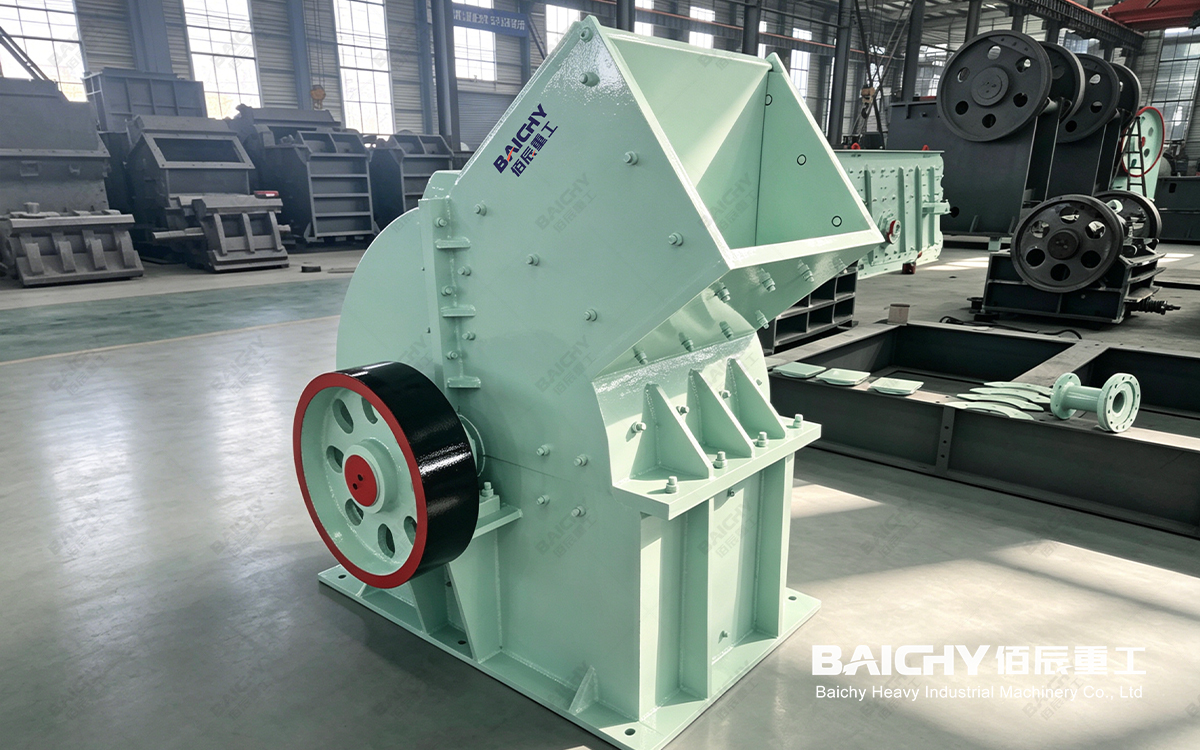
Hammer Crusher
For medium-hard, brittle materials—such as limestone, coal, coal gangue, gypsum, shale, salt bricks/tiles, and oxidized gold ore—the PC series hammer crusher offers the most direct route to "replacing two-stage crushing with a single machine." It handles feed sizes up to 400mm and produces output ≤15mm (via adjustable grate bars), accomplishing in one stage what traditionally required a combination of a jaw crusher and an impact crusher. This saves 40–60% on primary equipment investment and offers the fastest return on investment for production lines with capacities of 5–80 t/h. The series comprises four models ranging from 5–80 t/h and 11–110kW; the lightest unit weighs just 0.8 tons (PC400×300) and can be shipped via standard wooden crate to any inland job site. Hammer heads come standard with high-chromium manganese steel (Mn13Cr2), offering a lifespan of 300–500 hours when processing limestone; wear-part costs are kept to $0.03–0.08 per ton of material—roughly half the cost of impact crusher blow bars.
I. Pain Point Analysis: Three Common Sources of Unnecessary Expense in Medium-Soft Rock Production Lines
In the global market for aggregates and building materials, the processing volume of medium-hard materials like limestone, coal, and gypsum runs into the billions of tons (USGS 2025 data shows global annual limestone production exceeding 4 billion tons). Yet, many small-to-medium production lines still rely on the standard two-stage crushing setup—jaw crusher for primary crushing followed by impact crusher for secondary/fine crushing—incurring three additional costs:
Pain Point 1: Buying an extra machine means paying for an extra system
Jaw crushers typically output material sized 50–120mm; to obtain fine material ≤15mm, traditional setups require the addition of an impact crusher or fine crusher. This entails: a second main machine ($25,000–40,000), a second feed conveyor, a second motor and electrical distribution system, and a larger equipment footprint. When processing soft rock (such as limestone with a Mohs hardness of 3–4), these two stages of operation can be consolidated into a single process using a high-reduction-ratio hammer crusher.
Pain Point 2: The cost per ton for impact crusher blow bars is double that of hammer crusher hammers.
For impact crusher blow bars (made of high-chromium cast iron) used in limestone fine crushing, the service life of a single set is approximately 150–250 hours, with a wear-part cost of 0.06–0.12 per ton. In contrast, PC series hammers offer a service life of 300–500 hours per set, with a cost of 0.03–0.08 per ton. For an annual throughput of 200,000 tons of limestone, the difference in wear-part costs amounts to $6,000–8,000.
Pain Point 3: Uncontrollable discharge size and capacity loss due to screening returns.
Equipment with fixed crushing chambers produces a fixed particle size distribution; the production line relies on vibrating screens for separation, resulting in significant material recirculation (oversize material being returned repeatedly) and an effective capacity reduction of 30%. The PC series features adjustable bottom grate bar gaps, allowing the discharge size to be locked at ≤10mm, ≤15mm, or ≤20mm as required, thereby directly reducing the rate of material recirculation.
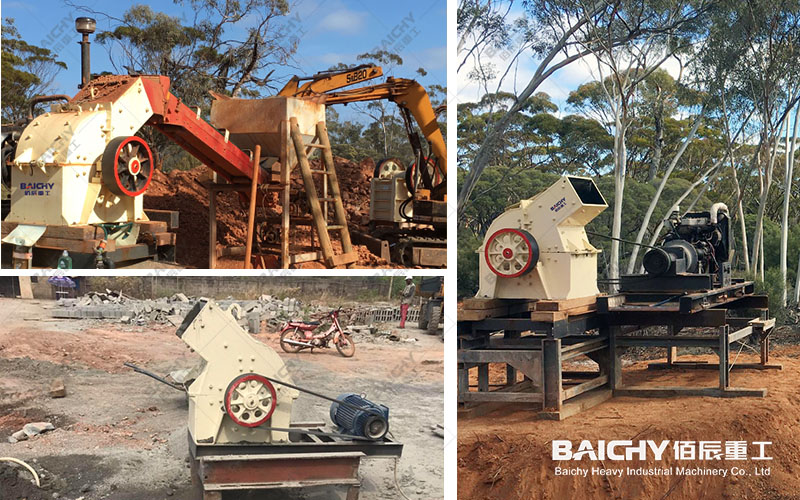
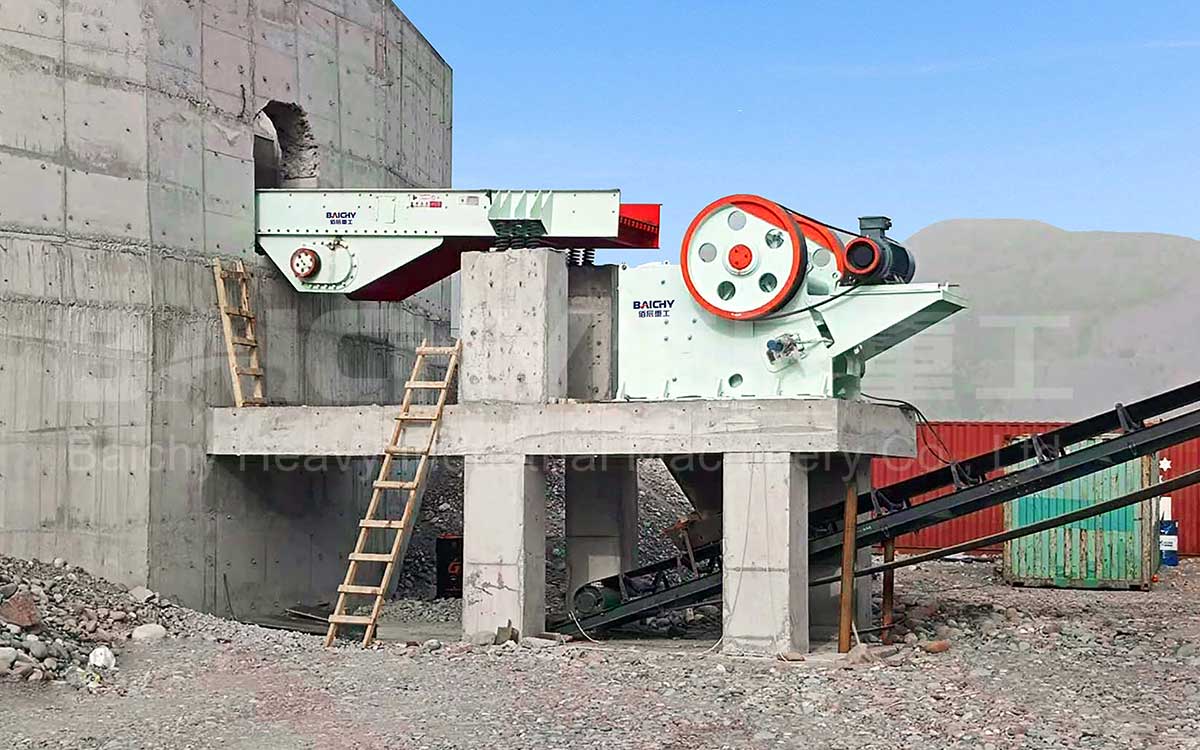
Hammer crusher customer site
II. Advantages of the PC Series Hammer Crusher
2.1 Single-stage crushing with a high reduction ratio → 40–60% savings on primary equipment investment.
Feed size ≤400mm (PC1000×800), discharge size ≤15mm; the reduction ratio can reach 25:1. For soft rock applications, replacing the "Jaw Crusher + Impact Crusher" setup with a single PC-series hammer crusher:
• Traditional Setup: PE400×600 Jaw Crusher + PF1007 Impact Crusher + intermediate conveying and power distribution ≈ $55,000+
• PC Setup: PC800×600 single unit (approx. $6,000) + direct discharge
Overall Savings: Primary equipment investment reduced by approx. 40–60%; power requirement reduced by approx. 80 kW. Based on a rate of $0.08/kWh and 3,000 operating hours per year, annual electricity costs are further reduced by approx. $19,000.
2.2 Adjustable Grate Bars → One machine covers three discharge scenarios
By swapping the bottom grate bars (screen plates), the same PC unit can be adapted for different production roles:
• φ10mm grate bars → Discharge ≤10mm: Feed for ball mills (e.g., gold ore, raw cement material)
• φ15mm grate bars → Discharge ≤15mm: Sand, gravel aggregates, and construction material feedstock (standard factory configuration)
• φ20mm grate bars → Discharge ≤20mm: Feed for wet gold grinding mills; coarse aggregates
Changing a set of grate bars takes only 15–20 minutes without needing to replace the entire machine—demonstrating the flexibility of "one machine serving multiple production lines."
III. Core Specifications: PC Series Hammer Crusher
Capacity figures are based on limestone (bulk density 1.6 t/m³); when processing coal (density 0.8–1.4 t/m³), capacity increases by a factor of approx. 1.1–1.3; when processing harder materials like dolomite, it is approx. 0.85–0.95 of the base capacity. The output particle size can be adjusted to ≤10 mm, ≤15 mm, or ≤20 mm by replacing the bottom grate bars.
| Model | Rotor Dimensions (mm) | Max. Feed Size (mm) | Output Size (mm) | Capacity (t/h) | Power (kW) |
| PC400×300 | φ400×300 | ≤100 | ≤15 (adjustable) | 5–10 | 11 |
| PC600×400 | φ600×400 | ≤220 | ≤15 (adjustable) | 10–25 | 22 |
| PC800×600 | φ800×600 | ≤350 | ≤15 (adjustable) | 20–40 | 55 |
| PC1000×800 | φ1000×800 | ≤400 | ≤15 (adjustable) | 25–80 | 110 |
Parameter Notes:
• Output Particle Size: Standard configuration is ≤15 mm; switching to ≤10 mm or ≤20 mm is achieved by replacing grate bars—no need to replace the machine, and reconfiguring the production line takes only 15–20 minutes.
• Capacity Adjustment: Table values are based on limestone. Capacity increases by 10–30% for lighter materials like coal and gypsum, and decreases by 5–15% for dolomite and hard limestone. When selecting a model, calculate the required capacity by piding the target output by the adjustment factor to ensure sufficient margin.
• Power Options: Models PC400×300 and PC600×400 can be driven by 25–40 kVA diesel generators (pulley systems support matching with diesel engine speeds of 1500–1800 rpm), making them fully suitable for mining sites without grid power.
IV. Selection Recommendations and Pitfall Avoidance
4.1 Quick Three-Step Selection Guide
Step 1—Check
Feed Size: For feed ≤100mm, choose PC400×300; ≤220mm, choose PC600×400; ≤350mm, choose PC800×600; ≤400mm, choose PC1000×800.
Step 2—Check Capacity (Based on Limestone):
5–10 t/h → PC400×300 (11kW, approx. $1,500)
10–25 t/h → PC600×400 (22kW, approx. $3,000)
20–40 t/h → PC800×600 (55kW, approx. $6,000)
25–80 t/h → PC1000×800 (110kW, approx. $10,000)
Step 3—Check Downstream Application:
Feeding a ball mill/powder mill → equip with φ10mm grate bars; producing sand/aggregate/construction raw materials → equip with φ15mm; feeding a gold grinding mill/coarse crushing needs → equip with φ20mm.
4.2 Four Common Selection Pitfalls
Pitfall 1: "Hammer crushers can serve as primary crushers for 500mm run-of-mine ore"
The PC series has a maximum feed size of 400mm and is suitable only for medium-to-fine crushing. Blasted or excavated raw ore (300–600mm) requires primary crushing using a jaw crusher or a PCZ heavy-duty hammer crusher first. If your ore size exceeds 400mm and you do not wish to use a jaw crusher, please choose the PCZ series (max. feed size 1200mm).
Pitfall 2: "Nominal capacity equals actual operational output"
Nominal capacity is based on limestone (1.6 t/m³). Actual capacity is higher when processing coal (due to lower density) and lower when processing dolomite. Additionally, a moisture content exceeding 10% significantly reduces production capacity and increases the risk of material clogging; pre-screening the feed is recommended during the rainy season.
Misconception 3: "Output ≤15mm means finished sand."
"≤15mm" refers to the maximum particle size, encompassing a 0–15mm mixture. To obtain premium 0–5mm manufactured sand, a vibrating screen must be integrated to form a closed-loop system (with oversize material recirculated); a hammer crusher performs "primary crushing," not "single-pass sand making."
Misconception 4: "Hammer crushers can handle hard rock."
Hammer crushers are suitable only for medium-hard, brittle materials (Mohs hardness ≤5, such as limestone, coal, gypsum, shale, salt, brick/tile, and oxidized gold ore). Hard rocks like granite, basalt, and quartzite (Mohs 6–7) cause hammer heads to wear out 2–3 times faster; for such materials, choose a cone crusher or impact crusher.
4.3 Positioning within the Baichy hammer crusher family
• PCZ Heavy-duty Hammer Crusher: Positioned for primary crushing; feed size ≤1200mm; replaces jaw crushers for the first crushing stage—ideal for large raw ore scenarios.
• PC Standard Hammer Crusher: Positioned for medium-to-fine crushing; feed size ≤400mm; output ≤15mm—general-purpose, lowest investment cost; the focus of this article.
• PCK Reversible Hammer Crusher: Positioned for precision medium-to-fine crushing; feed size ≤140mm; output ≤15mm; rotor capable of forward and reverse rotation—doubles hammer lifespan, automatically clears clogs caused by wet material; suitable for high-moisture feeds (≤15%) or large-scale lines requiring low maintenance.
• 2PC Two-stage Hammer Crusher: Positioned for fine crushing; feed size ≤130mm; output ≤3mm—dual rotors in series; directly produces powder or sand.
Selection summary: Budget-conscious, standard dry material crushing → PC; wet material, desire to minimize downtime for hammer replacement → PCK; need for direct powder output → 2PC.
V. FAQ
Q1: What is the difference between the PC standard hammer crusher and the PCK reversible hammer crusher? Which one should I choose?
The key difference lies in the rotor and hammer design: The PC model features unidirectional rotation, causing wear on only one side of the hammer (lifespan of approx. 300–500 hours). The PCK model features a reversible rotor, allowing both sides of the hammer to be used alternately, which doubles the lifespan (600–1000 hours); additionally, reversing the rotation for 2–3 minutes automatically clears blockages. There is a significant price difference: the PC costs approximately 1,500–10,000, while the PCK costs approximately 12,000–60,000. For small-to-medium production lines (≤80 t/h) with limited budgets and material moisture content ≤10%, the PC offers the best cost-performance ratio. For large-scale operations or scenarios involving high moisture content (e.g., during the rainy season), the PCK is more economical.
Q2: How hard a material can the hammer crusher handle? Is granite suitable?
It is recommended for medium-hard, brittle materials with a Mohs hardness of ≤5, such as limestone (3–4), coal (2–4), gypsum (1.5–2), shale (3–4), salt (2), and oxidized gold ore (3–5). Granite and basalt (Mohs hardness 6–7) are not recommended; processing them accelerates hammer wear by 2–3 times, leading to excessive costs per ton. A cone crusher or impact crusher should be used instead.
Q3: How is the output particle size adjusted? How fine can it get?
Adjustment is made by replacing the bottom grate bars. φ10mm grate bars yield an output of ≤10mm; φ15mm yields ≤15mm; and φ20mm yields ≤20mm. The grate bars are replaceable modules; changing a set takes 15–20 minutes. If fine powder (≤3mm) is required, a standard hammer crusher is not the optimal solution; a 2PC two-stage hammer crusher or a closed-loop screening system is recommended.
Q4: Can it crush wet material? What should be done about clogging during the rainy season?
It can crush materials with a moisture content of ≤10% normally (suitable for both dry and wet materials). If the moisture content exceeds 10%, the following measures are recommended: ① Add a pre-screening stage at the inlet to remove wet silty soil before feeding the material into the crusher; ② Switch to grate bars with larger apertures; ③ If the moisture content consistently exceeds 15% (e.g., with coal or coal gangue), upgrade directly to the PCK reversible hammer crusher—its reversible rotation automatically clears blockages, eliminating the need for manual cleaning and machine downtime.
Q5: How often do the hammer heads need replacing, and what is the cost?
Taking the PC800×600 model processing limestone as an example: a set of high-chromium manganese steel hammer heads lasts approximately 300–500 hours. A full set (20 pieces) costs around 400–700, resulting in a per-ton cost of 0.03–0.08. The crusher features an easy-open housing design, allowing the entire set to be replaced in about 2–3 hours. Note: Hammer head materials can be customized based on the feed material—high manganese steel is used for softer materials (offering superior wear resistance), while high-chromium cast iron is used for harder materials (offering superior impact resistance); choosing the wrong material can double the per-ton cost.
Q6: Can it be made mobile or powered by a diesel engine?
Yes. The PC400×300 (11kW) and PC600×400 (22kW) models can be powered by a 25–40kVA diesel generator, with pulley configurations designed to match diesel engine speeds (1500–1800 rpm)—a key requirement for off-grid mining sites and temporary material yards. Baichy can also integrate the PC series into mobile crushing stations (wheeled or tracked), enabling immediate relocation between sites.