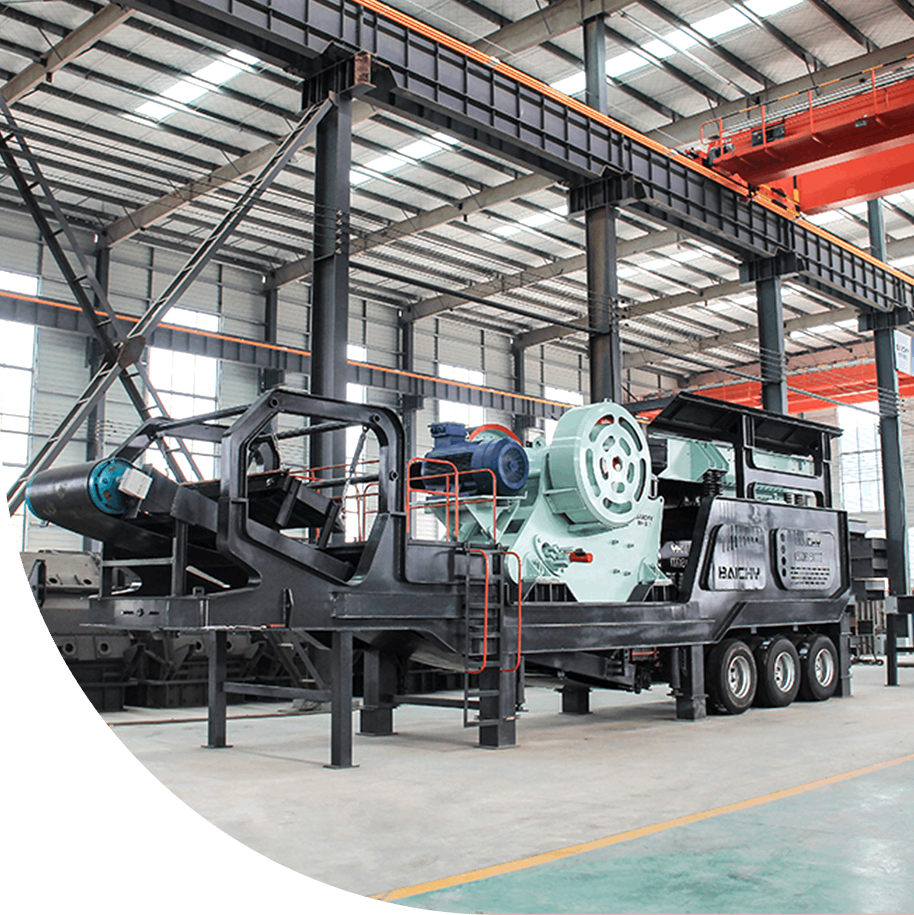


Heavy-duty hammer crusher primary crushing
Using a heavy-duty hammer crusher for primary crushing is entirely feasible, provided the material's compressive strength does not exceed 200 MPa and its moisture content remains below 15%. For low-to-medium hardness materials—such as limestone, dolomite, gypsum, coal gangue, and construction waste—a single heavy-duty hammer crusher can replace the traditional two-stage "jaw crusher plus impact crusher" setup. It handles feed sizes up to 1,000 mm with a reduction ratio exceeding 20:1, resulting in approximately 40% lower system investment costs and a reduction in electricity consumption per ton of over 35%. However, if these limits are exceeded—such as when processing high-hardness materials like granite, basalt, or iron ore—the heavy-duty hammer crusher primary crushing scheme is no longer economical; instead, a jaw crusher or a jaw-plus-cone crusher configuration should be used.
I. How Heavy-Duty Hammer Crushers Handle Primary Crushing
Primary crushing is the initial stage of a production line, traditionally performed by jaw crushers. Its function is to reduce large blocks of raw ore (300–1,200 mm)—obtained via blasting or quarrying—to a size of 150–300 mm suitable for secondary and tertiary crushing equipment.
Heavy-duty hammer crushers have disrupted this traditional pision of labor. Equipped with large-diameter, heavy-duty rotors and massive high-chrome hammer heads, they feature feed openings as large as 2,530 × 1,610 mm, allowing raw ore up to 1,000 mm in size to be fed directly into the machine. Inside the crushing chamber, material is struck by high-speed hammers and impacts against impact liners; the discharge size is ultimately controlled by grate bars. The output can proceed directly to screening or sand-making stages—a process known as "single-stage shaping."
The key distinction lies here: while standard hammer crushers are limited to secondary or tertiary crushing (handling feed sizes ≤300 mm), heavy-duty hammer crushers reduce "large raw ore blocks" directly to "finished product sizes" in a single step, eliminating the need for a second crusher. This capability is why they are described as "crushing large material with large-scale equipment."
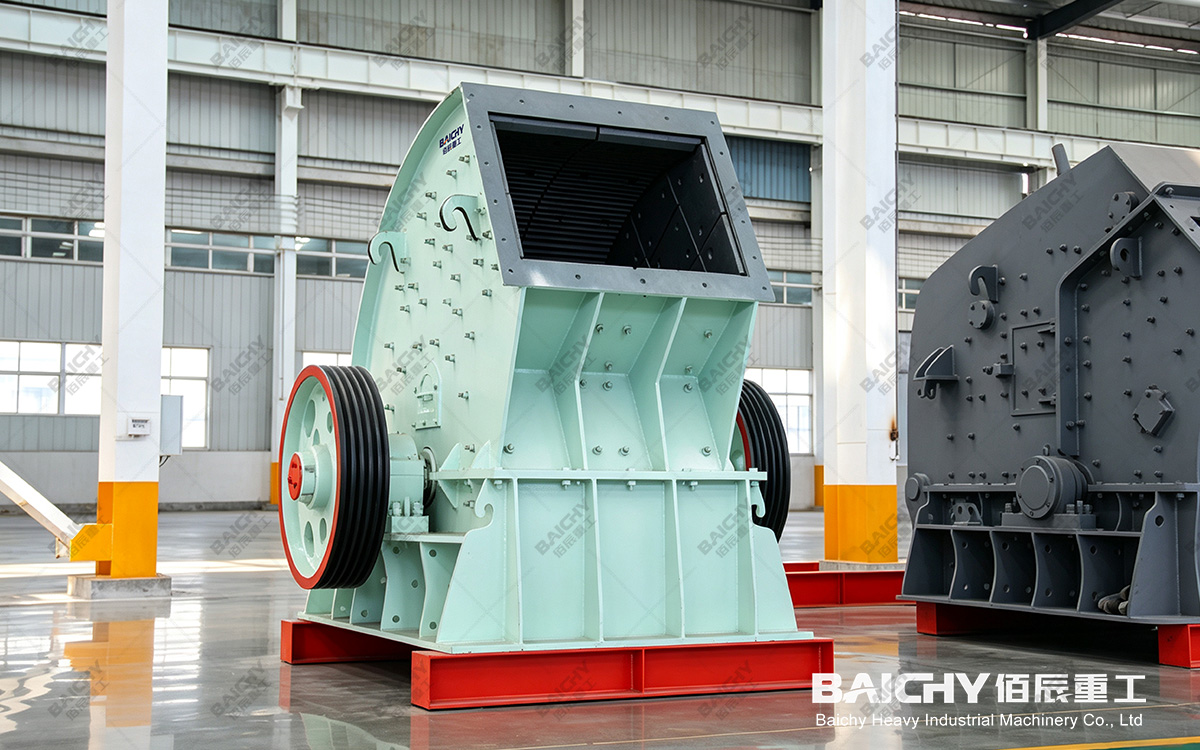
PCZ heavy-duty hammer crusher
II. Feasibility Criteria: When to Use and When Not to Use
The use of heavy-duty hammer crushers for primary crushing is not a universal solution; feasibility is determined by four key technical parameters:
1. Material Compressive Strength ≤ 200 MPa (Hard Constraint)
This is the most critical limitation. Materials such as limestone (60–150 MPa), dolomite, gypsum, and coal gangue fall within this range; however, granite (150–250 MPa) and basalt (200–350 MPa) exceed it. Forced use with these harder materials leads to a drastic reduction in hammer lifespan and uncontrollable wear-part costs per ton.
2. Moisture Content ≤ 15%
Excessive moisture causes material to stick and clog the grate bars, leading to a sharp drop in production capacity. During the rainy season, it is recommended to add a pre-screening stage at the feed end or increase the grate bar gap by 2–3 mm.
3. Feed Particle Size ≤ 1000 mm (Model-Dependent)
The PCZ2225 model accepts feed sizes up to 1000 mm, allowing mines to relax blasting fragmentation requirements or even eliminate grizzly screens; smaller to medium models (PCZ1308–PCZ1610) accept feed sizes of 380–480 mm, corresponding to medium-sized blasted rock fragments.
4. Target Capacity: 60–3000 t/h
The product series covers a capacity range of 60–3000 t/h, making it suitable for applications ranging from small-to-medium aggregate production lines to large-scale cement mine operations.
Feasibility Assessment Matrix
| Assessment Dimension | Conditions for Feasibility | Exclusion Criteria (Not Recommended) |
|---|---|---|
| Material Compressive Strength | ≤200 MPa (limestone, dolomite, gypsum, coal gangue) | >200 MPa (granite, basalt, iron ore) |
| Moisture Content | ≤15% | >15% (requires pre-screening or wider grate bar spacing) |
| Feed Particle Size | ≤1000 mm (model-dependent) | Oversized material requires a grizzly screen or jaw crusher upstream |
| Abrasiveness | Low to medium abrasiveness | High-silica, highly abrasive ores |
| Product Target | Aggregates, cement raw meal, recycled aggregates | Fine aggregates for high-grade concrete (requires downstream shaping) |
Assessment applies to the PCZ heavy-duty hammer crusher used as primary crushing equipment. Beyond the feasibility boundary — e.g. granite, basalt, iron ore — a jaw crusher or jaw + cone crusher circuit is recommended instead.
III. Application Scenarios
1. Sand and Aggregate Production Lines (Primary Market)
Limestone and dolomite quarries often employ a "single-stage crushing" approach using heavy-duty hammer crushers: the 0–40 mm output is fed directly into circular vibrating screens for classification. This configuration offers simplicity and high capacity, making it ideal for large-scale aggregate lines (100–3000 t/h) and the preferred primary crusher for new sand and gravel plants.
2. Limestone Crushing for Cement Plants
Cement raw meal mills are sensitive to feed particle size. A single heavy-duty hammer crusher can reduce run-of-mine ore (≤1000 mm) to a product size of ≤75 mm in one step, replacing the traditional jaw crusher plus impact crusher combination. This is the mainstream solution for energy-efficiency upgrades in cement plants worldwide, typically resulting in increased hourly throughput for raw meal mills.
3. Construction Waste Recycling
Mobile heavy-duty hammer crusher units can crush demolition concrete and brick-concrete waste into recycled aggregates in a single pass. The high reduction ratio and excellent particle shape meet the requirements for recycled aggregates, making this the mainstream primary crushing solution for urban solid waste disposal projects.
4. Coal Gangue, Gypsum, and Power Plant Desulfurization
Applications involving coal gangue, gypsum, and limestone for power plant desulfurization also benefit from the heavy-duty hammer crusher's low power consumption and single-stage processing capabilities; the unit can link directly with grinding mills to create an integrated crushing-and-grinding workflow.
IV. Core Advantages: Translating Specifications into Profit
1. 40% Savings on Investment. A single unit performs both primary and secondary crushing, eliminating the need for a separate impact crusher, an intermediate conveyor, and a buffer hopper; this reduces both system investment costs and the required footprint. For a limestone processing line with a capacity of 200 t/h, initial investment can be reduced by approximately 40%.
2. Over 35% Reduction in Specific Power Consumption. A high-inertia rotor combined with a high-efficiency crushing chamber results in significantly lower power consumption per ton compared to two-stage crushing systems, yielding annual electricity savings of hundreds of thousands of yuan during long-term operation.
3. High Reduction Ratio and Large Feed Size. The reduction ratio exceeds 20:1, allowing mining operations to relax blasting granularity requirements and eliminate grizzly screens, thereby reducing primary blasting costs.
4. Superior Product Shape. The finished product is angular and cubical with minimal flaky material, meeting the strict aggregate quality standards required for highway and bridge construction projects.
5. Compact Structure and Low Maintenance Requirements. Features a modular design requiring minimal foundation work; utilizes high-chrome hammers and replaceable liners, along with an external oil pump lubrication system and automatic shutdown protection, ensuring short downtimes for hammer replacement.
Comparison with Jaw Crusher + Impact Crusher Two-Stage Process
| Comparison Item | Heavy-Duty Hammer Crusher (Primary Crushing) | Jaw Crusher + Impact Crusher (Two-Stage) |
|---|---|---|
| Number of Units | 1 Unit | 2 Units |
| Feed Size | ≤1000 mm | ≤1200 mm (Jaw Crusher) |
| Crushing Stages | Single-stage (One-pass) | Two-stage |
| System Investment | ~40% Savings | Baseline |
| Specific Power Consumption | >35% Lower | Baseline |
| Civil Works & Conveying | Simple | Requires extra feeder/conveyor/buffer hopper |
| Applicable Hardness | ≤200 MPa | Cone crusher optional for high-hardness materials |
Investment and power-consumption savings are based on a typical 200 t/h limestone plant. For high-hardness materials (granite, basalt, iron ore), a jaw + cone crusher circuit is the recommended alternative.
V. Technical Specifications for PCZ Series Heavy-Duty Hammer Crusher
Capacity is based on limestone (bulk density: 1.6 t/m³); capacity decreases accordingly with higher material hardness and moisture content (recommended moisture ≤15%).
| Model | Rotor Diameter × Length (mm) | Feed Opening (mm) | Feed Particle Size (mm) | Capacity (t/h) | Motor Power (kW) |
|---|---|---|---|---|---|
| PCZ1308 | Φ1330×790 | 870×780 | ≤380 | 60–160 | 132 |
| PCZ1410 | Φ1400×1000 | 1060×740 | ≤450 | 80–210 | 2×90 |
| PCZ1610 | Φ1600×1000 | 1090×930 | ≤480 | 100–230 | 2×132 |
| PCZ1612 | Φ1600×1200 | 1340×1140 | ≤500 | 120–350 | 2×160 |
| PCZ1615 | Φ1600×1500 | 1570×1140 | ≤550 | 200–550 | 2×200 |
| PCZ1716 | Φ1700×1600 | 1420×1200 | ≤600 | 400–850 | 2×250 |
| PCZ1720 | Φ1700×2000 | 2030×1200 | ≤650 | 500–1000 | 2×400 |
| PCZ1920 | Φ1900×2000 | 1980×1210 | ≤750 | 800–1500 | 2×500 |
| PCZ2225 | Φ2200×2500 | 2530×1610 | ≤1000 | 1500–3000 | 1250 |
Capacity values refer to limestone conditions (density ≈ 1.6 t/m³). For harder or wetter materials (moisture ≤ 15%), actual capacity may be reduced. Customized configurations are available upon request.
VI. Application Cases: Data-Driven Results
Case 1: 1000 t/h Limestone Aggregate Line (Indonesia)
Configuration: ZSW600×130 Vibrating Feeder + PCZ1920 Heavy-Duty Hammer Crusher + YK3070 Circular Vibrating Screen. Run-of-mine ore (≤750 mm) is fed directly into the hammer crusher; the output (≤75 mm) proceeds to screening, yielding three aggregate sizes: 0–5 mm, 5–15 mm, and 15–31.5 mm. Compared to a Jaw Crusher + Impact Crusher setup of the same capacity, total investment is reduced by approximately 40%, and electricity consumption per ton drops by about 35%.
Case 2: 200 t/h Mobile Construction Waste Unit (Saudi Arabia)
Configuration: Wheeled mobile station equipped with a PCZ1615 Heavy-Duty Hammer Crusher + Iron Remover + Double-Deck Vibrating Screen. Demolition concrete blocks (containing rebar) undergo iron removal and are crushed in a single pass into recycled aggregate for on-site backfilling or brick making; this eliminates off-site disposal costs, resulting in a project payback period of approximately 2 years.
Case 3: Limestone Crushing System Upgrade for a Cement Plant (Vietnam)
The original two-stage crushing system had reached its capacity limit. After upgrading to a PCZ1720 Heavy-Duty Hammer Crusher, the single-unit capacity reached 500–1000 t/h with a stable output size of ≤65 mm. The feed particle size for the raw mill became uniform, hourly output increased by approximately 8%–10%, and annual electricity costs were reduced by about $50,000.
VII. Recommended Related Equipment
Heavy-duty hammer crushers used for primary crushing are typically integrated into complete production lines with the following equipment; Baichy Heavy Industry offers comprehensive solutions and process designs:
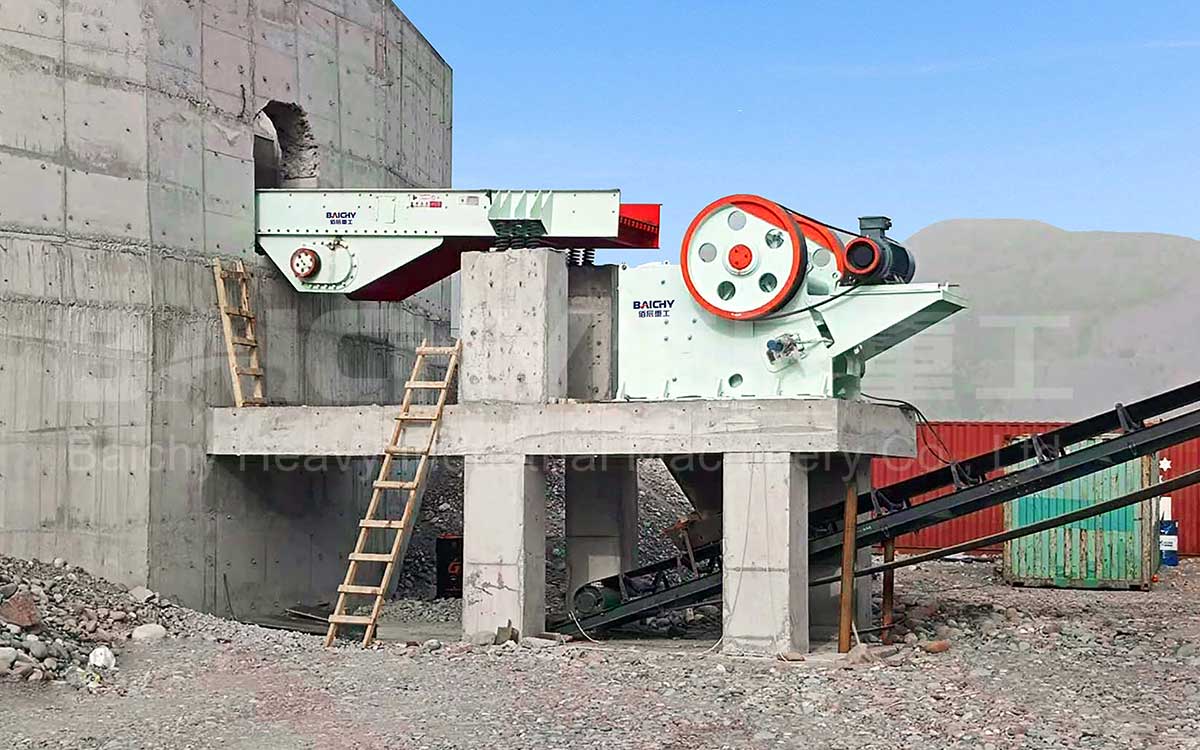
• ZSW Series Vibrating Feeder: Ensures uniform feeding and buffers material impact, protecting the crushing chamber and hammers.
• YK/GTS Series Circular Vibrating Screen: Classifies output and precisely controls the particle size of the finished product.
• Impact Crusher: Used downstream for shaping, suitable for high-grade concrete projects.
• VSI Sand-Making Machine: Used for sand making and shaping to improve the quality of fine aggregates.
• PE Jaw Crusher: An alternative option for the primary crushing of high-hardness materials.
• CS/HP Cone Crusher: Paired equipment for the secondary and tertiary crushing of hard rocks like granite and basalt.
• Suspended Iron Remover / Pulse Bag Dust Collector: Protects hammers and ensures compliance with environmental emission standards.
• Raymond Mill / Ball Mill: Can be directly linked with the heavy-duty hammer crusher for limestone powder production.
VIII. Frequently Asked Questions (FAQ)
Q1: Can a heavy-duty hammer crusher be used for primary crushing?
Yes, but with limitations. Heavy-duty hammer crushers are suitable for the primary crushing of medium-to-low hardness materials (such as limestone, dolomite, gypsum, coal gangue, and construction waste) with compressive strength ≤200 MPa, moisture content ≤15%, and feed size ≤1000 mm; a single unit can replace the two-stage "Jaw Crusher + Impact Crusher" process. For materials exceeding these limits (e.g., granite, basalt, iron ore), a Jaw Crusher or a Jaw Crusher + Cone Crusher combination is recommended.
Q2: How do I choose between a heavy-duty hammer crusher and a jaw crusher for primary crushing?
It depends on material hardness and system objectives: Choose a heavy-duty hammer crusher for medium-to-low hardness materials, high capacity, and single-stage shaping (offers 40% lower investment and 35% energy savings). Choose a jaw crusher for high-hardness or highly abrasive materials (eliminates the risk of hammer wear). Choose a Jaw Crusher + Cone Crusher combination when balancing high hardness with specific particle shape requirements. The classification criterion is a material compressive strength threshold of 200 MPa.
Q3: Will the hammerheads wear out too quickly when using a heavy-duty hammer crusher for primary crushing?
It depends on the material's abrasiveness and the hammerhead material. When crushing limestone, high-chromium alloy hammerheads typically last 3–6 months (corresponding to a throughput of 100,000–200,000 tonnes), with a wear-part cost of approximately $0.02–0.05 per tonne; however, the service life is significantly shorter when crushing construction waste or materials with high silica content. Hammerheads can be reversed to maximize utilization, and Baichy provides genuine spare parts to ensure supply. For high-silica materials, the economics of wear costs should be calculated in advance.
Conclusion
With three key performance benchmarks—single-stage shaping, 40% lower investment costs, and 35% energy savings—the heavy-duty hammer crusher offers the optimal Total Cost of Ownership (TCO) for the primary crushing of low-to-medium hardness materials. The operational limits (compressive strength ≤200 MPa; moisture content ≤15%) are clear and practical. Please contact Baichy Heavy Industry for technical specifications, process flow charts, or price quotes; we provide free equipment selection plans and complete production line equipment packages.
Baichy Heavy Industry
Baichy Heavy Industry is a high-tech mining equipment company integrating R&D, manufacturing, sales, and after-sales service. Focusing on crushing, grinding, and mineral processing equipment, we provide professional solutions to our customers. We are ISO9001:2015 、certified, and our products include mobile crushing palnts, crawler crushing plant, construction waste crushing plants, jaw crushers, sand making machines, cone crushers, fine crushers, grinding mills, ball mills, etc., all with reliable performance to meet diverse project needs.
Baichy Heavy Industry – Your Trusted Partner
To ensure optimal performance of your equipment, Baichy Heavy Industry offers:
- Professional on-site installation guidance
- Comprehensive operator training
- 24/7 technical support & maintenance services
Our complete after-sales service system guarantees long-term, stable operation of your machinery with minimal downtime.
Protect Your Rights – Only Use Official Channels
To avoid scams and ensure authentic support, contact us exclusively through:
• Official Website: www.baichychina.com
• WhatsApp: +8615093222637
• Email: [email protected]
Your satisfaction is our priority – expect prompt, professional service every time.
(Note: Beware of unauthorized third parties claiming to represent Baichy. Always verify through official contacts.)