
Key takeaway: A long-term Baichy partner runs its iron ore crushing line at 20 hours/day with a PE1200×1500 jaw crusher and three HPC-400 cone crushers in closed-circuit — achieving consistent 0–20mm output, zero unplanned downtime beyond seasonal wear-part swaps, and repeat equipment orders across three consecutive years. The line's reliability is what converts a first purchase into a multi-order partnership.
Iron-Ore-Crushing-Line
I. Project at a Glance
| Dimension | Specification | What It Means for You |
| Material | Iron ore (high hardness, high abrasiveness) | Equipment must handle continuous impact without premature liner failure |
| Feed size | ≤ 1000 mm | Direct mine-run ore — no pre-screening required, one less piece of equipment |
| Final product | 0–20 mm | Ready for grinding / beneficiation, eliminates the cost of a separate tertiary crusher |
| Operating hours | 20 hours/day | Pushes ~83% utilization (vs. industry average 60–70%), maximizing throughput per invested dollar |
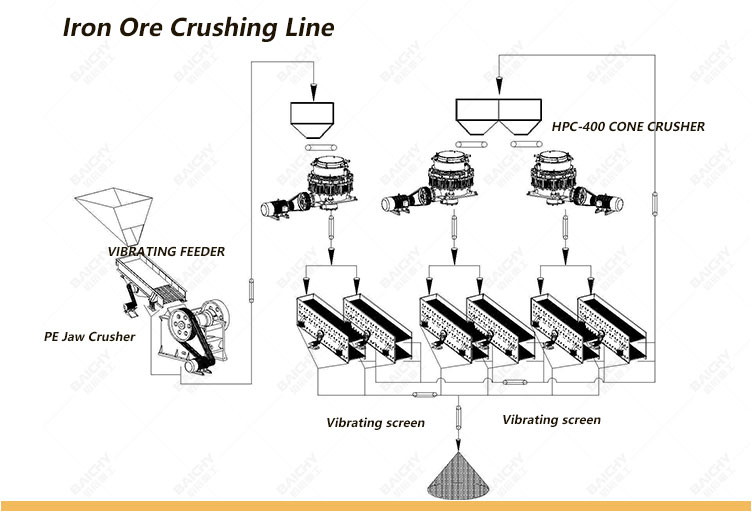
| Core fixed line | 1× PE1200×1500 + 3× HPC-400 | Classical hard-rock two-stage combo; three parallel cones provide redundancy — one unit can be serviced while the other two keep running |
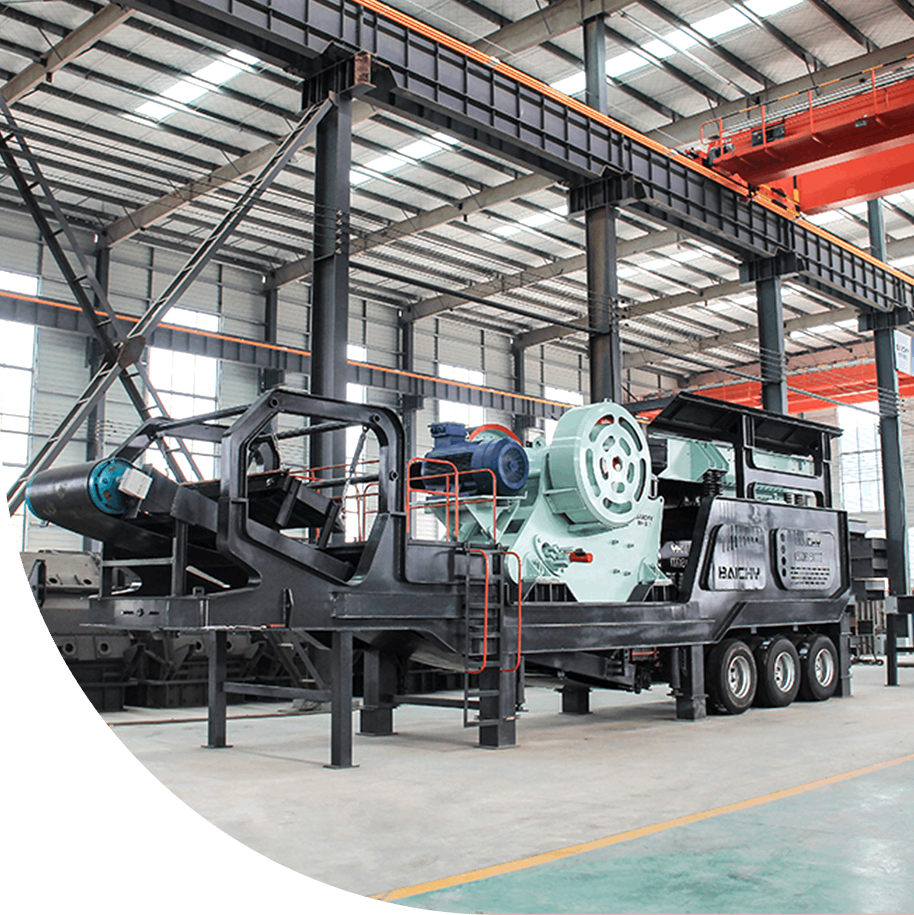
| Mobile auxiliary | 1× YDPZ75-1142 wheeled station | Deployed at remote faces or stockpile re-processing; avoids double-handling costs |
| Initial trial order | 1× PE750×1060 jaw crusher | Small-capacity entry model built trust → escalated to the full production line |
II. Process Flow: Three-Stage Closed-Circuit Crushing
This line follows the industry-standard "jaw → cone closed circuit" architecture, proven across hundreds of iron ore installations worldwide.
Stage 1 — Primary Jaw Crushing
| Parameter | Value |
| Equipment | PE1200×1500 stationary jaw crusher |
| Feed opening | 1200 × 1500 mm |
| Capacity | 400–800 tph (varies with ore density and feed gradation) |
| Function | Accepts raw ore ≤1000 mm, reduces it to ~150–200 mm for the secondary stage |
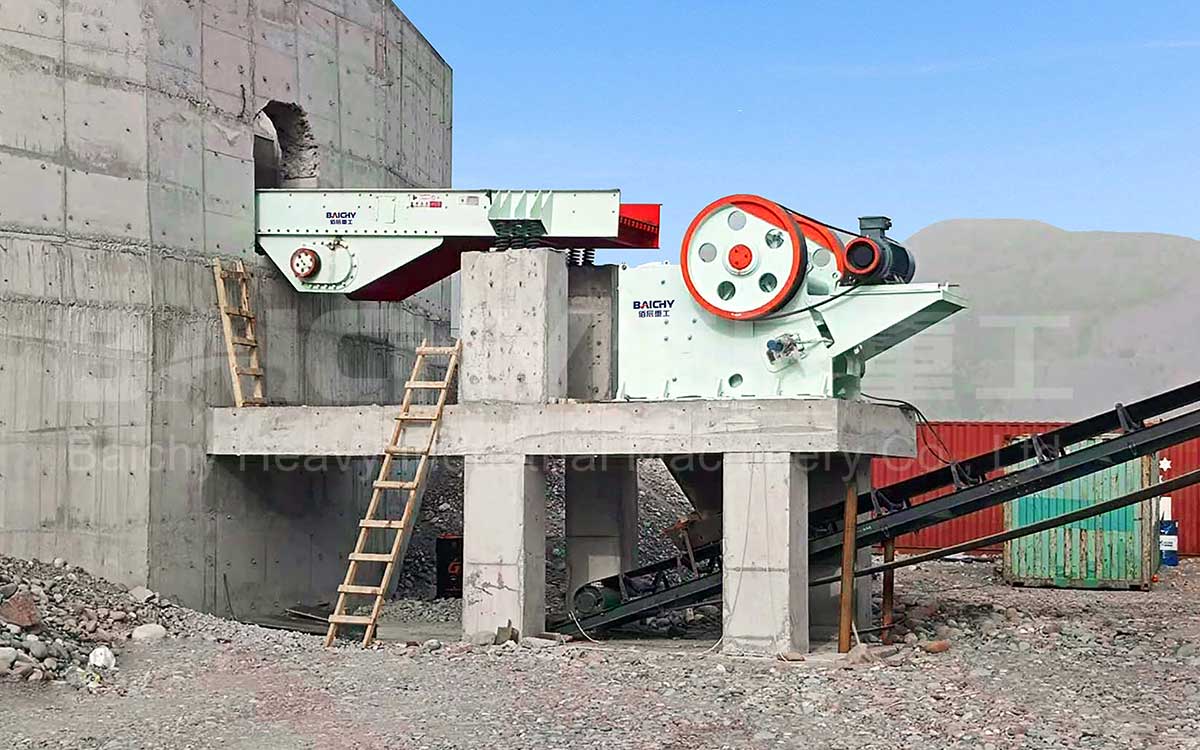
The PE1200×1500 is the backbone of the line. Its deep-V crushing chamber and heavy eccentric shaft are engineered for continuous shock loading. In this installation, jaw plate replacement cycles average 3–4 months under 20H/day operation — a figure the customer benchmarks against competitors and uses as the lead metric for parts re-ordering.
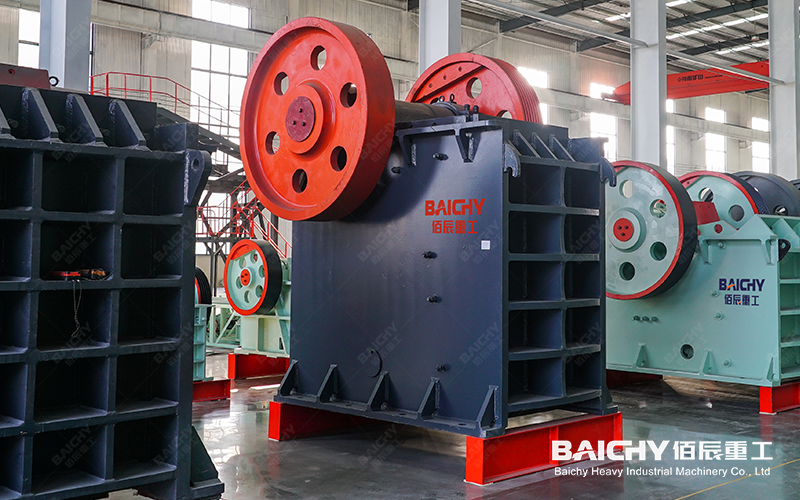
PE1200x1500 Jaw Crusher
Stage 2 — Secondary Cone Crushing (Closed-Circuit)
| Parameter | Value |
| Equipment | 3× HPC-400 hydraulic cone crushers (parallel) |
| Closed-side setting (CSS) | 16–25 mm (adjustable) |
| Function | Reduces jaw product to 0–20 mm final specification |
| Key advantage | Hydraulic CSS adjustment — no manual shimming; change settings in minutes |
The three HPC-400 units operate in parallel with a vibrating screen in closed circuit. Why three? Because iron ore is abrasive and throughput demands are high. Running three medium-sized cones instead of one large cone delivers:
• Built-in redundancy: One cone can be taken offline for liner inspection while the other two maintain ~67% capacity. Compare this to a single large cone — one shutdown stops the entire line.
• Finer control: Each HPC-400 can be set to a slightly different CSS to optimize the particle size distribution (PSD) curve for downstream grinding.
• Lower spare parts inventory: Three identical units share one spare parts pool — liners, mantles, and bowl liners are fully interchangeable.
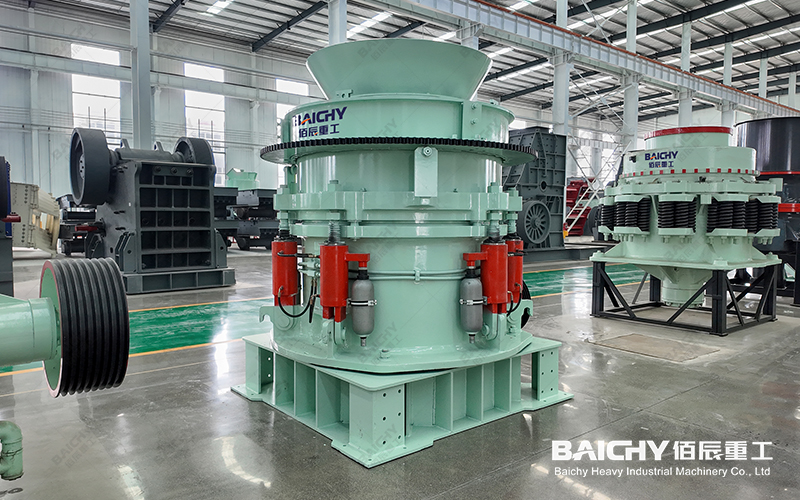
HP400 Hydraulic Cone Crusher
Stage 3 — Mobile Auxiliary Processing
| Parameter | Value |
| Equipment | YDPZ75-1142 wheeled mobile crushing station |
| Mobility | Towable; setup under 30 minutes at a new face |
| Function | Stockpile re-crushing, satellite face processing, or emergency overflow relief for the fixed line |
The YDPZ75 mobile station adds flexibility that fixed lines inherently lack. It can be driven to a remote stockpile, process low-grade ore at the source, and return — eliminating truck haulage cost for marginal material. In practice, the customer reports using it for roughly 15% of total throughput, primarily during maintenance windows on the fixed line.
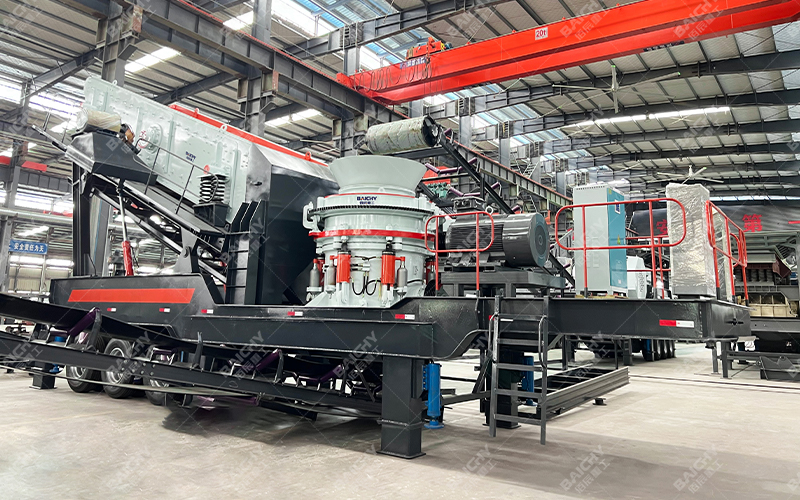
Mobile Cone Crusher
III. What the Customer Actually Says
"We established a relationship with Baichy after purchasing a PE750×1060 jaw crusher — the quality was excellent, so we decided to buy mobile crushing stations next. Now the production line's profits are stable. Based on this, we've also purchased three HPC-400 cone crushers."
The pattern is clear: a small entry-level order (PE750×1060) validated quality → escalated to mobile stations → escalated again to the full cone crusher fleet. This is not a single transaction; it's a three-year track record of repeat purchasing — the strongest signal of equipment satisfaction in heavy machinery.
"Your company's crushing equipment is of outstanding quality, and your service is equally satisfactory. At the beginning of last year, our equipment experienced some minor issues. To resolve these issues, Baichy's technical staff stayed at our factory through the Spring Festival holiday without complaint. We were deeply moved by this."
Two things matter here. First, the problem was "minor" — meaning it was not a catastrophic failure, but the kind of adjustment every production line encounters. Second, Baichy's on-site response during a major Chinese national holiday demonstrated service availability that surpasses contractual obligations. For a 20-hour/day production line, every hour of downtime costs real money — the speed of service response directly translates to annual profit.
IV. What Makes This Line Profitable: Four Drivers
1. Equipment Configuration Matches the Material
Iron ore is not limestone. Starting with a jaw crusher for primary reduction and following with cone crushers for secondary crushing is the mechanically correct path for materials with compressive strength above 200 MPa. This combination also produces cubical-shaped particles preferred by grinding circuits, reducing ball mill energy consumption by an estimated 5–8% compared to impact-crushed feed.
2. Redundancy Built Into the Design
Three parallel HPC-400 cones mean the line never fully stops. Liner swaps, oil changes, and inspections can be staggered. The customer estimates this design alone adds ~300 operating hours per year compared to a single-secondary-cone configuration.
3. Mobile Flexibility Eliminates Idle Assets
A fixed crushing line sitting idle while ore is stockpiled elsewhere is a capital-losing proposition. The YDPZ75 mobile station ensures the crushing fleet always has material to process, whether from the main pit or satellite deposits.
4. Service Continuity Protects Uptime
The on-site Spring Festival support incident is not just a story — it demonstrates a service model where technical staff are deployed for extended on-site stays, not rushed dispatch-and-rotate cycles. This matters because iron ore crushing lines in remote locations often lack local skilled maintenance personnel.
V. Equipment Summary
| Equipment | Model | Qty | Capacity Range | Application |
| Jaw Crusher | PE1200×1500 | 1 | 400–800 tph | Primary crushing, feed ≤1000 mm |
| Jaw Crusher (initial) | PE750×1060 | 1 | 110–320 tph | Trial entry order, later integrated |
| Cone Crusher | HPC-400 | 3 | 185–450 tph | each Secondary closed-circuit, 0–20 mm output |
| Mobile Station | YDPZ75-1142 | 1 | 75–200 tph | Auxiliary / satellite-face processing |
Looking for a different capacity? Baichy supplies jaw crushers from PE150×250 to PE1600×2100 and cone crushers from HPC-100 to HPC-800. Contact our engineers for a custom configuration.
VI. Frequently Asked Questions
Q1: Can this configuration handle iron ore with moisture above 8%?
A: The jaw + cone configuration handles wet iron ore better than impact crushers, which suffer from rotor buildup at high moisture. However, if moisture consistently exceeds 8%, we recommend adding a pre-screening scalper before the jaw crusher to remove fines and reduce packing in the crushing chamber. The closed-circuit vibrating screen should also use polyurethane mesh panels rather than woven wire to resist blinding.
Q2: What is the typical wear-part replacement cycle on this line?
A: Under 20-hour/day operation with abrasive iron ore:
Jaw plates (PE1200×1500): 3–4 months for Mn18Cr2 grade; 5–6 months for Mn22 grade
Cone mantle & bowl liner (HPC-400): 2–3 months for standard manganese; 4–5 months with high-chrome alloy
Screen mesh (vibrating screen): 1–2 months depending on aperture size and material abrasiveness
Actual cycles vary with ore hardness, feed gradation, and CSS settings. We recommend maintaining one full set of wear parts on-site at all times.
Q3: What's the estimated electricity cost per ton at this scale?
A: At a total installed power of approximately 880 kW (PE1200×1500: 220 kW; 3× HPC-400: 3×220 kW) and ~83% utilization, the estimated energy consumption is 1.2–1.8 kWh per ton, depending on ore hardness and final product size. At 0.08/kWh,thistranslatestoroughly0.10–$0.14/ton — competitive for a three-stage hard-rock line.
Q4: How does this configuration compare to an impact-crusher-based line for iron ore?
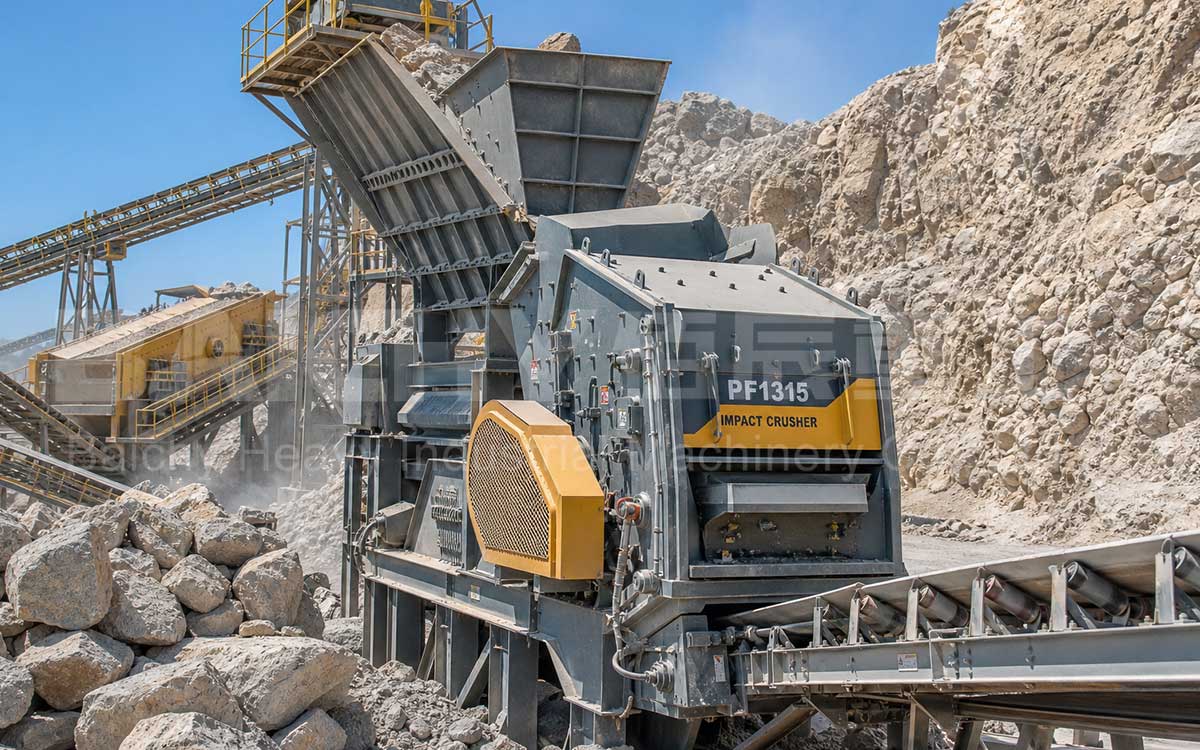
A: Impact crushers (PF series) are generally not recommended for abrasive iron ore. The high silica content in iron ore accelerates blow bar wear, driving spare parts cost 3–5× higher than a cone-crusher-based line over the same throughput. Cone crushers use compression crushing, which is inherently more wear-resistant and produces a more consistent PSD for downstream grinding. The trade-off is a slightly higher initial capital cost for cone crushers, which is recovered within the first year through lower wear-part expenditure.
Q5: What's the lead time for a PE1200×1500 + 3× HPC-400 configuration?
A: Standard lead time is 35–50 days for the jaw crusher and 25–35 days for each HPC-400 cone crusher, from deposit to FOB port. Complete-line delivery with all auxiliary equipment (vibrating feeder, screens, conveyors) typically ships within 60 days. Expedited production is available for urgent projects — contact our sales team with your timeline.