complete rotary drying systems
A complete rotary drying system is not merely a simple assembly of a rotary dryer and a few pipes; rather, it is an integrated, continuous production line linking five key stages: feeding, heat supply, drying, dust removal, and material conveying. Customers who attempt to assemble inpidual components themselves often incur three types of hidden costs: reduced output due to a mismatch between the hot-air furnace and the drying drum; environmental non-compliance caused by incompatible dust removal and induced-draft systems; and downtime and rework resulting from interface conflicts between equipment from different manufacturers.
I. What is a complete rotary drying system? Shifting from "single-machine thinking" to "systems thinking"
A complete rotary drying system is an integrated process unit centered on a rotary drying drum, linking feeding, heat supply, dust removal, conveying, and electrical control systems. Its true value lies in the concept of a "complete system": the selection of every piece of equipment within the system is based on the drying drum's evaporation capacity, rather than on the independent nominal capacities of inpidual units. Take, for example, a complete rotary drying system with dimensions of φ2.4m × 18m: under typical operating conditions—featuring continuous wet material input and dry material output, with moisture content reduced from 10% to 0.5%—the system maintains a stable production capacity of 35–55 t/h. This performance level can only be realized after the entire line has undergone integrated commissioning.
Five Key Components of the Complete Rotary Drying System
| Component Unit | Core Equipment | System Function | Selection Criteria |
|---|---|---|---|
| Feeding Unit | Hopper, screw/belt conveyor, chute | Quantitative, steady-speed feeding | Feed rate automatically adjusts based on drum load |
| Heat Supply Unit | Hot blast stove (coal/gas/biomass/waste heat) | Provides clean hot air at 600–700°C | Strict matching of furnace chamber, drum diameter, and airflow |
| Drying Unit | Rotary dryer drum and lifting flights | Agitates material; gas-solid heat exchange to evaporate moisture | Lifting flights customized based on material viscosity/abrasiveness |
| Environmental Unit | Cyclone dust collector, baghouse dust collector | Recovers fines; ensures exhaust meets emission standards | Cross-verification of dust concentration and induced draft volume |
| Conveying & Control Unit | Discharge conveyor, induced draft fan, electrical cabinet | Transfers finished product; manages system negative pressure and interlocks | PLC interlocks prevent overheating and combustion/explosion |
II. Application Scenarios for Complete Rotary Drying Systems
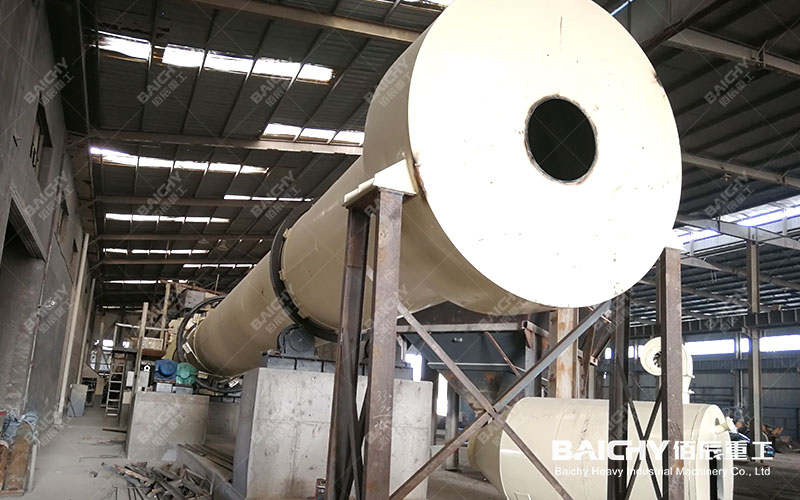
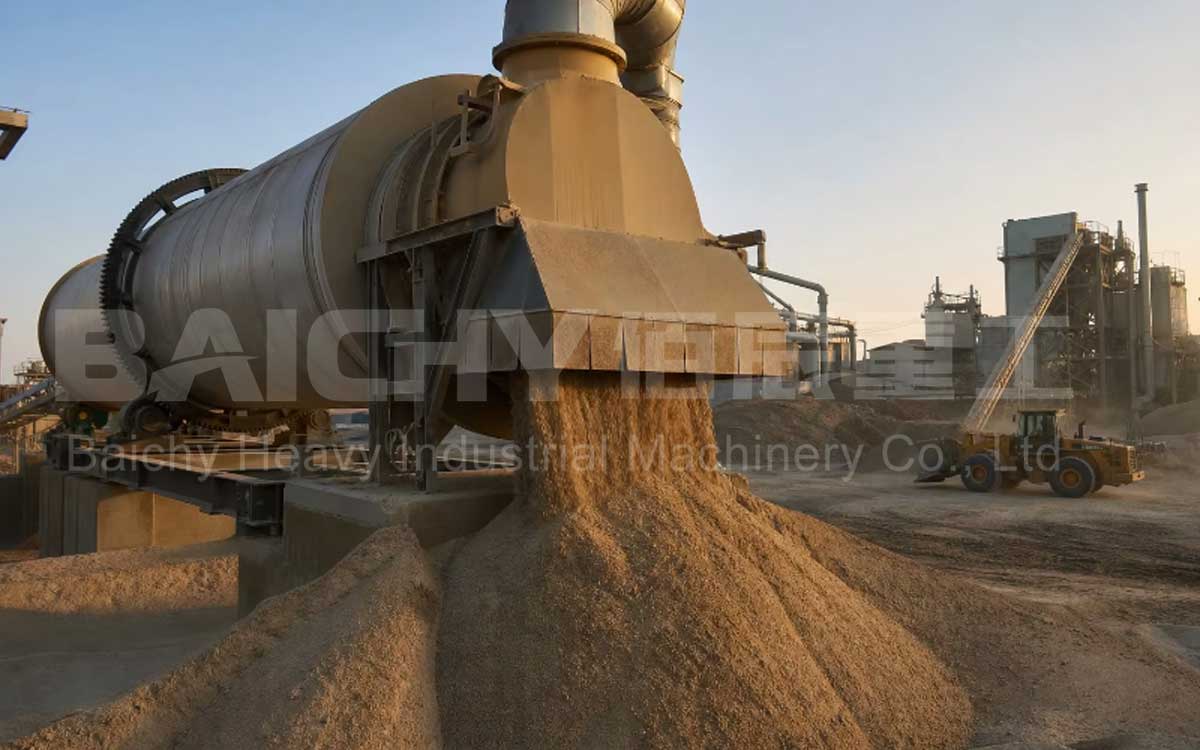
Single-drum dryer at a customer site
1. Manufactured Sand and Quartz Sand Production Lines: Wet sand from washing machines has a moisture content of 10–20% and must be dried to below 0.5% before entering dry-mixed mortar, glass, or casting processes. This is the largest market for these systems; requirements include low discharge temperatures, controllable fines content, and seamless integration with upstream and downstream belt conveyors.
2. Mineral Powder and Concentrate Drying: Iron concentrate powder and copper/zinc concentrate filter cakes often have moisture contents of 12–18%. Drying facilitates storage and transport while reducing energy consumption during smelting. Due to the highly abrasive nature of these materials, systems must be equipped with wear-resistant lifting flights and piping.
3. Industrial Sludge and Coal Slime Drying: These viscous materials (50–80% moisture) require auxiliary equipment such as breaking/disaggregation devices, dry material back-mixing, or indirect heating structures; this represents a highly challenging customization scenario for rotary drying systems.
4. Organic Fertilizer and Biomass Pre-treatment: Organic materials such as chicken manure, distillers' grains, and sawdust are temperature-sensitive (generally requiring temperatures below 200–350°C). Consequently, the system design must utilize low temperatures and high airflow rates to prevent scorching and mitigate the risk of dust explosions.
III. Process Flow: Transforming Wet Material into a Dried Finished Product
The material flow path for a standard complete rotary drying production line is as follows:
• Metered Feeding: Wet material is transferred from a storage hopper via a screw feeder into the inlet end of the drying drum; the feed rate is automatically regulated by a PLC based on the internal drum temperature and the moisture content of the discharged material;
• Internal Agitation: The drum rotates at 3–6 rpm, while lifting flights continuously scoop up and scatter the material to form a uniform curtain; hot air (600–700°C) passes through this curtain to facilitate gas-solid heat exchange;
• Moisture Evaporation: Material remains inside the drum for 15–45 minutes, with moisture evaporating progressively along the length of the drum; moist air is extracted by an induced draft fan;
• Dried Material Discharge: The finished product exits through the discharge port onto a conveyor; the temperature drops to below 60–80°C, allowing for direct packaging or transfer to the next processing stage;
• Tail Gas Purification: Dust-laden moist air first passes through a cyclone dust collector to recover coarse particles, then enters a baghouse dust collector, ensuring dust emission concentrations remain below 30 mg/Nm³.
IV. Core Configuration Parameters for the Complete Rotary Drying System
| Model/Spec. | Design Capacity (10% → 0.5%) | Heat Source Type | Inlet Air Temp. | Installed Power | Typical Auxiliaries |
|---|---|---|---|---|---|
| φ1.5×12 m | 8–15 t/h | Coal/Gas hot-blast stove | 600–700°C | 30–45 kW | Cyclone + bag dust collector |
| φ2.0×18 m | 20–30 t/h | Coal/Gas hot-blast stove | 600–700°C | 45–75 kW | Two-stage dust removal + ID fan |
| φ2.4×18 m | 35–55 t/h | Coal/Gas/Biomass | 600–700°C | 75–110 kW | Two-stage dust removal + auto-feeding |
| φ3.0×22 m | 70–110 t/h | Coal/Gas/Waste heat | 600–700°C | 132–200 kW | Fully automatic interlock control |
| φ3.6×25 m | 120–200 t/h | Coal/Gas/Waste heat | 600–700°C | 220–315 kW | For large-scale aggregate lines |
Capacity figures are calculated based on dry-basis material and fluctuate according to feed moisture content, particle size, and bulk density; for every 5-percentage-point increase in feed moisture, dry material throughput drops by approximately 20–30%. Model selection should account for peak moisture levels by stepping up to the next capacity tier.
V. Four Core Advantages of the Complete Rotary Drying System
1. Thermal Efficiency and Cost-per-Ton Advantages: The entire line’s hot air circulation, thermal insulation, and airflow are controlled based on a unified design standard. Thermal efficiency reaches 70–85%, and heat consumption per ton is 15–25% lower than that of lines assembled from disparate components. Based on an annual output of 200,000 tons and current fuel prices, annual fuel cost savings can amount to hundreds of thousands of yuan.
2. Unified interfaces, ready for immediate operation: All five major units are designed and manufactured by a single vendor, ensuring fully standardized interface dimensions and control logic. Installation and commissioning are completed within 15–30 days of delivery, eliminating the risk of disputes or rework associated with multi-vendor projects.
3. Environmental compliance, meeting standards from the start: The two-stage dust removal system (cyclone plus bag filter) and induced draft system are holistically calibrated based on exhaust gas volume to ensure dust emissions meet regulatory limits. Noise reduction designs ensure compliance with local environmental impact assessment (EIA) requirements, minimizing the risk of production shutdowns for rectification.
4. Automation and safety interlocks: Centralized PLC control features automatic alarms and interlocks for conditions such as overheating, material feed interruption, or abnormal dust collector pressure differentials. Explosion-proof designs are tailored for combustible materials like coal slime and biomass, reducing the need for manual intervention and lowering the risk of safety incidents.
VI. Application Cases of Complete Rotary Drying Systems
Case A (Quartz Sand Purification): A glass sand enterprise previously used multi-stage, modular drying equipment; discharge moisture content fluctuated by ±2%, and the waste sand rate remained high. After upgrading to a complete φ2.4×18m rotary drying system, moisture content stabilized at 0.3–0.5%, dust content decreased, the qualified product rate rose from 92% to over 98%, and the total investment was recouped within two years.
Case B (Coal Slime Drying): A coal washing plant processed flotation clean coal with 30% moisture content; uneven drying from the original equipment hindered subsequent pressure filtration and coal blending operations. After the delivery of a complete system featuring a material-breaking unit and explosion-proof design, discharge moisture stabilized below 8%, and the drying cost per ton dropped by approximately 20%.
Case C (Manufactured Sand Production Line): A project with an annual output of 1 million tons of manufactured sand incorporated a complete φ3.0×22m rotary drying system. Integrated commissioning was conducted alongside sand washing and screening lines; dry sand is supplied directly to a dry-mixed mortar station, and the system achieved its design capacity of 110 t/h in the very first year of operation.
VII. Recommended Equipment from Baichy Heavy Industry
Baichy Heavy Industry offers a comprehensive product line ranging from single-drum and triple-drum rotary dryers to complete drying systems. We provide customized solutions based on input moisture content, material samples, and target moisture levels:
| Recommended Products | Specification Range | Reference Capacity | Suitable Applications |
|---|---|---|---|
| Single-drum rotary drying system | φ1.5×12 m – φ3.6×25 m | 8–200 t/h | Large-scale lines for sand/gravel, mineral powder, sludge, coal slime |
| Triple-drum rotary drying system | φ2.0×4 m – φ4.0×10 m | 8–100 t/h | River sand, manufactured sand; sites with limited space |
| Indirect heating drying system | Customized | 5–60 t/h | High-purity silica sand, foundry sand, heat-sensitive materials |
| Hot blast stove & dust removal | Customized by capacity | — | Heat sources: coal, gas, biomass, or waste heat |
Selection Tip: Submit 5–10kg of material samples for free drying tests by Baichy; we provide moisture curves and complete configuration plans within 5 working days. Overseas projects can be customized for local voltage (e.g., 400V/50Hz, 380V/60Hz, 440V) and fuel availability.
FAQ
Q1: What is the difference between a complete rotary drying system and purchasing a dryer alone to assemble the rest yourself?
A: The main differences lie in system compatibility and accountability. When assembling a line from inpidual units, the hot blast stove airflow, dust collector capacity, and feeding rate often operate independently; common issues include under-loading or overloading the drying drum and excessive material carry-over in exhaust gas. If problems arise, multiple vendors may shift blame to one another. In contrast, a complete rotary drying system is designed and integrated as a unified whole across its five major units, ensuring output moisture and environmental standards are met from the start. It also comes with a whole-line warranty, and the total cost is usually lower than that of a piecemeal solution.
Q2: Can the system still guarantee stable output moisture if the input moisture content fluctuates frequently?
A: Yes, it can. The integrated system features PLC interlocking and variable-frequency drive (VFD) feeding. It links moisture sensor data from the inlet with internal drum temperature signals to automatically adjust feed rates and hot-blast stove loads, keeping discharge moisture fluctuations within ±0.5 percentage points. This performance relies on accurately specifying the moisture fluctuation range during the design phase and building in sufficient production capacity headroom.
Q3: What is the payback period for the complete rotary drying system?
A: The payback period depends on production capacity and the cost differential of fuels. Taking a φ2.4×18m system as an example—and comparing it to a conventional, high-energy-consumption setup—the system reduces heat consumption per ton by 15–25% and lowers the reject rate; the resulting annual savings typically cover the price difference of the equipment within 1–3 years. If the original setup faces shutdown risks due to non-compliance with environmental regulations, the payback period is shortened further. Baichy can provide an investment analysis based on your specific material and fuel costs.
Baichy Heavy Industry
Baichy Heavy Industry is a high-tech mining equipment company integrating R&D, manufacturing, sales, and after-sales service. Focusing on crushing, grinding, and mineral processing equipment, we provide professional solutions to our customers. We are ISO9001:2015 、certified, and our products include mobile crushing palnts, crawler crushing plant, construction waste crushing plants, jaw crushers, sand making machines, cone crushers, fine crushers, grinding mills, ball mills, etc., all with reliable performance to meet diverse project needs.
Baichy Heavy Industry – Your Trusted Partner
To ensure optimal performance of your equipment, Baichy Heavy Industry offers:
- Professional on-site installation guidance
- Comprehensive operator training
- 24/7 technical support & maintenance services
Our complete after-sales service system guarantees long-term, stable operation of your machinery with minimal downtime.
Protect Your Rights – Only Use Official Channels
To avoid scams and ensure authentic support, contact us exclusively through:
• Official Website: www.baichychina.com
• WhatsApp: +8615093222637
• Email: [email protected]
Your satisfaction is our priority – expect prompt, professional service every time.
(Note: Beware of unauthorized third parties claiming to represent Baichy. Always verify through official contacts.)