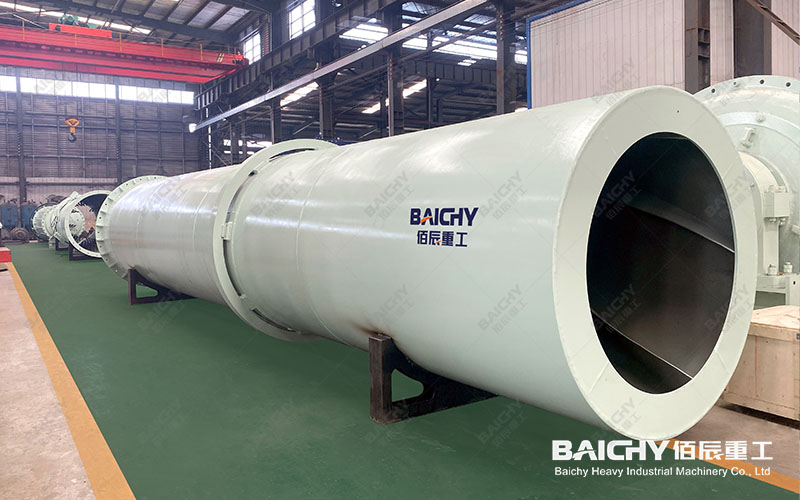
Kaolin Dryer
The challenge in drying kaolin has never been merely "driving off the water"; rather, the difficulties lie in preventing the wet, sticky filter cake from forming clumps inside the drying drum and avoiding discoloration (loss of whiteness) caused by localized overheating from the hot air. Baichy’s kaolin dryer addresses both issues simultaneously through a three-pronged process design: concurrent low-temperature airflow, spiral lifting and material breakup, and discharge temperature control. Washed kaolin filter cake with an initial moisture content of 25% can be consistently dried to below 1% moisture; the discharge temperature is kept below 90°C, and whiteness fluctuations remain well within acceptable industry limits. The following sections detail the mechanism, process, parameters, and case studies.
I. Why Kaolin Drying is Difficult: Clumping and Discoloration are Key Process Hurdles
1.1 Clumping: The "Dry-Outside, Wet-Inside" Dilemma of Filter Cakes
After pressure filtration, washed kaolin enters the drying stage as a filter cake with a moisture content typically ranging from 22% to 30%, exhibiting high plasticity and stickiness. In conventional drying equipment, the surface of the material clumps contacts the high-temperature hot air first, causing the outer layer to rapidly lose moisture and form a hard shell while trapping internal moisture. The tumbling action inside the drum fails to break up the clumps; instead, the material becomes increasingly compacted, forming "half-baked" spheres that are dry on the outside but wet on the inside. This results in uneven discharge moisture, leading to blockages in downstream grinding and classification processes. Fundamentally, clumping occurs because heat reaches the surface while water vapor has no escape route.
1.2 Discoloration: Whiteness is the Primary Selling Point of Washed Kaolin
The market price of kaolin—particularly the grade used for paper coating—is strongly correlated with its whiteness. Washed kaolin contains trace amounts of iron oxide and organic matter. If localized overheating occurs inside the drum (where material lingers in zones exceeding 400°C) or if the discharge temperature is too high, ferrous iron oxidizes and organic matter carbonizes. This causes the clay to turn yellow or gray—a phenomenon known as "heat-induced discoloration." A single discoloration incident can cause the whiteness level of a batch to drop by 2–3 points, directly resulting in a price downgrade based on quality classification. The function of the drying stage is to "rapidly remove free moisture" rather than to "heat-cure" the material; crossing this boundary means the calcination process is effectively being performed incorrectly at the wrong stage.
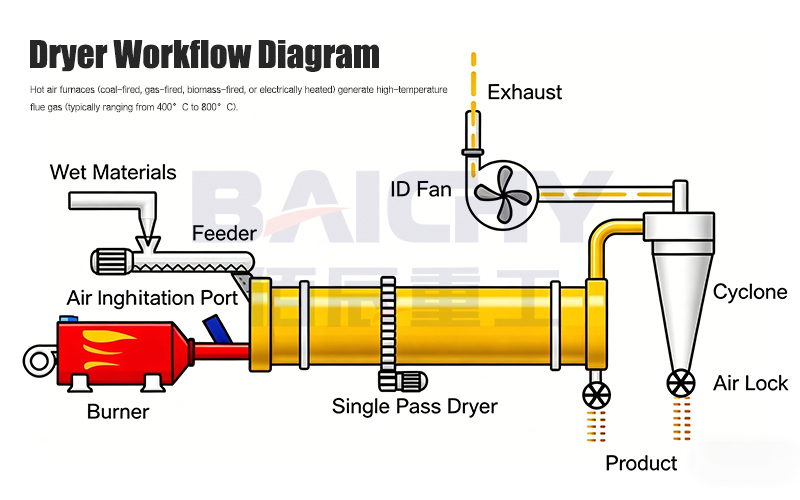
Working principle of the single-drum dryer
II. How the Kaolin Dryer Prevents Clumping and Discoloration
2.1 Co-current Low-Temperature Operation: Protecting Whiteness via Moisture
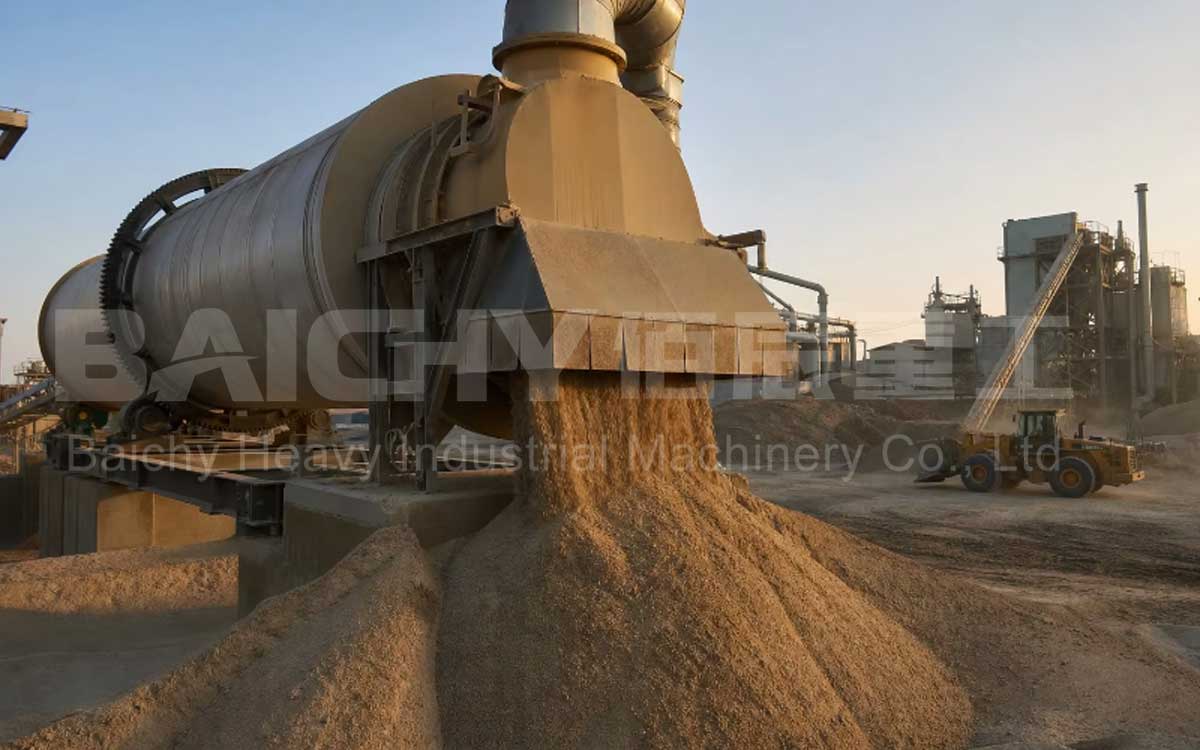
The dryer utilizes a co-current (parallel flow) configuration: hot air at 700–800°C enters at the feed end and travels in the same direction as the high-moisture wet material. The material is at its highest moisture content precisely where the temperature is highest; the evaporation of moisture absorbs a vast amount of latent heat, effectively "pinning" the material's surface temperature near the wet-bulb temperature. Consequently, the high-temperature hot air acts primarily on the water rather than the clay itself. As the material advances and moisture levels drop, the air temperature decreases synchronously, allowing the discharge temperature to be controlled below 90°C. This serves as the primary physical safeguard against discoloration: by eliminating the scenario where high-moisture material is exposed to high temperatures, the risk of localized over-burning is removed.
2.2 Spiral Lifting + Disaggregation Mechanism: Breaking Up Material Curtains for Drying
The interior of the drum features spirally welded lifting flights (designed to enhance heat transfer efficiency and production capacity), which continuously lift and scatter the material into a uniform curtain. For sticky materials, a disaggregation or vibration mechanism can be installed at the feed section to repeatedly break apart and shake loose filter cake clumps, ensuring every particle of clay is exposed to the hot air. Combined with a drum inclination of 3%–5% and variable frequency drive (VFD) speed control, the material's residence time can be adjusted to meet specific moisture targets. This "disaggregate-then-dry" sequence ensures the final product is free of agglomerates with dry shells and wet cores.
2.3 Low-Maintenance Design: Pin-Type Gears Reduce Downtime Costs
The drive system employs replaceable pin-type gears instead of traditional large cast-steel gears. When wear occurs, inpidual pins can be replaced on-site without needing to replace the entire gear ring, significantly reducing maintenance costs and downtime—a crucial advantage for kaolin plants requiring continuous production, where avoiding a single day of downtime means gaining a full day's output of finished product.
2.4 Kaolin Operating Parameter Table (Nominal Specs vs. Adjusted Operating Conditions)
The table below lists the actual specifications for the rotary dryer series (with a maximum equipment inlet gas temperature of 700–800°C). The "Kaolin Filter Cake Operating Conditions" column shows estimated values calculated based on an inlet moisture content of 25%, an outlet moisture content of ≤1%, and an evaporation intensity of approximately 40 kg/(m³·h); actual production capacity depends on material testing and local fuel conditions.

Process flow diagram of the single-drum dryer
| Specifications (Cylinder Diameter × Cylinder Length, mm) | Volume (m³) | Nominal capacity (t/h)* | Kaolin filter cake production capacity (t/h)** | Main motor (kW) |
|---|---|---|---|---|
| Φ1500×12000 | 21.2 | 4.5–5.7 | 2.5–3.5 | 15 |
| Φ1800×14000 | 35.6 | 7.6–9.5 | 4.5–5.5 | 18.5 |
| Φ2000×18000 | 56.5 | 8.4–12.3 | 5–7 | 22 |
| Φ2200×18000 | 68.3 | 12.8–16.2 | 7–9 | 22 |
| Φ2400×20000 | 90.4 | 19.3–24.1 | 10–13 | 55 |
| Φ2600×24000 | 127.4 | 27.2–34.0 | 15–19 | 75 |
| Φ3000×25000 | 176.6 | 37.7–47.1 | 21–26 | 90 |
* Nominal capacity is based on standard materials such as sand, coal, and mineral powder with an input moisture content of approximately 10%; ** for kaolin filter cake, estimates assume an input moisture content of 25% and an output moisture content of ≤1%, with actual capacity subject to material testing.
III. Typical Application Scenarios
| Scenario | Feed State | Target Moisture | Selection Key Points |
|---|---|---|---|
| Washed Kaolin Filter Cake (Paper Filler/Coating Grade) | Filter press cake (22%–28%) | ≤1% (Coating grade ≤0.5%) | Low-temp co-current flow + disintegration device + discharge temp control; whiteness is the priority |
| Ceramic Raw Clays (Ball Clay/China Stone/Refractory Clay) | 20%–25% | 3%–5% | Large-volume medium-temp zone; balancing moisture levels for pre-aging/maturation |
| Pre-treatment for Calcined Kaolin | 10%–15% | ≤1% | High throughput & energy-cost sensitivity; three-cylinder dryer option available |
| Filler/Chemical-Grade Kaolin (Rubber, Plastic, Pesticide Carriers) | 18%–22% | ≤1% | Discharge uniformity is the priority; integrated with downstream milling processes |
Actual selection should be verified with material moisture tests and local fuel conditions.
IV. Equipment Advantages: Translating Process Design into Business Returns
1. Stable Whiteness → Premium Pricing: No localized overheating; minimal whiteness fluctuation between batches; reduced losses from product downgrading. Industry standards show that a drop of just one point in whiteness for coating-grade kaolin can result in a price difference of tens of RMB per ton.
2. No Clumping → No Downstream Blockages: No un-dried "raw cores" in the discharge; smooth feeding for Raymond mills, ultrafine mills, and classifiers; higher overall line operational efficiency.
3. Low Maintenance → Reduced Downtime: Pin-type gears + standardized support rollers; fewer daily maintenance points; high interchangeability of spare parts.
4. Fuel Flexibility: Compatible with coal-fired, natural gas, or biomass hot-air furnaces, as well as waste-heat recovery systems; allows for the selection of the lowest-cost path based on local energy prices. 5. Transparent capacity specifications: Nominal capacity and capacity adjusted for actual kaolin operating conditions are listed separately (see table above); calculations based on evaporation load can be performed prior to contract signing, ensuring that capacity figures are not inflated by using generic materials.
V. Relevant Case Studies (Anonymized)
Washed kaolin processing plant in Shanxi: Filter cake moisture was 24%; the original rotary dryer caused significant batch-to-batch whiteness fluctuations and occasional yellow cores. After switching to a Φ2200×18000 rotary dryer paired with a coal-fired hot blast stove—operating in a low-temperature, co-current flow mode—discharge moisture stabilized at approximately 0.8%. The product consistently met the supply standards for ceramic-grade clients, and fuel consumption per ton of material dropped by about 20% compared to pre-retrofit levels (according to the plant).
Ceramic raw material enterprise in Southeast Asia (Indonesia): Raw material moisture spiked to 28% during the rainy season, causing frequent material blockages on the old production line. A Φ1800×14000 unit equipped with a material-breaking device was installed, adapted for the local 400V/50Hz power supply; rainy-season capacity remained above 90% of the design value, eliminating seasonal losses caused by production shutdowns.
Paint-grade kaolin project in South America (Brazil; currently under negotiation): Exports to Europe require meeting strict standards for both moisture content (≤1%) and consistent whiteness. The proposed solution features a Φ2400×20000 low-temperature, co-current flow unit with a closed-loop exhaust system utilizing a baghouse dust collector, configured to meet European emission standards; the project is currently in the technical clarification phase.
According to data from Mordor Intelligence (August 2026), the global kaolin market size was approximately 49.46 million tons in 2026 and is projected to grow at a compound annual growth rate (CAGR) of about 4.2%, reaching approximately 60.87 million tons by 2031. Papermaking, ceramics, and paint fillers are the three primary application sectors, and quality control during the drying process directly determines the product's price tier.
VI. Recommended Equipment Related to This Topic
| Recommended Equipment | Function | Applicable Stage |
|---|---|---|
| Rotary Kaolin Dryer (Model featured here) | Drying filter cake/powder without clumping or discoloration | Post-dewatering (mineral processing) |
| Three-cylinder Rotary Dryer | High-capacity, low-energy alternative | Pre-calcination treatment / Large-scale production lines |
| Hot Air Furnace (Coal/Natural Gas/Biomass) | Provides stable heat source and temperature control | Drying system auxiliary |
| Raymond Mill / HGM Ultrafine Mill | Grinding dried material into 325–1250 mesh filler powder | Post-drying powder production |
| Cyclone Dust Collector + Baghouse Dust Collector | Tail gas dust collection, compliance with emission standards, fine powder recovery | Drying system auxiliary |
Equipment sizing depends on target capacity, feed moisture and final product specification.
VII. FAQ
Q1: Will the kaolin dryer cause the clay to turn yellow or red?
No—provided a low-temperature co-current flow design is used. The material remains at a high moisture level during the highest-temperature phase; the latent heat of evaporation keeps the material temperature close to the wet-bulb temperature, eliminating the risk of "dry material exposed to high heat" (over-burning). Combined with a target discharge temperature of ≤90°C, this effectively prevents discoloration caused by iron oxide oxidation or organic matter coking. When purchasing, focus on the inlet air temperature configuration and the internal material-lifting structure rather than just the equipment's maximum temperature rating.
Q2: What is the maximum allowable feed moisture content? Can it handle filter cakes with over 30% moisture?
Standard kaolin filter cakes (22%–28%) can be fed directly; for moisture levels exceeding 30%, it is recommended to install a breaking/disaggregation device at the feed end or use dry material back-mixing to prevent sticky material from accumulating in the feed chute. While the equipment has a maximum temperature rating of 700–800°C, operating conditions for kaolin suggest controlling the inlet air temperature between 550°C and 650°C to strike a balance between the moisture evaporation rate and the preservation of whiteness.
Q3: How do I select the right kaolin dryer model? How is production capacity estimated?
Select the model based on "evaporation load" rather than "material tonnage": first, determine the hourly water evaporation rate (feed moisture content minus discharge moisture content); next, pide this by the empirical evaporation intensity (approximately 30–40 kg/(m³·h) for wet, sticky kaolin) to calculate the required drum volume; finally, select the appropriate model from the specifications table. For example, drying 10 t/h of filter cake from 25% to 1% moisture requires evaporating approximately 2.42 t of water per hour and an effective volume of about 60–80 m³, corresponding to model sizes ranging from Φ2000×18000 to Φ2200×18000. Upon submission of a material analysis report, Baichy can provide a selection proposal that includes evaporation capacity calculations.
Baichy Heavy Industry
Baichy Heavy Industry is a high-tech mining equipment company integrating R&D, manufacturing, sales, and after-sales service. Focusing on crushing, grinding, and mineral processing equipment, we provide professional solutions to our customers. We are ISO9001:2015 、certified, and our products include mobile crushing palnts, crawler crushing plant, construction waste crushing plants, jaw crushers, sand making machines, cone crushers, fine crushers, grinding mills, ball mills, etc., all with reliable performance to meet diverse project needs.
Baichy Heavy Industry – Your Trusted Partner
To ensure optimal performance of your equipment, Baichy Heavy Industry offers:
- Professional on-site installation guidance
- Comprehensive operator training
- 24/7 technical support & maintenance services
Our complete after-sales service system guarantees long-term, stable operation of your machinery with minimal downtime.
Protect Your Rights – Only Use Official Channels
To avoid scams and ensure authentic support, contact us exclusively through:
• Official Website: www.baichychina.com
• WhatsApp: +8615093222637
• Email: [email protected]
Your satisfaction is our priority – expect prompt, professional service every time.
(Note: Beware of unauthorized third parties claiming to represent Baichy. Always verify through official contacts.)