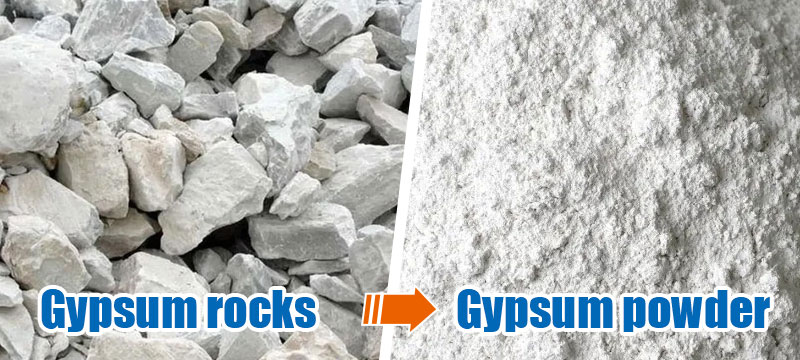
gypsum rocks to powder
When selecting a gypsum grinding mill, the primary decision factor is not the specific machine model but the processing method. Construction-grade gypsum powder requires calcination to remove water of crystallization; this dictates the choice among three possible routes: "calcine-then-grind," "integrated grinding and calcination," or "no calcination (filler-only production)." The machine model can only be selected once the route is determined.
• For 80–200 mesh construction gypsum powder (used in plastering and as raw material for gypsum board), the primary choice is the YGM Raymond Mill, which features closed-circuit air classification and the lowest electricity consumption per ton. For high-capacity lines (exceeding 15 t/h) producing gypsum board raw material, a dry ball mill is selected, allowing for integrated grinding and calcination.
• For 600–2500 mesh filler-grade gypsum powder (used in plastics, papermaking, and coatings), the HGM Ultrafine Mill is chosen to capture the price premium associated with fine particle size.
Gypsum has a Mohs hardness of only 1.5–2 and excellent grindability; its wear-related processing costs are less than one-third of those for calcium carbonate—an often-overlooked cost advantage in gypsum processing.
I. Lesson One in Equipment Selection: The Fundamental Difference Between Gypsum and Calcium Carbonate—Calcination
While gypsum and calcium carbonate grinding processes may appear similar—involving crushing, grinding, and classification—they differ by a crucial chemical step. Calcium carbonate is an inert filler; once ground to the target mesh size, the product is ready. In contrast, gypsum (CaSO₄·2H₂O) must undergo calcination at 150–180°C to remove 1.5 molecules of water of crystallization, transforming it into β-calcium sulfate hemihydrate (CaSO₄·0.5H₂O) to acquire hydraulic properties—making it suitable for use in plaster, gypsum board, and gypsum blocks. Uncalcined gypsum powder can only be sold as a filler, with a price difference of an order of magnitude.
Basic Material Parameters for Gypsum (Selection Baseline)
| Parameter | Value | Impact on Equipment Selection |
| Mohs Hardness | 1.5–2 | Soft and brittle material; extremely low wear costs; no need for hard-rock grade wear-resistant design |
| Bulk Density | 1.3–1.5 t/m³ | Production capacity must be adjusted based on density (≈85–95% of the limestone baseline) |
| Bond Work Index | ≈8 kWh/t | Easy to grind; specific energy consumption (per ton) is 20–30% lower than limestone for the same fineness |
| Moisture Content (Natural Ore) | 3–5% | Can be fed directly into the mill (hot air in the grinding chamber provides drying capability) |
| Moisture Content (FGD Gypsum) | 10–15% | Must be dried, then calcined, then ground; crushing stage is eliminated |
| Phase Transition Temperature | ≈150°C (loss of crystal water) | Grinding chamber temperature must be controlled to prevent "over-burning" inside the mill |
Three Process Routes (Select route first, then the mill)
| Route | Process Flow | Application Scenario | Corresponding Mill |
| A. Calcination before Grinding (Mainstream) | Crushing → Calcination (Rotary Kiln) → Grinding → Classification | Construction gypsum powder, plastering gypsum powder; small-to-medium capacity | YGM Raymond Mill / Ball Mill |
| B. Integrated Grinding & Calcination | Crushing → Ball Milling (Hot-air grinding & calcination inside the mill) | High-capacity gypsum board raw material powder (15 t/h+) | Dry Ball Mill |
| C. Non-calcined Filler | Crushing → Ultrafine Grinding → Classification | Filler powder for plastics/paper/coatings (600–2500 mesh) | HGM Ultrafine Mill |
The core reason why Route A ("calcination before grinding") is superior to "grinding before calcination" is that calcined gypsum (stucco) has a loose structure and a broken crystal lattice; its grindability is significantly improved, resulting in 20–30% higher mill capacity (estimated) and lower wear rates. This is why the rotary kiln plus Raymond mill combination has become the mainstream process for producing construction gypsum powder.
II. Comparative Analysis of Three Major Grinding Mill Solutions
| Dimension | YGM Raymond Mill (High-pressure suspended roller mill) | Dry Ball Mill | HGM Ultrafine Mill (Three-ring micro-powder mill) |
| Working Principle | Suspended roller grinding + closed-circuit air classification | Rotating drum with steel ball grinding | Three-ring multi-roller grinding + variable-frequency classification |
| Finished Product Fineness | 80–425 mesh | 80–400 mesh | 150–3000 mesh (D97: 5–47 μm) |
| Typical Capacity | 0.5–12 t/h | 10–50 t/h | 0.5–45 t/h |
| Electricity Consumption per Ton | ★★★★★ Lowest | ★★☆ Relatively high | ★★★★ Moderate |
| Wear Part Costs | ★★★★★ Low | ★★★ Moderate | ★★★★ Low |
| Investment Threshold | ★★★★★ Lowest | ★★☆ High | ★★★☆ Medium-High |
| Calcination Integration | Requires external rotary kiln | Integrated grinding & calcination possible | Requires external calcination/drying |
| Optimal Positioning | Mainstream for architectural gypsum powder | High-capacity raw material lines for gypsum board | Premium segment for ultrafine filler powder |
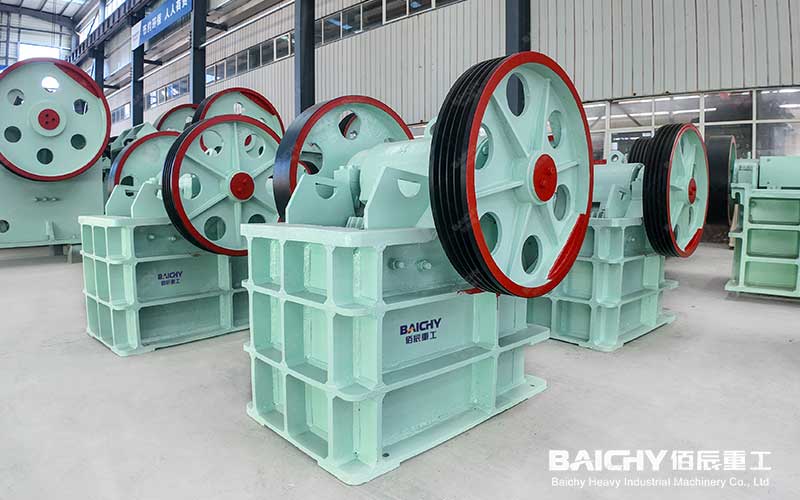
YGM Raymond Mill Series (Mainstream for architectural gypsum powder; 5R baseline parameters)
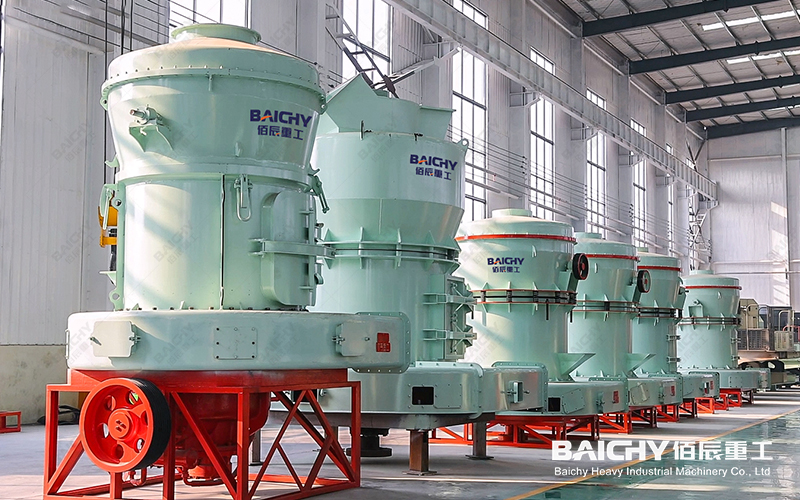
gypsum grinding mill
| Parameter | 5R Raymond Mill (Typical) |
| Number of Grinding Rollers | 5 (Suspended roller type) |
| Max. Feed Size |
≤ 30 mm |
| Finished Product Fineness | 80–425 mesh (0.18–0.038 mm) |
| Capacity Range | 0.5–12 t/h (depending on fineness and material) |
| Main Motor Power | 75–90 kW |
| Total Installed Power | ≈150–175 kW (including fan and classifier) |
| Applicable Hardness | Mohs ≤ 7 (gypsum, limestone, dolomite, etc.) |
HGM Ultrafine Mill Series (Filler-grade gypsum powder; selection highlights)
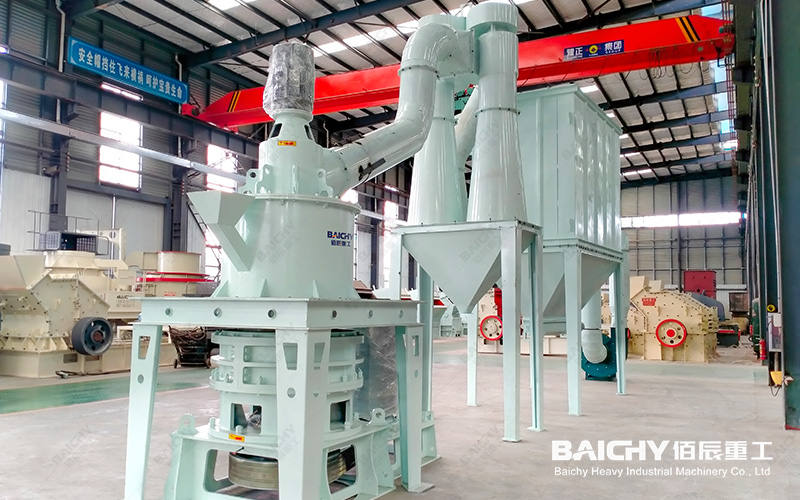
HGM mill for gypsum
| Model | Number of Grinding Rollers | Main Unit Power | Typical Capacity (t/h) | Finished Product Fineness (D97) |
| HGM80 | 21 units (3 grinding rings) | 75–90 kW | 1–5 | 150–3000 mesh |
| HGM90 | 27 units | 90–110 kW | 0.6–6.5 | Same as above |
| HGM100/100A | 30 units | 110–132 kW | 0.8–8 | Same as above |
| HGM125 | 36 units | 185–220 kW | 1.5–14 | Same as above |
| HGM1680 | 42 units | 315–400 kW | 2–30 | Same as above |
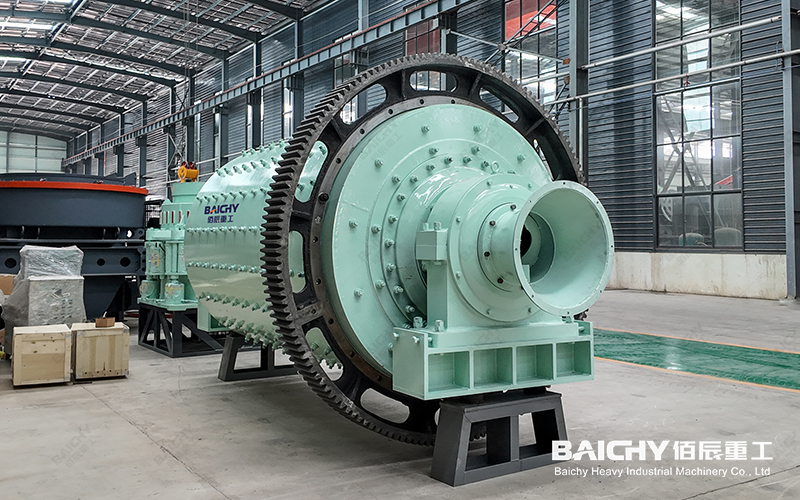
Dry Ball Mill (High-capacity gypsum board raw material line)
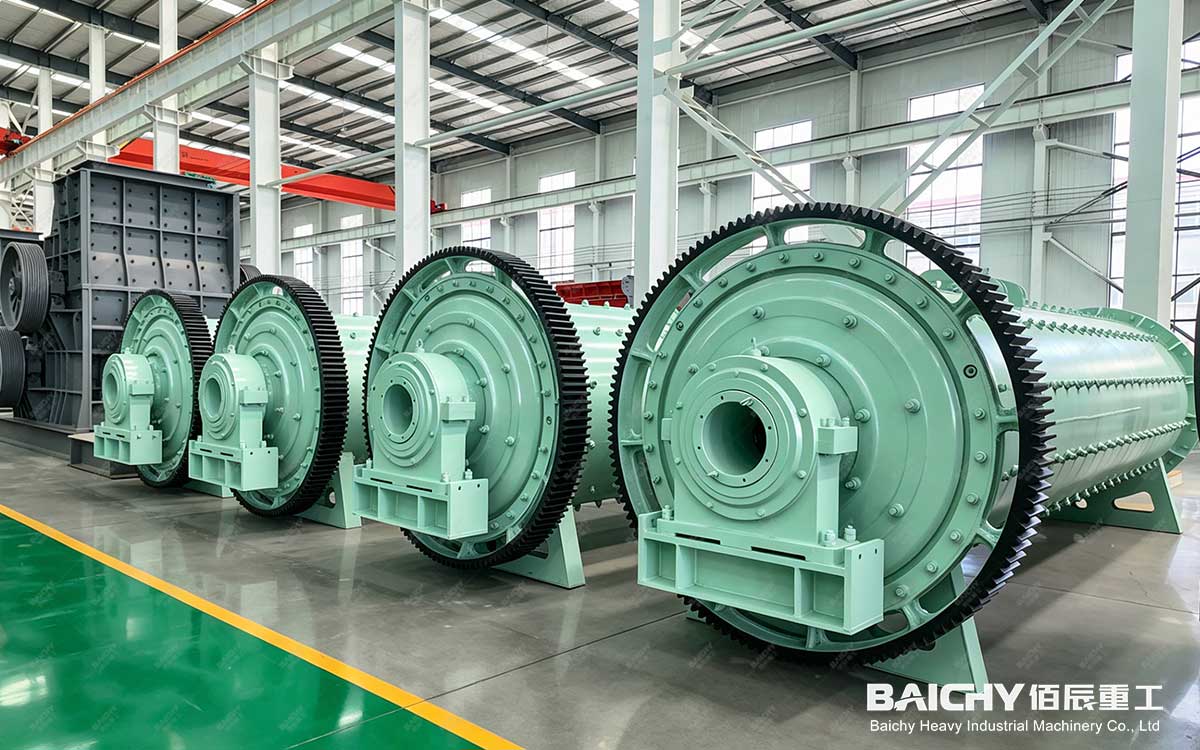
ball mill for gypsum
• Capacity: 10–50 t/h (gypsum application, depending on shell specifications);
• output fineness: 80–400 mesh (external classifier can be equipped).
• Integrated grinding and calcination: Hot air (150–180°C) is fed into the shell; grinding and calcination occur within the same unit. The system is compact and eliminates the need for a separate calcination unit, though electricity consumption per ton and wear rates are higher compared to the Raymond mill process.
• Preferred choice for gypsum board plant raw material powder (stable fineness, rigid capacity requirements); Raymond mills are prioritized for small-to-medium capacity construction powder lines.
*Note: The capacities listed above are based on calcium carbonate/limestone (bulk density: 1.6 t/m³). Gypsum has a bulk density of approximately 1.3–1.5 t/m³; assuming constant volumetric capacity, the tonnage capacity is approximately 85–95% of the baseline value (estimated). Gypsum has better grindability at the same fineness, potentially reducing electricity consumption per ton by another 20–30% (estimated). Capacity at 600 mesh is approximately 3–5 times that at 2500 mesh (estimated). Final specifications are subject to the signed technical agreement and material grinding test report.
III. Five-Step Selection Decision Method
1. Fineness determines the product. Construction-grade gypsum powder (80–200 mesh) → Raymond mill; raw powder for gypsum board (150–250 mesh) → Ball mill/Raymond mill; filler-grade (600–2500 mesh) → HGM ultrafine mill; agricultural gypsum (coarse powder) → Raymond mill (coarse setting). First ask "Who is the customer?", then ask "Which machine to buy?".
2. Raw material determines the process route. Natural gypsum ore: Crushing → Calcination → Grinding (Route A/B); FGD desulfurization gypsum: Skip crushing stage; Drying → Calcination → Grinding. If raw material moisture content >5%, include a dryer first.
3. Production capacity determines the model. <5 t/h: Select 3R/4R Raymond mill; 5–12 t/h: Select 5R Raymond mill; >15 t/h with stable particle size requirements: Evaluate integrated ball mill-calciner systems or parallel dual-line setups.
4. Calcination determines the process. Producing construction-grade gypsum powder requires calcination—choose between an external rotary kiln (Route A) or an integrated ball mill-calciner (Route B) based on capacity and footprint; for filler-grade products requiring no calcination (Route C), proceed directly to ultrafine grinding.
5. Power supply determines auxiliary equipment. Confirm on-site voltage and frequency (e.g., 380V/50Hz or 440V/60Hz); customize the complete set of main motors, fans, classifiers, and feeders to local standards to avoid capacity loss and overheating issues associated with using "50Hz motors + VFDs."
IV. How to make the choice?
Recommended Solution A (Construction-grade gypsum powder, 5–12 t/h): PC Hammer Crusher (crush gypsum to ≤30mm) → Rotary Kiln Calcination → 5R Raymond Mill → Classification & Dust Collection. Offers the lowest investment and lowest electricity consumption per ton; the top choice for small-to-medium capacity gypsum powder or gypsum plaster plants. Recommended Option B (Raw material for gypsum board, 15 t/h+): Jaw/Hammer Crusher → Dry Ball Mill (integrated grinding & calcination) → Classification. Offers rigid production capacity and stable particle size; the top choice for large-scale gypsum board plants.
Recommended Option C (Ultrafine filler powder): Crushing → HGM Ultrafine Mill → Variable-frequency Classification → Pulse Dust Collection. Targets the 600–2500 mesh premium market; the top choice for filler plants serving the plastics, paper, and coatings industries.
Not recommended: ① Buying an HGM mill solely for coarse 80-mesh powder—using premium-tier equipment for coarse work wastes investment; ② Raw material consistently >5% moisture content without a drying budget—resolve the drying issue before considering the mill; ③ Buying a generic mill without temperature control when the target market has zero tolerance for initial setting time issues—hydration performance is a critical acceptance criterion for gypsum powder.
V. FAQ
Q1: What are the fundamental differences in selecting a gypsum mill versus a calcium carbonate mill?
A1: The difference lies in calcination. Calcium carbonate is inert; once ground to the target mesh, it is a finished product. To produce construction-grade gypsum powder, the material must first be calcined at 150–180°C to remove crystal water (forming β-hemihydrate gypsum); otherwise, the finished product will not hydrate. When selecting a gypsum mill, the primary decision factor is the process route (calcine-then-grind, integrated grind-and-calcine, or no calcination for fillers), followed by the specific machine model.
Q2: How do I choose between Raymond mills, ball mills, and HGM mills for gypsum?
A2: Choose the YGM Raymond mill for 80–200 mesh construction gypsum powder (lowest electricity consumption per ton); choose the dry ball mill (capable of integrated grinding and calcination) for gypsum board raw material powder at capacities exceeding 15 t/h; choose the HGM ultrafine mill for 600–2500 mesh filler powder. Selection can be determined by plotting the requirements on two axes: "finished product fineness" and "production capacity."
Q3: Why is calcination necessary for gypsum powder production? Should calcination occur before or after grinding?
A3: Dihydrate gypsum acquires hydraulic properties only after losing 1.5 molecules of crystal water to become β-hemihydrate gypsum; this is the chemical basis of construction gypsum powder. The "calcine-then-grind" process is the mainstream approach: calcined material is porous and easy to grind, resulting in 20–30% higher mill productivity (estimated). The "grind-then-calcine" process (integrated ball milling and calcining) is suitable for high-capacity gypsum board raw material lines, offering a compact system footprint.
Q4: What are the differences in the grinding processes for natural gypsum and desulfurization gypsum (FGD)?
A4: Natural gypsum requires crushing → calcining → grinding. FGD gypsum is already a fine powder (<1mm), eliminating the crushing stage; however, due to a moisture content of 10–15%, it must first undergo drying → calcining → grinding. In 2023, China generated approximately 158 million tons of FGD gypsum with a comprehensive utilization rate of about 80%, whereas the EU-27 achieved a 96% utilization rate—indicating that the resource utilization of by-product gypsum is a clear growth sector.
Q5: Can gypsum mill capacity ratings be overstated? How is the capacity calculated?
A5: Mill capacity ratings are based on calcium carbonate/limestone (density: 1.6 t/m³). Gypsum has a bulk density of 1.3–1.5 t/m³; its tonnage capacity is approximately 85–95% of the baseline (estimated), but it offers good grindability, resulting in 20–30% lower electricity consumption per ton. Before signing a contract, Baichen provides free material grinding tests, issuing D97 test reports and guaranteed capacity figures to prevent overstated ratings.
Q6: Can gypsum with high moisture content be fed directly into the mill? Are there requirements for the temperature inside the grinding chamber?
A6: Feeding wet material with >5% moisture directly into the mill causes roller coating and ring buildup, leading to a drastic drop in yield; therefore, pre-drying is mandatory. The temperature inside the grinding chamber must be controlled below 150°C (typically 60–100°C) to prevent premature loss of crystal water within the mill, which would cause abnormal initial setting times in the finished product—this is a unique design feature distinguishing gypsum grinding from that of other minerals.
Q7: Can the system operate stably on a 60Hz / 440V power grid?
A7: Yes. The main motor, blower, classifier, and feeder are all custom-configured for the local voltage and frequency, rather than relying on a compromise solution involving 50Hz motors paired with variable frequency drives (VFDs). We have a track record of delivering this series of equipment to projects in Latin America, the Middle East, and Southeast Asia, and we can arrange for remote factory inspections or on-site visits.