
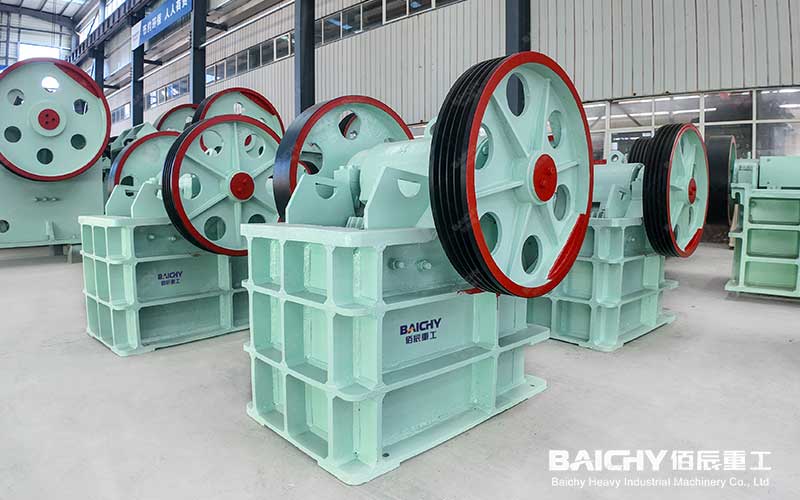
PE250x400 jaw crusher complete system
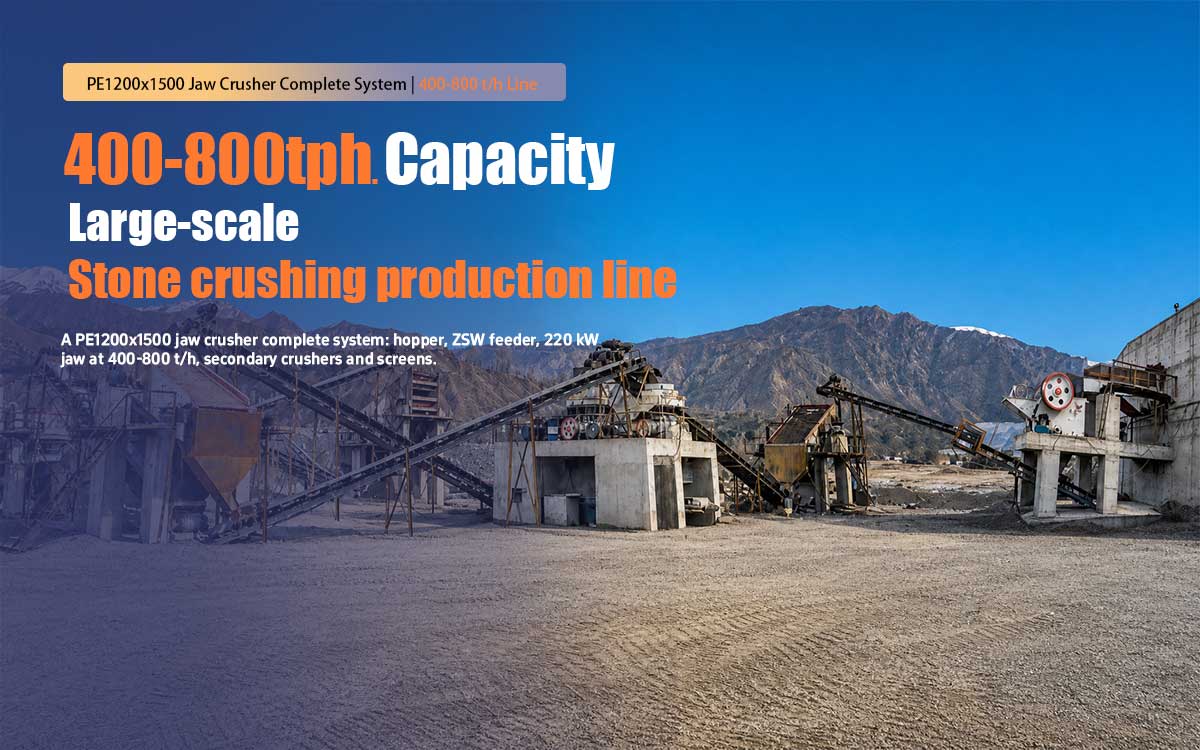
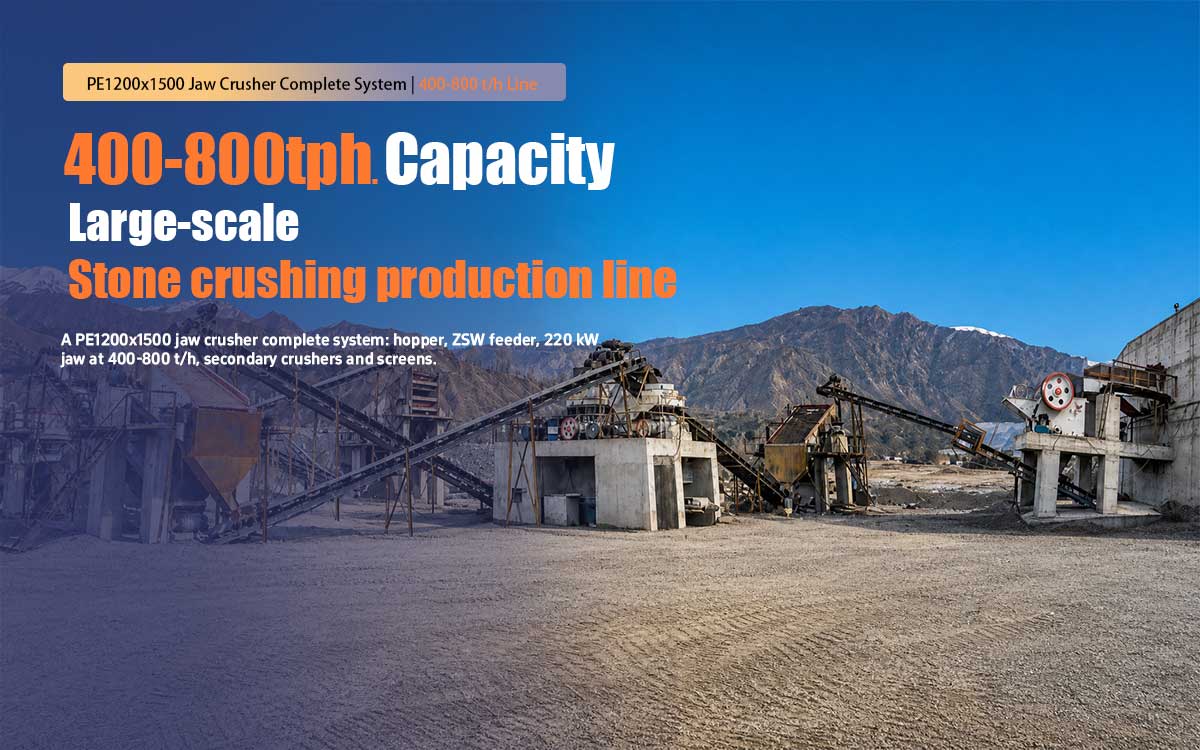
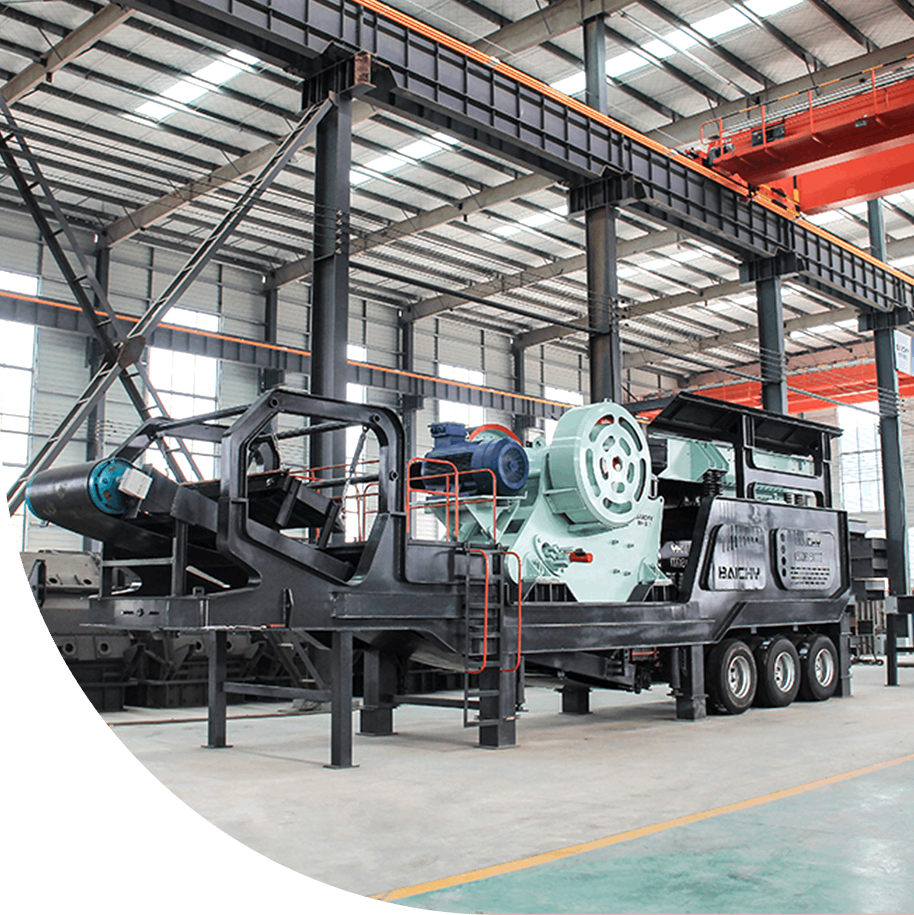
A PE250x400 jaw crusher complete system is a two-stage crushing and screening line built around one 15 kW primary jaw: a feed hopper, a vibrating feeder, the PE250x400 jaw crusher rated at 5-20 t/h, a PEX fine jaw crusher as the secondary stage, one YK circular vibrating screen and belt conveyors. This page prints the published PE250x400 specifications, explains what actually moves output inside the 5-20 t/h band, and gives the component sizes that match a line this small.
What are the PE250x400 jaw crusher specifications?
The PE250x400 jaw crusher takes a 210 mm maximum feed into a 250x400 mm feed opening and drives it with a 15 kW motor.
| Parameter | Value |
|---|---|
| Model | PE250×400 |
| Feeder mouth size (mm) | 250 × 400 |
| Max. feeding size (mm) | 210 |
| Outlet adjusting size (mm) | 25–60 |
| Motor power | 15 kW / 22 HP |
| Capacity (t/h) | 5–20 |
Values as published on the PE250x400 jaw crusher page. Output figures are reference values and vary with the material, feed size and required fineness.
Two numbers in that table decide everything downstream. The 210 mm maximum feed is 84% of the 250 mm opening width, which is the normal design margin: oversized lumps bridge across the jaws, load the eccentric shaft on one side and wear the jaw plates unevenly. The 25-60 mm outlet range is the lever you actually operate day to day, because every other component in the line is sized from it.
What capacity does a PE250x400 jaw crusher really deliver?
The published 5-20 t/h is a reference band. Where your line lands inside it is set by five variables, none of which is the machine's nameplate.
1. Discharge setting. Opening the outlet from 25 mm toward 60 mm raises tonnage and coarsens the product at the same time. You are trading gradation for throughput, not gaining both.
2. Material compressive strength. The machine is rated for material up to 320 MPa. Harder, more brittle rock fractures quickly but loads the jaw plates harder, while limestone at the same setting throughputs more easily.
3. Feed size distribution. A graded feed with the fines already removed runs faster than an all-lump feed, because the chamber spends less time on each piece. This is the single largest swing factor on a small line.
4. Moisture and stickiness. Wet or clay-bearing feed packs the chamber and can push effective output well below the published band.
5. Feed uniformity. Continuous choke feeding keeps the chamber full and the tonnage stable. Batch loading with a loader bucket produces peaks and idle time that never average out to the top of the range.
The practical consequence: if you need a dependable planning figure, quote a PE250x400 line at 10-15 t/h. Treat 20 t/h as the figure you reach with easy material, a wide setting and genuinely even feeding.
What happens if you feed lumps bigger than 210 mm?
The machine stalls or wears out early, and the second failure is the expensive one. A lump above 210 mm bridges the jaws; the toggle plate and eccentric shaft take an off-centre load; jaw plate wear accelerates on one side only. The immediate symptom is a stalled chamber or a slipping drive belt. The slow symptom is a jaw plate that wears out months early and an outlet setting that never quite holds.
If your run-of-mine regularly contains oversize, do one of two things: put a hydraulic breaker at the hopper, or run a coarser jaw upstream and let the PE250x400 work as the second stage rather than the first.
Two working habits prevent most of this. Keep the hopper grizzly clear, because a blinded grizzly is what lets oversize reach the chamber in the first place — the pre-screen is the machine's only defence against lumps it was not built for. Then check the jaw plate wear pattern weekly rather than monthly. On a machine this size an uneven wear line shows up early, a plate swap is a two-hour job, and an eccentric shaft repair is not.
Which materials does a PE250x400 jaw crusher process?
The machine handles medium-hard and lower-hard material with a compressive strength of no more than 320 MPa. Baichy lists granite, marble, basalt, river pebbles, iron ore, limestone, diabase, construction waste (concrete and bricks), slag and coal gangue.
The list splits usefully in two when you are sizing the line. Limestone, coal gangue, brick and slag are the easy half: they crush fast, wear the plates slowly and tend to sit in the upper part of the 5-20 t/h band. Granite, basalt, river pebble and iron ore are the abrasive half: they still fit the machine, but budget for more frequent jaw plate replacement and expect the lower half of the band.
Construction waste is worth singling out. Concrete and brick rubble are exactly the feed this size of jaw was built for, but reinforcing bar changes the job: the bar has to be cut or the feed has to be screened out before it reaches the chamber, or it wraps the eccentric shaft.
Which secondary crusher should follow a PE250x400 jaw crusher?
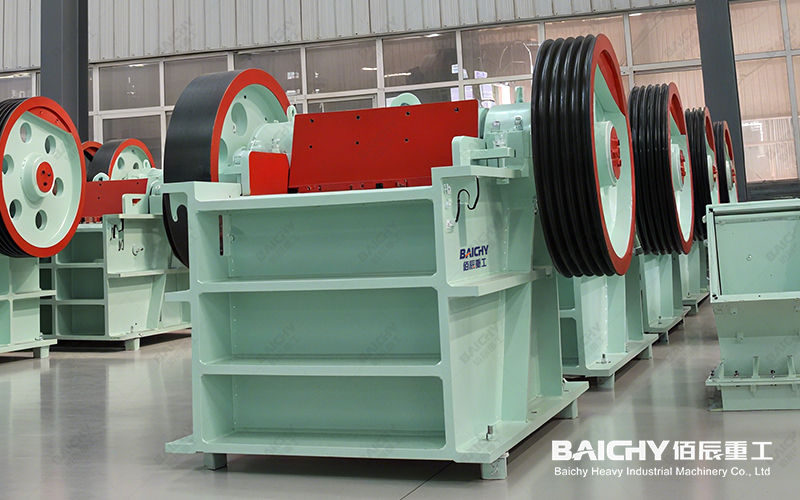
PEX Series Jaw Crusher
Match the secondary crusher's rated maximum feed size against the widest setting of the jaw's outlet — 60 mm. Both PEX models Baichy publishes clear that figure by a wide margin.
| Model | Feed opening (mm) | Max. feeding size (mm) | Outlet adjusting size (mm) | Motor power (kW) | Capacity (t/h) | Overall dimension (mm) |
|---|---|---|---|---|---|---|
| PEX-250×750 | 250 × 750 | 210 | 15–50 | 22 | 15–30 | 1,440 × 1,751 × 1,515 |
| PEX-250×1200 | 250 × 1200 | 210 | 15–60 | 37 | 20–60 | 1,730 × 2,150 × 1,400 |
For a 5-20 t/h line the PEX-250x750 fine jaw crusher is the match. Its 15-30 t/h band sits just above the jaw's ceiling, so the secondary never starves or chokes the primary. PEX-250×1200 only makes sense if you are buying for the line you intend to have in three years, because at 20-60 t/h it is waiting for a primary jaw two sizes larger than a PE250x400.
Be clear about what the PEX stage is for. It converts the jaw's 25-60 mm discharge into 15-50 mm and finer, which is what lets one screen produce sellable fractions instead of a single coarse pile. If your only product is 25-60 mm road base, skip the secondary entirely and run a single-stage line — the PEX machine and one conveyor are pure cost in that case.
What feeder, screen and conveyors match a 5-20 t/h jaw?
Three sizing rules, then the component data that is actually published.
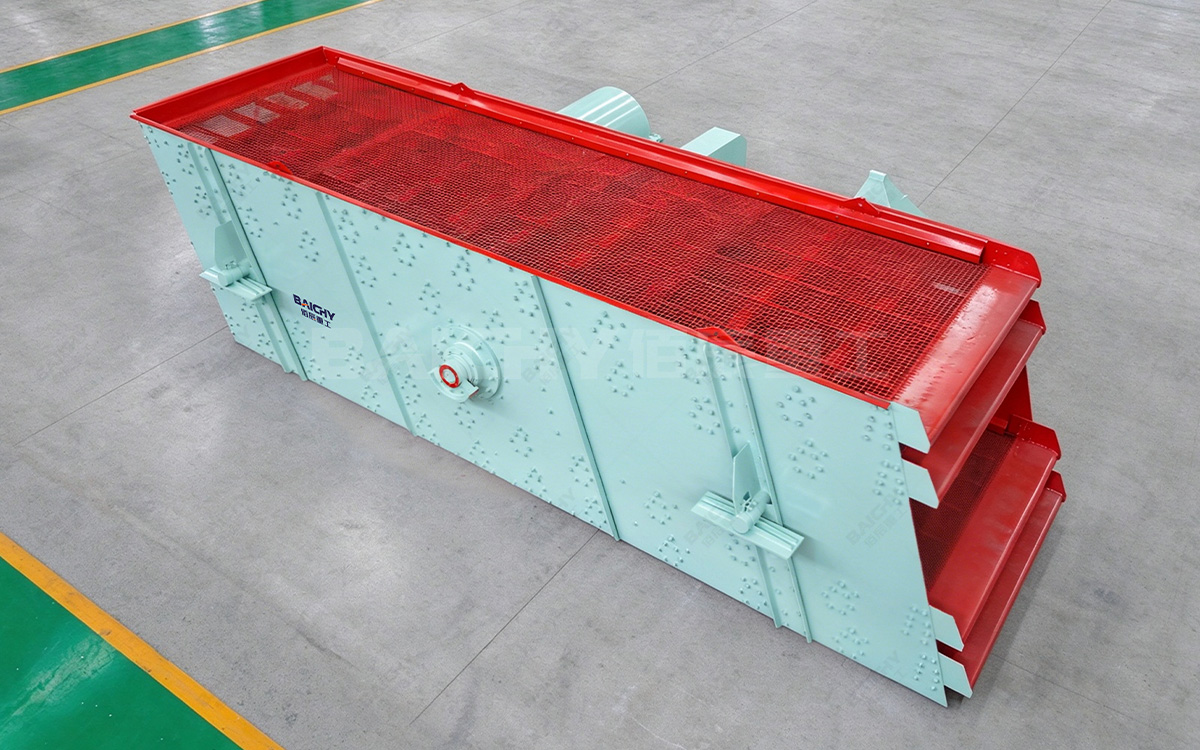
YK Series Vibrating Screen
• Feeder: rated at or above the crusher's design output, with a grizzly that passes 210 mm. A ZSW grizzly feeder pre-screens the feed: fines drop through the bar section to the belt below, and only oversize continues into the jaw. That is what keeps the chamber from grinding material that never needed crushing, and it is part of why the capacity band spreads as wide as 5-20 t/h. Baichy's published 30-50 t/h plan uses a ZSW650x2500, which is the smallest ZSW reference point the company prints.
• Screen: match the deck count to the fractions you sell, not to the tonnage. YK circular vibrating screens start at the 1237 size, and the three variants differ only in deck count and motor.
| Model | Screen surface (mm) | Layers | Sieve pore size (mm) | Max. feeding size (mm) | Capacity (t/h) | Power (kW) |
|---|---|---|---|---|---|---|
| 2YK1237 | 3700 × 1200 | 2 | 3–50 | 200 | 30–100 | 7.5 |
| 3YK1237 | 3700 × 1200 | 3 | 3–50 | 200 | 30–100 | 11 |
| 4YK1237 | 3700 × 1200 | 4 | 3–50 | 200 | 30–100 | 15 |
Values as published on the YK circular vibrating screen page.
Read those capacity figures against a 5-20 t/h jaw and one conclusion follows: even the smallest published YK screen out-runs the crusher by a factor of two or more. The screen is never the bottleneck on a PE250x400 line. Choose the deck count from the number of finished sizes you sell — three decks for 0-5 mm, 5-10 mm and 10-20 mm plus an oversize return — and accept that the machine will run well below its rating. Do not size the screen down expecting a proportional price cut, because the 1237 is the smallest surface Baichy builds in this series.
Conveyors: B500 and B650. Those are the belt widths printed in the published 30-50 t/h crushing plant plan, and both are more than adequate for a 20 t/h line.
What do the published Baichy configurations look like?
Two printed plans bracket the PE250x400 line and show the equipment-group structure you are assembling. The smaller one, published as a 30-50 t/h solution, prints its equipment list as follows:
| No. | Equipment | Model | Qty |
|---|---|---|---|
| A-1 | Hopper | LC3000×4000 | 1 |
| A-2 | Vibrating feeder | ZSW650×2500 | 1 |
| A-3 | Jaw crusher | PE400×600 | 1 |
| A-4 | Impact crusher | PF1007 | 1 |
| A-5 | Vibrating screen | 4YK1237 | 1 |
with four conveyor lines in B500 and B650 widths, at 15 to 23 m.
The larger reference plan, printed on the fine jaw crusher page as a 200 t/h gravel plant, repeats the same structure with different numbers:
| No. | Product name | Model | Quantity |
|---|---|---|---|
| 1 | Hopper | — | 1 |
| 2 | Vibrating feeder | ZSW1142 | 1 |
| 3 | Jaw crusher | PE750×1060 | 1 |
| 4 | Fine jaw crusher | PEX-250×1200 | 4 |
| 5 | Vibrating screen | 4YK2160 | 1 |
| 6 | Belt conveyor | B1000 | 4 |
| 7 | Belt conveyor | B650 | 5 |
The structure is identical at every scale: hopper, feeder, primary jaw, secondary, screen, conveyors. Only the models and the counts change. A PE250x400 line is the same list with a smaller jaw, a PEX-250x750 instead of four PEX-250x1200 units, and a 3YK1237 instead of a 4YK2160.
How do you size a PE250x400 line in four steps?
Step 1 — lock the feed. Write down the largest lump in your run-of-mine, in millimetres. Above 210 mm, either add a breaker at the hopper or move the PE250x400 to the second stage. Everything else in the design depends on this number.
Step 2 — lock the product. Decide which finished fractions you sell. One coarse product at 25-60 mm means a single-stage line. Two to four fractions means a PEX secondary plus a three-deck screen, and the PEX outlet range sets the finest fraction you can hold.
Step 3 — match the auxiliary equipment to the crusher, not to each other. The feeder is sized from the jaw's design output and maximum feed size; the screen is sized from the number of fractions; the conveyors are sized from the belt widths already used at this scale, B500 and B650.
Step 4 — check installed power and the layout. Total the motor list before you talk to an electrician: 15 kW on the PE250x400, 22 kW on a PEX-250x750, 7.5-15 kW on the screen, plus the feeder. The jaw needs a foundation sized to its overall dimension, so confirm that figure against the current spec sheet rather than an older quotation.
What is a PE250x400 line not suitable for?
Four limits are worth stating plainly, because each one turns into a redesign rather than an adjustment.
• Feed above roughly 210 mm. There is no setting that fixes this. It needs a breaker or a larger primary.
• Targets much above 20 t/h. Two PE250x400 units in parallel is a legitimate answer for a 30 t/h requirement, but it is a different design and a different budget. Do not plan on stretching one machine.
• Highly abrasive hard rock over long campaigns. Granite, basalt and river pebble work, but plate consumption is a running cost, and on a machine this size the plates are a larger share of the bill than on a big jaw.
• Sticky, high-moisture feed. Wet clay-bearing material blinds the grizzly and packs the chamber. This case needs a wider trough without grid bars, or pre-drying, and neither is standard on a small line.
One further honest note on screening: because the smallest published YK screen is rated 30-100 t/h and the jaw tops out at 20 t/h, a PE250x400 line always runs its screen at a fraction of its rating. That is a deliberate and safe choice, not a mistake — but it does mean the screen will not be where you save money.
FAQ: PE250x400 jaw crusher complete system
Q: What are the PE250x400 jaw crusher specifications?
A: The PE250x400 jaw crusher has a 250 × 400 mm feed opening, a 210 mm maximum feeding size, a 25-60 mm adjustable outlet, a 15 kW (22 HP) motor and a published capacity of 5-20 t/h. These are the values printed on the Baichy PE250x400 product page.
Q: What is the capacity of a PE250x400 jaw crusher?
A: The published band is 5-20 t/h and it is a reference range, not a guaranteed figure. Actual output depends on the discharge setting, material compressive strength, feed grading, moisture and how evenly the machine is fed. For planning purposes, 10-15 t/h is the dependable figure for a typical small quarry line.
Q: What is the maximum feed size of a PE250x400 jaw crusher?
A: 210 mm, against a 250 mm feed opening width. That is roughly 84% of the opening, and feeding lumps larger than 210 mm causes bridging, off-centre loading of the eccentric shaft and accelerated jaw plate wear.
Q: What secondary crusher should follow a PE250x400 jaw crusher?
A: A PEX-250x750 fine jaw crusher. Its 210 mm maximum feed size comfortably covers the jaw's widest 60 mm outlet setting, and its 15-30 t/h capacity band sits just above the primary's ceiling so it neither starves nor chokes the line. Choose PEX-250x1200 only if you are designing for a materially larger primary later.
Q: What screen and feeder does a 5-20 t/h jaw crusher line need?
A: A grizzly vibrating feeder rated at or above the crusher's design output and able to pass a 210 mm lump, and a YK circular vibrating screen chosen by deck count rather than capacity. The smallest YK model, 2YK1237, is rated 30-100 t/h, so it already exceeds the jaw's output; three decks covers 0-5, 5-10 and 10-20 mm plus oversize.

Baichy Heavy Industry
Baichy Heavy Industry is a high-tech mining equipment company integrating R&D, manufacturing, sales, and after-sales service. Focusing on crushing, grinding, and mineral processing equipment, we provide professional solutions to our customers. We are ISO9001:2015 、certified, and our products include mobile crushing palnts, crawler crushing plant, construction waste crushing plants, jaw crushers, sand making machines, cone crushers, fine crushers, grinding mills, ball mills, etc., all with reliable performance to meet diverse project needs.
Baichy Heavy Industry – Your Trusted Partner
To ensure optimal performance of your equipment, Baichy Heavy Industry offers:
- Professional on-site installation guidance
- Comprehensive operator training
- 24/7 technical support & maintenance services
Our complete after-sales service system guarantees long-term, stable operation of your machinery with minimal downtime.
Protect Your Rights – Only Use Official Channels
To avoid scams and ensure authentic support, contact us exclusively through:
• Official Website: www.baichychina.com
• WhatsApp: +8615093222637
• Email: [email protected]
Your satisfaction is our priority – expect prompt, professional service every time.
(Note: Beware of unauthorized third parties claiming to represent Baichy. Always verify through official contacts.)