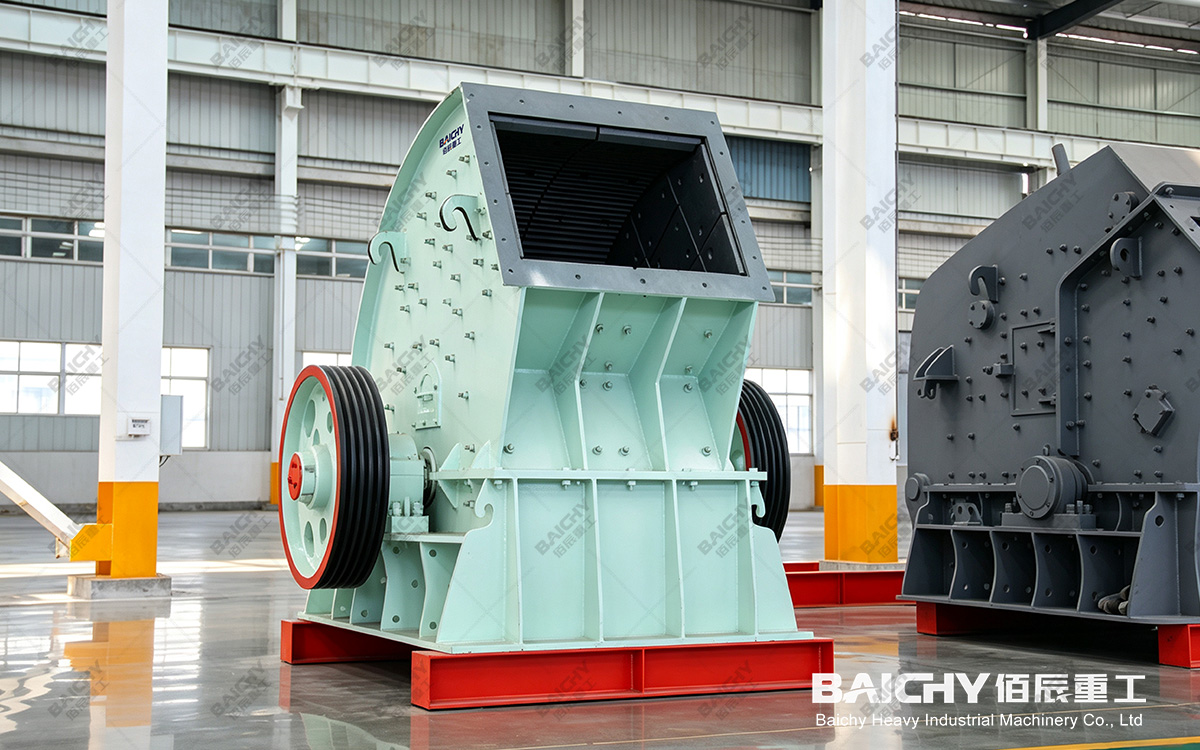
gypsum crusher
Gypsum is a soft, brittle material; it does not require "heavy weaponry." With a Mohs hardness of only 1.5–2, gypsum is easily crushed by impact; a heavy-duty two-stage configuration—such as a jaw crusher followed by an impact or cone crusher—is a waste of money. Baichen Heavy Industry’s PC series single-stage hammer crusher reduces gypsum ore (up to 350mm) to ≤30mm in a single pass, replacing a two-stage system. This saves 30–40% on equipment investment and reduces installed power capacity by approximately 35%; furthermore, the uniform output boosts the productivity of downstream grinding mills by 15–20%.
I. Four Common Mistakes in Gypsum Crushing Decisions
1.1 Selecting gypsum crushers using a "hard rock" mindset. Applying the same jaw-plus-cone crusher configuration used for limestone to gypsum (Mohs 1.5–2) means paying for unnecessary durability. This approach doubles the number of main units, conveyors, and dust collection systems, as well as the required infrastructure footprint; installed power capacity is over 35% higher than the single-stage solution, and electricity costs skyrocket due to the increased number of machines.
1.2 Focusing only on "can it crush?" rather than "who uses the crushed product?" The crushing stage feeds the grinding stage: if output granularity is uneven—with a mix of large chunks and fine powder entering the mill—mill productivity drops by 15–20%, and grinding rollers and rings suffer uneven wear and reduced lifespans. A crusher that ignores the needs of the mill creates a critical disconnect in the integrated production line.
1.3 Ignoring gypsum’s "wet and sticky" nature. Gypsum becomes sticky when wet; material with a surface moisture content exceeding 8% causes clogging of grate bars and rotor jamming in standard hammer crushers. While natural gypsum ore (3–5% moisture) can be fed directly, wet desulfurization gypsum or damp ore requires pre-drying—without anti-clogging features, the rainy season becomes a season of downtime.
1.4 Basing gypsum project specifications on limestone production capacities. Crusher capacity ratings are based on limestone (bulk density: 1.6 t/m³); however, the bulk density of gypsum is only 1.3–1.5 t/m³, meaning the tonnage capacity for the same volume decreases by 5–15%. Quotations that fail to adjust for material density often lead to "insufficient capacity" issues immediately upon commissioning.
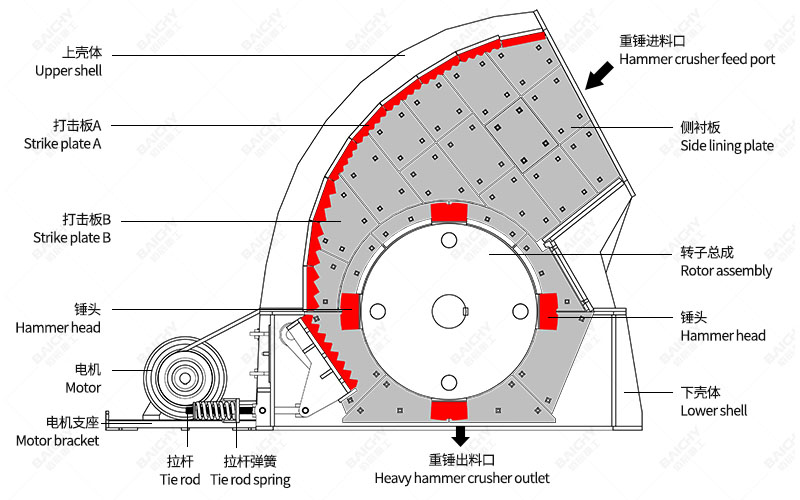
Structural diagram of a heavy-duty hammer crusher
II. Key Specifications: PC Series Single-Stage Hammer Crusher Selection Table
| Model | Rotor Dimensions (mm) | Max. Feed Size | Discharge Size | Capacity (t/h)* | Main Motor Power |
| PC600×400 | Ø600×400 | ≤ 100 mm | ≤ 30 mm | 8–15 | 22–30 kW |
| PC800×600 | Ø800×600 | ≤ 150 mm | ≤ 30 mm | 15–30 | 55–75 kW |
| PC1000×800 | Ø1000×800 | ≤ 250 mm | ≤ 30 mm | 30–50 | 90–110 kW |
| PC1200×1000 | Ø1200×1000 | ≤ 350 mm | ≤ 30 mm | 50–80 | 110–160 kW |
*Note: The capacities listed above are baseline values based on limestone (bulk density: 1.6 t/m³). Given that gypsum has a bulk density of approximately 1.3–1.5 t/m³, and assuming volumetric capacity remains constant, the tonnage capacity is approximately 85–95% of the baseline value (estimated); actual figures vary based on feed and discharge size requirements. Before contract signing, we provide free material crushing tests, issuing particle size analysis reports and guaranteed capacity figures—ensuring that limestone capacity ratings are not used to represent gypsum performance. The final terms are subject to the signed technical agreement.
III. Recommendations for Gypsum Crusher Selection
Recommended for:
• Natural gypsum processing plants (raw material crushing stage for gypsum board or construction-grade gypsum powder): PC-series single-stage hammer crusher for one-step shaping, directly replacing two-stage systems;
• Gypsum powder production lines (paired with Raymond mills or HGM mills): Produces uniform feed material ≤30mm, boosting both mill productivity and grinding component lifespan;
• Plants processing high-moisture gypsum or operating during rainy seasons: Anti-clogging design combined with a pre-drying system.
Not recommended for:
• Mines with raw ore lump sizes consistently >350mm: Requires a primary PE jaw crusher for coarse crushing (using a "jaw crusher + hammer crusher" two-stage setup); single-stage hammer crushing is unsuitable;
• Applications targeting a mix of sand and powder <5mm: Should use a double-roll crusher or a hammer crusher with a screening/re-circulation system; the lower limit for single-stage hammer crusher output is approximately 20mm;
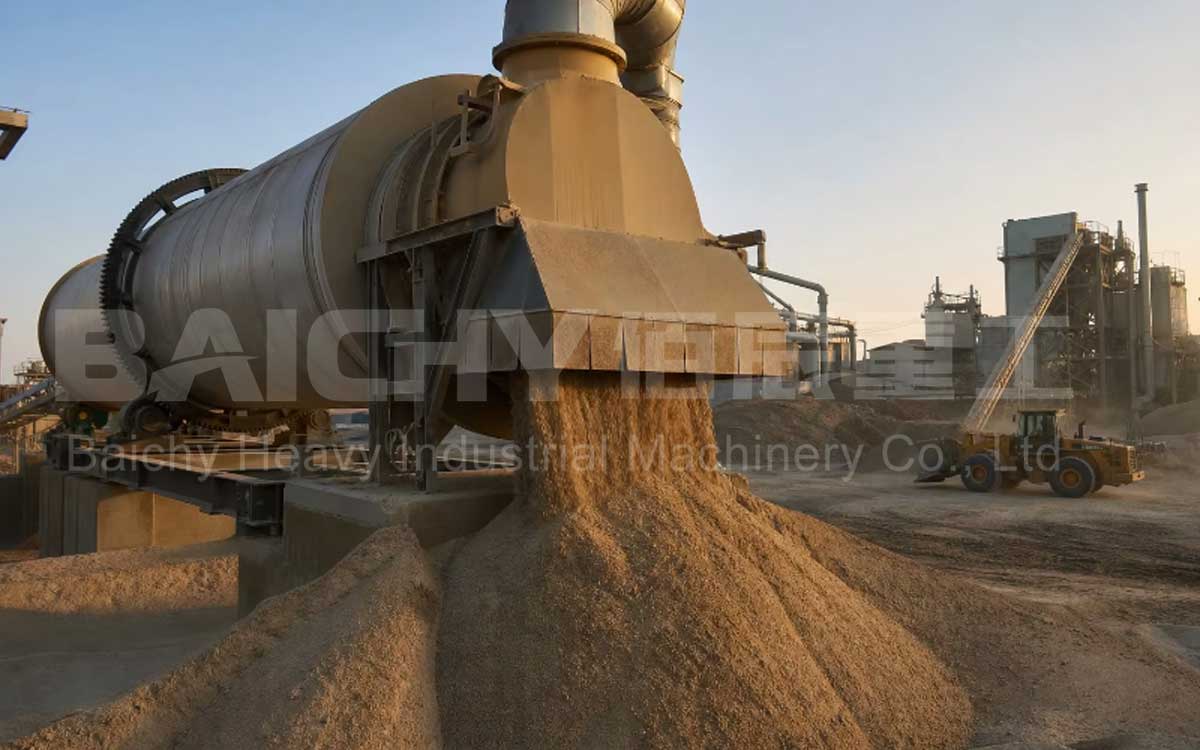
• Direct crushing of wet gypsum with >8% moisture content: Must be dried first (can be paired with Baichen rotary or triple-pass dryers); otherwise, screen plates will clog and yield rates will plummet.
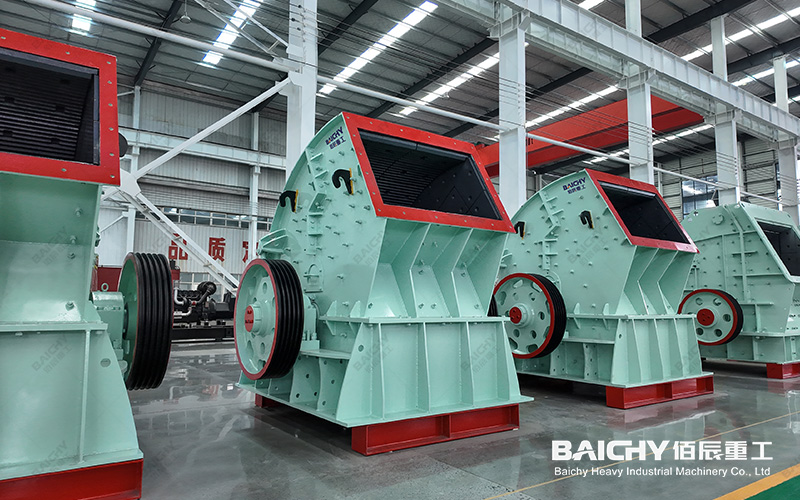
Heavy Hammer Crusher
IV. FAQ
Q1: Why choose a hammer crusher for gypsum instead of a jaw crusher plus a cone crusher?
A1: Gypsum has a Mohs hardness of only 1.5–2; it is a soft, brittle material that can be effectively processed via impact crushing. A single-stage hammer crusher offers a reduction ratio of up to 1:15–30, crushing gypsum ore from ≤350mm down to ≤30mm in one pass. A single unit replaces a two-stage system (primary jaw crushing + secondary impact/cone crushing)—saving the cost of one main machine, one conveyor belt, a dust collection system, and associated infrastructure. This reduces equipment investment by 30–40% and lowers installed power capacity by approximately 35%. A two-stage configuration designed for hard rock is a waste of money for gypsum applications.
Q2: What maximum lump size can the single-stage hammer crusher handle? How is the output particle size controlled?
A2: Taking the Baichen PC series as an example, the maximum feed size ranges from 100 to 350 mm (depending on the model), and the output particle size is controlled by the gap between the grate bars, allowing for a fixed output of ≤20/25/30 mm. If the raw ore exceeds 350 mm in size, a primary PE jaw crusher is required upstream to create a two-stage "jaw crusher + hammer crusher" setup; for materials with high moisture content, pre-drying is recommended.
Q3: How do the processing methods for natural gypsum and desulfurization gypsum (FGD gypsum) differ?
A3: Natural gypsum ore requires crushing, whereas FGD gypsum is already in a fine powder form (particle size usually <1 mm) and does not require crushing; instead, it requires drying and grinding. Wet gypsum with a moisture content >8% will clog the grate bars if fed directly into a hammer crusher; therefore, it must be dried before proceeding to the grinding stage. China's annual FGD gypsum production exceeds 80 million tons with a comprehensive utilization rate of approximately 71.3%, while the EU-27 reaches a utilization rate of 96% (as of 2023)—making the resource recovery of by-product gypsum a sector clearly driven by both policy and market demand.
Q4: How is gypsum crushing capacity calculated? Are the figures ever overstated?
A4: Crusher capacity ratings are based on limestone (density: 1.6 t/m³). Since the loose bulk density of gypsum is approximately 1.3–1.5 t/m³, the capacity in tons is roughly 85–95% of the limestone-based rating (estimated value) when calculated based on constant volumetric throughput. Before signing a contract, Baichen provides free material crushing tests, issuing particle size analysis reports and guaranteed capacity figures to prevent the practice of overstating capacity by using limestone-based ratings to represent gypsum performance.
Q5: How often do the hammer heads need to be replaced? Is the cost of wear parts high?
A5: When processing gypsum (Mohs hardness 1.5–2), the service life of high-chromium alloy hammerheads is approximately 1,200–2,000 hours (estimated)—three to four times that of hard rock applications. Based on 10 hours of daily operation, replacement is required roughly every 4–7 months. The wear cost is kept to the range of $0.02–$0.05 per ton, a figure far lower than the cost of downtime losses; spare parts are available from domestic stock, ensuring shorter delivery times compared to imported models.
Q6: How does the discharge particle size affect the subsequent grinding process?
A6: Grinding mills perform poorly with a mixed feed of "large lumps and fine powder": large lumps reduce grinding efficiency, while fine powder occupies the grinding chamber, undergoing ineffective circulation. The hammer crusher’s grate bars ensure a uniform discharge size of ≤30mm, stabilizing the feed for Raymond or HGM mills. Under identical operating conditions, mill capacity increases by 15–20% (estimated), and wear on grinding rollers and rings becomes more uniform, extending their service life.