Quarry stone crushers are categorized based on two logical criteria: the crushing stage (primary/coarse → secondary/medium → tertiary/fine → sand making) and material hardness (compression for hard rock; impact for soft material). When these two criteria intersect, the six mainstream crusher types fall into their respective roles; there is no such thing as a "universal crusher"—any selection error stems from using a machine in the wrong application.
| Crushing Stage | Hard Rock (Granite/Basalt/River Pebbles) | Medium-Soft Rock (Limestone/Gypsum/Construction Waste) |
| Primary (Coarse) | Jaw Crusher | Jaw Crusher / Double-Rotor Hammer Crusher |
| Secondary (Medium) | Cone Crusher | Impact Crusher |
| Tertiary (Fine) / Sand Making | Cone Crusher (Fine-crushing type) / VSI Sand Maker | Impact Crusher / Double-Roll Crusher / VSI |
| Sand Shaping | VSI Impact Sand Maker | VSI / Double-Roll Crusher |
Three ironclad rules to remember before selecting equipment:
1. Highly abrasive hard rock (granite, basalt, iron ore, river pebbles)—use "compression crushing" throughout the line: Jaw Crusher (primary) + Cone Crusher (secondary/tertiary) + VSI (sand making). The compression principle ensures a long lifespan for wear parts and the lowest cost-per-ton for hard rock operations;
2. Medium-soft rock (limestone, gypsum, dolomite)—prioritize "impact crushing": Impact Crushers produce cubical particles in a single pass, eliminating the need for a separate shaping stage investment; for high-volume production of brittle materials, use a Double-Rotor Hammer Crusher to replace a two-stage process with a single machine;
3. For concrete or asphalt aggregates requiring cubical particle shapes and a needle-and-flake content of <10%, the fine-crushing and sand-making stages *must* utilize a VSI or a Cone Crusher equipped with a shaping chamber—this is not optional; it is a mandatory acceptance criterion for concrete and asphalt mixing plants.
I. Understand the quarry crushing process: Three-stage crushing + one-stage sand making
The first step in selecting quarry equipment is not choosing the machines themselves, but drawing the process flow chart. The crushing circuit of a standard quarry (using hard rock as an example) follows a fixed sequence:
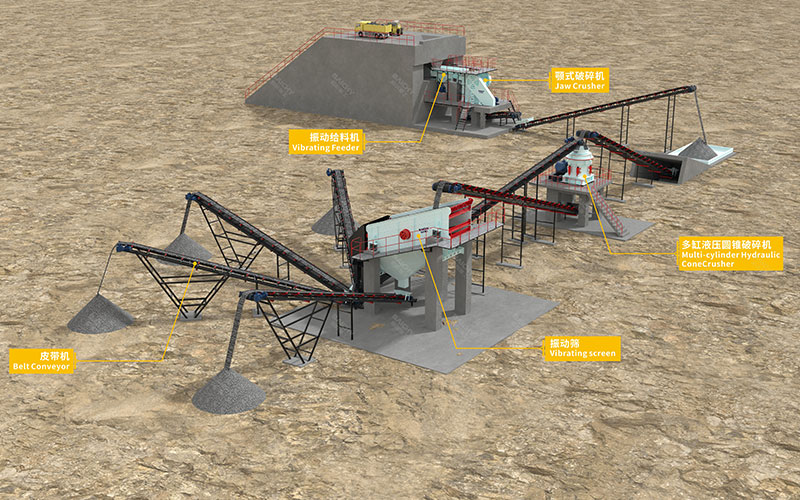
Three-stage crushing + one-stage sand making
Why can't the order be changed? Because every crusher has its own "optimal feed range":
| Crushing Stage | Feed Size | Discharge Size | Reduction Ratio |
| Primary Crushing | ≤500–1000mm | 100–300mm | 4:1–6:1 |
| Secondary Crushing | 100–300mm | 30–80mm | 3:1–5:1 |
| Tertiary Crushing | 30–80mm | 5–25mm | 3:1–6:1 |
| Sand Making | 5–40mm | 0–5mm | 5:1–8:1 |
Using equipment across stages (e.g., using a jaw crusher for sand making or a VSI to crush 200mm boulders) results in, at best, a halving of production capacity, and at worst, total equipment failure. Selecting equipment types is essentially a "fill-in-the-blank" exercise matched to the specific crushing stage.
II. A Detailed Breakdown of the 6 Mainstream Stone Crushers
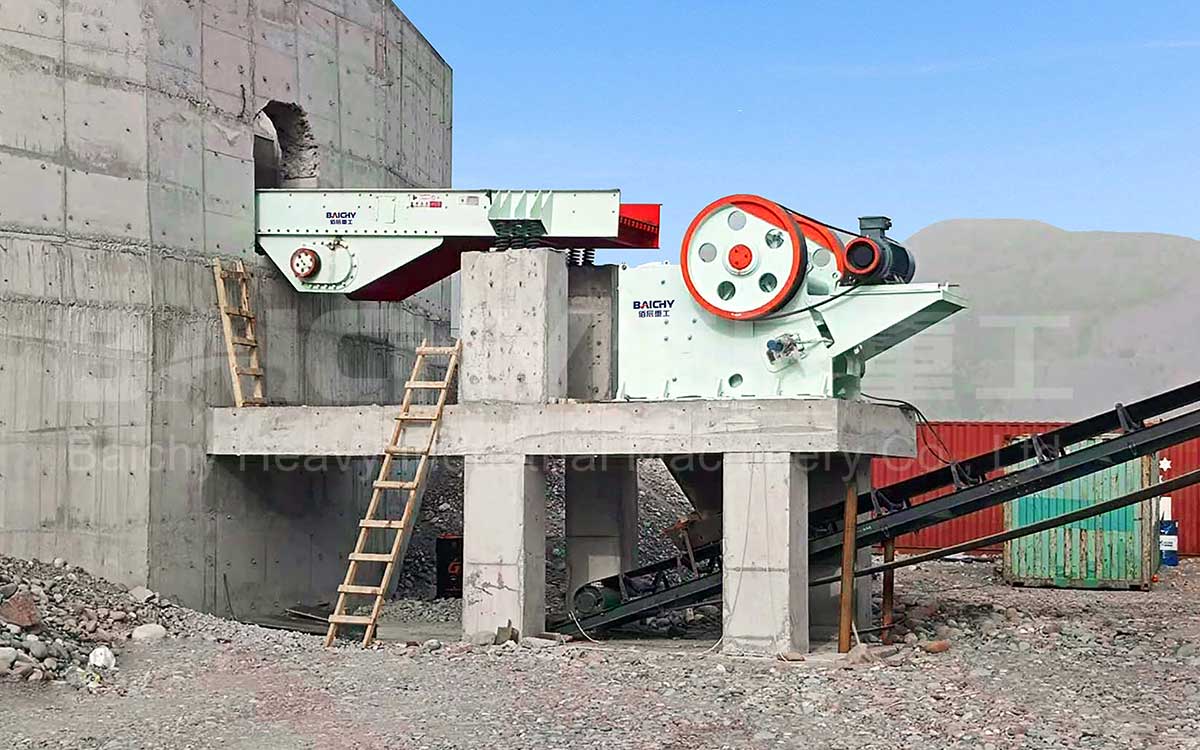
2.1 Jaw Crusher (PE / PEX / C Series) — The primary crushing workhorse; the top choice for hard rock
• Working Principle: Driven by an eccentric shaft, the movable jaw plate reciprocates against the fixed jaw plate at a frequency of 250–350 strokes per minute. It crushes and splits rock within the V-shaped crushing chamber until the fragments are smaller than the discharge opening (Closed Side Setting, or CSS) and fall through. It relies purely on compressive crushing; there is no impact action.
• Applicable Stage: Primary crushing (first stage). The PEX series (fine-crushing type) can be used for the secondary stage, but its primary role is initial crushing.
• Why it is almost always the first machine in a quarry: Large feed opening (e.g., the PE750×1060 can accept raw material up to 630mm); handles rock of any hardness; simple structure; jaw plate lifespan of 800–3000 hours (depending on material abrasiveness); and low failure rate. Since a breakdown at the primary crushing stage is catastrophic for the entire production line, the reliability of the jaw crusher is the fundamental requirement for the 24-hour continuous operation of hard-rock quarries.
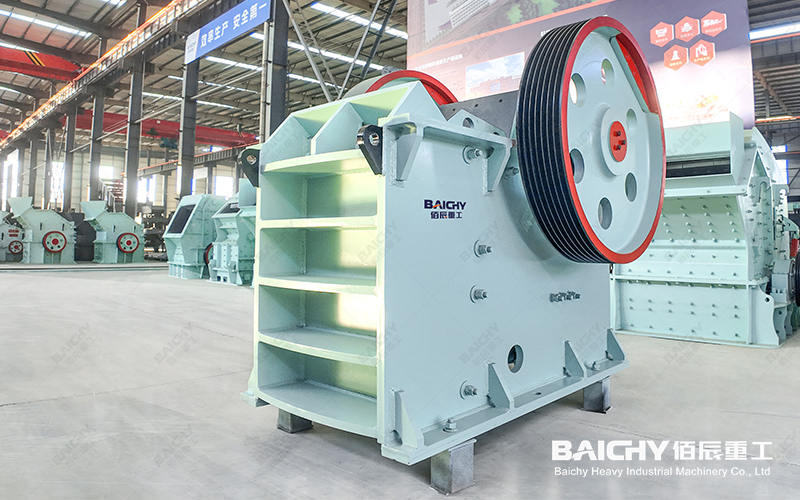
PE Jaw Crusher
Specifications of Representative Models:
| Model | Feed Opening (mm) | Max. Feed Size (mm) | Capacity (t/h) | Motor Power (kW) |
| PE400×600 | 400×600 | ≤340 | 16–64 | 30 |
| PE500×750 | 500×750 | ≤425 | 45–110 | 55 |
| PE600×900 | 600×900 | ≤500 | 50–160 | 75 |
| PE750×1060 | 750×1060 | ≤630 | 110–320 | 110 |
| C90 | 600×900 | ≤500 | 50–180 | 90 |
• Advantages: Lowest investment, simplest maintenance, and superior impact resistance.
• Drawbacks: Coarse output particle size (65–160 mm), making it unsuitable for independent medium-to-fine crushing; continuous compression generates significant vibration, requiring a solid foundation (stationary plants) or a heavy-duty chassis (mobile stations).
2.2 Cone Crusher (CS / HP / PYB Series)—The "Standard Choice" for Medium-to-Fine Crushing of Hard Rock
• Working Principle: Inter-particle (lamination) crushing. Material is crushed through compression between particles within the crushing chamber rather than by single-point impact; the resulting product has a uniform shape with low needle-and-flake content.
• Application Stages: Medium crushing and fine crushing (secondary and tertiary stages).
• Comparison with Impact Crushers for Hard Rock: The conclusion is definitive. When processing granite, basalt, or river pebbles, impact crusher blow bars require replacement 1–2 times per month, leading to frequent downtime; in contrast, the wear parts of cone crushers last 6–10 times longer. For hard-rock quarries with a monthly output exceeding 30,000 tons, the initial cost difference for a cone crusher setup can be recouped within 2–3 years through savings on wear parts and reduced downtime costs.
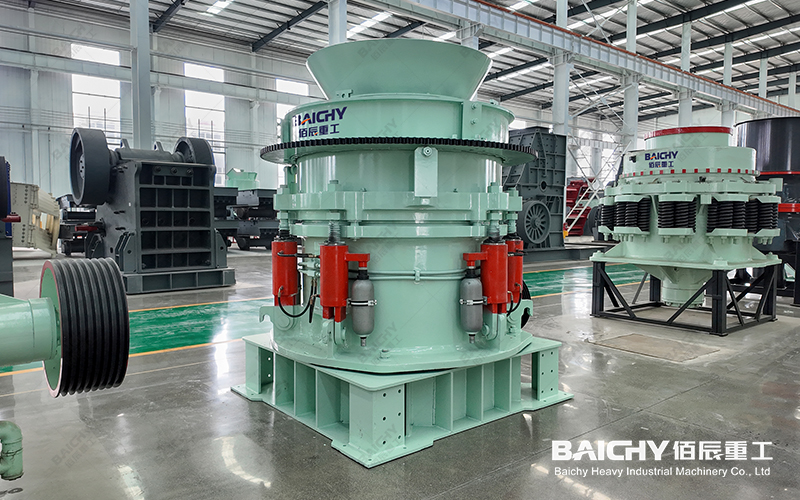
Hydraulic Cone Crusher
Specifications of Representative Models:
| Model | Max. Feed Size (mm) | Discharge Size (mm) | Capacity (t/h) | Motor Power (kW) |
| PYB900 | ≤85 | 5–20 | 15–50 | 55 |
| CS110 | ≤160 | 13–38 | 50–150 | 110 |
| CS160 | ≤215 | 19–51 | 110-280 | 160 |
| HP300 | ≤230 | 6-38 | 150-380 | 220 |
• Advantages: Low wear, good particle shape, consistent product quality, and high automation (hydraulic chamber clearing/tramp iron protection).
• Drawbacks: Higher unit price and maintenance requirements compared to impact crushers; unsuitable for materials with high clay content or stickiness; sensitive to feed uniformity.
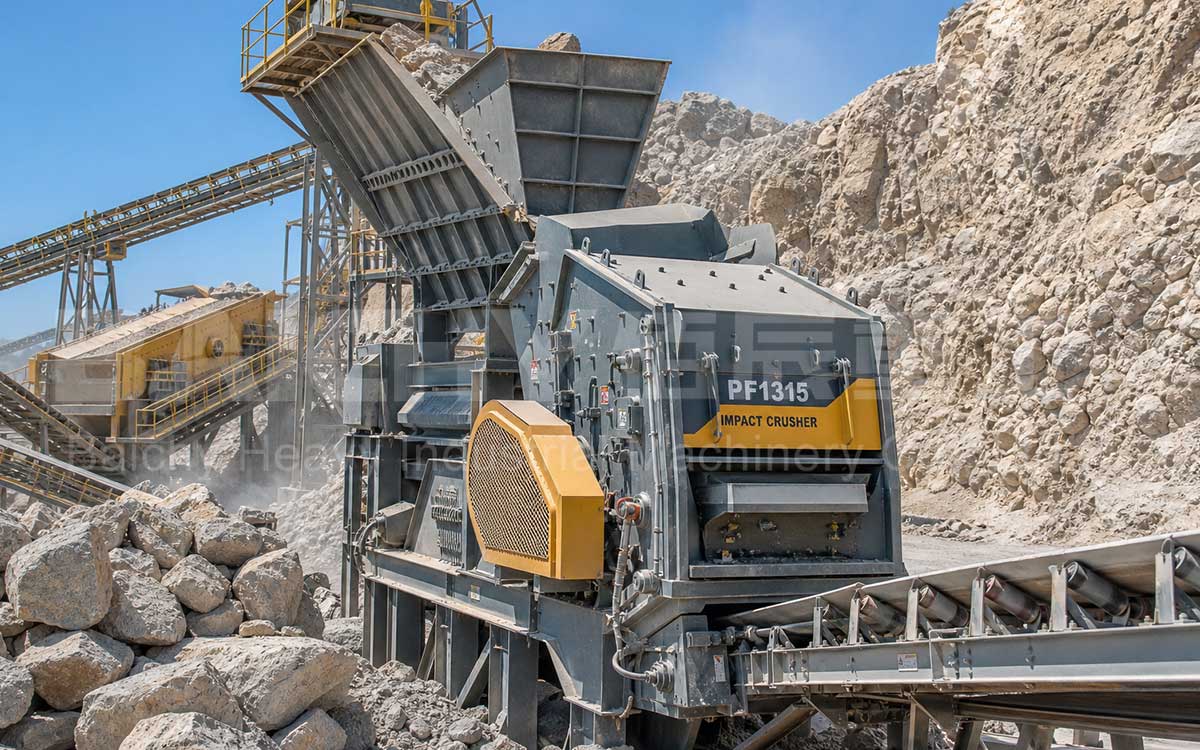
2.3 Impact Crusher (PF Series) — "Dual-purpose" machine for medium-soft rock
• Working Principle: High-speed rotating blow bars throw material against impact plates for crushing; material undergoes repeated impacts until it is small enough to pass through the discharge opening. Utilizes impact crushing with a high reduction ratio (exceeding 10:1).
• Application Stages: Secondary crushing, fine crushing, and shaping. Ideal for medium-soft rock such as limestone (compressive strength ≤250 MPa).
• Value Proposition: Produces cubic particles in a single pass; flake and elongation content can be controlled within 8–12%; aggregates for concrete or asphalt meet standards directly—allowing many production lines for medium-soft rock to eliminate the need for a separate shaping machine.
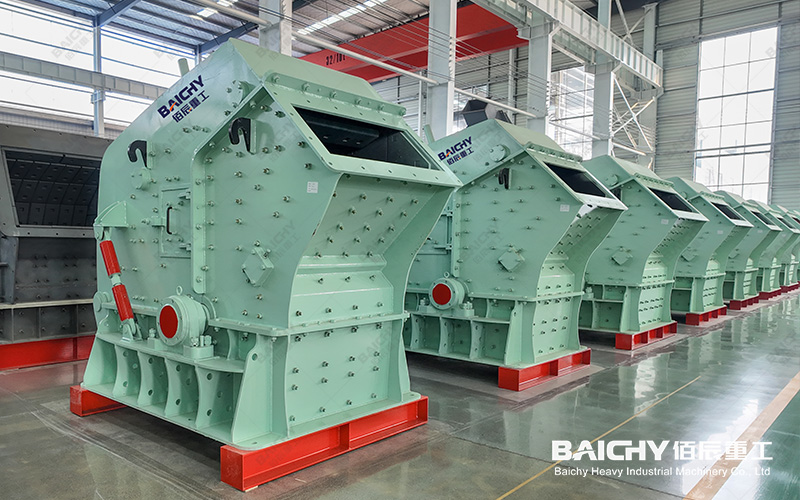
PF Impact Crusher
Specifications of Representative Models:
| Model | Rotor Dimensions (mm) | Max. Feed Size (mm) | Capacity (t/h) | Motor Power (kW) |
| PF1007 | 1000×700 | ≤300 | 30–70 | 75 |
| PF1214 | 1250×1400 | ≤350 | 80–180 | 132 |
| PF1315 | 1300×1500 | ≤350 | 120–250 | 200 |
| PFW1214 (European Version) | 1250×1400 | ≤500 | 130–250 | 160–200 |
• Advantages: High reduction ratio; produces good particle shape; lower initial investment compared to cone crushers; capable of processing materials with higher moisture content (≤12%).
• Drawbacks: Blow bars wear out quickly, leading to soaring wear-part costs when processing hard rock; extremely sensitive to material abrasiveness (Abrasion Index)—this is the fundamental reason they are positioned specifically for "soft materials."
2.4 Hammer Crusher (2PC / PCK Series)—A single-stage shaping solution for brittle materials
• Working Principle: High-speed rotating hammers shatter the material; material impacts grate liners for further breakage; sized product discharges through grate openings. Single-stage crushing with a reduction ratio exceeding 15:1.
• Application Stage: Single-stage shaping (for brittle, medium-soft materials like limestone, gypsum, coal, cement clinker, etc.); reduces feed size of ≤350mm directly to ≤25mm.
• Value Proposition: A single unit replaces the two-stage "primary + secondary" crushing process, saving on equipment, conveyor belts, and foundation costs; the 2PC dual-rotor hammer crusher accommodates moisture content <20% without clogging the crushing chamber when processing wet material.
Specifications of Representative Models:
| Model | Rotor Specs (mm) | Max. Feed (mm) | Discharge (mm) | Capacity (t/h) | Motor (kW) |
| PCK1413 | 1400×1300 | ≤350 | ≤25 | 100-180 | 180 |
| 2PC1000×1200 | 1000×1200 | ≤350 | ≤25 | 80-120 | 110×2 |
| 2PC1214 | 1200×1400 | ≤400 | ≤25 | 120–200 | 160×2 |
• Advantages: Shortest process flow, lowest investment, and low power consumption (energy consumption per ton is 20–30% lower than two-stage processes).
• Drawbacks: Suitable only for brittle, medium-to-soft materials; hammer lifespan drops drastically when processing hard rock; produces a high proportion of fine powder, requiring screening to control aggregate gradation.
2.5 VSI Impact Sand-Making Machine—The "Ultimate Process" for Manufactured Sand and Shaping
• Working Principle: Material is projected at high speed (impeller tip speed of 60–80 m/s) and crushed through mutual impact (dual-chamber "rock-on-rock" and "rock-on-iron" modes), utilizing the material's own kinetic energy. Finished products are cubic with rounded shapes; the fineness modulus is adjustable.
• Application Stage: Sand making (fourth stage) and shaping. Feed size ≤50mm; discharge size 0–10mm (adjustable).
• Value Proposition: Stable manufactured sand gradation, adjustable fines content, and needle/flaky particle content <5% (meeting strict acceptance criteria for commercial concrete and asphalt plants); also functions as a hard-rock aggregate shaper, increasing the selling price of the finished product.
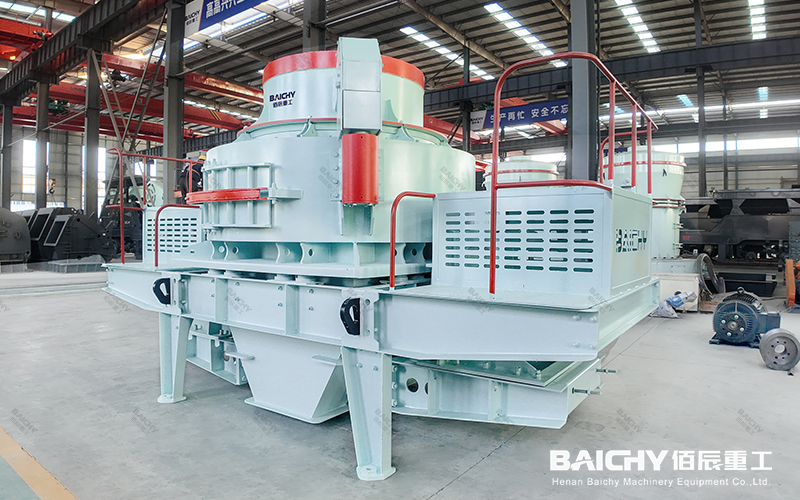
VSI Sand Making Machine
Specifications of Representative Models:
| Model | Max. Feed Size (mm) | Capacity (t/h) | Motor Power (kW) | Throughput (t/h) |
| VSI-7611 | ≤35 | 80–180 | 110–160 | 80–180 |
| VSI-8518 | ≤40 | 120-260 | 180-220 | 120-260 |
| VSI-9526 | ≤45 | 200-380 | 264-320 | 200-380 |
• Advantages: Superior particle shape; adjustable gradation; includes particle shaping capabilities; symmetrical dual-motor layout offers high tolerance for voltage fluctuations (compatible with 60Hz/380V/440V grids).
• Drawbacks: Cannot handle large feed sizes; must be positioned after the secondary/fine crushing stage; high-speed operation places strict demands on bearing lubrication and the thin-oil lubrication system; higher unit price compared to double-roll crushers.
2.6 Double-Roll Crusher (2PGY Series)—A "Low-Energy" Option for Fine Crushing and Sand Making
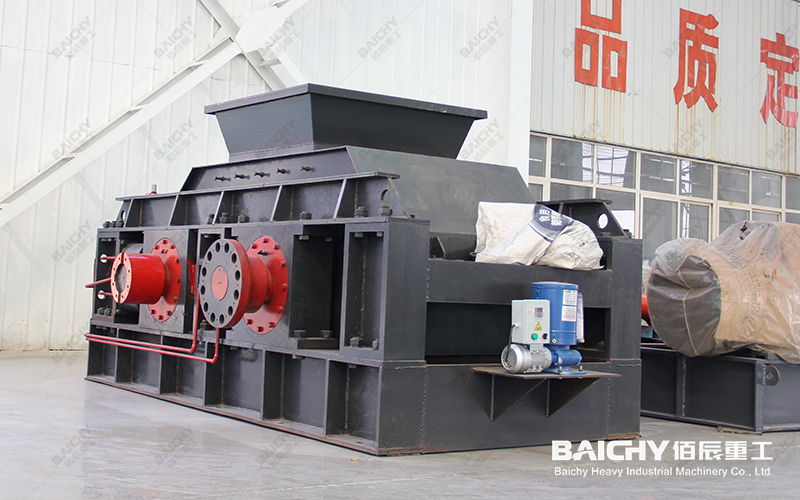
Double Roller Crusher
• Working Principle: Two rolls rotate in opposite directions; material is crushed via compression and shearing in the gap between the rolls; discharge particle size is precisely controlled by the roll gap.
• Application Stage: Fine crushing and sand making (a low-investment alternative to VSI); suitable for medium-soft materials and limestone.
• Value Proposition: Uniform discharge particle size; low over-pulverization rate; low energy consumption; the 2PGY1200×1200 model delivers a stable capacity of 100–150 t/h in limestone processing operations in Vietnam.
• Drawbacks: Roll surfaces require hard-facing repair after wear; low single-stage reduction ratio (2:1–4:1); suitable only for the final crushing stage.
2.7 Supplementary Note: Mobile Crushing Stations (YDPZ Series)—A matter of configuration, not core crushing logic.
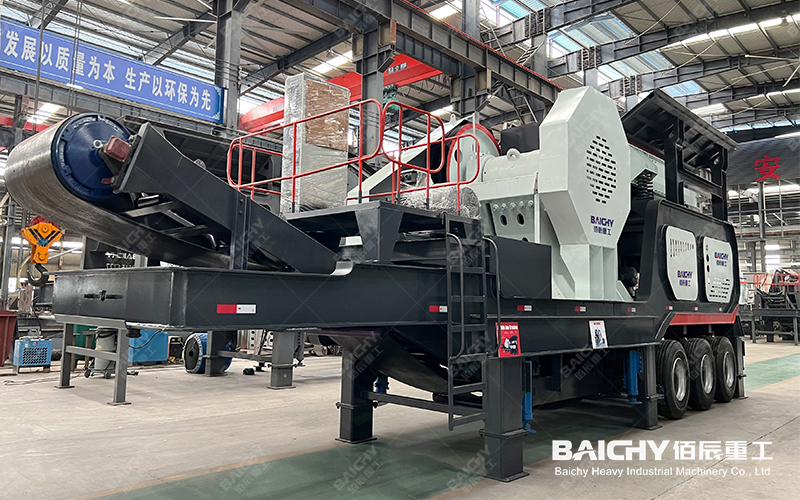
Mobile jaw crusher
Mobile stations (wheeled or tracked) simply mount the aforementioned primary crushing units onto a mobile chassis; the selection logic remains identical to that of stationary lines: jaw or cone crushers are paired with hard rock, while impact crushers are used for medium-to-soft materials. They are suitable for projects involving dispersed material sources, contract durations of 12 months or less, and the need for rapid site relocation. The choice between stationary and mobile setups is determined by the product of "material source stability" and "operational duration," rather than the material type itself.
III. Golden Rule for Equipment Selection: Match the machine model to material hardness and target product specifications
| Material Type | Compressive Strength | Recommended Process | Rationale |
| Granite, basalt, iron ore, river pebbles | 150–350 MPa | Jaw Crusher → Cone Crusher → (VSI) | High abrasiveness requires compression crushing; ensures long wear-part life and lowest cost per ton. |
| Andesite, diabase | 100–250 MPa | Jaw Crusher → Cone or Impact Crusher | Depends on the abrasiveness index: choose cone crusher for high abrasiveness; impact crusher is suitable for low abrasiveness. |
| Limestone, dolomite, gypsum | ≤150 MPa | Jaw Crusher → Impact Crusher → (VSI/Double-roll Crusher) | Impact crushing produces cubical particles in a single pass, eliminating the need for a separate shaping stage. |
| High-volume limestone (cement plants/power plant desulfurization) | ≤150 MPa | Single-stage dual-rotor hammer crusher | Feed size ≤350 mm reduced directly to ≤25 mm; shortest process flow. |
| Construction waste, recycled aggregate | 30–80 MPa | Jaw/Impact Crusher + Magnetic Separation | Contains rebar/debris; requires impact crusher for impact resistance and iron remover for protection. |
| Coal, coke, shale | Brittle | Hammer Crusher/Double-roll Crusher | High reduction ratio; priority placed on controlling the fines (over-crushing) rate. |
Ⅳ.FAQ
Q1: What types of crushing equipment are typically used in quarries?
A: Categorized by crushing stage: primary (jaw crusher), secondary (cone/impact crusher), tertiary/fine (fine-crushing cone/double-roll crusher), and sand making/shaping (VSI sand maker); categorized by configuration: stationary lines and mobile stations (YDPZ series). A standard hard-rock quarry is typically equipped with the "Jaw Crusher + Cone Crusher + VSI" trio. Q2: How should crushing equipment be selected for a granite quarry? A: Adopt a full-line compression crushing approach: PE series jaw crusher for primary crushing (feed size ≤500mm) → CS/HP cone crusher for secondary/tertiary crushing → VSI crusher for sand making and shaping. Avoid using impact crushers for granite; the blow bars have a lifespan of only a few hundred hours, leading to uncontrollable wear-part costs. If low fines content is required in the final product, a closed-circuit configuration (with recirculating material) for the cone crusher is the standard setup.
Q3: What is the difference between a jaw crusher and a cone crusher?
A: The jaw crusher is a primary crusher featuring a large feed opening (up to 750×1060mm), capable of handling large rocks and producing a coarse output (65–160mm); it has a simple structure and requires low investment. The cone crusher is a secondary/tertiary crusher (feed size ≤215mm) that utilizes inter-particle (lamination) crushing to produce particles with regular shapes; it offers long wear-part life and is suitable for continuous, precision processing of hard rock. They serve sequential stages of the process rather than acting as substitutes for one another.
Q4: Should a limestone quarry use an impact crusher or a hammer crusher?
A: It depends on the target product: for aggregates (5–31.5mm graded sizes), choose an impact crusher, as it offers adjustable settings and produces good particle shapes. For fines or mixed material ≤25mm (e.g., for cement plants, power plant desulfurization, or gypsum lines), choose a double-rotor hammer crusher; a single unit replaces a two-stage process, resulting in the shortest workflow. In scenarios with moisture content >8%, prioritize the 2PC double-rotor model (which tolerates <20% moisture), as single-rotor hammer crushers are prone to chamber clogging.
Q5: What is a typical equipment configuration for a quarry with a 100 t/h capacity?
A: For hard rock: ZSW380×95 feeder + PE600×900 jaw crusher + CS110 cone crusher + 2YK1860 vibrating screen. For medium-soft rock: ZSW380×95 + PE500×750 jaw crusher + PF1214 impact crusher + 2YK1548 vibrating screen. If manufactured sand is required, add a VSI-7611 to the final stage, or...