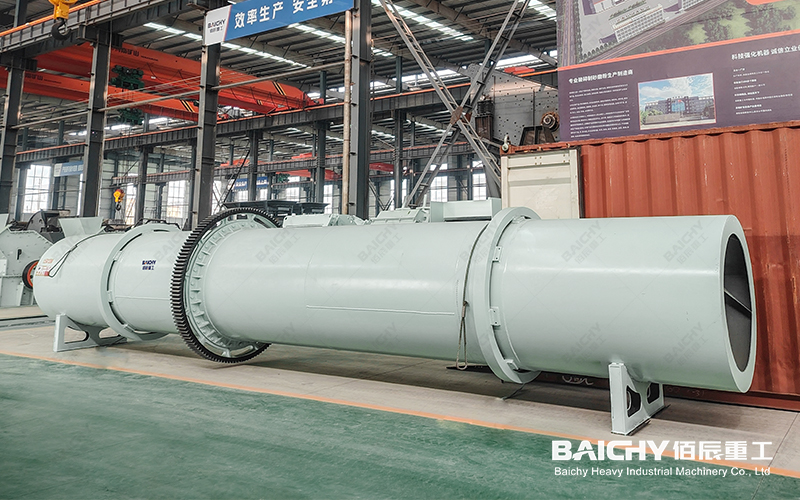
High-purity silica sand dryer
Drying high-purity silica sand is not merely about "drying the sand out"; it is about "drying it to meet the required grade." Procurement contracts for glass-grade and foundry-grade sands strictly mandate a discharge moisture content of ≤0.5%. While washing and refining processes bring SiO₂ and Fe₂O₃ levels up to contractual standards, drying is the final link in the chain; if the moisture content fails to meet specifications at this stage, the entire investment in prior purification efforts is effectively wasted, as the batch may be rejected or downgraded. The true value of a high-purity silica sand dryer (rotary sand dryer) lies not simply in its drying capability, but in its ability to transform discharge moisture levels from a variable that "fluctuates with the weather" into a precise, contractually binding acceptance criterion.
This article focuses exclusively on the high-purity silica sand segment. If your operations involve bulk construction aggregates—such as river sand or manufactured sand—where the goal is simply to reduce moisture to 1–2% to lower weight and facilitate transport, please refer instead to the section on rotary drying systems for aggregates. That approach addresses logistics and storage costs, whereas this article addresses product grading and regulatory compliance; the piding line between the two approaches is the difference between a 1% and a 0.5% moisture content.
1. High-Purity Silica Sand Segmentation: Glass Sand vs. Foundry Sand (Two Distinct Contract Types)
Washed silica sand from the same mine is split into two independent markets based on downstream applications, with acceptance criteria that rarely overlap:
| Comparison Item | Glass Sand (Float/Container Glass) | Foundry Sand (Resin/Coated/Sodium Silicate Sand) |
|---|---|---|
| Purity Focus | SiO₂ ≥99% (higher for premium float lines); Fe₂O₃ ≤0.10% (typical industry value; stricter for ultra-clear lines) | SiO₂ ≥96–99% (depending on cast steel/iron); greater focus on Acid Consumption Value (ACV) and Loss on Ignition (LOI) |
| Particle Size Focus | Concentrated distribution at 0.1–0.6 mm; deviations directly affect melting and homogenization | Primarily 40–140 mesh; focus on AFS fineness and angularity coefficient |
| Contracted Moisture Content | ≤0.5% (some kiln-feed silos require ≤0.3%) | Base sand for resin/coated sand typically ≤0.2–0.5%; reclaimed steel-casting sand often requires lower levels |
| Consequences of Excess Moisture | Batch segregation, increased kiln heat consumption, silo bridging | Inconsistent sand-mixing strength, increased gas evolution, casting porosity defects |
Note: The table above reflects typical industry contract thresholds; actual requirements vary significantly by plant—always refer to your specific procurement contract.
In both contract types, moisture content is a parameter characterized by "low cost but high impact": while it does not directly determine chemical composition, excessive moisture can cause an entire shipment to be rejected during incoming inspection. For glass sand, unstable moisture leads to batch segregation at the kiln inlet and increased melting heat consumption; for foundry sand, excess moisture disrupts resin curing and increases gas evolution, directly driving up casting scrap rates. This explains why buyers of high-purity silica sand are willing to pay a premium for "stable ≤0.5%" moisture levels, whereas buyers of construction-grade sand settle payments based solely on tonnage.
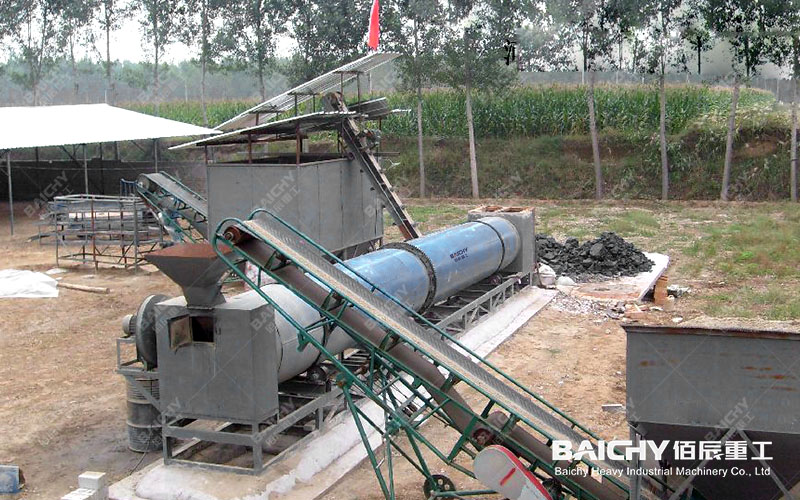
Single-drum dryer at the customer's site
2. Why ≤0.5% is a hard threshold, not merely a "stricter requirement for construction sand"
Three rigid constraints from downstream processes drive the shift of drying from a standard handling step to a critical grading step:
Glass manufacturing: Moisture content is a dual variable affecting both furnace heat consumption and batch stability. A float glass furnace consumes over a thousand tons of batch material daily, with silica sand accounting for approximately 60%. For every percentage point increase in silica sand moisture, the batch carries extra water that must be evaporated, directly driving up melting heat consumption. Even more problematic are issues like silo bridging and batch segregation caused by moisture fluctuations; no matter how precise the weighing scales are, segregated material no longer matches the designed formula. Consequently, glass plants generally require silica sand to be transported and stored (in kiln-head silos) in a dry state, with contractual limits typically set at ≤0.5%.
Foundry casting: Moisture directly interferes with resin chemical reactions. Sand mixing processes using furan or phenolic resins are extremely sensitive to base sand moisture. Excess moisture "dilutes" the resin-to-hardener ratio, leading to inconsistent sand mold strength. Furthermore, residual moisture vaporizes during molding and pouring, increasing gas evolution and causing defects such as pinholes and blowholes. The resin-coated sand process imposes even stricter moisture requirements (typically ≤0.2%) than standard resin sand, as the uniformity of the resin coating is directly determined by the surface condition of the base sand.
Quality inspection: Moisture content is a hard acceptance criterion subject to re-inspection and rejection. While disputes over chemical composition can be protracted and ambiguous, moisture content is easily verified through testing. Consistently keeping discharge moisture below the 0.5% threshold effectively shifts delivery risk from the buyer back to the supplier—serving as the first line of defense in ensuring quality-graded delivery.
3. How high-purity silica sand dryers consistently keep moisture below the 0.5% threshold
The process chain for high-purity silica sand involves: washing (scrubbing/desliming) → dewatering (dewatering screens/fine sand recovery) → drying (the focus of this article) → screening and grading → packaging or bulk shipment. The drying stage is the only link in the entire process chain that transforms "natural fluctuations" into "specification-compliant output." Feedstock from the sand washing and dewatering stage typically has a moisture content of 8–15%; the dryer must narrow this range to ≤0.5% while maintaining long-term stability.
3.1 Four control factors affecting discharge moisture
Residence time: Drum length and rotational speed determine the duration of drying within the drum. Silica sand exhibits good flowability and is non-sticky; a residence time of 20–40 minutes is sufficient to complete the evaporation and conditioning stages, providing the process foundation for achieving moisture levels below 0.5%.
Air temperature and flow direction: Inlet air temperature is typically 600–750°C; the configuration of the heat source side in high-purity applications determines whether secondary Fe₂O₃ contamination occurs (details are provided later and in the section on heat source contamination control; this topic will not be repeated here).
Airtight discharge: Air leakage at the discharge end introduces cold, moist air, causing the finished product to reabsorb moisture; an airtight discharge valve (rotary valve/star feeder) is an engineering prerequisite for "drying to 0.5% and maintaining that level."
Closed-loop control: By integrating an online moisture analyzer with a variable-frequency feeder, the feed rate is automatically reduced when discharge moisture exceeds the target, replacing reliance on "operator intuition" with "instrument-based closed-loop control."
3.2 Evaporation calculation example: Determine the amount of water to be evaporated before selecting equipment
Taking a 20 t/h dry sand production line with a feed moisture content of 10% and a target of ≤0.5% as an example, the evaporation rate is calculated using the formula E = Q × (m₁ − m₂) / (1 − m₂): E = 20 × (0.10 − 0.005) / (1 − 0.005) ≈ 1.9 t/h of water. With 6,000 hours of annual operation, approximately 11,400 tons of water are evaporated—this serves as the true benchmark for heat source and fuel budgeting. Based on a natural gas calorific value of approximately 36 MJ/Nm³ and a system thermal efficiency of 60–70%, evaporating one tonne of water requires roughly 90–100 Nm³ of natural gas; this translates to a specific natural gas consumption of approximately 9–11 Nm³ per tonne of dry sand (a figure that fluctuates based on altitude, ambient temperature, and equipment condition, serving here only as a budgetary benchmark). Comparing this figure against heat sources such as coal, biomass, or waste heat is far more reliable than any sales pitch.
4. Key Specifications: Baichy Rotary Sand Dryer (Three-Cylinder Series, Official Data)
| Model | Outer Diameter (m) | Length (m) | Drum Volume (m³) | Rotation Speed (r/min) | Capacity (t/h) | Main Motor Power (kW) |
|---|---|---|---|---|---|---|
| Φ2.0×4m | 2.0 | 4 | 12.56 | 4–10 | 8–15 | 5.5×2 |
| Φ2.2×5m | 2.2 | 5 | 18.99 | 4–10 | 12–20 | 5.5×2 |
| Φ2.5×6m | 2.5 | 6 | 29.43 | 4–10 | 18–28 | 7.5×2 |
| Φ2.8×6m | 2.8 | 6 | 36.92 | 4–10 | 25–35 | 11×2 |
| Φ3.0×6m | 3.0 | 6 | 42.39 | 4–10 | 30–40 | 7.5×4 |
| Φ3.2×7m | 3.2 | 7 | 56.27 | 4–10 | 35–55 | 11×4 |
| Φ3.6×8m | 3.6 | 8 | 81.39 | 4–10 | 55–75 | 18.5×4 |
| Φ4.0×10m | 4.0 | 10 | 125.60 | 4–10 | 70–100 | 22×4 |
Data Source: Baichy official three-cylinder dryer product page. Maximum inlet air temperature: 700–750°C; thermal efficiency: approx. 45% (vs. approx. 35% for single-cylinder models). Capacity ratings are based on typical washed sand processing conditions; high-moisture feed material will reduce actual throughput by 20–30%, in which case selecting the next larger model size is recommended. Standard configuration for high-purity applications: Using any model listed in the table as the main unit, paired with a heat-exchanger hot-blast stove (indirect heating; flue gas does not contact the material) or direct combustion of low-ash, low-sulfur fuel (such as natural gas) on the heat source side, and equipped with an air-lock discharge system and two-stage dust collection (cyclone + bag filter) at the discharge end, this setup forms a high-purity silica sand drying unit suitable for glass or foundry grades—an engineering combination that ensures stable discharge moisture content of ≤0.5% without increasing Fe₂O₃ levels.
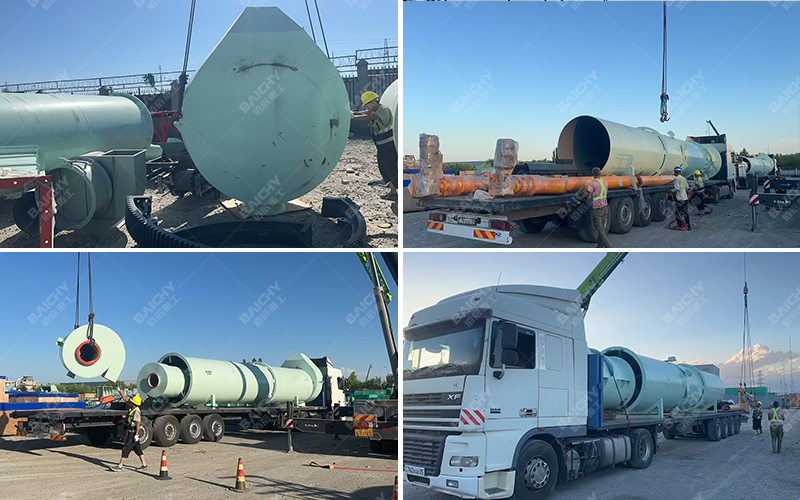
Photos of single-drum dryer shipment from the port
5. Five engineering advantages of graded drying (translating parameters into your bottom line)
Adjustable residence time → Meeting contractual moisture specifications is a matter of control, not luck. With rotation speed linked to the feed rate, discharge moisture becomes a reproducible process parameter rather than something dictated by the day's weather.
Thermal efficiency of 45% vs. 35% for single-drum dryers → Fuel savings of approximately 20% for the same amount of water evaporation. Based on the 20 t/h line described in §3.2, annual fuel savings equate to the cost of evaporating an additional 2,000 tons of water—fuel cost is the largest operational variable for a drying line, and thermal efficiency directly determines it.
Lifting flights create a uniform material curtain → No "dry-outside-wet-inside" crusting or degradation of particle size. Silica sand is highly abrasive; wear-resistant lifting flights and optimized lifting angles keep wear within predictable limits, ensuring the 0.1–0.6 mm particle size distribution isn't ruined by excessive agitation.
Clean heat source design → Zero increase in Fe₂O₃ or ash content. The costliest hidden expense for high-purity sand is contamination during drying that causes an entire batch to be downgraded; the heat-exchanger stove physically isolates flue gas from the material, so quality assurance no longer hinges on the specific batch of fuel used (see the section on counter-flow and indirect heating for a quantitative analysis of mechanisms and costs).
Air-lock + two-stage dust collection → No moisture re-absorption at discharge and compliance with environmental assessments. Drying to 0.5% is only the first half of the process; maintaining that level is what constitutes a successful delivery. The dust collection system simultaneously protects the workshop environment and ensures compliance with local emission standards.
6. Case Studies: Retrofitting the Drying Section of High-Purity Sand Lines
Case A: Float glass sand, 20 t/h drying unit. A glass raw material processing enterprise supplies sand to a 600 t/d float glass line.
The incoming scrubbed quartz sand has a moisture content of 9–12%. The original process involved natural air-drying followed by direct-fired drying, resulting in fluctuating output moisture (0.8–1.5%) and a monthly rejection rate of approximately 11%. After retrofitting with a Φ3.0×6m triple-pass dryer, a heat-exchanger hot-blast stove, and an air-lock discharge system, the output moisture stabilized at ≤0.5% (controlled via a closed-loop online moisture analyzer). The increase in Fe₂O₃ content during drying fell within the instrument's detection limit; consequently, the supply contract was upgraded from "batch sampling inspection" to "direct supply without inspection," and the rejection rate dropped to zero. (The figures cited are representative values based on industry ranges; actual performance is subject to project acceptance.)
Case B: Cast steel resin sand reclamation line, 12 t/h reclaimed sand drying.
In a cast steel plant's furan resin sand reclamation system, the reclaimed sand had a moisture content of 4–6%, leading to inconsistent sand-mixing strength and a high defect rate due to casting porosity. After installing a high-purity silica sand dryer (single-pass drum + heat-exchanger hot-blast stove) to reduce reclaimed sand moisture to ≤0.3%, resin dosage and curing times stabilized, the porosity-related defect rate dropped by approximately 40%, and both sand temperature and moisture content came under automatic control. (Same as above; figures are representative.)
Both cases share the same lesson: the investment logic for the drying section of a high-purity sand line is not about "saving on transportation costs," but rather about "reducing return rates and defect rates to zero." This represents the fundamental difference in return on investment between high-purity silica sand dryers and construction sand drying equipment.
7. Recommended Equipment: Combinations Based on Capacity and Grade
10–30 t/h small-to-medium high-purity lines: Φ2.5×6m or Φ2.8×6m triple-pass dryer + heat-exchanger hot-blast stove + air-lock discharge system. This is the mainstream specification range for new construction or retrofitting of glass sand and foundry sand plants. 30–60 t/h scale lines: Φ3.2×7m or Φ3.6×8m units, equipped with two-stage dust removal and online moisture analyzers; typical configuration for foundry sand reclamation centers and regional glass sand suppliers.
Capacities exceeding 60 t/h or special grades (e.g., feedstock for photovoltaic-grade quartz sand): Φ4.0×10m or large-scale custom single-drum units; priority is given to indirect heating and waste heat recovery. For high-purity requirements, please provide the contractual Fe₂O₃ specifications and the heat source plan to our engineers (see below).
Recommended auxiliary equipment: Heat-exchanger hot blast stove, two-stage dust removal system (cyclone + bag filter), air-lock discharge valve, and online moisture analyzer with a variable-frequency drive (VFD) closed-loop feeding system. For upstream and downstream integration equipment, please refer to the complete silica sand washing-drying-grinding process plan (including the equipment list for sand washing, dewatering, and screening).
8. FAQ
Q1: What exactly is the difference in moisture content requirements between glass sand and foundry sand?
A: Glass sand (for float glass or containers) typically requires a moisture content of ≤0.5% per contract specifications, with some kiln-feed silos requiring ≤0.3%; exceeding these limits primarily causes batch segregation, increased furnace heat consumption, and bridging in storage silos. Foundry sand falls into two categories: base sand for resin-bonded sand or pre-coated sand generally requires ≤0.2–0.5% (with stricter standards for pre-coated sand); excessive moisture directly interferes with resin curing and increases gas evolution. Neither downstream application can tolerate moisture fluctuations in the ±0.5% range; this is precisely why high-purity sand requires mechanical drying, whereas construction sand can rely on natural air-drying.
Q2: From what initial moisture level can the sand dryer consistently reduce the content to ≤0.5%?
A: Sand typically enters the process with a moisture content of 8–15% after washing and dewatering. By optimizing the balance between residence time, inlet air temperature (up to 700–750°C), and rotation speed, a rotary sand dryer (either triple-pass or single-pass) can consistently reduce the output moisture content to ≤0.5%. For high-purity applications, a heat-exchanger-equipped hot blast stove and an air-lock discharge system are used to prevent secondary contamination and moisture re-absorption. Final performance guarantees are based on a test run using 5–10 kg of material; simply send us your sample and target moisture level, and Baichy will provide a free test run, along with equipment selection and a price quote within 24 hours.
Q3: Will the drying process "bake" Fe₂O₃ or ash into the sand, causing the entire batch to be downgraded?
A: It can, if the heat source is chosen incorrectly. With direct heating, combustion flue gases come into contact with the material; alkali metals, sulfur, and ash can adhere to the particle surfaces via the airflow, driving up Fe₂O₃ levels or the Acid Consumption Value (ACV)—often the most significant hidden cost in drying high-purity silica sand. The solution is to use a heat-exchanger-equipped hot blast stove (indirect heating) to physically separate the flue gas from the material, or to use low-ash, low-sulfur fuels (such as natural gas) combined with a two-stage dust removal system. For criteria on equipment selection and a quantitative comparison regarding thermal efficiency trade-offs, please refer to the section on heat source contamination control for high-purity silica sand.
Baichy Heavy Industry
Baichy Heavy Industry is a high-tech mining equipment company integrating R&D, manufacturing, sales, and after-sales service. Focusing on crushing, grinding, and mineral processing equipment, we provide professional solutions to our customers. We are ISO9001:2015 、certified, and our products include mobile crushing palnts, crawler crushing plant, construction waste crushing plants, jaw crushers, sand making machines, cone crushers, fine crushers, grinding mills, ball mills, etc., all with reliable performance to meet diverse project needs.
Baichy Heavy Industry – Your Trusted Partner
To ensure optimal performance of your equipment, Baichy Heavy Industry offers:
- Professional on-site installation guidance
- Comprehensive operator training
- 24/7 technical support & maintenance services
Our complete after-sales service system guarantees long-term, stable operation of your machinery with minimal downtime.
Protect Your Rights – Only Use Official Channels
To avoid scams and ensure authentic support, contact us exclusively through:
• Official Website: www.baichychina.com
• WhatsApp: +8615093222637
• Email: [email protected]
Your satisfaction is our priority – expect prompt, professional service every time.
(Note: Beware of unauthorized third parties claiming to represent Baichy. Always verify through official contacts.)