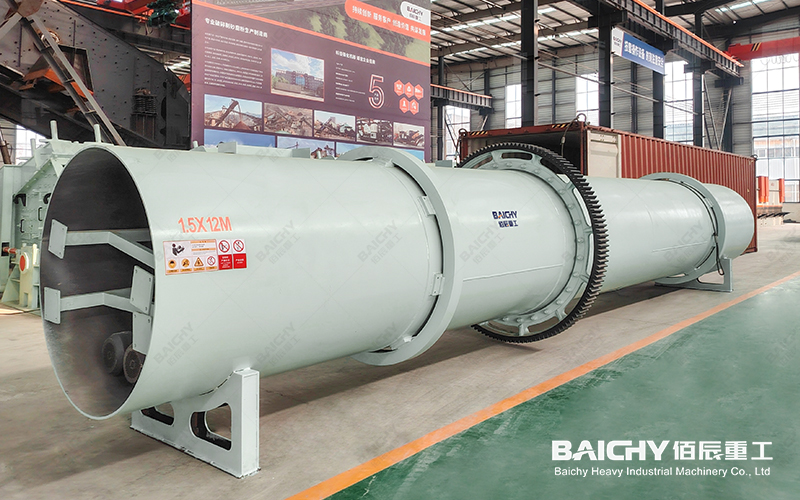
Rotary fertilizer dryers
Fertilizer drying is not as simple as merely "baking off the water"—it is the stage in the entire production line where nutrient loss, complaints about caking, and uncontrolled energy consumption are most likely to occur simultaneously. Fertilizer granules are heat-sensitive, prone to melting, and hygroscopic; achieving target moisture levels through high-temperature baking often comes at the cost of nitrogen loss, excessive biuret content, and caking upon discharge. Conversely, failure to control moisture directly compromises packaging, storage, and shelf life. Baichy Heavy Industry designs its rotary fertilizer dryers based on three principles: low-temperature co-current flow, rapid evaporation via high airflow, and uniform discharge moisture. Combined with complimentary material drying tests, this approach ensures that both target moisture levels and nutrient retention are achieved.
I. Overview: Why Fertilizer Drying Presents a Trilemma of Moisture, Nutrients, and Energy
Fertilizer moisture originates from two sources: residual free water following granulation (e.g., compound fertilizer granules from drum or pan granulators contain 15–20% moisture) and residual water from fermentation (e.g., fermented chicken or cattle manure contains 35–50% moisture). High moisture triggers a chain reaction of problems: insufficient granule strength leading to dusting, caking after packaging, uneven nutrient distribution, mold growth during storage (for organic fertilizers), and weight loss during transport. However, simply raising the temperature is not the solution; the dual nature of fertilizers—being both heat-sensitive and hygroscopic—means that drying parameters and process windows cannot simply replicate practices used for mineral materials.
1. Heat Sensitivity: The Fundamental Difference Between Fertilizer Drying and Mineral Drying
Urea decomposes and volatilizes at high temperatures; ammonium nitrogen undergoes hydrolysis, resulting in ammonia loss; and ammonium phosphates undergo condensation. In compound fertilizer drying, if the inlet air temperature is uncontrolled, nitrogen content can drop by 0.5–1.5 percentage points, and biuret levels may exceed the limits set by standards GB/T 15063 (Compound Fertilizers) and GB/T 2440 (Urea). Furthermore, functional bacteria in bio-organic fertilizers begin to lose viability en masse at temperatures above 60°C. While mineral materials can withstand inlet air temperatures of 700–800°C, fertilizers have a much narrower "safe air temperature window"—this distinction marks the piding line between specialized fertilizer drying equipment and general-purpose industrial dryers.
2. Hygroscopic properties: Drying targets should align with the "safe storage threshold."
For most finished fertilizers, lower moisture content is not necessarily better; national standards set the limit at ≤2.0% for compound fertilizers (GB/T 15063-2020) and ≤30% for organic fertilizers (NY/T 525-2021). Over-drying wastes fuel and can actually accelerate moisture re-absorption due to surface activation of the granules. From an engineering perspective, the priority is ensuring stable discharge moisture within the target range—drying uniformity is more critical than the absolute depth of drying.
II. Working principle: Co-current, low-temperature heat exchange within a rotary drum
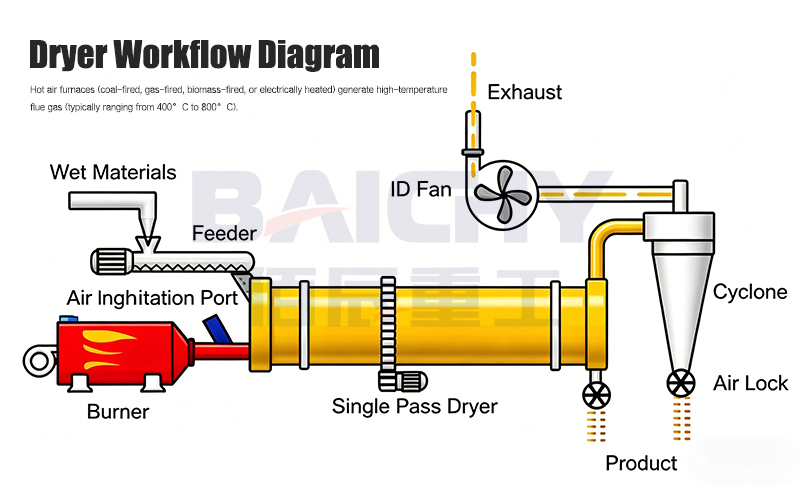
Dryer Workflow Diagram
Material enters the high end of an inclined (3–5% slope) rotary drum, where lifting flights repeatedly scoop and shower it into a uniform curtain. It makes co-current contact with hot air; moisture evaporates and is carried away by the exhaust draft, while dried material discharges from the low end. The fertilizer process employs a co-current flow combined with zoned temperature control: inlet air temperatures can be raised to 350–450°C to rapidly initiate evaporation (granule surfaces remain at the wet-bulb temperature, preventing scorching), while discharge material temperatures are strictly kept below 90°C—crucial for preserving urea and ammoniacal nitrogen. Residence time (approx. 20–40 minutes) is determined by both rotation speed and internal drum components; variable frequency drives allow for recalibration within 10 minutes when switching formulas or handling seasonal variations in raw material.
III. Application scenarios for fertilizer rotary dryers
Compound fertilizer and controlled-release fertilizer production lines
After drum or pan granulation, granules contain 15–20% moisture; the rotary dryer reduces this to under 3%, followed by a rotary cooler that brings the temperature below 40°C. The finished product meets the ≤2% moisture standard, balancing granule strength with anti-caking properties. Low-load drying can also be used for moisture adjustment in the downstream stages of high-tower melt granulation processes.
Organic Fertilizer Production Lines
For fermented feedstocks—such as chicken manure, cattle manure, and food waste—with moisture content between 35% and 50%, the mainstream configuration is a "rotary dryer + biomass/biogas hot-blast stove." This setup enables on-site processing of livestock waste and crop straw; the material is dried to 20–30% moisture before being packaged directly or used as granulation feedstock. Highly viscous, wet materials require anti-sticking lifters and cleaning mechanisms to prevent ring formation inside the drum.
Phosphate and Inorganic Fertilizer Production Lines
Materials such as Monoammonium Phosphate (MAP), Diammonium Phosphate (DAP), and Ammonium Sulfate are characterized by "low moisture but high corrosivity." While the moisture load is low, the presence of chloride ions and acidic atmospheres necessitates corrosion-resistant drum materials; material selection must be tailored to the specific medium, alongside appropriate sealing and tail-gas treatment.
IV. Baichy Rotary Dryer: Six Design Details Tailored to Fertilizer Processing Conditions
Low-Temperature, High-Airflow Thermal Matching: Inlet air temperatures are customized based on the material's thermal sensitivity window—avoiding the standard 700–800°C configurations used for minerals. High airflow maintains evaporation rates while keeping nitrogen loss below 0.3 percentage points (subject to actual material testing); the nutrients retained per ton of finished product translate directly into higher market value and fertilizer efficacy.
Anti-Sticking Lifters and Cleaning Devices: These prevent highly viscous, wet materials (like organic fertilizer) from caking onto the plates or forming rings, reducing downtime for material clearance from days to hours.
Material Selection Based on Process Medium: Corrosion protection for the drum and lining is specifically engineered to withstand chloride ions and acidic atmospheres, doubling the drum's service life and lowering the total lifecycle cost.
Integrated Thermal and Environmental Systems: A complete package—including biomass/natural gas hot-blast stove, rotary cooler, cyclone dust collector, and tail-gas scrubber (for ammonia and odor removal)—is supplied under single-source responsibility, preventing parameter mismatches often caused by multi-vendor assembly.
Variable Frequency Drive (VFD) and Adjustable Residence Time: A single production line can handle multiple formulas without stopping; switching product varieties requires only a reset of the rotation speed parameters. Data-driven delivery: We offer free drying tests for 5–10 kg samples and provide "moisture vs. time" curves, along with recommended inlet air temperatures and residence time windows. This allows process parameters to be finalized prior to full-scale production, thereby minimizing on-site trial-and-error.
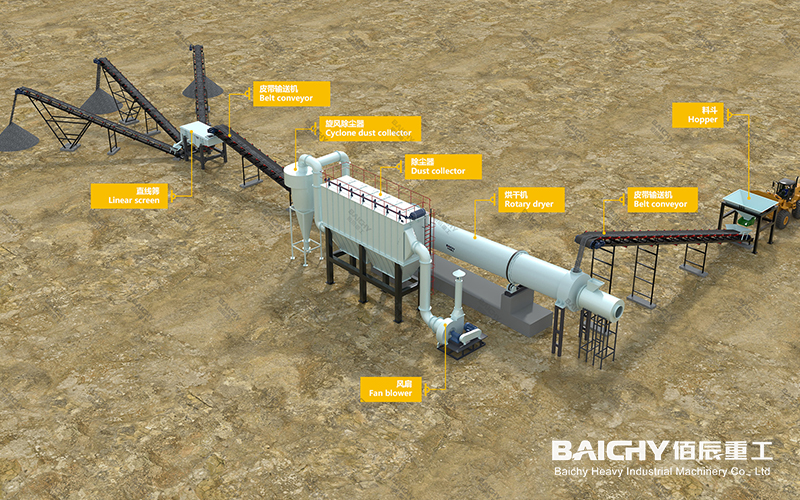
Process flow diagram of the single-drum dryer
V. Technical Parameters for Fertilizer Rotary Dryers (Baichy Typical Configuration)
The following details Baichy's typical single-drum rotary dryer series; production capacities are based on the wet basis of standard materials. For fertilizer applications, the inlet air temperature is typically controlled between 250°C and 450°C, with specific parameters determined by actual material drying tests.
| Specifications (Diameter × Length, m) | Drum Volume (m³) | Reference Capacity (t/h) | Installation Slope | Max. Inlet Air Temp. (°C) | Main Motor (kW) | Typical Production Line Positioning |
|---|---|---|---|---|---|---|
| Φ1.5×12 | 21.2 | 4.5–5.7 | 3–5% | 700–800 (Equipment limit) | 15 | 20,000–30,000 t/a organic fertilizer; small-scale compound fertilizer line |
| Φ1.8×14 | 35.6 | 7.6–9.7 | 3–5% | 700–800 (Equipment limit) | 18.5 | 30,000–50,000 t/a organic/compound fertilizer line |
| Φ2.0×16 | 50.24 | 9.5–13 | 3–5% | 700–800 (Equipment limit) | 18.5 | 50,000–80,000 t/a compound/granular fertilizer line |
| Φ2.2×16 | 60.8 | 13–16.2 | 3–5% | 700–800 (Equipment limit) | 22 | 80,000–100,000 t/a compound fertilizer line |
| Φ2.4×20 | 90.4 | 19.3–24.1 | 3–5% | 700–800 (Equipment limit) | 45 | 100,000–150,000 t/a large-scale compound fertilizer line |
| Φ2.6×24 | 127.4 | 27.2–34 | 3–5% | 700–800 (Equipment limit) | 55 | Production line with capacity >150,000 t/a |
Reference capacity is rated on a wet basis for general materials. "700–800 (Equipment limit)" is the maximum allowable inlet air temperature for high-moisture duties such as slag and lignite; for heat-sensitive fertilizer pellets, the inlet air window is typically customized at 250–450°C with discharge material temperature kept below 90°C to protect nitrogen nutrients. Confirm the final model against the moisture reduction curve from free sample testing.
Note: The "Max. Inlet Air Temp. of 700–800°C" listed in the table represents the equipment's permissible upper limit, intended for high-moisture materials such as slag and lignite; however, the operational parameters that determine nutrient preservation are the inlet air temperature range (250–450°C) and the discharge material temperature (≤90°C) specific to fertilizer drying. The drum rotation speed is 3–8 r/min, adjustable via a variable-frequency drive (VFD). When the feed moisture content is at the high end of the range, the actual dry material throughput decreases accordingly; therefore, equipment selection must be verified against the worst-case feed conditions.
VI. Relevant Application Cases
Case A: Southeast Asian organic fertilizer plant replaces open-air sun-drying with mechanical drying, maintaining production during the rainy season.
A livestock waste resource utilization project processed fermented chicken manure with an initial moisture content of 38–42%. The original process relied on open-air sun-drying for 7–10 days, with production capacity chronically constrained by the rainy season and land availability. After switching to a Φ2.0×16 single-drum rotary dryer paired with a rice husk biomass hot-air furnace, moisture content was reduced to ≤20% and capacity reached 8–10 t/h, eliminating weather-related constraints. By utilizing locally sourced rice husks as fuel, the fuel cost per ton of dried product dropped by approximately 40% compared to gas-fired alternatives, and product moisture consistently met the NY/T 525 standard. (Client name omitted due to confidentiality agreements.)
Case B: Nitrogen loss control in a compound fertilizer line—shifting from "nutrient loss" to "nutrient preservation."
At a 150,000 t/a NPK drum granulation line, the original drying section utilized a high-temperature configuration, with inlet air temperatures consistently exceeding 600°C. This resulted in a nitrogen loss of 0.8–1.2 percentage points relative to the formulation, while biuret levels approached the regulatory limit. Baichy adjusted the main dryer unit to operate under low-temperature, high-airflow, co-current conditions: inlet air temperature was reduced to 350–400°C, discharge material temperature was controlled below 85°C, and a retaining ring was installed at the discharge end to narrow the residence time distribution. Following the retrofit, nitrogen loss dropped to within 0.3 percentage points, the biuret compliance rate recovered to 100%, and thermal energy consumption decreased while maintaining the same production capacity. (Client name omitted per confidentiality agreement)
VII. Recommended Equipment
Fertilizer drying is a systematic process; Baichy supplies complete systems comprising: "Main drying unit + Heat source + Cooling + Dust/Ammonia removal + Conveying & Screening."
| Equipment | Recommended Configuration | Application/Positioning |
|---|---|---|
| Single-cylinder rotary dryer | Φ1.5×12 ~ Φ2.6×24 | Main drying unit; low-temperature, high-airflow, co-current flow process |
| Triple-cylinder rotary dryer | Sized based on capacity | Space-constrained sites or energy-saving retrofits; footprint is approx. 1/2 that of a single-cylinder unit |
| Biomass/Natural gas hot air furnace | Sized based on evaporation load | Supplies clean hot air at 250–450°C |
| Rotary cooler | Matched to dryer specifications | Cools product to ≤40°C post-drying; prevents caking during packaging |
| Cyclone dust collector + Tail gas scrubber | Sized based on airflow | Recovers dust; removes ammonia/odor; ensures emissions compliance |
| Screw conveyor / Bucket elevator | Sized based on throughput | Enclosed conveying; minimizes dust and moisture re-absorption |
Fertilizer drying is delivered as a complete system — dryer main unit + heat source + cooling + dust/ammonia removal + enclosed conveying. Final sizing for each unit is based on material properties, inlet moisture, target outlet moisture and annual capacity; Baichy confirms the configuration against the moisture reduction curve from free sample testing.
Related Reading: Rotary dryer lifter design (anti-sticking solutions for viscous materials); Coal rotary dryer residence time and drying curves (logic for adjusting residence time vs. discharge moisture). For equipment selection, please provide material type, feed moisture, target moisture, and capacity; Baichy offers free drying test reports and delivers drying solutions and quotations within 5 working days.
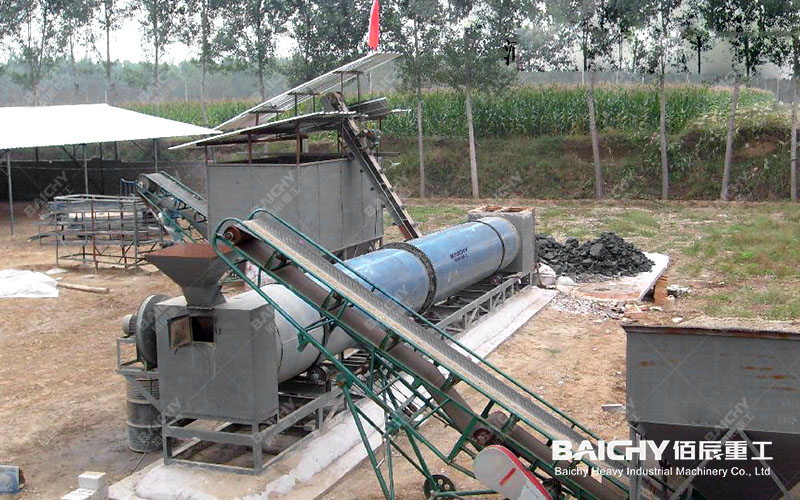
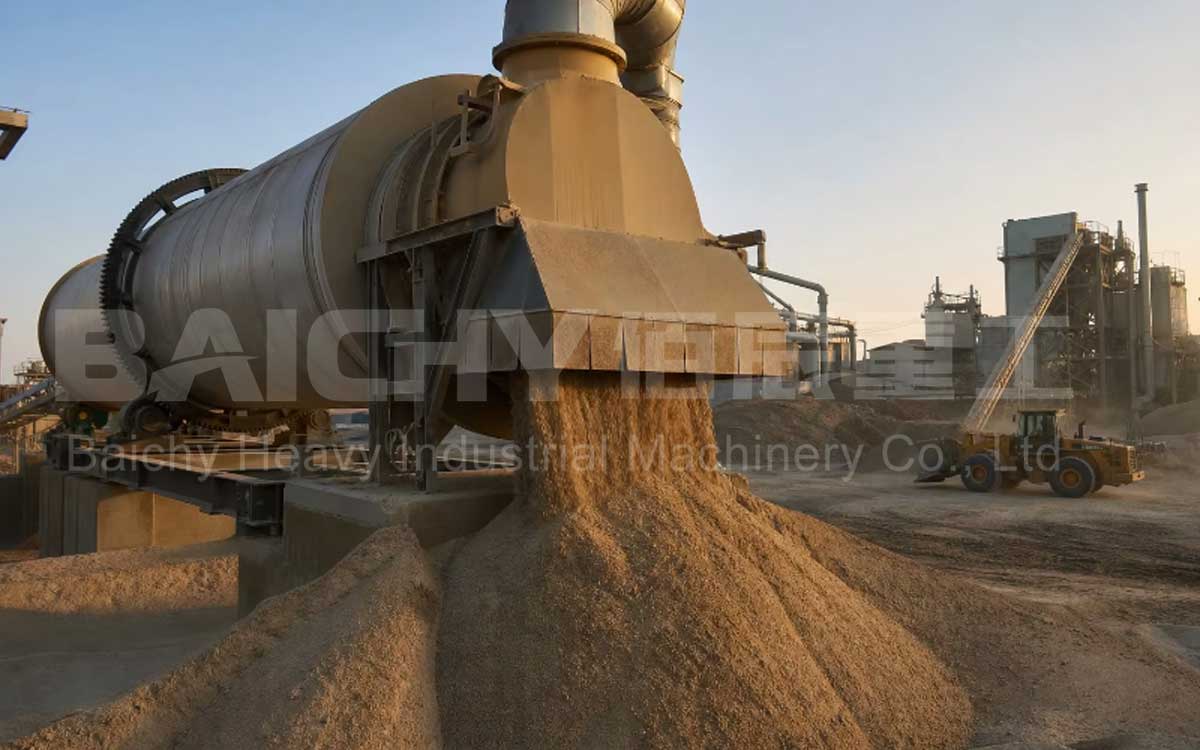
On-site photo of a single-cylinder dryer
FAQ
Q1: How low can a fertilizer rotary dryer reduce moisture content? How is the target moisture determined?
A: Standards are established before discussing equipment: For compound fertilizer lines, the drying section outlet typically achieves 2–3% moisture, meeting the national standard of ≤2.0% (GB/T 15063-2020) after cooling; for organic fertilizer lines, the standard is ≤30% (NY/T 525-2021), though engineering practice often targets 20–25% to maintain a safety margin. The specific achievable moisture level depends on the feed moisture content, evaporation load, and target production capacity. We recommend conducting drying tests with a 5–10 kg sample to establish target values based on empirical data, rather than arbitrarily aiming for "the lower, the better."
Q2: Why can't fertilizer drying utilize the high temperatures used for mineral drying? What happens if the temperature is too high?
A: Nitrogen in fertilizers is prone to loss at high temperatures: the decomposition of urea and ammoniacal nitrogen accelerates above 90–120°C; ammonium phosphates undergo condensation; and biological inoculants lose viability en masse at 60°C. These issues manifest directly as substandard nutrient content, excessive biuret levels, and reduced fertilizer efficacy. While a high inlet air temperature does not equate to a high material temperature, excessive residence time or localized overheating can still scorch and degrade nutrients. The optimal approach for fertilizer drying is a combination of high inlet air temperatures (250–450°C) for rapid evaporation and controlled discharge temperatures (kept below 90°C), thereby balancing evaporation rates with nutrient preservation.
Q3: Organic fertilizer is highly viscous; will it stick to the walls or clog the rotary dryer? How can this be prevented?
A: Yes, it can. High-moisture, high-viscosity materials used with standard lifting flights tend to form rings on the drum wall, accumulating until the system jams. Four standard countermeasures are employed: pre-dewatering via filter press or centrifuge to reduce feed moisture below 40%, thereby minimizing evaporation and adhesion loads at the source; using anti-stick lifting flights and installing chain-based cleaning mechanisms; controlling internal airflow velocity and fill rates to prevent wet material from accumulating in low-temperature zones; and using variable frequency drives (VFDs) to periodically clear accumulated material from the drum. Baichy customizes internal drum components based on material viscosity and moisture content, verifying the absence of ring formation using empirical data prior to delivery.
Baichy Heavy Industry
Baichy Heavy Industry is a high-tech mining equipment company integrating R&D, manufacturing, sales, and after-sales service. Focusing on crushing, grinding, and mineral processing equipment, we provide professional solutions to our customers. We are ISO9001:2015 、certified, and our products include mobile crushing palnts, crawler crushing plant, construction waste crushing plants, jaw crushers, sand making machines, cone crushers, fine crushers, grinding mills, ball mills, etc., all with reliable performance to meet diverse project needs.
Baichy Heavy Industry – Your Trusted Partner
To ensure optimal performance of your equipment, Baichy Heavy Industry offers:
- Professional on-site installation guidance
- Comprehensive operator training
- 24/7 technical support & maintenance services
Our complete after-sales service system guarantees long-term, stable operation of your machinery with minimal downtime.
Protect Your Rights – Only Use Official Channels
To avoid scams and ensure authentic support, contact us exclusively through:
• Official Website: www.baichychina.com
• WhatsApp: +8615093222637
• Email: [email protected]
Your satisfaction is our priority – expect prompt, professional service every time.
(Note: Beware of unauthorized third parties claiming to represent Baichy. Always verify through official contacts.)