
5R Raymond Mill
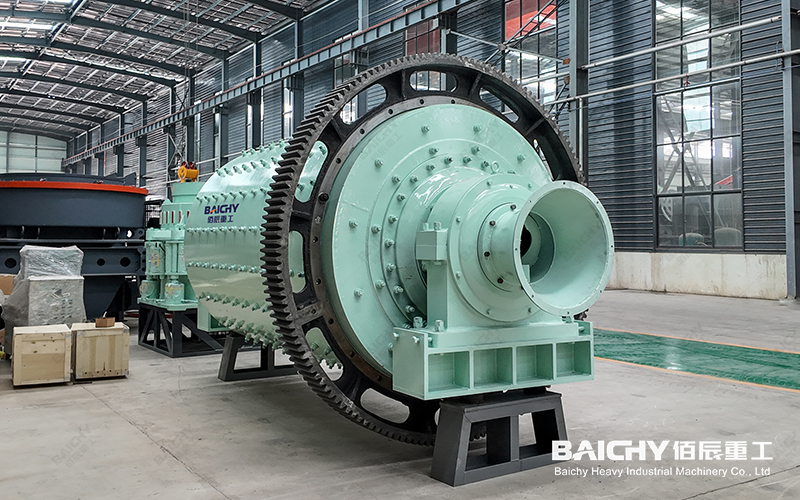
A factory-direct 5R Raymond mill complete system from Baichy Heavy Industry (Zhengzhou, China) depending on automation level, wear-part material grade, and auxiliary equipment inclusion. Request an itemized configuration list — not a single-line price — to make a meaningful comparison.
1. 5R Raymond Mill: Performance Baseline
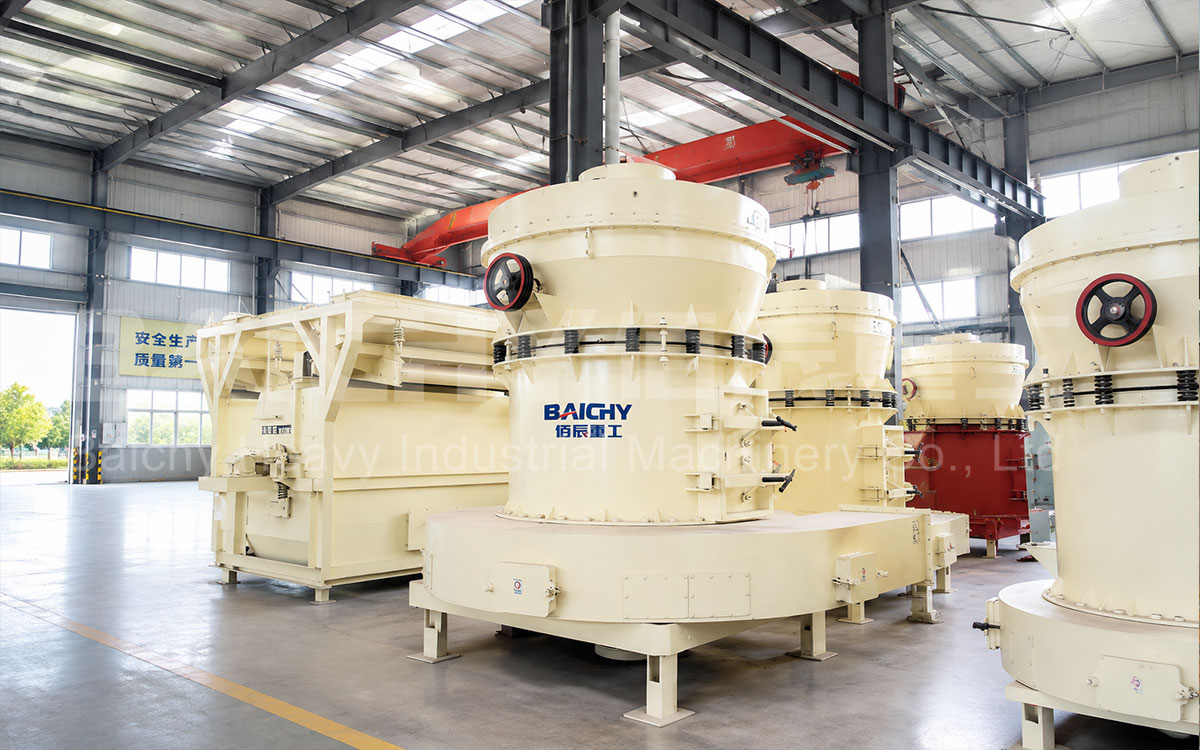
Before discussing price, understand what you are buying. The 5R Raymond mill (5-roller pendulum mill) is a medium-capacity grinding workhorse for ore processing, building materials, and chemical powder production. Its five grinding rollers against a single grinding ring deliver higher throughput and finer output than 3R and 4R counterparts — the practical ceiling for small-to-medium powder plants before graduating to vertical mills.
| Parameter | 5R Raymond Mill (Typical) |
| Grinding Rollers | 5 |
| Max Feed Size | ≤ 30 mm |
| Finished Fineness | 80–425 mesh (0.18–0.038 mm) |
| Capacity Range | 0.5–12 t/h (material-dependent) |
| Material Hardness | Mohs ≤ 7 (limestone, calcite, barite, gypsum, dolomite, etc.) |
| Main Motor Power | 75–90 kW |
| Total Installed Power | ~150–175 kW |
| Complete System Footprint | ~150 m² |
Three reasons this configuration dominates the mid-capacity segment:
1. Proven pendulum suspension: Decades of field operation across mining and industrial powder sites; low maintenance frequency with predictable wear-part replacement cycles.
2. Wide fineness adjustability: From coarse 80-mesh fillers to fine 425-mesh industrial powder — a single analyzer speed adjustment changes output specification without equipment modification.
3. Energy advantage over ball mills: The closed air-circulation system consumes significantly less power per ton for the same output range, especially at 200–325 mesh targets.
2. Price Breakdown: What You Are Actually Paying For
When comparing quotations from Chinese manufacturers, price gaps of 15–40% are normal. Below are the four variables that explain every dollar of that spread.
2.1 Wear-Part Material Grade
Grinding rollers and rings are consumables. Material choice directly impacts both upfront cost and replacement frequency:
| Material Grade | Relative Cost | Service Life | Best For |
| Standard cast iron | Baseline | 6–10 months | Low-abrasion materials, intermittent operation |
| High-manganese steel (Mn13) | +15–25% | 10–15 months | Medium-abrasion ores, continuous single-shift |
| Wear-resistant alloy steel | +30–40% | 15–22 months | High-silica materials, 24/7 operation |
Rule of thumb: If your material contains quartz (Mohs 7), skip cast iron. The price difference is recovered within the second replacement cycle through reduced downtime alone.
2.2 Auxiliary Equipment: The "Hidden" Cost
The most common pricing trap: a quotation that sounds competitive because it omits half the system. A production-ready 5R Raymond line requires these components — verify each appears on any quotation you evaluate:
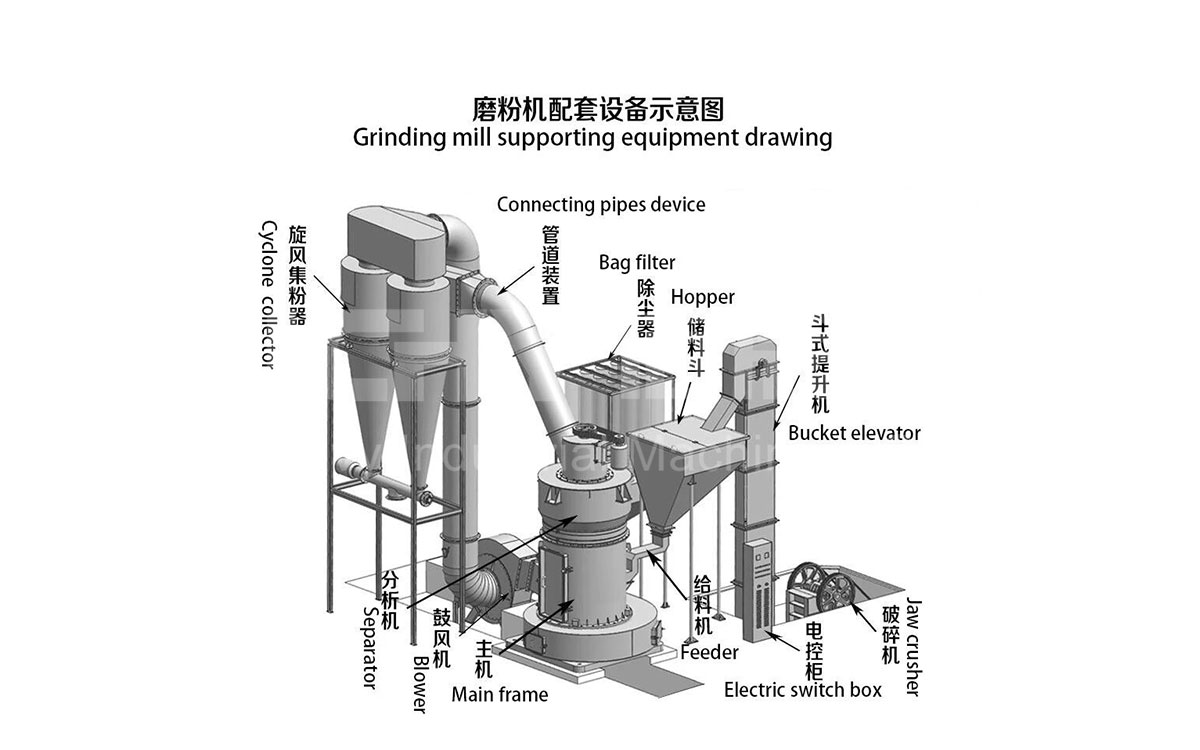
Grinding-mill-supporting-equipment-drawing
| Component | Function | Risk If Omitted |
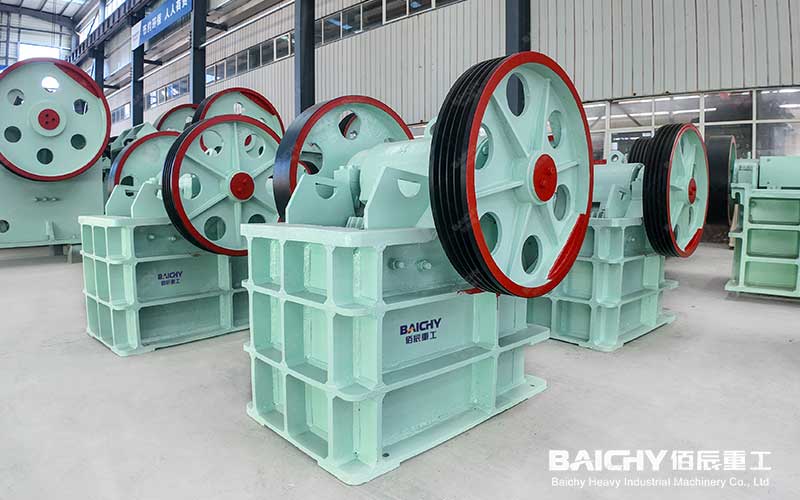
| Jaw crusher | Pre-crushing feed to ≤30 mm | Mill cannot accept raw feed; separate procurement required |
| Bucket elevator | Vertical material transfer Manual feeding; | inconsistent throughput |
| Electromagnetic vibrating feeder | Metered feed control | Overload, uneven grinding, accelerated wear |
| Analyzer/classifier | Fineness control | No ability to adjust output specification |
| Cyclone collector | Product collection | Powder loss; workplace dust hazard |
| Pulse dust collector | Emissions compliance | Regulatory violation; respiratory risk for operators |
| Centrifugal blower | Air-circulation power | System cannot operate |
| Electrical control cabinet | System automation | Manual start/stop per component; no overload protection |
An itemized configuration list is the only basis for price comparison. A missing dust collector alone subtracts several thousand dollars from the quote — and adds an immediate operational problem on commissioning day.
2.3 Automation and Energy Efficiency
Newer-generation 5R models incorporate:
• Frequency-drive (VFD) controls on the analyzer and feeder for precise fineness adjustment without mechanical changes.
• Optimized grinding-chamber airflow geometry reducing internal recirculation losses.
• Low-resistance cyclone design for higher collection efficiency at lower fan power.
These features add 8–15% to unit price but typically reduce electricity consumption by 10–18%. On a 3-shift, 300-day operating year at industrial electricity rates, the premium recovers within 12–18 months — after which the savings are pure margin.
2.4 Manufacturer Verification
A factory-direct purchase from a manufacturer with in-house foundry, machining, and assembly eliminates middleman markup. Three verification steps before committing:
1. Live factory video tour (WeChat/WhatsApp) — production floor, testing bench, finished equipment inventory. A real manufacturer can show all three immediately.
2. Customer reference sites in your country or region, with independently verifiable contact details.
3. Export shipment history to your region — consistent records indicate logistics experience and after-sales presence.
Sourcing FAQ: Decisions That Affect Your Final Cost
Q1: Should I take the cheapest quotation?
Rarely. An abnormally low 5R price signals one or more of: substandard wear-part material (premature failure), omitted dust collector or classifier, or zero after-sales support. Compare total lifecycle cost instead: purchase price + estimated annual wear-part replacement + energy consumption + downtime risk over 5 years.
Q2: How do I prepare for an accurate quotation?
Provide the manufacturer four data points upfront:
1. Material type and Mohs hardness — limestone (3–4) vs. quartz (7) determines wear-part specification.
2. Target finished fineness — 200 mesh for construction filler vs. 325 mesh for chemical-grade powder requires different classifier parameters.
3. Target hourly throughput — determines whether one 5R unit suffices or parallel lines are needed.
4. Site voltage and phase — 380V/50Hz 3-phase vs. 440V/60Hz must be confirmed before control cabinet design.
Q3: What is the typical lead time?
• Standard configuration: 15–25 working days from deposit confirmation.
• Custom requirements (special wear alloys, explosion-proof motors, containerized packaging for remote sites): add 7–10 days.
• Ocean freight to major ports in Southeast Asia, Middle East, Africa, South America: add 15–45 days depending on destination.
Q4: What after-sales support should I expect?
Minimum expectations from a qualified manufacturer:
• On-site installation supervision (engineer dispatched to your site).
• Minimum 12-month warranty on main unit structural components.
• Wear-part availability — express air freight options for emergency replacements.
• Operator training — both on-site and remote video support.
4. The Bottom Line
China is the world's largest production hub for industrial grinding equipment. A well-sourced 5R Raymond mill delivers a rare combination: low capital cost, proven field reliability, and rapid payback. The "best price" is not the lowest number on a quotation sheet — it is the price that balances equipment quality, energy efficiency, wear-part longevity, and manufacturer support across a 5-to-10-year operating horizon.
Contact Baichy Heavy Industry for a tailored 5R Raymond mill configuration and itemized quotation. An engineering team will recommend the optimal setup based on your material, capacity target, and site conditions — with comprehensive after-sales support including installation guidance, operator training, and fast spare parts delivery worldwide.