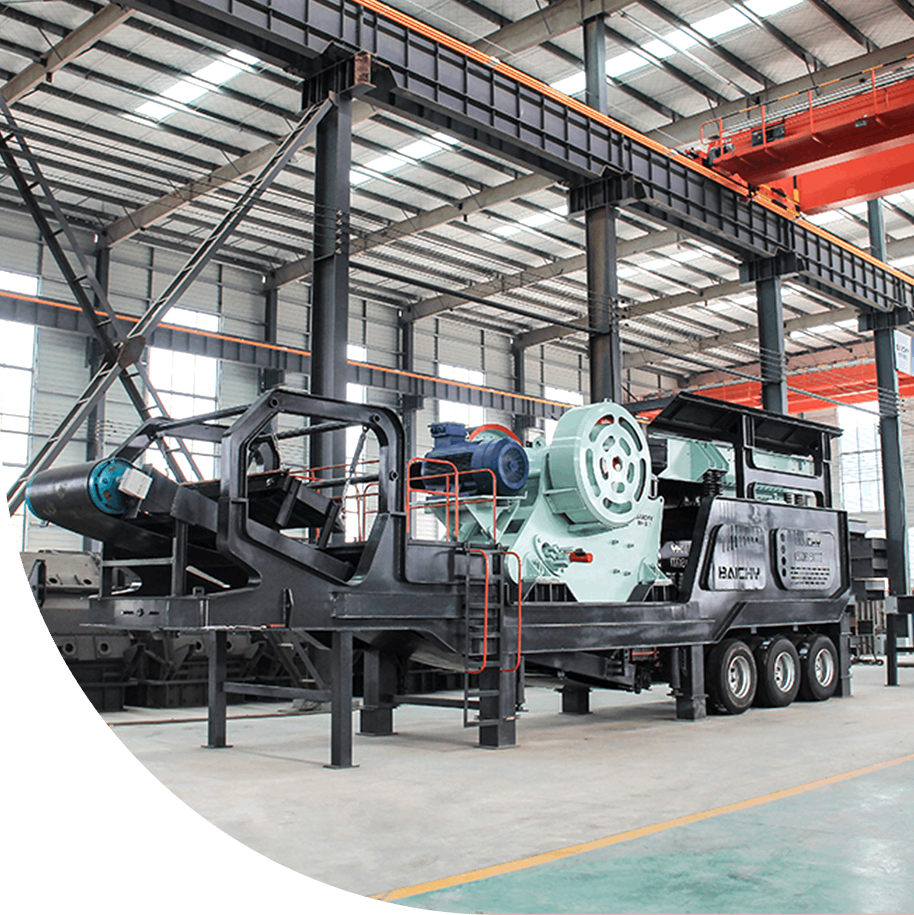


Coal rotary dryer
Residence time is the only adjustable variable in a rotary coal dryer that simultaneously determines both outlet moisture content and production capacity. If residence time is insufficient, the coal exits the drum before surface moisture has fully evaporated during the constant-rate drying phase, inevitably leading to excessive and fluctuating outlet moisture levels. Conversely, if residence time is excessive, the material passes the economic endpoint of the drying curve, resulting in wasted fuel, an artificial drop in capacity, and the risk of coal dust spontaneous combustion. Aligning the residence time near the inflection point where the drying curve transitions from the constant-rate phase to the falling-rate phase is the key to achieving both compliant outlet moisture and minimal heat consumption per ton. Baichy Heavy Industry determines the optimal residence time window based on material drying test data and then translates this theoretical curve into stable production output through a combination of variable-frequency drive (VFD) speed control and internal drum component configuration.
I. Residence Time: The Most Underestimated Control Lever in Coal Drying
Residence time refers to the total duration from the moment material enters the drum at the feed end to the moment it is discharged at the discharge end. Typical residence times for rotary coal dryers range from 20 to 45 minutes, extending to 50–60 minutes for large-scale lignite upgrading lines—durations far longer than those required for sand or gravel. This is because coal is a heat-sensitive and flammable material with a narrow drying temperature window; moisture removal cannot be achieved simply by "cranking up the heat," but rather relies on sufficient time.
Residence time serves three critical functions in coal drying: first, it determines the "total duration" of moisture migration, directly anchoring the discharge moisture content; second, it dictates the material bed fill rate and material curtain density, indirectly influencing gas-solid heat exchange efficiency; and third, it determines the duration of coal dust exposure to the high-temperature gas stream, directly correlating with the risk of ignition and spontaneous combustion. A common engineering error is adjusting hot air temperature while ignoring residence time; raising the temperature causes fine coal dust and volatile components to overheat prematurely without a proportional increase in moisture removal—a classic case of "trading safety for illusory progress."
II. The Coal Drying Curve: Only One of the Three Stages Does the Real Work
The drying curve illustrates the trajectory of material moisture reduction over drying time (or along the axial position of the drum). The coal drying process within a rotary dryer can be pided into three stages:
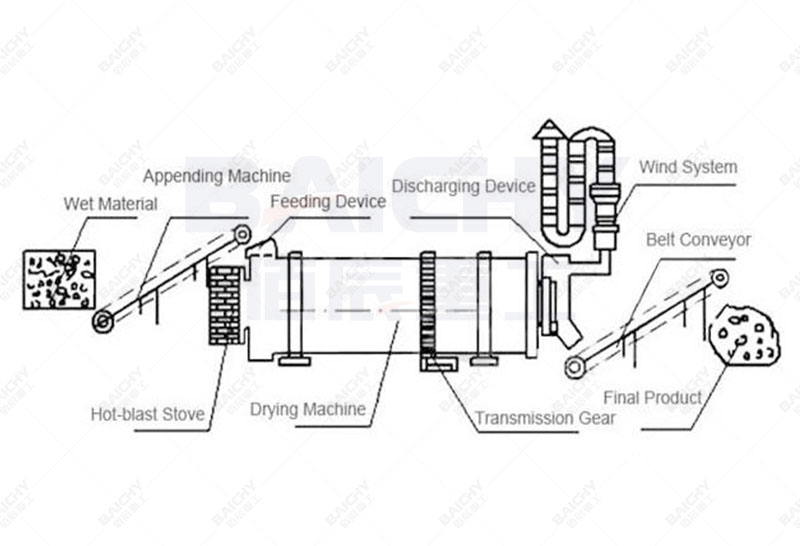
Structural diagram of a three-drum dryer
1. Preheating and Temperature-Rise Stage
The material is heated from ambient temperature to the wet-bulb temperature; moisture content remains essentially unchanged, as the heat from the hot air is primarily consumed for raising the material's temperature. This stage typically occurs within the first 1–2 meters of the feed end; while it occupies a small fraction of the drum's length, it determines how quickly the subsequent evaporation rate can be established.
2. Constant-Rate Drying Stage (Primary Evaporation Phase)
Free surface moisture evaporates continuously at a constant rate, represented on the curve by a steep, nearly linear segment. The rate during this stage is governed by hot air temperature, airflow velocity, and the surface area of the material curtain created by the lifters; it is largely independent of the coal type. More than 70% of the total evaporation occurs here, making this the "critical phase" of the drying curve.
3. Falling-Rate Drying Stage (Bottleneck Phase)
Once surface free moisture is depleted, the rate at which internal capillary water and bound water migrate to the surface becomes the limiting factor; the evaporation rate declines, and the curve flattens. For materials with high porosity and significant bound water content—such as lignite or coal slime—this stage is particularly prolonged. Extending residence time further yields only a slow reduction in moisture, while fuel consumption and operational risks continue to rise.
Understanding these three stages is significant because the optimal economic endpoint for drying lies near the curve's inflection point (the end of the constant-rate stage). Extending residence time beyond this point results in negligible improvements in final moisture content, yet causes a linear increase in specific heat consumption and discharge temperature.
III. How Residence Time Determines Material Discharge Moisture: Four Operating Scenarios and a Conclusion
By superimposing residence time onto the drying curve, one can clearly explain four common types of discharge moisture issues encountered on-site:
| Operating Scenario | Residence Time Status | Discharge Moisture Outcome | Associated Consequences |
|---|---|---|---|
| Under-drying | Material exits the drum before completing the constant-rate drying phase | 2–5 percentage points above target; high batch-to-batch fluctuation | Loss of calorific value; difficulties in downstream coal milling and transport |
| Mildly Under-dried | Material exits just as it enters the falling-rate phase | Marginally compliant but at the upper limit | Zero tolerance for fluctuations in feed moisture; exceeds limits with any change in operating conditions |
| Optimal Match | Process ends near the inflection point | Stable, falling within the median of the target range | Lowest heat consumption per ton; maximized production capacity |
| Over-retention | Prolonged retention after passing the inflection point | Moisture content barely decreases further | Artificial 10–20% drop in capacity; material temperature accumulation; increased risk of spontaneous combustion |
Engineering Conclusion: The sensitivity of discharge moisture to residence time is concentrated at the transition between the constant-rate and falling-rate drying phases. Higher feed moisture requires a longer "effective residence time" within the constant-rate phase; this explains why high-moisture lignite requires longer drums and lower rotational speeds. Furthermore, a distinction must be made between "nominal residence time" and the "actual residence time distribution": fine particles are easily entrained by the airflow and exit the drum prematurely, while coarse particles and wet clumps are retained longer, resulting in uneven discharge moisture. Methods to narrow this time distribution include controlling internal airflow velocity, installing retaining rings at the discharge end, and utilizing axially zoned lifter arrangements.
IV. Adjusting Residence Time On-Site: Five Variables and Adjustment Directions
| Adjustment Method | Direction of Change | Effect on Residence Time | Notes |
|---|---|---|---|
| Drum Rotation Speed | Increase | Shorten (roughly inversely proportional) | Variable frequency drive (VFD) is the fastest on-site adjustment method |
| Drum Inclination | Increase slope (typically 3–5%) | Shorten | Usually fixed after installation; modification is costly |
| Lifter Design & Rows | Wider spacing / Deeper flights | Lengthens material tumbling path | Coupled with evaporation rate; requires coordinated calibration |
| Internal Air Velocity | Decrease | Lengthen (reduces premature exit of fines) | Air velocity for coal fines should be controlled at 1.5–3 m/s |
| Feed Rate & Particle Size | Reduce rate / Crush | Relatively lengthen | Overfeeding is the primary cause of moisture-related issues |
Recommended commissioning sequence: First, verify if the actual feed rate exceeds the design value; next, stabilize the hot air temperature; then, use rotation speed as the primary adjustment variable, limiting each adjustment to no more than 10%; sample and test outlet moisture every 30–40 minutes until the moisture curve aligns with the design. Record data throughout the adjustment process to create a "rotation speed vs. moisture" calibration chart for that specific coal type, facilitating direct reference when switching coal types in the future.
V. Typical Parameters for Coal Rotary Dryers (Residence Time Reference)
The following details the typical configuration of Baichy Heavy Industry’s single-drum coal rotary dryer (drum slope: 3–5%). The data serves as an engineering reference; actual performance depends on material drying tests.
| Model | Reference Capacity (Wet Basis) | Inlet Moisture → Outlet Moisture | Drum Rotation Speed | Hot Air Inlet Temperature | Typical Residence Time | Typical Applications |
|---|---|---|---|---|---|---|
| φ1.5×12m | 4–8 t/h | 18–22% → ≤10% | 3–5 r/min | 550–700°C | 15–25 min | Coal briquettes, low-capacity clean coal |
| φ2.2×18m | 15–25 t/h | 18–25% → ≤10% | 3–5 r/min | 550–700°C | 20–30 min | Clean coal from washeries, blended coal |
| φ2.4×20m | 20–35 t/h | 20–28% → ≤10% | 2.5–4.5 r/min | 600–750°C | 25–35 min | Flotation clean coal, middlings |
| φ2.8×22m | 30–50 t/h | 25–35% → ≤15% | 2.5–4 r/min | 600–750°C | 30–45 min | Lignite upgrading, pre-drying of power plant coal |
| φ3.2×25m | 50–80 t/h | 25–35% → ≤15% | 2–3.5 r/min | 600–750°C | 35–50 min | Large-scale lignite upgrading lines |
Key Points: Outlet material temperature is controlled based on the volatile matter content of the coal; for bituminous coal, it is generally kept below 90°C, with further reductions for high-volatile coal types and fine coal powder. Hot air inlet temperatures can be raised moderately for low-volatile coals (like lignite) but must be lowered for high-volatile bituminous coal and fine powders; specific temperature ranges should be determined based on actual measurements. Capacities in the table are calculated on a wet basis; if inlet moisture is at the high end of the range, actual dry material throughput will decrease by 20-30%.
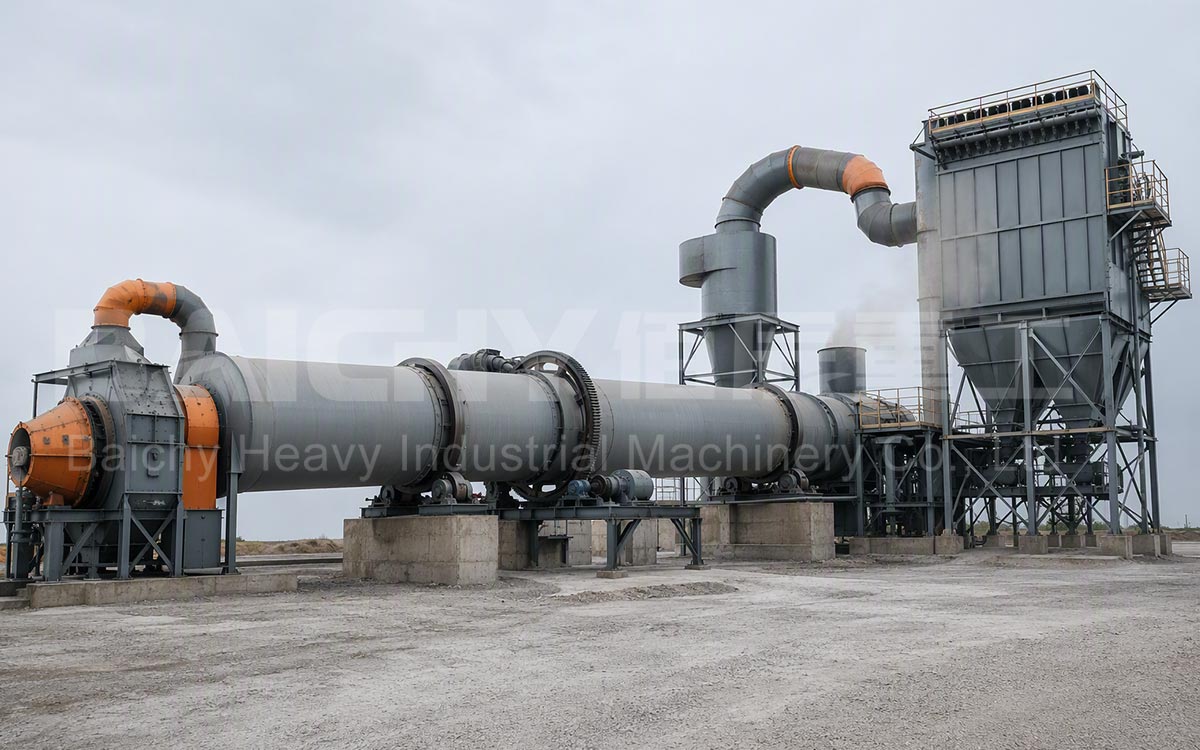
On-site photo of the three-cylinder dryer
VI. Application Scenarios: The Tangible Economic Value of Outlet Moisture Levels
Clean Coal Dewatering (Coal Preparation Plants): Drying flotation or dense-medium clean coal from 20–30% moisture down to 8–10% directly boosts the calorific value and market price of the commercial coal. Every 1-percentage-point reduction in moisture increases the net calorific value (as received) by approximately 60–70 kcal/kg (depending on coal type), while simultaneously reducing losses from frozen railcars and tonnage shrinkage during transport in winter.
Lignite Upgrading & Pre-drying for Power Plants: Drying lignite from 30–40% moisture down to 15–18% before it enters the pulverizer and furnace reduces both pulverizing power consumption and boiler flue gas heat loss; this is a standard retrofit strategy for lowering coal consumption in thermal power plants.
Coal Slime Drying: Drying coal slime (tailings) from preparation plants allows it to be blended and sold, transforming waste into a marketable coal product.
Coking & Pulverized Coal Injection (PCI): Controlling furnace-entry moisture stabilizes coke quality and blast furnace injection efficiency; precise control of residence time is the prerequisite for achieving uniform moisture content.
The common thread across these scenarios is that the outlet moisture level should not simply be "as low as possible," but rather "stable within the contractually specified range"—this is precisely where residence time regulation adds value.
VII. Baichy Coal Rotary Dryer: Engineered for Residence Time Control
Variable Frequency Drive (VFD): Rotational speed is continuously adjustable; residence time settings can be reconfigured within 10 minutes when switching coal types or handling seasonal variations in feed material, without requiring a system shutdown.
Coal-Specific Internal Components: High-moisture lignite and coal slime applications utilize bent, self-cleaning lifting flights to prevent material adhesion; fine-powder applications employ shallow arc-shaped plates and discharge retaining rings to narrow the residence time distribution.
Temperature Zoning & Spontaneous Combustion Prevention: Features zoned control (high-temperature inlet section and low-temperature outlet section) and discharge temperature monitoring; optional flue gas recirculation creates a low-oxygen atmosphere, reducing the risk of coal dust ignition and spontaneous combustion.
Integrated Thermal System: Supplied as a complete package—including the hot blast stove (coal/gas/biomass-fired), cyclone and baghouse dust collectors, induced draft fan, and electrical control system—ensuring single-source accountability and avoiding parameter mismatches often caused by multi-vendor assembly. Data-Driven Delivery: We offer free drying tests for 5–10 kg samples and provide "moisture vs. time" curves along with recommended residence time windows. This allows clients to obtain process parameters before full-scale production begins, thereby reducing on-site trial-and-error costs.
VIII. Relevant Case Studies
Case A (Lignite Upgrading: Adjusting Residence Time to Resolve Excessive Moisture)
A fuel coal pretreatment line at a power plant processed lignite with an initial moisture content of 32–35%, aiming for a final moisture content of ≤16%. Initially, rotation speeds were set based on experience with sand and gravel drying, resulting in discharge moisture levels consistently hovering between 19% and 21%. Baichy engineers analyzed drying curve test data and determined that the residence time was insufficient; the material exited the drum after completing only about 70% of the constant-rate evaporation phase. Corrective measures included reducing the rotation speed by approximately 20% and optimizing the lifting flights in the feed section. This extended the residence time from roughly 24 minutes to 34 minutes, stabilizing the discharge moisture at 15–16% and reducing fuel consumption per ton by about 12% compared to the initial trial run. (Client name omitted due to confidentiality agreements.)
Case B (Coal Preparation Plant: Flotation Clean Coal – Narrowing Residence Time Distribution)
A heavy-medium coal preparation plant in North China sought to dry flotation clean coal from 22% moisture to a target of 9±1%. Issues included fluctuating discharge moisture levels and frequent carry-over of fine particles into the dust collector. Investigation revealed that air velocities exceeding 3.5 m/s within the drum were entraining fine particles, causing them to exit prematurely and resulting in highly uneven actual residence times. Corrective measures involved reducing the air velocity to 2.5–3 m/s and installing a retaining ring at the discharge end. Consequently, the moisture content of the fines dropped from 2–3 percentage points above the limit to near 9%, the batch-to-batch variation narrowed from ±2 percentage points to within ±0.5 percentage points, and the load on the dust collector decreased simultaneously.
IX. Recommended Equipment
Coal drying is a systems engineering process; residence time is merely one of the control parameters involved. Baichy Heavy Industry supplies complete drying systems comprising the main drying unit, heat source, dust collection system, and conveying equipment:
| Equipment | Recommended Configuration | Function/Positioning |
|---|---|---|
| Single-drum rotary dryer | φ1.5×12m – φ3.2×25m | Main unit for coal drying; adjustable residence time |
| Hot blast stove | Coal/gas/biomass-fired; 1.4–30 MW output | Supplies hot air at 550–750°C |
| Cyclone + baghouse dust collector | Matched to airflow volume | Recovers fine coal dust; ensures emissions compliance |
| Screw/belt conveyor | Variable-frequency drive (VFD) feeding | Stable feed rate is essential for controlling residence time |
Related reading: Rotary dryer lifter design (solutions to prevent sticking with cohesive materials); coal slime dewatering screens (pre-drying dewatering significantly reduces evaporation load); double-toothed roll crushers (crushing large coal lumps to uniform size before drying shortens the falling-rate drying period). When selecting equipment, please provide details on coal type, feed moisture content, target output moisture, and production capacity; Baichy will generate a free drying curve test report based on material samples and deliver a residence time matching plan within 5 working days.
FAQ
Q1: What is the appropriate residence time for a coal rotary dryer? How is the optimal value determined?
A: The general empirical range is 20–45 minutes, extending to 50–60 minutes for large-scale high-moisture lignite operations; there is no universal fixed value. The optimal residence time corresponds to the "inflection point" where the drying curve transitions from the constant-rate period to the falling-rate period—at this stage, surface free moisture has largely been removed, and further residence time yields very slow moisture reduction. Determination method: Conduct a drying test on 5–10 kg of material to obtain a moisture-vs.-time curve, then calculate parameters based on capacity, drum length, and rotation speed, followed by on-site calibration; this usually requires 2–3 rounds of sampling and verification.
Q2: If the output moisture content consistently exceeds the limit, does it necessarily mean the residence time is insufficient? What is the troubleshooting sequence?
A: Not necessarily. Residence time is just one variable; it is recommended to troubleshoot in the following order: feed rate → hot air temperature → internal airflow velocity → lifter condition → rotation speed. First, verify whether the actual feed rate exceeds the design capacity (the most common cause); next, check for a drop in hot air temperature, entrainment of fines by high-speed airflow (causing premature exit), and lifter wear or material buildup; finally, adjust the rotation speed to alter the residence time. Adjust only one variable at a time and take samples at 30–40 minute intervals to avoid confounding factors that make it impossible to pinpoint the cause.
Q3: Can an excessively long residence time cause the coal to ignite?
A: There is a genuine risk. Coal dust and volatile matter tend to spontaneously ignite in high-temperature, oxygen-rich environments. Excessive residence time leads to heat accumulation within the drum; the risk increases significantly, particularly when the material temperature at the discharge section consistently exceeds the safety threshold for the specific coal type. Control measures include: maintaining the discharge temperature within a safe range based on the coal type (applying stricter limits for high-volatile coals); using flue gas recirculation to lower the oxygen content inside the drum; emptying the drum during shutdowns; and setting up monitoring alarms for discharge temperature and internal CO concentration.

Baichy Heavy Industry
Baichy Heavy Industry is a high-tech mining equipment company integrating R&D, manufacturing, sales, and after-sales service. Focusing on crushing, grinding, and mineral processing equipment, we provide professional solutions to our customers. We are ISO9001:2015 、certified, and our products include mobile crushing palnts, crawler crushing plant, construction waste crushing plants, jaw crushers, sand making machines, cone crushers, fine crushers, grinding mills, ball mills, etc., all with reliable performance to meet diverse project needs.
Baichy Heavy Industry – Your Trusted Partner
To ensure optimal performance of your equipment, Baichy Heavy Industry offers:
- Professional on-site installation guidance
- Comprehensive operator training
- 24/7 technical support & maintenance services
Our complete after-sales service system guarantees long-term, stable operation of your machinery with minimal downtime.
Protect Your Rights – Only Use Official Channels
To avoid scams and ensure authentic support, contact us exclusively through:
• Official Website: www.baichychina.com
• WhatsApp: +8615093222637
• Email: [email protected]
Your satisfaction is our priority – expect prompt, professional service every time.
(Note: Beware of unauthorized third parties claiming to represent Baichy. Always verify through official contacts.)